
On this page
Start here
Quick answer
A Trane furnace is short cycling when it starts and stops before reaching the thermostat's set temperature, especially when the pattern repeats in ordinary weather. First rule out a thermostat setting or battery issue, then check the furnace switch and breaker from a safe position, replace a dirty model-correct filter, and make sure return and supply vents are not blocked. A restricted filter or return can make the furnace overheat and open its limit safety; a thermostat located in direct sun or near a heat source can end the call early; an oversized system can also cycle off quickly. Observe the sequence only from outside the cabinet and record whether the inducer, ignition, flame, blower, and warm air appear before shutdown. Do not bypass a limit or rollout switch, open the burner compartment, adjust gas controls, or repeatedly reset the furnace. If there is gas odor, a carbon-monoxide alarm, soot, smoke, abnormal flame, loud banging or hissing, a breaker trip, or repeated shutdown after basic checks, leave or keep the furnace off and arrange qualified HVAC service.
Before you begin
Safety first
- Homeowner checks should remain outside the cabinet and be limited to thermostat settings and batteries, safe visual power checks, model-correct filter and accessible grilles, external vent observations, and timing documentation. A qualified technician should test airflow, blower, limits and safeties, ignition and flame sensing, inducer and flue, heat exchanger, controls, ducts, thermostat signal, and equipment sizing as applicable.
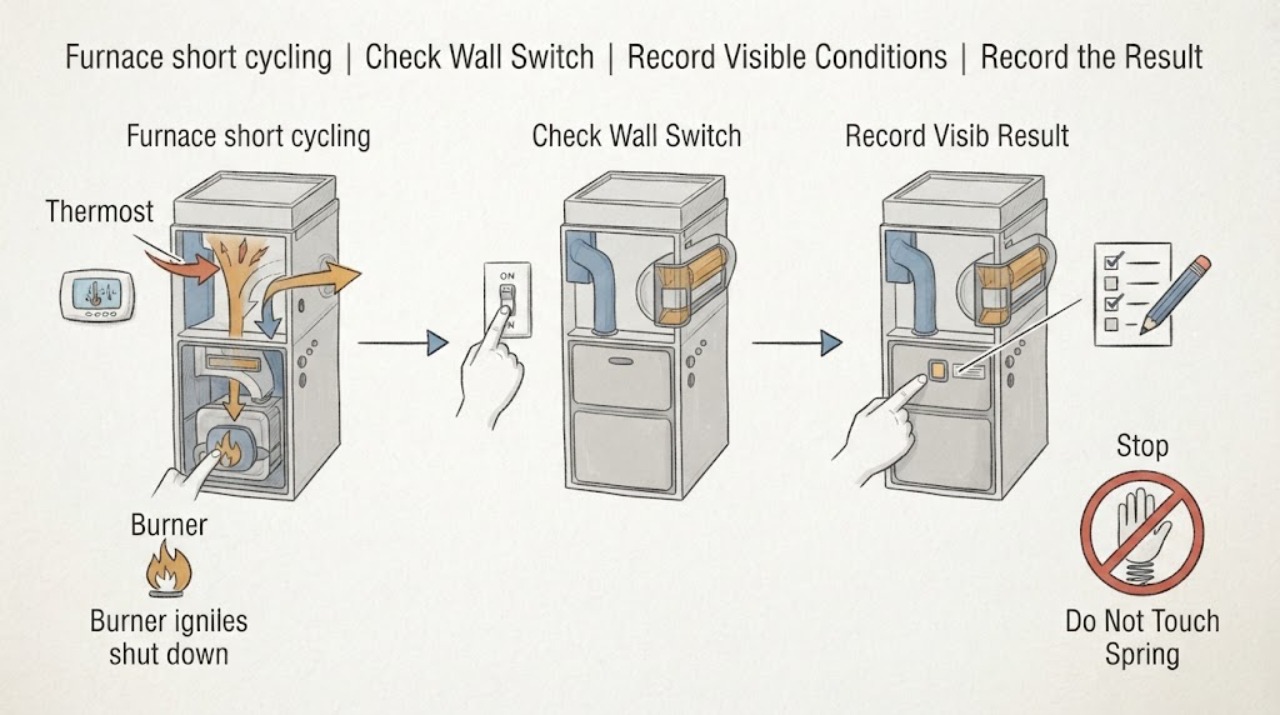
Work through in order
Diagnostic checks
Use only checks that match the exact appliance or system and its official guide.
-
Check 1
Leave immediately for a strong or lingering gas odor, a carbon-monoxide alarm, smoke, soot, flame outside the burner area, or symptoms such as headache, dizziness, weakness, nausea, chest pain, or confusion; do not operate switches or use flames inside.
Expected result: No combustion danger sign is present, or a gas, carbon-monoxide, smoke, soot, flame, or illness warning is present.
Next step: For any danger sign, get everyone outside and contact emergency services or the gas utility from a safe location; keep the furnace off until qualified personnel clear it. Otherwise continue only with external checks.
Why this matters
Why: A repeated cycle can be caused by a safety response, but combustion and carbon-monoxide hazards take priority over diagnosing the timing of the cycles.
-
Check 2
At the thermostat, confirm Heat mode, an active display, a setpoint above room temperature, and a fan setting that matches the owner instructions; replace batteries only when the thermostat requires them and record any delay or code.
Expected result: The display is blank, batteries are low, the mode or setpoint is wrong, the thermostat is in direct sun or near a heat source, a code appears, or the thermostat continues calling while the furnace stops.
Next step: Correct only the accessible setting, location influence, or battery issue allowed by the thermostat instructions and allow one normal cycle. If short cycling remains, do not remove the thermostat or change wiring; continue to safe furnace checks and service documentation.
Why this matters
Why: A thermostat can end or interrupt a heat call, while a continuing heat call during shutdown shifts attention to airflow, a limit, ignition, control, or equipment sizing.
-
Check 3
From a dry, safe position, check the labeled furnace switch and breaker for an obvious off or tripped state; do not open panels, touch wiring, or repeatedly reset a breaker or furnace safety.
Expected result: The switch is off, the breaker is tripped, a reset holds but cycling returns, or power appears normal while the furnace still stops early.
Next step: Restore a plainly switched-off control once according to the equipment instructions. If it trips again, smells hot, shows damage, or short cycling continues, leave it off and arrange HVAC or electrical diagnosis.
Why this matters
Why: Power interruption can stop a heat cycle, but a repeated trip or reset can indicate a motor, control, wiring, or other electrical fault rather than a simple setting.
-
Check 4
With the furnace off, inspect the return filter and accessible return grilles; replace a loaded disposable filter or clean a permanent filter only as the Trane model instructions specify, and ensure furniture or drapes do not block returns or supplies.
Expected result: The filter is dirty or restrictive, a return is blocked, supplies are closed, the filter type is unknown, or filter and grilles appear clear.
Next step: Use only the model-correct filter and open accessible registers. If the furnace still short cycles, airflow is weak, or the filter loads unusually fast, stop changing parts and arrange professional airflow and safety testing.
Why this matters
Why: Restricted airflow can make the furnace overheat and open its limit before the call is complete. A clear filter does not rule out a dirty blower, duct restriction, blocked flue, or limit fault.
-
Check 5
During one normal heat call, observe from outside the cabinet and record whether the inducer starts, ignition is attempted, the flame remains established if an approved sight area exists, the blower starts, warm air reaches registers, and the thermostat still calls when the furnace stops.
Expected result: The furnace is silent, ignition never establishes, flame starts then drops out, the blower runs with weak or cool air, the unit heats then stops and restarts after cooling, or it reaches setpoint normally.
Next step: Record any status-light pattern and stop if flame is abnormal, ignition is delayed, smoke or soot appears, or shutdown repeats. Do not open the burner area, adjust gas, bypass a limit, or keep restarting to gather more data; arrange qualified HVAC service.
Why this matters
Why: The sequence distinguishes a call or power issue from ignition, flame-sensing, vent, airflow-limit, blower, control, or normal satisfaction. A repeated shutdown after heating is consistent with a safety or airflow issue but does not identify a part.
-
Check 6
Look only at accessible external vent and flue terminations for obvious blockage, snow, a nest, debris, or damage, without climbing, removing a cover, patching a pipe, or reaching into the combustion path.
Expected result: The termination is blocked or damaged, a repeated fault follows cold or windy weather, or the termination appears clear but short cycling continues.
Next step: Keep the furnace off and request qualified HVAC inspection for any blockage or damage; use emergency guidance for carbon-monoxide alarm or symptoms. Do not alter the vent or restart repeatedly.
Why this matters
Why: A blocked exhaust can trigger a flue safety response and may allow combustion products to accumulate. A clear exterior does not rule out an internal vent, pressure, inducer, or heat-exchanger problem.
-
Check 7
Gather the exact Trane model, fuel type, thermostat settings, cycle start and stop timing, outdoor temperature, filter size and date, status code or light pattern, warm-air and register observations, maintenance history, and whether short cycling began after installation, remodeling, or a thermostat change.
Expected result: The pattern has existed since installation, began after a filter or thermostat change, appears only in extreme weather, affects every room, or continues after safe checks.
Next step: Give the record to a qualified HVAC technician and request checks of airflow, filter fit, blower, limit and other safeties, thermostat signal, ignition and flame sensing, inducer and flue, heat exchanger, duct distribution, and equipment sizing as applicable.
Why this matters
Why: Since-installation behavior keeps sizing, duct design, and thermostat placement in consideration; a recent change points to an installation or maintenance issue; weather-linked operation may reflect heat loss or vent conditions. Timing alone cannot prove a cracked exchanger or failed limit.
Use your observations
Decision map
Find the observation that best matches what you see, then follow the next safe action.
-
PATH 01Next step
What you see
The thermostat display or settings are wrong, the battery is low, or direct sunlight or a nearby heat source makes the thermostat satisfy early.
Do this next
Correct the accessible setting or battery and allow one normal call. If the thermostat still ends calls early or reads implausibly, arrange thermostat/HVAC diagnosis without changing wiring.
Why this path and its safety boundary
Why it matters: A thermostat call or sensing problem is more likely than a furnace limit or burner problem.
-
PATH 02Next step
What you see
The furnace heats for a while, the blower runs, airflow is weak or a filter/return is restricted, and the furnace restarts after a cooling pause while the thermostat still calls.
Do this next
Correct only the model-correct filter and accessible grille obstruction. If the pattern persists, keep the furnace off and request professional airflow, temperature-rise, blower, and safety testing.
Why this path and its safety boundary
Why it matters: An airflow restriction or limit response is more likely; the repeated pattern can stress the furnace and does not identify a failed limit switch by itself.
-
PATH 03Next step
What you see
Ignition is attempted but the flame never establishes, drops out, or a status code repeats before warm air reaches the home.
Do this next
Stop repeated starts and arrange qualified HVAC diagnosis. Do not relight, adjust gas controls, clean burner parts, or bypass pressure, flame, rollout, or limit safeties unless a qualified technician directs a model-specific procedure.
Why this path and its safety boundary
Why it matters: Ignition, flame sensing, gas supply, inducer, vent pressure, control, or another safety condition is more likely than thermostat placement.
-
PATH 04Next step
What you see
Short cycling has occurred since installation or after major insulation, air-sealing, duct, or thermostat changes, without a filter, code, or combustion warning.
Do this next
Request a qualified load, duct, thermostat-location, and operating evaluation. Do not replace the furnace or alter settings based solely on cycle timing.
Why this path and its safety boundary
Why it matters: Equipment sizing, duct distribution, heat-load change, or thermostat placement is more likely than a sudden dirty filter alone.
-
PATH 05Next step
What you see
Short cycling is accompanied by gas odor, a carbon-monoxide alarm, soot, smoke, abnormal flame, loud banging or hissing, a blocked flue, water near electrical parts, or a breaker that trips again.
Do this next
Leave for gas, carbon-monoxide, smoke, or flame danger and contact emergency or gas authorities from outside. Otherwise keep the furnace off and arrange qualified HVAC/electrical service before reuse.
Why this path and its safety boundary
Why it matters: A combustion, venting, fire, electrical, or mechanical hazard outweighs ordinary short-cycle troubleshooting.
Helpful context
Understand the symptom
Confirm that it is really short cycling
A furnace may cycle more often on an unusually cold night, and a variable-speed or modulating system may run differently from a single-stage furnace. The useful pattern is repeated shutdown before the home reaches the setpoint, followed by another call after a short pause. Record whether the thermostat still calls for heat, whether warm air was delivered, and whether the furnace restarts only after it cools.
Start at the thermostat and room conditions
A weak battery, incorrect mode, dust, calibration issue, or thermostat mounted in direct sunlight or near a vent can end a heat call early. Keep the thermostat away from direct heat and drafts, and check only accessible settings and batteries. Do not remove the thermostat from its base or alter low-voltage wiring as a test.
Airflow restrictions can trigger the furnace limit
The return filter and return grilles feed the blower. A loaded filter, blocked return, closed supply register, dirty blower, or duct restriction can reduce airflow, make the heat exchanger run too hot, and open a limit safety. Trane recommends replacing or cleaning the filter according to the model instructions and never operating without one.
A safe observation can separate heat production from distribution
From outside the cabinet, note whether the inducer starts, ignition occurs, the flame remains established, the blower starts, and warm air reaches the registers. A burner that lights then drops out is different from a furnace that heats normally but stops because the thermostat is satisfied. Never open the burner compartment or defeat a safety to see what happens.
Sizing and heat loss are professional questions
If short cycling has happened since installation, an oversized furnace or a thermostat location may be involved. Home insulation, air sealing, or other changes can also alter the heat load. Do not choose a replacement furnace or change gas settings based only on cycle timing; a qualified technician should evaluate load, duct distribution, and equipment operation.
Protect the combustion and exhaust boundary
A blocked flue or vent can trigger a safety shutdown and create a carbon-monoxide risk. Do not block, patch, or modify venting, and do not inspect combustion parts beyond an approved external sight area. Gas odor, soot, a yellow or unstable flame, smoke, or a carbon-monoxide alarm ends homeowner troubleshooting.
Safety boundary
Stop conditions
- Leave immediately and contact emergency or gas authorities from outside for gas odor, carbon-monoxide alarm, smoke, soot, abnormal flame, or symptoms consistent with carbon-monoxide exposure; do not operate switches, use flames, or restart.
- Keep the furnace off and arrange qualified HVAC service for repeated limit or rollout shutdown, delayed ignition, a blocked or damaged flue, unexplained flame loss, a water leak near electrical parts, or a breaker that trips again.
- Do not open the burner or control cabinet, test live voltage, adjust gas pressure, clean ignition or flame-sensing parts by guesswork, bypass any limit/pressure/rollout/door safety, or patch or modify the flue.
- Arrange service when short cycling persists after one safe thermostat, power, filter, and accessible-vent check; when it began after installation or remodeling; or when it affects comfort despite normal settings. Do not keep resetting or cycling the furnace to collect evidence.
Only after diagnosis
Potential parts
- furnace air filter
Consider replacement only when the filter is loaded, damaged, or the exact model-correct filter is confirmed; short cycling alone does not prove the filter is the cause.
Match the exact Trane system, dimensions, airflow direction, and owner guidance; never operate the furnace without its required filter. - furnace thermostat or temperature control
Consider only after testing confirms an inaccurate sensor, intermittent heat call, failed battery compartment, or incompatible control; thermostat location and settings can mimic a bad thermostat.
Match the exact Trane system, control wiring, staging, communication method, and approved setup; do not change low-voltage wiring by guesswork. - furnace limit or rollout safety component
Consider only after a qualified technician confirms a failed safety or the cause of its trip; repeated opening may be caused by airflow, combustion, venting, or heat-exchanger problems.
Match the exact model, trip characteristics, mounting, wiring, and safety sequence; never bypass or substitute a safety device. - furnace blower or airflow component
Consider only when testing confirms inadequate airflow from a blower, wheel, motor, capacitor, or control after filter and duct restrictions are evaluated.
Match the exact model, motor type, speed/control method, wheel, capacitor if used, wiring, and airflow requirements; internal access is service work.
When checks do not resolve it
Need a professional?
Safety scope: Homeowner checks should remain outside the cabinet and be limited to thermostat settings and batteries, safe visual power checks, model-correct filter and accessible grilles, external vent observations, and timing documentation. A qualified technician should test airflow, blower, limits and safeties, ignition and flame sensing, inducer and flue, heat exchanger, controls, ducts, thermostat signal, and equipment sizing as applicable.
Common questions
FAQ
How can I tell whether a Trane furnace is short cycling?
It repeatedly starts and stops before the home reaches the thermostat setting, often while the thermostat continues calling for heat. Record the sequence and whether the furnace restarts after cooling; normal operation can vary by model and weather.
Can a dirty filter cause short cycling?
Yes. A restricted filter or blocked return can reduce airflow, cause overheating, and open a furnace limit safety. Replace or clean only the model-correct filter and have persistent cycling professionally evaluated.
Should I reset the limit switch when the furnace short cycles?
No. Do not bypass or reset a limit, rollout, pressure, or other safety as a repair. Repeated trips can signal airflow, combustion, venting, heat-exchanger, or control problems that require qualified diagnosis.
Could an oversized Trane furnace cause short cycling?
It can. Trane lists oversized equipment as a possible cause, particularly when the pattern dates from installation or follows changes to insulation, air sealing, ducts, or thermostat location. A technician should evaluate the heat load and system operation before replacement.
Read the exact guide
Official sources
- Thermostat Troubleshooting: Solutions for Common IssuesTrane · Trane identifies thermostat battery, power, dust, calibration, location, and sizing-related causes and cautions homeowners against repairing HVAC electrical issues themselves.
- Furnace Troubleshooting: Gas Furnace SolutionsTrane · Trane gives homeowner-safe checks for thermostat, registers, filter, power, and external furnace symptoms while directing gas, electrical, combustion, and unresolved faults to professionals.
- Furnace Short Cycling: Causes and SolutionsTrane · Trane explains how to recognize short cycling and discusses thermostat placement, dirty filters, blocked returns or flues, limit protection, heat exchanger concerns, and oversized equipment.
Community feedback
Share a repair observation
Share a plain-text repair observation. Accepted observations are published automatically; this page may take a moment to update.