
On this page
Start here
Quick answer
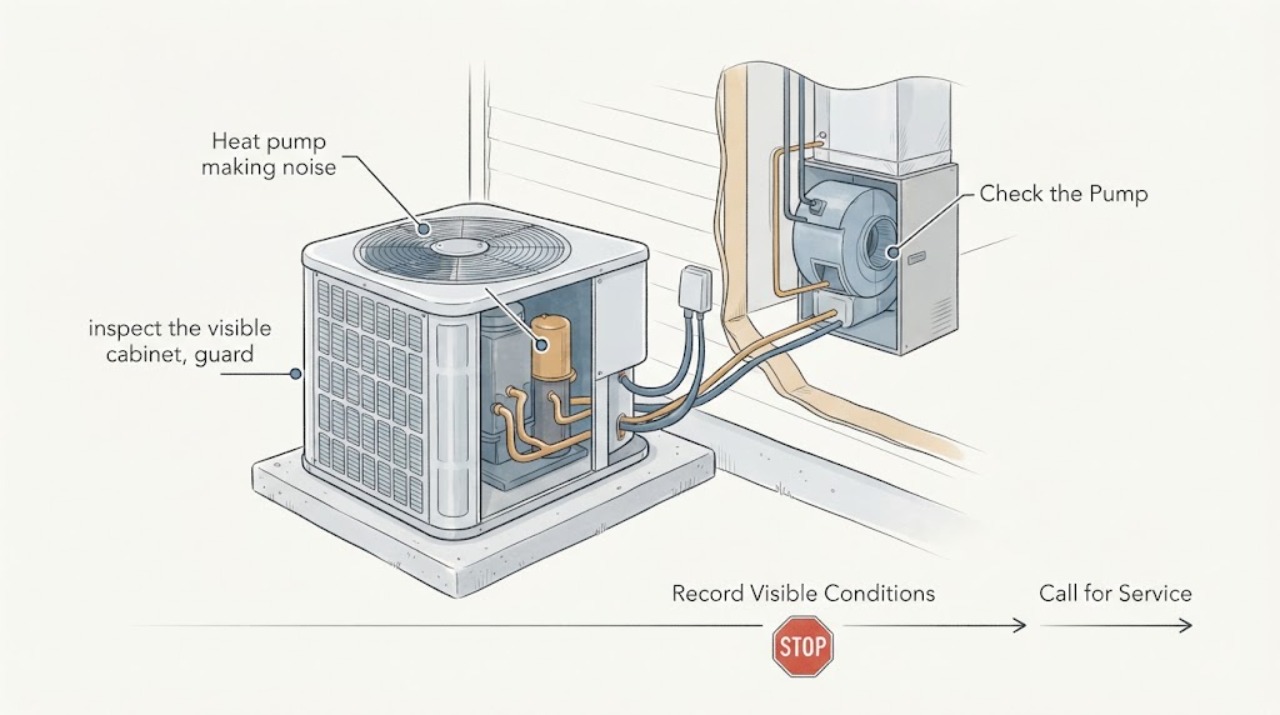
A Trane heat pump may hum, click, or briefly change sound during a normal mode transition or defrost, but a new, loud, prolonged, or worsening bang, screech, rattle, buzz, grind, gurgle, or hissing sound needs attention. First note whether the sound comes from the outdoor unit, indoor air handler, duct or register, and whether it occurs at startup, shutdown, heating, cooling, or defrost. From a safe position, check that the outdoor unit is not blocked by leaves, snow, ice, plants, or an object, and that the indoor filter, returns, and registers are accessible. Trane says unusual heat-pump noises can signal electrical issues or system failure and should be handled by an HVAC professional; it also notes that a fan that is not running while the compressor runs can overheat the compressor. A temporary defrost hum or steam can be normal and should settle when defrost ends. Turn the system off and arrange qualified HVAC service for grinding, severe vibration, persistent hissing, a stuck outdoor fan, burning or electrical odor, heavy ice, smoke, or noise accompanied by poor heating or cooling. Do not open panels, touch the fan or compressor, test live wiring, add refrigerant, or lubricate parts by guesswork.
Before you begin
Safety first
- Homeowner checks should remain limited to sound location and timing, safe external debris and clearance observations, model-correct filter and register checks, and defrost or performance documentation. A qualified technician should inspect the fan, blower, compressor and electrical components, refrigerant circuit, controls, defrost system, airflow, and mounting.
Work through in order
Diagnostic checks
Use only checks that match the exact appliance or system and its official guide.
-
Check 1
Turn the heat pump off from the thermostat and disconnect power only from a safe position if there is smoke, burning or electrical odor, sparks, severe vibration, grinding, a hot or discolored disconnect, persistent hissing, visible refrigerant damage, or a fan that binds; do not approach moving parts.
Expected result: The sound is a mild familiar operating hum with no hazard sign, or it is sudden, severe, worsening, prolonged, or accompanied by odor, heat, smoke, sparks, leak, or damage.
Next step: For smoke or fire, leave and use emergency help. For electrical, refrigerant, or severe mechanical symptoms, keep the system off and arrange qualified HVAC service. Otherwise continue with cool, external checks only.
Why this matters
Why: Normal operation can produce sound, but a new severe mechanical, electrical, or refrigerant symptom can injure someone or damage the heat pump if it keeps running.
-
Check 2
From safe positions, identify whether the sound is loudest at the outdoor cabinet, indoor air handler, duct or register, or refrigerant-line area, and record whether it occurs at startup, shutdown, heating, cooling, defrost, or continuously.
Expected result: The sound is outdoor, indoor, register-related, line-related, brief and mode-specific, or persistent regardless of mode.
Next step: Make one safe recording from a distance and stop for a new loud, grinding, hissing, or persistent noise. Do not put a hand on the cabinet or lines, remove a guard, or open a panel.
Why this matters
Why: Location and timing distinguish airflow or duct resonance from fan, blower, compressor, defrost, electrical, or refrigerant concerns; sound can travel from its source.
-
Check 3
With the outdoor unit off, inspect the visible cabinet, guard, pad, and surrounding area for leaves, snow, ice, plants, an object, or visible rubbing or vibration; do not remove the top, reach through the guard, or use a tool near the fan.
Expected result: Debris, snow, heavy ice, a nearby object, an unsteady-looking pad, or visible panel vibration is present, or the exterior appears clear and stable.
Next step: Clear only loose debris from a safe powered-off position and keep the unit uncovered. Arrange service for heavy ice, damage, fan obstruction, a loose panel, or any issue requiring guard or panel removal.
Why this matters
Why: An external airflow or vibration source can create rattling or roaring without proving an internal part has failed. A clear stable exterior keeps fan, compressor, electrical, refrigerant, and mounting causes in consideration.
-
Check 4
With the system off, inspect the indoor filter, return grilles, and supply registers; replace a loaded filter only with the exact model-approved type and make sure furniture or drapes do not block airflow.
Expected result: The filter is dirty or restrictive, returns or supplies are blocked, noise changes at registers, or filter and airflow conditions appear normal.
Next step: Correct only an obvious filter or grille obstruction. If the noise persists, airflow is weak, or heating/cooling changes, keep the system off as needed and arrange HVAC inspection.
Why this matters
Why: Airflow restriction can change pressure and blower noise and can reduce comfort. Normal indoor airflow does not rule out an outdoor fan, compressor, refrigerant, or electrical fault.
-
Check 5
During one normal call, observe the outdoor fan only from a safe distance and note whether it runs when the compressor sounds active; do not touch, spin, unblock, or test the fan or capacitor.
Expected result: The fan runs normally, the compressor sound is present while the fan is stopped, the fan starts and stops abnormally, or no outdoor sound occurs.
Next step: Turn the system off if the compressor is running without the fan or if fan motion is abnormal, and arrange qualified HVAC service. Do not remove the top or reset power repeatedly.
Why this matters
Why: A compressor running without its cooling fan can overheat. A fan motor, capacitor, control, obstruction, or power issue may be involved, and the sound pattern cannot identify which one.
-
Check 6
If frost is visible in heating mode, observe from a safe distance whether a normal defrost event clears light frost and the unit returns to its prior operation; do not chip ice, pour water, use flame, or force a mode change.
Expected result: Light frost clears and noise settles, or ice is heavy, remains, returns quickly, the fan does not resume, or heating performance declines.
Next step: Arrange qualified HVAC service for heavy ice, failed defrost recovery, persistent noise, or poor heating. Do not operate through severe icing or open the outdoor cabinet.
Why this matters
Why: Temporary defrost sound and light frost can be normal. Persistent ice may indicate airflow, refrigerant, sensor, or defrost-control trouble and can make the unit noisy.
-
Check 7
Gather the exact Trane model, indoor and outdoor unit locations, sound recording, mode and timing, fan behavior, frost or debris findings, filter and register condition, thermostat or alert information, weather, recent maintenance, and heating/cooling performance.
Expected result: The sound is new, worsening, hard to localize, persistent after external checks, associated with ice or an odor, or accompanied by reduced comfort or an alert.
Next step: Give the record to a qualified HVAC technician and request inspection of airflow, fan and blower, compressor and electrical components, refrigerant circuit, controls, defrost operation, and mounting as applicable.
Why this matters
Why: Fan, blower, compressor, capacitor, controls, refrigerant circuit, defrost, airflow, duct, and mounting causes remain possible. No single noise description proves which part needs replacement.
Use your observations
Decision map
Find the observation that best matches what you see, then follow the next safe action.
-
PATH 01Next step
What you see
The sound is a brief, familiar hum or click at startup, shutdown, or defrost; the unit performs normally and no ice, odor, vibration, or alert appears.
Do this next
Record the normal pattern and monitor without repeated testing. Arrange service if the sound becomes louder, persists, changes character, or affects comfort.
Why this path and its safety boundary
Why it matters: A normal operating transition is more likely than a failing component, but a change from the established baseline deserves monitoring.
-
PATH 02Next step
What you see
The outdoor unit rattles or roars and visible debris, snow, ice, a nearby object, or external vibration is present.
Do this next
Turn the system off, clear only safe loose debris, keep the unit uncovered, and arrange service if the noise or vibration remains or a guard/panel is involved.
Why this path and its safety boundary
Why it matters: An external airflow or mounting source is more likely than an internal compressor fault, although the noise may have exposed damage.
-
PATH 03Next step
What you see
The sound occurs during defrost with light frost, then settles and heating returns normally.
Do this next
Do not interrupt or force defrost. Arrange service if ice becomes heavy, the fan fails to resume, the sound continues outside defrost, or heating performance declines.
Why this path and its safety boundary
Why it matters: A normal defrost transition is more likely than a persistent mechanical fault.
-
PATH 04Next step
What you see
A new bang, screech, rattle, grind, prolonged buzz, or hissing persists outside a normal transition or occurs with reduced heating/cooling.
Do this next
Shut the system off and arrange qualified HVAC service. Do not touch moving or energized parts, open panels, add refrigerant, or lubricate components by guesswork.
Why this path and its safety boundary
Why it matters: Fan, blower, compressor, capacitor, electrical, refrigerant, mounting, or control trouble is more likely than normal operation.
-
PATH 05Next step
What you see
The compressor sounds active while the outdoor fan is stopped, or noise is accompanied by smoke, burning or electrical odor, sparks, severe vibration, a hot disconnect, refrigerant-like hissing, or heavy ice.
Do this next
Turn the system off, disconnect only from a safe position, keep the area clear, and arrange qualified HVAC or electrical service; use emergency help for active fire.
Why this path and its safety boundary
Why it matters: An overheating, electrical, refrigerant, mechanical, or equipment-damage hazard outweighs ordinary sound troubleshooting.
Helpful context
Understand the symptom
Locate the sound before naming a part
Noise can travel through refrigerant lines, ductwork, registers, framing, or the cabinet. Listen from a safe distance at the outdoor unit and indoor air handler, and note whether the sound is strongest at a register or line. Location, mode, and timing are more useful than assuming every outdoor noise is the compressor.
Defrost can temporarily change the sound
In heating mode, frost can form on the outdoor coil and a defrost cycle can reverse the refrigerant flow to melt it. Trane says steam and a temporary sound change during defrost can be normal. The noise should settle and the unit should return to heating; heavy ice or a sound that continues outside defrost needs service.
External debris and vibration are the safe first checks
Leaves, snow, ice, plants, a loose object, an unsteady pad, or a visibly vibrating panel can affect airflow and sound. With power off, look only for loose debris from outside the guard. Never remove the top or reach into the fan compartment; Trane warns of high-voltage wiring and sharp edges.
Indoor airflow can amplify or create noise
A loaded filter, blocked return, closed supply register, restrictive duct, or indoor blower issue can change pressure and make whistling, rattling, or humming travel through the home. Replace a model-correct filter only with the equipment off and keep blower, electrical, and refrigerant work professional.
The fan and compressor must be treated as a pair
If the compressor appears to run while the outdoor fan is stopped, Trane says the compressor can overheat. A failed capacitor, fan motor, control, obstruction, or wiring issue may be involved. Do not wait beside the unit, touch the fan, or try to spin it by hand; shut the system off and arrange service.
Hissing and sudden sound changes are escalation clues
A new hissing sound can indicate refrigerant or compressor/electrical trouble, while a sudden loud startup or shutdown can involve a capacitor, compressor, contactor, fan, or mounting issue. Trane recommends professional repair for unusual or prolonged sounds. Record a safe audio sample and leave the system off if the sound is severe.
Safety boundary
Stop conditions
- Shut the heat pump off for grinding, screeching, severe vibration, persistent hissing, smoke, burning or electrical odor, sparks, a hot or discolored disconnect, visible refrigerant damage, or a fan that binds; use emergency help for active fire.
- Do not open the outdoor or indoor cabinet, remove the fan top, reach through guards or registers, touch energized wiring, tighten live connections, add refrigerant, chip ice, use flame or hot water, or lubricate internal parts.
- Do not cover the outdoor unit, block its vents, force a defrost or mode change, run while the compressor is active and the fan is stopped, or repeatedly cycle the system to reproduce an abnormal sound.
- Arrange qualified HVAC service when a new or worsening noise persists after safe external checks, appears with reduced heating or cooling, returns after defrost, or cannot be localized to a safe external cause.
Only after diagnosis
Potential parts
- heat-pump outdoor fan or fan motor
Consider only when a qualified technician confirms a worn, obstructed, unbalanced, or failed fan or motor after debris and airflow causes are evaluated; noise alone is not proof.
Match the exact Trane model, motor, blade, rotation, connector, control, and airflow requirements; guard and electrical access are service work. - heat-pump capacitor or compressor start component
Consider only after professional testing confirms capacitor, contactor, compressor, or start-circuit trouble; startup hum or roar can also be normal or mounting-related.
Match the exact outdoor-unit model and electrical specifications; do not test live terminals or replace a pressurized-system component by guesswork. - heat-pump defrost control or sensor
Consider only when heavy or recurring ice and failed defrost operation are confirmed by a technician; light frost and a brief defrost sound can be normal.
Match the exact Trane model, sensor arrangement, board, wiring, and approved defrost procedure; do not force or bypass defrost controls. - heat-pump blower or airflow component
Consider only after testing confirms a blower, wheel, filter, or duct airflow fault; an outdoor noise may have a separate fan or compressor cause.
Match the exact system, filter dimensions, blower configuration, motor, wheel, and control method; internal access requires qualified service.
When checks do not resolve it
Need a professional?
Safety scope: Homeowner checks should remain limited to sound location and timing, safe external debris and clearance observations, model-correct filter and register checks, and defrost or performance documentation. A qualified technician should inspect the fan, blower, compressor and electrical components, refrigerant circuit, controls, defrost system, airflow, and mounting.
Common questions
FAQ
Is a humming sound from a Trane heat pump normal?
A steady operating hum or a temporary defrost-related change can be normal. A new, louder, prolonged, rattling, grinding, hissing, or vibration-related hum—especially with poor comfort—needs qualified HVAC inspection.
Why does a Trane heat pump sound different during defrost?
During defrost, the system reverses operation to melt frost from the outdoor coil, and steam or a temporary sound change may occur. The unit should return to normal; heavy ice or noise that continues outside defrost requires service.
What if the heat-pump compressor runs but the outdoor fan does not?
Turn the system off. Trane warns that the fan cools the compressor, so running without it can overheat the compressor. Do not remove the top or touch the fan; arrange qualified service.
Should I replace the capacitor or compressor because my heat pump is noisy?
No. Similar sounds can come from a fan, blower, mounting, airflow, control, refrigerant, or normal mode transition. A qualified technician should identify the source and test the component before replacement.
Read the exact guide
Official sources
- Heat Pump Troubleshooting: Diagnosing Common IssuesTrane · Trane identifies unusual heat-pump noises and explains that persistent banging, screeching, rattling, buzzing, grinding, or gurgling should receive professional attention.
- Heat Pump Fan Not SpinningTrane · Trane warns that a compressor can overheat when the outdoor fan is stopped, identifies debris and fan/capacitor causes, and says not to remove the top because of high voltage and sharp edges.
- Homeowner's Guide to Heat Pump RepairTrane · Trane explains normal frost and defrost behavior, outdoor clearance and filter maintenance, and the professional inspection of moving, electrical, refrigerant, and defrost components.
- Is This Normal? HVAC Smells and Sounds, ExplainedTrane · Trane distinguishes temporary defrost humming from persistent abnormal noise and advises shutdown and repair for hissing, loud, mechanical, or electrical symptoms.
Community feedback
Share a repair observation
Share a plain-text repair observation. Accepted observations are published automatically; this page may take a moment to update.