
On this page
Start here
Quick answer
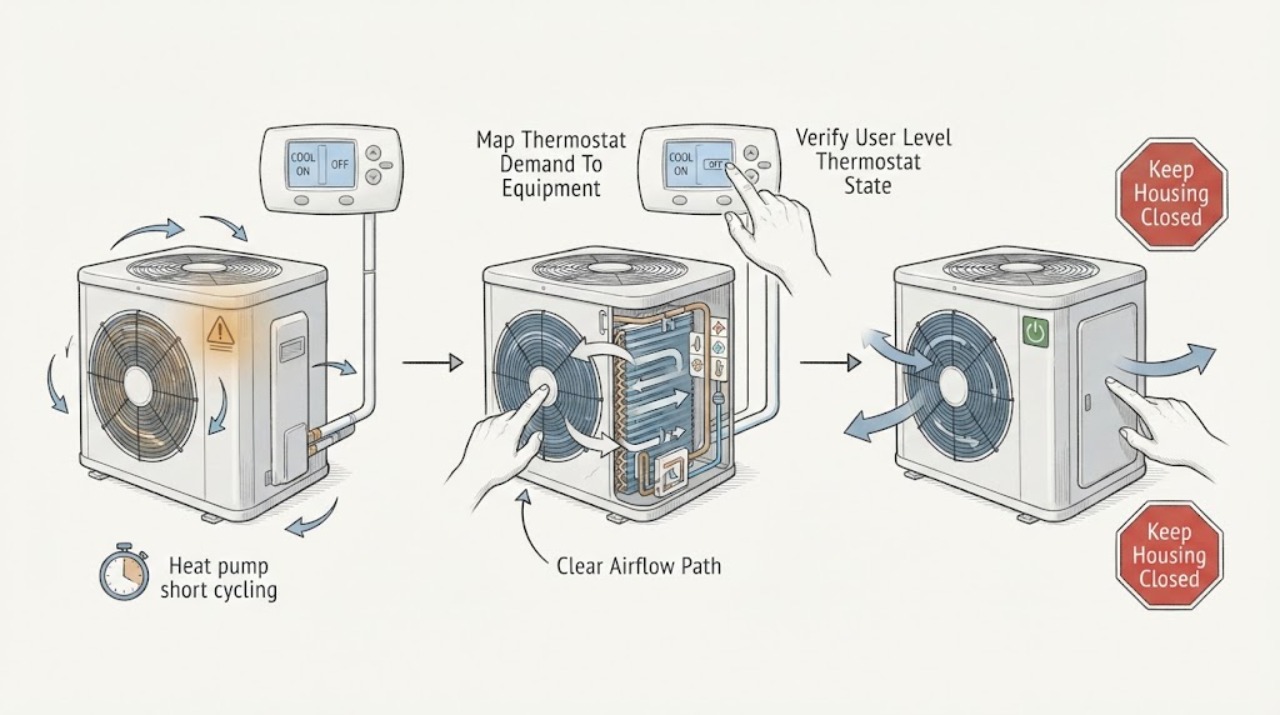
A Trane heat pump is short cycling when it starts and stops repeatedly before a normal heating or cooling call is complete. The useful first split is whether the thermostat still shows a demand when the equipment stops: a disappearing demand points toward mode, schedule, sensor, or control behavior, while a continuing demand points toward airflow, outdoor fan, defrost, protection, refrigerant, or equipment problems. Check only the display, accessible filter and grilles, outdoor obstructions, and visible ice. A brief defrost event with steam, a stopped outdoor fan, or AUX heat can be normal; growing ice, a frozen coil, a fault indication, abnormal noise, or rapid starts with lost comfort is not. Do not open panels, change installer settings or wiring, test electricity, handle refrigerant, bypass a safety, or repeatedly force the compressor to restart.
Before you begin
Safety first
- Owner checks are limited to user-level thermostat observation, an accessible filter replacement, clear return and supply grilles, safely visible outdoor obstructions, visible frost documentation, and safely visible model identification. A licensed professional must handle panels, wiring, electrical tests, capacitors, motors, refrigerant, pressure measurements, coil or blower disassembly, defrost controls, safety devices, reversing-valve diagnosis, load sizing, duct testing, and control rewiring.
Work through in order
Diagnostic checks
Use only checks that match the exact appliance or system and its official guide.
-
Check 1
From a safe location, write down whether the Trane thermostat is calling for Heat, Cool, Auto, Aux, or Emergency Heat, the displayed room temperature, and whether the outdoor unit or indoor blower stops while that demand remains. Watch one ordinary call without repeatedly changing the setpoint.
Expected result: The demand disappears before the unit stops; the demand remains while the unit stops; the display changes mode or temperature unexpectedly; or the unit pauses only while a defrost indication, steam, or AUX heat is present.
Next step: Record the exact pattern and proceed to the matching branch below. If the equipment is starting again almost immediately, stop forcing calls and arrange qualified service so the compressor is not repeatedly commanded to start.
Stop if: Stop for smoke, burning odor, arcing, exposed conductors, water near electrical equipment, a loud grinding or electrical sound, repeated breaker trips, or an outdoor unit that appears unsafe to approach.
Why this matters
Why: A disappearing demand makes schedule, mode, sensor placement, or thermostat behavior more likely. A continuing demand with an unexpected stop makes airflow, fan, defrost, protection, electrical, refrigerant, or equipment faults more likely. A brief defrost signature is not the same as a completed call followed by rapid restarts.
-
Check 2
Check only user-level thermostat settings: use the intended single mode, make sure the fan is not intentionally set to run continuously, look for a schedule or displayed fault, and note whether the thermostat is in direct sun, beside a supply vent, or near a heat-producing appliance. Keep the setpoint steady while observing.
Expected result: The mode or schedule is wrong; the displayed temperature jumps or disagrees with a nearby room thermometer; the thermostat is affected by a vent, draft, sunlight, or heat source; or the display keeps calling while the equipment stops.
Next step: Correct only an obvious mode, schedule, or fan mistake and allow one normal call. If the reading remains implausible, the display is erratic, or the demand and equipment disagree, leave installer menus, cycle settings, staging, and wiring alone and request a technician check the thermostat and Trane system compatibility.
Stop if: Stop if the thermostat is blank, hot, damaged, loose, or would need to be opened or rewired to continue.
Why this matters
Why: A thermostat can end or create a call based on a misleading reading, and a changed control configuration can cause behavior that resembles a failing heat pump. A stable display with a continuing demand shifts attention away from a simple user setting and toward equipment-side diagnosis.
-
Check 3
With the thermostat call ended, inspect the accessible filter and the return and supply grilles. Replace a visibly loaded filter only with the correctly sized replacement and arrow direction, and move furniture or curtains that block grilles. From outside, look for snow, leaves, stored items, or dense vegetation restricting the Trane outdoor unit; do not remove panels or reach near the fan.
Expected result: The filter is loaded or collapsed; several grilles are blocked; airflow is weak throughout the home; outdoor clearance is restricted; or these accessible areas are clear but cycling continues.
Next step: After correcting an obvious filter or grille obstruction, allow one normal call and compare the pattern. If airflow is still weak, the unit is overheating or freezing, or short cycling persists, turn it off and schedule qualified HVAC diagnosis rather than increasing filter restriction or changing dampers as a test.
Stop if: Stop for a wet or frozen filter, water near electrical equipment, a stopped fan with compressor-like sound, a fixed cover, sharp or exposed parts, or any need to open the air handler or outdoor cabinet.
Why this matters
Why: A restriction can make the indoor or outdoor heat exchanger work outside its intended conditions and can contribute to an early stop. If the filter, grilles, and outdoor path are clear, a dirty coil, blower issue, duct restriction, fan fault, refrigerant problem, or control fault cannot be ruled out by looking alone.
-
Check 4
If frost or ice is visible, observe it only from a safe distance during the system's ordinary operation. Note whether a light coating clears during a short defrost event, whether steam or AUX heat appears, and whether ice instead grows, covers the coil, or returns with repeated incomplete defrost behavior.
Expected result: Light frost clears and heating resumes; the outdoor fan pauses and the thermostat shows defrost or AUX; ice remains or grows; the indoor coil is frozen; or no ice is present.
Next step: Treat a brief self-clearing defrost as an observation to document, not a reason to force a restart. For persistent ice, a frozen coil, or repeated incomplete defrost, turn the system off at the thermostat and arrange service; do not scrape, pour hot water, add refrigerant, or bypass a control.
Stop if: Stop immediately for heavy ice, water approaching electrical components, damaged coil fins, an obstructed fan, or any request to handle refrigerant or defrost controls.
Why this matters
Why: Trane describes periodic frost, a brief refrigerant reversal, steam, a stopped outdoor fan, and AUX heat as possible normal defrost signs. Ice that does not clear, a frozen indoor coil, or constantly repeating or lengthening defrost makes airflow, refrigerant, defrost control, sensor, or another fault more likely.
-
Check 5
Without rapidly switching modes, document whether the short cycling occurs in heating, cooling, or both. Use the normal seasonal mode and a steady user-level setpoint; note whether the symptom began immediately after a mode change, thermostat replacement, duct work, or a control upgrade.
Expected result: Only heating cycles; only cooling cycles; both modes cycle; one mode fails to complete while the other is stable; or the symptom began after installation or a control or duct change.
Next step: Give the technician the mode comparison and the date of any installation or control change. Do not buy a replacement thermostat, change cycle-per-hour or deadband settings, or assume a larger unit will solve the symptom without a model-specific diagnosis and load assessment.
Stop if: Stop if comparing modes would require opening equipment, altering wiring, forcing emergency heat, or repeatedly starting a unit with an active fault or unsafe symptom.
Why this matters
Why: A heating-only pattern gives defrost, outdoor conditions, auxiliary heat, and heat-pump control priority. A mode-specific change can make a reversing-valve or control-signal problem more likely. Cycling in both modes, especially from the first day of operation or after a load change, makes sizing, staging, airflow, or thermostat compatibility more likely.
-
Check 6
Collect the Trane model and serial information from paperwork or a safely visible label, the mode and displayed demand, start and stop timing pattern, indoor and outdoor conditions, filter and grille results, ice behavior, and any recent installation, repair, schedule, or thermostat change. Photograph only visible conditions from a safe distance.
Expected result: The symptom is reproducible in one mode or both; the demand remains or disappears at the stop; the unit has a clear airflow or ice observation; or the record shows a new installation, control change, power event, fault, noise, or loss of comfort.
Next step: Send the record to a licensed HVAC professional and request diagnosis against the exact Trane model. Keep the system off if cycling is rapid, comfort is deteriorating, ice is persistent, or any unsafe symptom is present.
Stop if: Do not remove panels to find a label or perform electrical, pressure, refrigerant, compressor, capacitor, or control tests.
Why this matters
Why: These combinations help a technician separate thermostat behavior, equipment protection, airflow, defrost, refrigerant, reversing-valve, staging, and sizing hypotheses without guessing at a part. A model number is needed before any control or component compatibility question can be answered.
Use your observations
Decision map
Find the observation that best matches what you see, then follow the next safe action.
-
PATH 01Next step
What you see
The thermostat demand disappears before the Trane unit stops, the room-temperature display jumps, or cycling follows a schedule or setpoint change.
Do this next
Correct only an obvious user setting, then request a technician verify the thermostat location, sensor behavior, wiring, stages, and equipment compatibility if the pattern returns.
Why this path and its safety boundary
Why it matters: The control side is more likely than a compressor failure: mode, schedule, sensor placement, thermostat calibration, staging, or compatibility may be ending the call early. Direct sunlight, a vent, or a heat source near the thermostat can distort the local reading.
-
PATH 02Next step
What you see
The thermostat continues to call while the indoor or outdoor unit stops, especially when airflow is weak, the outdoor fan is not spinning, or a fault indication appears.
Do this next
Leave the cabinet closed and stop operation if the compressor seems to run without the outdoor fan, if airflow remains weak after the accessible filter check, or if the display shows a fault. Arrange qualified diagnosis.
Why this path and its safety boundary
Why it matters: An equipment-side stop or protection response is more likely than a completed thermostat call. Restricted airflow, a fan or motor problem, electrical protection, refrigerant conditions, or a control fault can share this signature.
-
PATH 03Next step
What you see
The pause is brief, occurs during cold humid weather, light frost clears, the outdoor fan pauses, steam appears, AUX heat shows, and heating resumes normally.
Do this next
Document it and monitor normally. If defrost becomes constant, lasts longer, fails to clear ice, or no longer restores comfort, move to the persistent-ice branch and call for service.
Why this path and its safety boundary
Why it matters: That combination is consistent with Trane's described defrost behavior and does not by itself establish short cycling. Judge the complete call and comfort after the event rather than the temporary sound or outdoor appearance.
-
PATH 04Next step
What you see
Ice grows or remains on the outdoor coil, the indoor coil freezes, or the unit repeatedly enters and exits defrost without restoring comfort.
Do this next
Turn the system off at the thermostat and arrange qualified service. Do not scrape ice, pour hot water, adjust refrigerant, or force a defrost cycle.
Why this path and its safety boundary
Why it matters: A defrost sensor or control issue, airflow restriction, low refrigerant, coil problem, or another fault is more likely than normal frost. The exact cause cannot be identified safely from the appearance of ice.
-
PATH 05Next step
What you see
Cycling occurs in only one mode, began after installation or a thermostat or duct change, or appears mainly in mild weather while accessible airflow looks normal.
Do this next
Ask a licensed HVAC professional to compare the load calculation, equipment and thermostat match, stages, duct airflow, control operation, and refrigerant measurements against the exact Trane model.
Why this path and its safety boundary
Why it matters: The likely decision shifts toward reversing-valve or mode control, staging or thermostat compatibility, duct design, commissioning, or an oversized system that satisfies the thermostat too quickly. This pattern is not proof that one particular part has failed.
-
PATH 06Next step
What you see
There is smoke, a burning smell, arcing, exposed wiring, water near electrical equipment, repeated breaker trips, loud grinding or electrical noise, or rapid starts that do not stop.
Do this next
Turn the system off at the thermostat, keep clear, and obtain urgent qualified HVAC or electrical help. Do not reset a tripped breaker to keep testing or approach wet or exposed equipment.
Why this path and its safety boundary
Why it matters: The symptom may involve an unsafe electrical or mechanical failure and is beyond homeowner observation.
Helpful context
Understand the symptom
Use the thermostat demand as the first diagnostic split
Do not decide that every short pause is a failed compressor. Trane heat pumps can reverse refrigerant briefly for defrost; the outdoor fan may stop, the sound may change, and AUX heat or a little steam may appear. The more useful observation is the relationship between the thermostat's call and the equipment: note whether the display still requests heating or cooling when the outdoor unit or indoor airflow stops, and whether comfort is restored after the pause.
Trane controls can make a model-specific difference
Trane has several thermostat and equipment control arrangements, so an installer menu or an anti-cycle feature in one model's guide is not a universal setting for every Trane system. If the symptom began after a thermostat, staging, or control change, preserve the model information and have a qualified technician verify the equipment type, stages, sensor inputs, and control configuration rather than changing those settings as a trial.
Airflow and outdoor heat exchange can imitate a control fault
A loaded filter, blocked return, closed supply register, snow or foliage around the outdoor unit, or an outdoor fan that is not running can make the system stop protecting itself or fail to complete the call. A clean filter and clear grilles are useful exclusions, not proof that the coil, blower, ductwork, refrigerant circuit, or protection controls are healthy.
A mode-specific pattern narrows the service diagnosis
If cycling appears only in heating, record outdoor conditions and any frost or repeated defrost indication. If it appears only after changing between heating and cooling, or one mode fails while the other operates normally, the reversing valve, control signal, sensor, or refrigerant circuit deserves professional testing. If it has occurred since installation or after a duct or thermostat change, sizing, staging, compatibility, and commissioning move higher on the list.
Safety boundary
Stop conditions
- Do not open the outdoor unit, air handler, electrical panel, thermostat case, or control box.
- Do not test live wiring, capacitors, compressor terminals, refrigerant pressure, coil temperature, or safety controls.
- Do not scrape ice, pour hot water on a coil, add refrigerant, bypass a safety, force a defrost cycle, or repeatedly restart the compressor.
- Do not change installer-only cycle, deadband, staging, compressor-off, balance-point, or thermostat wiring settings as a trial repair.
- Stop and call for service for heavy ice, a frozen coil, an outdoor fan that does not run with compressor-like sound, persistent weak airflow, a fault indication, or any unsafe smell, sound, water, or electrical symptom.
Only after diagnosis
Potential parts
- HVAC air filter
Consider this only when the accessible filter is visibly loaded or damaged and the correct size and airflow direction are known. A filter replacement does not explain persistent cycling if airflow is already normal.
Confirm the filter dimensions and the exact system documentation before buying; do not increase restriction or substitute a size by guesswork. - heat-pump-compatible thermostat or control
Consider this only after a qualified diagnosis finds a failed, misconfigured, or incompatible thermostat or control and separates that finding from airflow, defrost, refrigerant, and sizing causes.
Verify the exact Trane equipment type, communicating requirements, stages, auxiliary heat, and wiring before replacement; a generic thermostat is not a safe trial. - defrost sensor or control component
Consider this only when persistent ice or incomplete defrost is confirmed and professional testing identifies a model-specific sensor or control fault.
Match the exact model and control architecture through qualified service documentation; frost alone does not justify ordering this part. - outdoor fan motor or capacitor component
Consider this only when the outdoor fan symptom is reproduced and a technician identifies a failed motor, capacitor, or related component after ruling out normal defrost behavior.
Electrical ratings and fitment are model-specific and require professional diagnosis; do not open the cabinet or test the component yourself. - reversing valve or control component
Consider this only when one mode fails or cycles abnormally and a qualified technician confirms a reversing-valve or associated control fault.
Confirm the exact heat-pump model, refrigerant circuit, and service diagnosis before any component is selected.
When checks do not resolve it
Need a professional?
Call a licensed HVAC professional when the thermostat demand and equipment behavior disagree, short cycling continues after an obvious accessible obstruction is corrected, airflow remains weak, the outdoor fan behaves abnormally, ice persists or an indoor coil freezes, a fault or lockout appears, the symptom began after installation or control changes, or refrigerant, electrical, defrost, reversing-valve, duct, staging, or sizing diagnosis may be needed. Seek urgent help for smoke, burning odor, arcing, exposed wiring, water near electrical equipment, repeated breaker trips, loud grinding or electrical noise, or rapid starts that do not stop.
Safety scope: Owner checks are limited to user-level thermostat observation, an accessible filter replacement, clear return and supply grilles, safely visible outdoor obstructions, visible frost documentation, and safely visible model identification. A licensed professional must handle panels, wiring, electrical tests, capacitors, motors, refrigerant, pressure measurements, coil or blower disassembly, defrost controls, safety devices, reversing-valve diagnosis, load sizing, duct testing, and control rewiring.
Common questions
FAQ
How can I tell whether my Trane heat pump is really short cycling?
Record the mode, thermostat demand, indoor temperature, and the start and stop pattern. Short cycling is repeated starting and stopping before a normal call is complete; a brief self-clearing defrost pause is a different event.
Why does the outdoor fan stop during a Trane heat-pump pause?
During defrost, Trane says the outdoor fan may stop while refrigerant reverses to warm the outdoor coil. If the compressor-like sound continues while the fan does not run outside defrost, turn the system off and arrange service.
Can a dirty filter cause a Trane heat pump to short cycle?
A loaded filter or blocked return can restrict airflow and make the system work harder. Replace an accessible, visibly loaded filter with the specified size, but have a technician investigate if cycling continues or airflow stays weak.
Is steam or AUX heat during a Trane defrost cycle a failure?
Not necessarily. Trane describes steam, a temporary fan pause, changed sound, and AUX heat as possible normal defrost signs. Constant or lengthening defrost, ice that grows, or lost comfort needs service.
What if the thermostat still calls for heat but the Trane unit stops?
That pattern shifts attention to airflow, fan operation, protection controls, defrost, refrigerant, or another equipment-side issue. Do not open the cabinet; document the display and arrange qualified diagnosis.
Could a Trane thermostat be causing short cycling?
Yes, a wrong mode, schedule, sensor location, display reading, staging setup, or incompatible control can end or create a call. Correct only an obvious user setting and leave installer settings and wiring to a professional.
Can an oversized Trane heat pump short cycle?
Yes. Trane explains that an oversized system can reach the thermostat setting too quickly, while an undersized system tends toward long operation. A load and commissioning assessment is needed before considering replacement.
Does a heating-only short-cycling problem point to the reversing valve?
It can, but heating-only cycling can also involve defrost, airflow, refrigerant, sensors, or controls. Give the technician the mode comparison instead of ordering a reversing valve from the symptom alone.
Should I change the cycles-per-hour or deadband setting?
No. Trane control guides show that anti-cycle, stage, and sensor parameters are model-specific installer settings. Changing one as a trial can hide the fault or create an equipment mismatch; have the system diagnosed first.
When should I stop troubleshooting a Trane heat pump?
Stop for smoke, burning odor, arcing, exposed wiring, water near electrical equipment, repeated breaker trips, loud grinding or electrical noise, heavy ice, a frozen coil, a fan that does not run with compressor-like sound, or any need to open panels or handle refrigerant.
Read the exact guide
Official sources
- What Is the Heat Pump Defrost Cycle?Trane · Used for the normal-defrost branch and for interpreting outdoor fan pauses, steam, AUX indications, and persistent or lengthening defrost.
- Heat Pump Fan Not SpinningTrane · Used for the owner stop boundary when a fan is not spinning with compressor-like sound and for keeping fan, capacitor, and power diagnosis professional.
- Heat Pump Troubleshooting: Diagnosing Common IssuesTrane · Used to distinguish self-clearing frost from persistent ice and to set the boundary for electrical, power, fan, and system diagnosis.
- HVAC Short Cycling: Causes and SolutionsTrane · Used for the meaning and impact of short cycling, thermostat location, and oversized or undersized heat-pump context.
- Trane Communicating Thermostats for Heat Pump Control User GuideTrane · Model-specific control reference only; it is not evidence that every Trane thermostat exposes the same menus or settings.
- Troubleshooting Tips for a Heat Pump Not HeatingTrane · Used only for the mode-specific branch: a heating-only symptom can involve reversing-valve behavior, airflow, or refrigerant and needs professional diagnosis.
- Heat Pump MaintenanceTrane · Used for owner-level filter, return, supply, and outdoor-obstruction observations and the professional checklist for airflow, refrigerant, controls, sensors, and defrost.
- Coil TroubleshootingTrane · Used for the boundary around frozen indoor coils and persistent ice; no coil disassembly or refrigerant work is assigned to the reader.
Community feedback
Share a repair observation
Share a plain-text repair observation. Accepted observations are published automatically; this page may take a moment to update.