
On this page
Start here
Quick answer
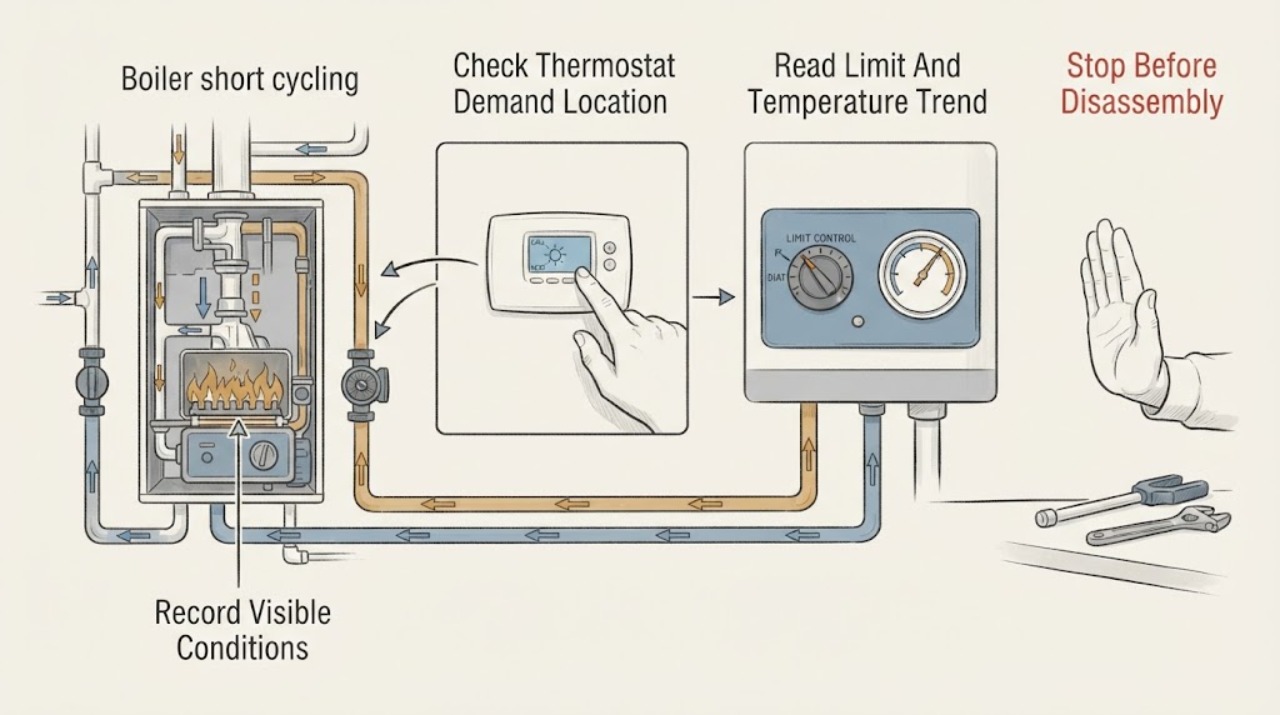
A Weil-McLain boiler is short cycling when its burner starts and stops repeatedly during a continuing call for heat, before the home or zone is satisfied. The cause may be a thermostat or heat-anticipator issue, an operating limit reached too quickly, insufficient water flow through the boiler, a closed or failed circulator path, low system demand for the installed output, or a control or safety response. First record whether the thermostat still calls, how quickly the burner stops, whether the circulator continues, the boiler temperature or display status, and which zones heat. Do not adjust gas, combustion, limit, low-water, or pressure controls from a guess. Turn the boiler off and obtain qualified heating service for a gas or flue odor, rollout, carbon-monoxide alarm, relief discharge, leak, overheating indication, repeated lockout, or unsafe wiring.
Work through in order
Diagnostic checks
Use only checks that match the exact appliance or system and its official guide.
-
Check 1
From a safe position, observe one heating call without opening the Weil-McLain cabinet. Note whether the thermostat continues to call when the burner stops, how long the burner runs before stopping, whether the circulator continues, whether the same pattern occurs in every zone, and whether the burner restarts soon afterward.
Expected result: Record a call that ends normally, a call that remains active during repeated burner starts, a boiler that stops at a displayed temperature or limit status, a burner that lights and drops out, a circulator that runs or stays off, or a lockout or alert.
Next step: Write down the sequence and model information for service. Do not change the limit, gas valve, combustion setting, or safety reset based on the observation.
Stop if: Stop and turn the boiler off for gas or flue odor, smoke, flame rollout, a carbon-monoxide alarm, exposed wiring, water near electrical parts, or a repeated lockout.
Why this matters
Why: A thermostat call that ends points toward demand, thermostat placement, schedule, or zone control rather than boiler short cycling. A continuing call with rapid burner restarts points toward an operating limit, flow, low load, control, or safety path. A flame drop-out or lockout is not a normal cycling adjustment.
-
Check 2
Check the thermostat display, mode, schedule, and call indicator, and note whether the thermostat is near a draft, supply register, boiler-room heat, direct sun, or another local heat source. If the system has multiple zones, identify which thermostat is calling and whether another zone satisfies first.
Expected result: Record no call, a call that ends when the burner stops, a call that remains active, a thermostat affected by a draft or heat source, mismatched zone behavior, or a display that resets or shows an alert.
Next step: Correct only an obvious mode or schedule error and do not relocate or recalibrate the thermostat without the installation instructions. Give a qualified technician the thermostat location and call timeline if the pattern remains.
Stop if: Do not open the thermostat or boiler control, change wiring, bridge terminals, or adjust an anticipator or other setting without model-specific qualified guidance.
Why this matters
Why: A thermostat reading affected by local heat or drafts can end a call too early; an incorrect heat-anticipator or control setting can also contribute, but its adjustment is model-specific. A continuing call with the boiler cycling shifts attention to limit, flow, load, and safety checks.
-
Check 3
Read only the accessible Weil-McLain display, pressure/temperature gauge, and status indicators while the boiler operates. Compare the displayed boiler temperature or limit status with the thermostat call and note whether the burner stops at a high temperature, the temperature rises unusually fast, or the control reports a limit, low-water, or other alarm.
Expected result: Record a normal call and temperature trend, rapid rise to an operating limit, a limit or low-water message, abnormal pressure, relief discharge, a blank display, or a temperature reading that does not match the heating response.
Next step: Photograph the display and gauge for the technician. Do not raise or lower a limit, add water, open a relief valve, or reset a low-water or safety device to force longer burns.
Stop if: Stop for relief discharge, steam, a leak, abnormal pressure, overheating, a safety alarm, or water near electrical components.
Why this matters
Why: A rapid temperature rise with active demand can indicate low flow, a closed valve, an inactive circulator, a small active zone, or a limit/control relationship. A low-water, pressure, or safety indication requires service; a generic pressure or temperature number cannot be judged without the exact model manual.
-
Check 4
Without touching hot piping, compare the accessible radiators, baseboards, radiant zones, or air handlers during a heat call. Note whether the boiler becomes hot while emitters remain cold, whether one zone differs from the others, and whether the circulator's external sound or status changes with the call.
Expected result: Record all zones warming, one zone cold, all emitters cold with a hot boiler, gurgling or air noise, no circulator response, a closed-looking valve, or a visible leak around piping or the pump.
Next step: Keep the boiler operating only if no safety warning exists and the exact manual permits normal observation; arrange qualified hydronic service for flow, air, valve, circulator, or leak symptoms. Do not purge, drain, bleed hot water, or change valve positions by guesswork.
Stop if: Do not touch hot pipes, pumps, relief hardware, vents, leaking connections, or electrical covers; stop for steam, a leak, or a pump that is seized, vibrating, or overheating.
Why this matters
Why: A hot boiler with cold zones makes insufficient flow, air, a valve, circulator, or blocked circuit more likely; Weil-McLain lists insufficient water flow as a rapid-cycling cause. A single cold zone can be a zone-control or flow issue, while all zones cold can indicate a broader circulator, control, pressure, or safety problem.
-
Check 5
Inspect only the accessible boiler room and exterior areas for blocked combustion or ventilation openings, unusual vent termination condition, gas or flue odor, soot, smoke, water, or a safety indicator. Keep the burner compartment and controls closed and do not attempt a combustion or gas test.
Expected result: Record clear openings and no warning, an obstructed air or vent path, soot or corrosion, gas or flue odor, a rollout or spill-switch indication, a recurring lockout, or a leak from the boiler or piping.
Next step: Turn the boiler off and obtain qualified service for any safety indication, odor, soot, leak, or repeated lockout. For smoke, strong gas or flue odor, or a carbon-monoxide alarm, leave the area and follow local emergency guidance.
Stop if: Do not bypass a limit, low-water cutoff, spill or pressure switch, adjust gas or draft, remove the jacket, or repeatedly reset a safety control.
Why this matters
Why: A blocked air or vent path, rollout response, lockout, gas odor, or flue symptom can interrupt firing and is a safety condition. A clear exterior does not prove combustion or vent safety; internal testing belongs to a qualified technician.
-
Check 6
After recording the call, temperature, zone, and safety pattern, compare the symptom with the exact Weil-McLain manual and arrange one qualified diagnostic visit if the burner continues to cycle before the demand is satisfied. Do not run repeated forced calls just to collect more cycles.
Expected result: Record whether short cycling remains after an obvious thermostat schedule correction, whether it is limited to a small zone or mild demand, whether it follows a flow symptom, and whether it recurs after a reset or power event.
Next step: Leave control and safety settings unchanged and request qualified Weil-McLain boiler and hydronic diagnosis. Provide the model, fuel, thermostat call, cycle sequence, display, gauge trend, zone pattern, and recent service or system changes.
Stop if: Stop operation for any gas, flue, combustion, electrical, leak, pressure, overheating, relief, or carbon-monoxide warning.
Why this matters
Why: Persistent cycling after basic observations can involve system sizing, control differential, staging, sensor location, circulation, water-side balance, or a component fault. These causes require measurements and model-specific settings; the observed pattern alone cannot identify a replacement part.
Use your observations
Decision map
Find the observation that best matches what you see, then follow the next safe action.
-
PATH 01Next step
What you see
The thermostat call ends when the burner stops, or the thermostat is exposed to a draft, boiler-room heat, sun, or another local temperature source.
Do this next
Correct only an obvious mode or schedule issue, keep thermostat wiring and settings unchanged, and ask a qualified technician to verify placement and call control if the room remains cold.
Why this path and its safety boundary
Why it matters: The apparent short cycle may be a demand or thermostat-location issue rather than the Weil-McLain boiler stopping against its limit. A heat-anticipator or zone-control setting can also be involved but is model-specific.
-
PATH 02Next step
What you see
The thermostat continues to call, the boiler temperature rises quickly to its operating limit, and the burner restarts after a short off period while the zone remains below target.
Do this next
Do not alter the limit or bypass control. Have a qualified technician check load, control settings, sensor placement, staging, and heat transfer.
Why this path and its safety boundary
Why it matters: Low active load, an output-to-zone mismatch, a narrow control differential, sensor or limit relationship, or insufficient flow is more likely. Weil-McLain's control features and settings vary by product and system.
-
PATH 03Next step
What you see
The boiler becomes hot while one or more zones remain cold, the circulator does not respond as expected, air or gurgling is present, a valve appears closed, or pressure and temperature change abnormally.
Do this next
Keep away from hot or pressurized parts and arrange qualified hydronic service. Do not bleed, purge, drain, add water, or adjust valves based on a generic instruction.
Why this path and its safety boundary
Why it matters: Insufficient water flow, air, a circulator, zone valve, blocked circuit, or water-side condition can make the boiler reach its limit quickly and cycle off.
-
PATH 04Next step
What you see
A limit, low-water, spill or pressure switch, vent or combustion warning, rollout symptom, leak, relief discharge, gas or flue odor, or recurring lockout accompanies the cycling.
Do this next
Turn the boiler off and obtain qualified service. Leave the area for smoke, strong gas or flue odor, or a carbon-monoxide alarm and follow local emergency guidance.
Why this path and its safety boundary
Why it matters: The boiler may be protecting against an unsafe condition. This is not a normal short-cycle setting to tune from the user interface.
-
PATH 05Next step
What you see
The thermostat call remains active, load and flow observations are normal, no safety warning is present, but the boiler still cycles rapidly across normal demands or zones.
Do this next
Request qualified Weil-McLain boiler service for measured diagnosis of the burner, limits, controls, sensors, circulator, piping, and active heat load.
Why this path and its safety boundary
Why it matters: System sizing, control differential, staging, sensor placement, software setting, or a component fault may be involved. An owner observation cannot distinguish these causes or select a compatible part.
Helpful context
Understand the symptom
Confirm that the cycling is abnormal
A burner normally turns off after reaching an operating limit and may restart after the control differential is satisfied; a circulator may continue moving heat. Short cycling is the repeated on-off pattern that happens while a thermostat still calls and the zone has not recovered, or that repeats so quickly that the system cannot deliver heat steadily. Record the pattern instead of changing a limit setting by guesswork, because Weil-McLain boiler models and controls use different setpoints and operating sequences.
Use the symptom pattern to separate control from water flow
If the thermostat stops calling or is affected by a draft or nearby heat source, the call itself may be ending. If the call remains active but the boiler reaches its limit quickly, low system demand, output that exceeds the active zone, a narrow temperature differential, or a flow problem becomes more relevant. Weil-McLain's troubleshooting table specifically links rapid cycling with thermostat conditions, limit setting, and insufficient flow; determining which pattern is present is more useful than assuming the boiler is oversized or the control is defective.
Safety controls are not cycling adjustments
A boiler can stop because a limit, low-water cutoff, spill or pressure switch, vent condition, or another safety input has opened. Weil-McLain documentation treats recurring safety faults, rollout protection, leaks, and abnormal pressure as service conditions. Keep the cabinet closed, do not bypass a safety or repeatedly reset a lockout, and give the technician the display state and exact sequence of burner, circulator, and thermostat events.
Only after diagnosis
Potential parts
- boiler control or temperature sensor
Consider only after qualified testing confirms a failed control, sensor, differential function, or related wiring is causing the burner to cycle before the demand is satisfied.
Confirm the exact Weil-McLain model, control family, sensor type, wiring, and system configuration; do not substitute a control based on terminal appearance. - boiler circulator pump or flow component
Consider only if qualified hydronic testing confirms insufficient circulation, a failed pump, or a flow component restriction after valves, air, and system conditions are evaluated.
Match required flow, head, voltage, flange or connection arrangement, control method, and exact system configuration with a qualified technician. - thermostat or heat-demand control
Consider only when qualified testing confirms the thermostat or demand control is ending or repeating calls incorrectly after placement, schedule, and wiring conditions are checked.
Confirm heating-system type, staging, voltage, anticipator or cycle-rate requirements, and exact wiring before replacement.
When checks do not resolve it
Need a professional?
Arrange qualified Weil-McLain boiler service when the burner cycles repeatedly during a continuing thermostat call, the boiler reaches its limit before zones are warm, flow or circulator symptoms appear, a display alert or lockout returns, or the pattern persists after an obvious thermostat setting correction. Turn the boiler off for gas or flue odor, smoke, rollout, carbon-monoxide alarm, relief discharge, leak, abnormal pressure, overheating, exposed wiring, or water near electrical parts.
Have this ready
- Give the technician the exact model and fuel, thermostat call and location, burner run and off pattern, display or lockout state, gauge and temperature trend, circulator response, zone heat pattern, valve or air observations, recent changes, and any gas, flue, smoke, leak, relief, or carbon-monoxide warning.
Common questions
FAQ
What does short cycling mean on a Weil-McLain boiler?
It is repeated burner start-and-stop while the thermostat or zone still calls for heat, before the space is satisfied. A normal burner shutoff at an operating limit is different; the useful clues are the continuing call, run duration, temperature trend, circulator response, and zone heat.
Can a thermostat cause a Weil-McLain boiler to short cycle?
Yes. Weil-McLain lists thermostat location and heat-anticipator adjustment among rapid-cycling causes. Check for drafts, nearby heat, mode, schedule, and which zone is calling, but do not alter thermostat wiring or calibration without qualified, model-specific guidance.
Can low flow make a boiler short cycle?
Yes. If the boiler heats rapidly while zones remain cold, insufficient flow, air, a circulator, valve, or blocked circuit can make the boiler reach its limit before heat is delivered. Do not purge, drain, bleed hot water, or adjust valves by guesswork; arrange hydronic service.
Should I raise the Weil-McLain boiler limit to stop short cycling?
Do not change a limit from a generic recommendation. The correct limit and differential depend on the exact model, fuel, controls, piping, and heat load. Record the display and temperature behavior and have a qualified technician verify the setting and cause.
When is Weil-McLain boiler short cycling unsafe?
Turn the boiler off for gas or flue odor, smoke, rollout, a carbon-monoxide alarm, relief discharge, a leak, abnormal pressure, overheating, a repeated lockout, exposed wiring, or water near electrical parts. Leave the area for smoke or strong gas or flue odor and follow local emergency guidance.
Read the exact guide
Official sources
- Boiler Sequencing Control (BSC)Weil-McLain · Official Weil-McLain BSC product page used for multi-boiler control context and lockout boundary; it is not a diagnosis for every residential boiler.
- CGa, CGi, EG, PEG, & LGB USER MANUAL — OPERATIONWeil-McLain · Official Weil-McLain user manual covering listed boiler families; settings and procedures are not universal across all Weil-McLain models.
- Boiler Control Panels (BCP)Weil-McLain · Official Weil-McLain BCP product page used for control-function context; BCP features do not establish settings for a different boiler control.
Community feedback
Share a repair observation
Share a plain-text repair observation. Accepted observations are published automatically; this page may take a moment to update.