
On this page
Start here
Quick answer
A York central air conditioner that starts and stops before the home is comfortable may have restricted airflow, a thermostat or control problem, a blocked condensate drain or safety response, an outdoor condenser airflow issue, incorrect sizing, or a refrigerant or electrical fault. First record whether the compressor actually stops, check the thermostat display and settings, replace a visibly dirty filter with the manufacturer-approved type, clear supply and return registers, and remove loose debris around the outdoor unit only from a safe, unpowered position. Do not open panels, test live voltage, handle refrigerant, bypass a safety, or keep forcing repeated starts. If the pattern continues, cooling is poor, ice or water appears, a breaker trips, or there is smoke or a burning smell, leave the system off as appropriate and arrange qualified HVAC service.
Before you begin
Safety first
- This article supports ordinary-access observation and manufacturer-directed filter and clearance maintenance only. It does not authorize panel removal, live electrical testing, control bypass, refrigerant handling, gauge connection, drain chemicals, or internal component replacement.
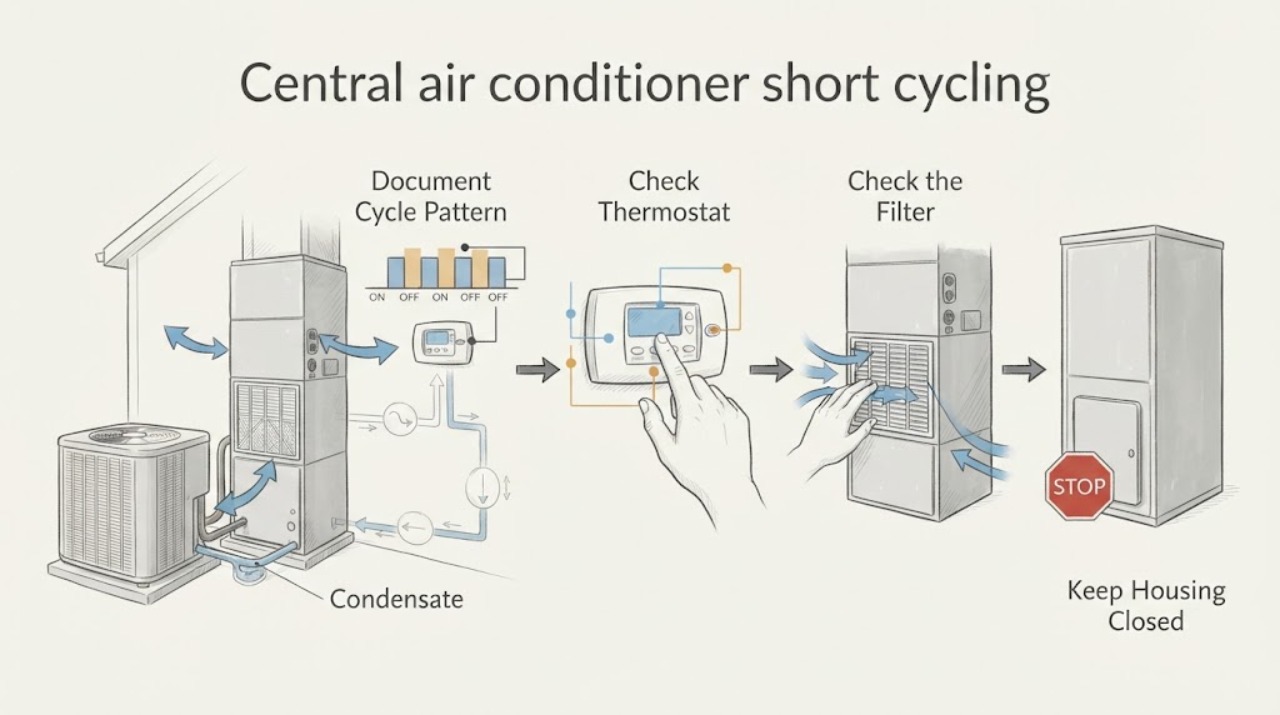
Work through in order
Diagnostic checks
Use only checks that match the exact appliance or system and its official guide.
-
Check 1
From normal use and a safe position, record each cooling call while the home is still above the requested comfort level: note the thermostat setting, displayed room temperature, whether the indoor blower continues, and whether the outdoor fan or compressor stops and restarts.
Expected result: The call ends after the displayed temperature reaches the setting; the compressor stops while the blower continues; the thermostat still calls for cooling; the outdoor fan stops too; or the pattern repeats with little cooling.
Next step: Keep a brief event log and continue only with safe external checks. Arrange service if the room remains uncomfortable, the pattern repeats, or the unit stops on a fault indication.
Stop if: Stop operating the system for smoke, burning odor, arcing, exposed wiring, repeated breaker trips, loud mechanical impact, or any need to open an energized unit.
Why this matters
Why: A completed call can be normal satisfaction. A compressor or complete outdoor unit that repeatedly stops while demand remains supports short cycling or a control or safety response; an indoor blower that continues points to a different control sequence than a full system shutdown.
-
Check 2
Inspect the thermostat from the front without removing its cover or wiring; verify that it is in the intended cooling mode, the displayed temperature is plausible, the cooling call indicator behaves consistently, and any accessible batteries are not depleted when the model uses them.
Expected result: The mode is wrong, the display is blank or erratic, the set point is already met, the display temperature is implausible, the call indicator remains on while the outdoor unit is off, or the thermostat appears normal.
Next step: Correct only an obvious mode or set-point mistake and document the display. If the display is abnormal or the unit ignores a consistent call, arrange HVAC service rather than changing wiring or repeatedly resetting controls.
Stop if: Do not remove the thermostat, jumper terminals, change wiring, bypass a low-temperature or condensate control, or use a reset as a substitute for diagnosis.
Why this matters
Why: A mode, display, battery, or temperature-sensing issue can end or create calls without proving a York compressor fault. A continuing cooling call with repeated outdoor shutdown suggests a control, safety, airflow, or equipment problem that needs diagnosis.
-
Check 3
With the system off if the filter is being handled, inspect the accessible air filter, return grille, and supply registers; replace a dirty or damaged filter only with the size and type specified by the system or its manual, and move furniture or objects away from grilles.
Expected result: The filter is visibly loaded, wet, collapsed, missing, or the wrong size; a return or supply is blocked; airflow is weak at several registers; or the filter and grilles look clear.
Next step: Correct the accessible filter or grille condition, then record whether the cycling pattern and airflow change during a normal cooling call. Request service if airflow remains weak, the filter becomes wet or quickly dirty, or short cycling persists.
Stop if: Do not operate without the required filter, install a filter that does not fit, remove a blower or coil panel, wash the coil, or reach into the air handler.
Why this matters
Why: Restricted or bypassed filtration and blocked airflow can make the system work harder and may contribute to shutdowns or poor cooling. Clear visible obstructions and a correct filter are useful maintenance steps, but a clean filter with weak airflow points toward the blower, coil, duct, or control system.
-
Check 4
From outside the equipment enclosure and with no contact with the unit, look for leaves, grass, snow, storage items, or plant growth blocking the outdoor condenser grille; clear only loose debris that can be removed without tools, and do not open or wash the cabinet.
Expected result: The outdoor grille is visibly obstructed, the unit is clean but the fan stops unexpectedly, the condenser is iced, or there is no obvious outdoor obstruction.
Next step: Keep the outdoor area clear and document the fan, ice, sound, and timing. Leave the system off and arrange service for ice, a stopped fan, repeated trips, or continued short cycling.
Stop if: Do not remove the grille, bend coil fins, hose the inside, touch a fan, use a tool near wiring, or restart an iced or electrically abnormal unit.
Why this matters
Why: Blocked outdoor airflow can impair heat rejection and comfort. A stopped fan, ice, or a clean grille with continued short cycling suggests a control, motor, coil, refrigerant, or other equipment problem rather than more debris removal.
-
Check 5
From a dry, ordinary-access position, inspect the visible condensate drain outlet and any accessible pan area for overflow, standing water, algae-like blockage, or a disconnected-looking line; do not remove an air-handler panel or insert a tool into the drain.
Expected result: Water is overflowing, the drain outlet is visibly blocked, the pan is dry, or the drain path cannot be seen safely.
Next step: Turn the system off if water is reaching electrical equipment, ceilings, or flooring, protect the area from damage, and arrange HVAC service for a blockage or uncertain drain condition. Record whether the cycling began with water or humidity symptoms.
Stop if: Do not pour chemicals into the drain, blow compressed air into the system, open the air handler, or bypass a condensate safety switch.
Why this matters
Why: A condensate problem can reduce cooling and may activate a protective control on systems equipped with one. A dry visible outlet does not rule out an internal blockage, and an inaccessible path is not a reason to open the air handler.
-
Check 6
Review the installation and comfort history without changing equipment: record the York model and serial information, system age if known, rooms that stay warm or humid, recent filter or duct work, and whether short cycling began after installation, remodeling, or a repair.
Expected result: The problem began with a new installation, occurs mainly in mild weather, affects rooms unevenly, follows a repair, or has no clear trigger; humidity is also high or the home never reaches the set point.
Next step: Give the history and observations to a qualified HVAC technician and ask for airflow, duct, control, sizing, and refrigerant-circuit assessment as applicable. Do not select a replacement unit or refrigerant charge from symptoms alone.
Stop if: Do not open the refrigerant circuit, connect gauges, adjust charge, change control wiring, or replace a safety or compressor component as a home test.
Why this matters
Why: Frequent cycling after installation or mostly in mild loads can make sizing, staging, thermostat location, or system matching more likely. Uneven comfort and high humidity can support airflow or duct issues; a sudden change after repair can point to a component or control fault. None can be confirmed without measurements.
Use your observations
Decision map
Find the observation that best matches what you see, then follow the next safe action.
-
PATH 01Safety boundary
What you see
The outdoor unit stops only after the thermostat reaches its requested temperature, the home is comfortable, and the cycle does not immediately repeat.
Do this next
Continue ordinary York maintenance and monitor the next cooling calls; request service if the room remains uncomfortable or the starts and stops become frequent or abrupt.
Why this path and its safety boundary
Why it matters: The observed event may be normal thermostat satisfaction rather than short cycling.
Safety stop: Do not change wiring or thermostat settings to force longer operation.
-
PATH 02Safety boundary
What you see
The filter is dirty or incorrect, several registers or the return are blocked, airflow is weak, or the outdoor grille is obstructed, and the symptom changes after the accessible restriction is corrected.
Do this next
Keep the correct filter installed, keep registers and the outdoor area clear, and arrange service if weak airflow, ice, poor cooling, or short cycling remains.
Why this path and its safety boundary
Why it matters: An airflow or heat-transfer restriction is more likely than a conclusively failed compressor, though a persistent fault may have another cause.
Safety stop: Do not remove panels, clean internal coils with improvised chemicals, or operate without the required filter.
-
PATH 03Safety boundary
What you see
The thermostat display or temperature is abnormal, the cooling call remains active while the outdoor unit repeatedly stops, or the system behavior changed after thermostat or electrical work.
Do this next
Leave wiring untouched, document the display and timing, and arrange qualified HVAC diagnosis.
Why this path and its safety boundary
Why it matters: A thermostat, low-voltage control, safety, or wiring problem is more likely than a simple filter issue, but the exact fault cannot be identified from the display alone.
Safety stop: Do not jumper terminals, bypass safeties, remove the thermostat, or reset a tripping breaker repeatedly.
-
PATH 04Safety boundary
What you see
Water is visible at the condensate pan or drain, the drain outlet is blocked, or cooling stops alongside an overflow or high-humidity symptom.
Do this next
Turn the system off when water is reaching equipment or building materials, keep the area safe, and arrange HVAC service for drain access and testing.
Why this path and its safety boundary
Why it matters: A condensate drainage problem or protective response is plausible and can cause water damage if the system continues to operate.
Safety stop: Do not pour drain chemicals, force a blockage clear, or bypass a condensate safety.
-
PATH 05Safety boundary
What you see
The filter and visible airflow paths are clear, but short cycling persists; the home has uneven comfort or humidity, the issue began after installation, or the system has a recent repair history.
Do this next
Request a qualified HVAC evaluation that considers sizing, airflow, ducts, controls, and refrigerant circuit; provide the York model, history, and cycle record.
Why this path and its safety boundary
Why it matters: System sizing, duct leakage or restriction, incorrect charge, coil or compressor performance, or another professional-level condition becomes more likely.
Safety stop: Do not add refrigerant, connect gauges, alter charge, open the sealed circuit, or buy a compressor or capacitor from the symptom alone.
-
PATH 06Safety boundary
What you see
The unit has smoke, burning odor, arcing, exposed wiring, repeated breaker trips, a loud mechanical impact, a stopped outdoor fan, or substantial ice.
Do this next
Stop using the equipment, isolate power only if this can be done without contact with hazards, keep people away, and arrange urgent qualified HVAC or electrical service.
Why this path and its safety boundary
Why it matters: This is a safety or equipment-damage boundary, not a routine homeowner adjustment.
Safety stop: Do not restore a tripping breaker, touch wiring or a fan, chip ice, or continue test cycles.
Helpful context
Understand the symptom
Confirm that this is short cycling
A thermostat call can end because the set point was reached, a control deliberately staged the equipment down, or a safety or fault stopped the compressor. Before assuming a failed York part, record the thermostat setting, room temperature shown, supply-air behavior, whether the indoor blower continues, whether the outdoor fan or compressor stops, and whether the cycle repeats while the room is still uncomfortable. A call that ends normally after the set point is reached is different from a compressor that repeatedly starts and stops while the demand remains.
Airflow is the first homeowner-safe maintenance path
YORK recommends maintaining the air handler filter, keeping supply and return grilles clear, and removing outdoor debris without disturbing the equipment. A dirty filter, blocked return, closed register, furniture against a return, or a condenser covered by leaves can change airflow and heat transfer. Check the filter and visible airflow path from ordinary access, but do not remove an access panel or wash the inside of a live unit. Use the filter type and replacement instructions specified for the installed system rather than choosing a restrictive replacement by guesswork.
Thermostat, condensate, and outdoor observations narrow the branch
A thermostat that reports an unexpected temperature, changes modes, loses power, or calls for cooling after the compressor stops can point to controls or wiring. A condensate line or pan that is visibly blocked or overflowing can activate a safety control on some systems, so note water without reaching into the air handler. Outside, listen and observe from a safe distance: a fan that stops, an unusual sound, ice, or a dirty condenser can distinguish a heat-transfer or control symptom from ordinary temperature satisfaction. These observations do not establish a refrigerant charge or electrical diagnosis.
Short cycling after airflow checks needs service diagnosis
ENERGY STAR lists oversized equipment, poor airflow, improper refrigerant charge, and duct problems as installation or performance issues that can cause frequent cycling, comfort problems, or shortened equipment life. If a clean filter and unobstructed grilles do not change the pattern, do not add refrigerant, adjust a pressure control, replace a capacitor, or bypass a safety. Give the technician the cycle record, thermostat behavior, filter details, outdoor observations, ice or water evidence, and the York model and serial information.
Safety boundary
Stop conditions
- Stop the system and arrange urgent qualified service for smoke, burning odor, arcing, exposed wiring, repeated breaker trips, loud mechanical impact, a stopped outdoor fan, or substantial ice.
- Do not open access panels, probe live terminals, jumper thermostat wires, bypass condensate or other safety controls, or handle a fan or compressor while power is present.
- Do not connect gauges, add or release refrigerant, open the sealed circuit, adjust charge, or substitute a refrigerant; these are qualified technician tasks.
- Do not chip ice, wash the inside of the condenser or air handler, pour chemicals into a condensate drain, or run repeated cycles to force a diagnosis.
- Arrange qualified HVAC service when short cycling persists after safe filter and airflow observations, the home remains warm or humid, water appears, the thermostat call is abnormal, or sizing, duct, control, refrigerant, or internal equipment work is suspected.
Only after diagnosis
Potential parts
- York-compatible air filter
Consider this category only when the existing filter is dirty, damaged, missing, or the wrong size and the installed system documentation identifies a compatible replacement.
Confirm the exact filter dimensions, type, airflow requirements, and York or air-handler instructions; do not choose a more restrictive filter by symptom alone. - York-compatible thermostat
Consider this category only after qualified diagnosis confirms that the thermostat or temperature-sensing control is causing an abnormal call or incorrect cycling.
Confirm the exact York system, staging, heat-pump or cooling configuration, wiring, and manufacturer compatibility before ordering or installing. - condensate drain or safety component
Consider this category only when service diagnosis confirms a blocked, damaged, or failed condensate drainage or safety component after checking for visible overflow.
Confirm the installed air-handler model, drain arrangement, safety-control design, and local installation requirements with the technician; do not bypass a safety switch.
When checks do not resolve it
Need a professional?
Arrange qualified HVAC service when a York central air conditioner repeatedly starts and stops before comfort is reached, continues after the correct filter and visible airflow paths are restored, develops ice or condensate overflow, has a persistent thermostat call while the outdoor unit stops, or shows uneven comfort or high humidity. Treat smoke, burning odor, arcing, exposed wiring, repeated breaker trips, a stopped outdoor fan, or substantial ice as urgent safety boundaries. Ask the technician to evaluate airflow, ducts, thermostat and safeties, sizing and staging, condensate drainage, outdoor heat transfer, and refrigerant or compressor operation as applicable.
Safety scope: This article supports ordinary-access observation and manufacturer-directed filter and clearance maintenance only. It does not authorize panel removal, live electrical testing, control bypass, refrigerant handling, gauge connection, drain chemicals, or internal component replacement.
Common questions
FAQ
What does short cycling mean on a York central air conditioner?
It means the cooling equipment starts and stops repeatedly before the home reaches the requested comfort level. First confirm that the compressor or complete outdoor unit is stopping while the thermostat still calls for cooling; a call that ends after the set point is reached may be normal satisfaction.
Can a dirty filter cause a York air conditioner to short cycle?
A clogged filter can restrict airflow and reduce cooling performance, so it is a reasonable first maintenance check. Replace it only with the size and type specified for the installed system, keep return and supply grilles clear, and arrange service if cycling or weak airflow remains.
Can I add refrigerant to stop short cycling?
No. Refrigerant diagnosis and charging require qualified service, and a leak should be located and repaired rather than repeatedly topped off. Short cycling can also come from airflow, controls, ducts, sizing, condensate, or electrical faults, so a charge cannot be selected from the symptom alone.
Should I keep running the system if it is short cycling?
Do not force repeated starts when cooling is poor or the system has ice, water, smoke, a burning odor, unusual noise, or electrical symptoms. Keep the equipment off as appropriate and arrange service; for a clean, safe system with only a suspected cycle-pattern issue, limit operation and schedule diagnosis rather than repeatedly testing it.
When does York short cycling need an HVAC technician?
Arrange qualified service when the pattern persists after safe filter and clearance checks, the thermostat call is abnormal, comfort or humidity is poor, condensate overflows, ice appears, the outdoor fan stops, or sizing, ductwork, refrigerant, controls, or internal components may be involved. Treat smoke, burning odor, arcing, exposed wiring, and repeated breaker trips as urgent.
Read the exact guide
Official sources
- Clean Heating and CoolingENERGY STAR · Official ENERGY STAR homeowner guidance on frequent on-off cycling, sizing, humidity, airflow, and maintenance for central cooling systems.
- Home HVAC Maintenance TipsYORK · Official YORK homeowner guidance for air conditioner and heat-pump maintenance and service boundaries; the exact installed model manual controls.
- HVAC Quality InstallationENERGY STAR · Official ENERGY STAR guidance for residential HVAC installation and performance evaluation.
- Purchasing and Repairing Home Air-Conditioners or Heat PumpsU.S. Environmental Protection Agency · Official EPA homeowner guidance for refrigerant-containing residential air conditioners and heat pumps.
- HomeCooling101U.S. Department of Energy · Official Department of Energy homeowner guide for central air conditioning symptoms and basic maintenance; model instructions and qualified service control.
- HVAC Troubleshooting GuideYORK · Official YORK troubleshooting guidance for residential HVAC owners; the opened page now redirects to the current YORK residential site, so exact model documentation controls.
Community feedback
Share a repair observation
Share a plain-text repair observation. Accepted observations are published automatically; this page may take a moment to update.