
On this page
Start here
Quick answer
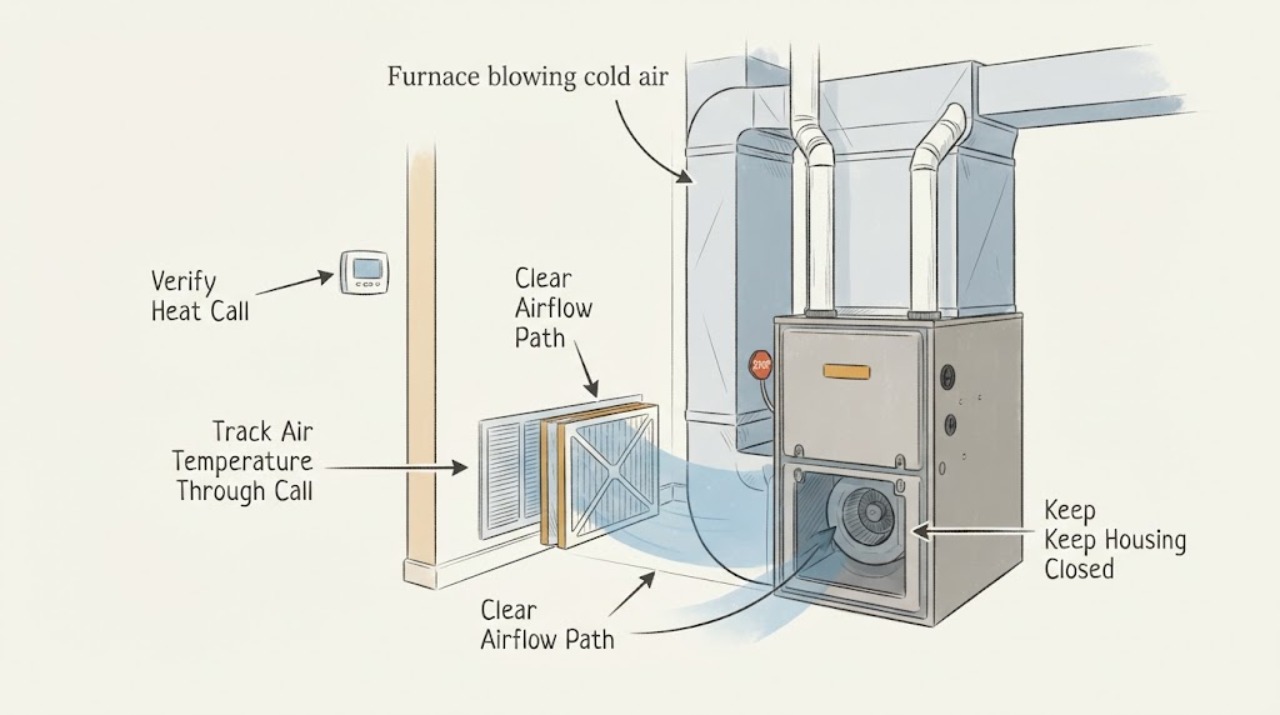
First separate a brief cool period at the beginning or end of a call from air that stays cool for the whole call. York sells furnaces with single-stage, two-stage, modulating, and variable-speed features, so a startup ramp or a lower first stage is not the same as a failed heater; the air should still become warm and the room should recover. Set the thermostat to Heat, use Auto for the fan unless continuous circulation is intended, and observe one complete call without opening the cabinet. Then check the accessible filter, return grille, and supply grilles. If air remains cool during a valid heat call, turns cool after briefly warming, or the blower runs without heat, stop repeated restarts and arrange qualified HVAC service. Gas odor, a carbon-monoxide alarm, smoke, soot, abnormal flame, water near equipment, or a blocked or damaged vent is an urgent safety reason to leave the area or stop using the furnace as appropriate.
Before you begin
Safety first
- This article supports thermostat observation, ordinary-access filter and grille checks, room-to-room airflow comparison, and safe external observation of visible terminations only. It does not authorize panel removal, combustion or gas work, live electrical testing, control bypass, vent disassembly, or internal part replacement.
Work through in order
Diagnostic checks
Use only checks that match the exact appliance or system and its official guide.
-
Check 1
From the thermostat front panel, select Heat, set the requested temperature above the room reading, and set the fan to Auto unless you intentionally use continuous circulation; do not remove the cover or change wiring.
Expected result: The fan runs with no heat request, the fan is set to On or circulate, the set point is already satisfied, the display is blank or erratic, or the thermostat clearly shows a heat request.
Next step: Correct only an obvious front-panel setting and observe one call. If a valid heat request still produces cold air, do not jumper terminals or remove the thermostat; continue only with the safe observations below and plan service.
Stop if: Do not bypass the thermostat, alter low-voltage wiring, or repeatedly reset a breaker or furnace control.
Why this matters
Why: Fan-only circulation or an incorrect mode can feel like cold air without proving the York furnace has a failed heat source. A clear heat request with a blower but no heat shifts attention to the furnace sequence or a control issue.
-
Check 2
During one heat call, observe airflow from a nearby register without touching hot metal and note the sequence: blower first, warm air later, warm air that turns cool, or cool air throughout; remain outside the furnace cabinet.
Expected result: Air warms after startup and stays warm, is cool only briefly at startup or shutdown, never warms, or warms and then turns cool while the room is still below the requested temperature.
Next step: Record the order of events, whether the blower keeps running, and any visible thermostat or status alert. Stop repeated calls and arrange qualified diagnosis if warm air never arrives or disappears before the call is satisfied.
Stop if: Do not open access doors, watch burners, probe wiring, reset a rollout or limit switch, or relight a pilot as a test.
Why this matters
Why: Brief cool airflow can be normal sequencing, especially on a staged or variable-speed York system. Air that never warms suggests the heat section or its controls are not completing a call; warm-then-cool behavior makes an airflow, venting, condensate, limit, ignition, or control interruption more plausible.
-
Check 3
With the furnace off, inspect only the accessible return-air filter and the visible return and supply grilles; replace a filter only with the size and type specified for the installed system, and move furniture or dust away from grilles.
Expected result: The filter is loaded, wet, collapsed, missing, or a poor fit; the large return is blocked; several supplies are obstructed; airflow is weak; or the filter and grilles are clear with normal airflow.
Next step: Correct the accessible filter or obstruction, then observe one complete call. Arrange service if the filter loads quickly, airflow stays weak, the furnace short-cycles, or cold air returns after the correction.
Stop if: Do not run the furnace without its required filter, install a more restrictive filter by guesswork, or open the blower or coil compartment.
Why this matters
Why: A restricted filter or return path can reduce airflow, increase furnace run time, and contribute to poor heat delivery or a protective shutdown. If airflow is normal but the air remains cool through a valid call, a filter is unlikely to be the whole explanation.
-
Check 4
From a safe, ordinary-access position, inspect only the visible furnace intake and exhaust terminations, vent connections, and the floor or pan around the unit for leaves, snow, nests, ice, a visible gap, rust, or water; do not reach into a pipe or remove a guard.
Expected result: A termination or connection is visibly blocked or damaged, water is collecting near the furnace, the area is dry and clear, or the vent and drain path cannot be checked safely.
Next step: Keep the furnace off and arrange qualified service for a blockage, damaged vent, water near equipment, or an inaccessible path. Only move loose debris around the area if it can be done without touching the equipment or climbing.
Stop if: Do not disassemble venting, clear a pipe with tools, pour chemicals into a drain, enter a crawlspace or roof area, or bypass a condensate safety.
Why this matters
Why: Venting, combustion-air, or condensate problems can interrupt safe furnace operation and leave the blower moving unheated air. A clear external termination does not rule out an internal vent, drain, ignition, or control fault.
-
Check 5
Read the York model and serial information from an exterior label or existing thermostat interface, and record any status light or alert that is visible without removing a furnace door; note recent filter, thermostat, installation, or repair changes.
Expected result: The model is identifiable and the alert repeats, the alert is not present, the symptom began after a change, or the label or alert is inaccessible without opening the cabinet.
Next step: Give the exact model information, alert pattern, thermostat settings, and timing of the cold air to a qualified York or HVAC technician. If the information is behind a panel, leave it for the technician.
Stop if: Do not remove panels, defeat the door switch, test live terminals, or order an igniter, sensor, valve, board, or blower from an alert pattern alone.
Why this matters
Why: York furnace families use different stages, fan controls, and service information, so an exact model and unaltered alert pattern are more useful than a generic blink-code translation. A recent change can point to setup, airflow, control, or installation context, but it does not identify a part by itself.
-
Check 6
Compare airflow and warmth at the closest register, a distant register, and the main return during the same call, and note whether the complaint affects every room or only a zone or branch.
Expected result: All registers deliver similarly cool air, nearby registers warm while distant rooms stay cool, airflow is weak at several supplies, or only one room or zone is affected.
Next step: Keep grilles clear and give the technician the room-by-room pattern. Request an airflow and duct assessment rather than closing registers, changing blower speed, or selecting a furnace part from comfort symptoms.
Stop if: Do not open ducts, alter dampers or blower settings, or close registers to force more heat into one room.
Why this matters
Why: Cool air everywhere during a valid call points back to heat generation or furnace control. Warm air near the furnace with cold distant rooms makes duct leakage, a blocked branch, return-air imbalance, or zone-distribution trouble more likely than a failed York burner.
Use your observations
Decision map
Find the observation that best matches what you see, then follow the next safe action.
-
PATH 01Next step
What you see
The thermostat is not making a heat request, the fan is set for continuous circulation, or the air is cool only briefly before a York heat call begins or after it ends.
Do this next
Use the intended thermostat fan mode and watch one complete call. If the air never becomes warm or the room does not recover, move to service rather than forcing the blower off.
Why this path and its safety boundary
Why it matters: Fan-only operation or a normal startup/shutdown sequence is more likely than a failed heat source. On staged or variable-speed models, the first airflow may not feel like full output.
-
PATH 02Next step
What you see
The thermostat shows a valid heat call, airflow is present at several registers, and the air remains cool for the entire call.
Do this next
Stop repeated starts, preserve the model and alert information, and arrange qualified York or HVAC diagnosis. Do not replace an ignition or control part from cold air alone.
Why this path and its safety boundary
Why it matters: A completed heat cycle is not occurring. Ignition or another heat-source problem, a control command, or a safety interruption is more likely than a simple fan setting; the symptom does not identify which component failed.
-
PATH 03Next step
What you see
Warm air begins but turns cool before the requested temperature is reached, the blower continues after the heat disappears, or the furnace repeatedly starts and stops.
Do this next
Check only the accessible filter, grilles, and visible terminations. If those are clear, keep the furnace off and provide the technician with the timing and alert pattern.
Why this path and its safety boundary
Why it matters: The sequence is being interrupted. Restricted airflow, a vent or combustion-air issue, condensate protection, a temperature limit, ignition or flame-sensing loss, or a control problem are all plausible; repeated cycling can worsen the underlying fault.
-
PATH 04Next step
What you see
Registers near the furnace become warm, but one distant room, zone, or branch remains cold or has markedly weaker airflow.
Do this next
Keep supply and return grilles clear and request an airflow and duct assessment. Do not close other registers or change blower settings to compensate.
Why this path and its safety boundary
Why it matters: Distribution, duct leakage, a blocked branch, return-air imbalance, or zone-control issue is more likely than a York heat-source failure. If every register is equally cool, use the whole-house no-heat path instead.
-
PATH 05Next step
What you see
There is gas odor, a carbon-monoxide alarm, smoke, soot, abnormal flame, a visibly blocked or damaged vent, or water reaching electrical equipment.
Do this next
Leave the area and follow local emergency guidance for gas odor or a CO alarm; otherwise stop using the furnace as appropriate and obtain qualified HVAC service. Do not restart it to collect more observations.
Why this path and its safety boundary
Why it matters: Safety takes priority over identifying a filter, sensor, or control. Fuel-burning furnace exhaust and venting problems can create carbon-monoxide risk, and water can create an electrical hazard.
Helpful context
Understand the symptom
Cold at the vent is a timing clue, not a part diagnosis
A York blower can move room-temperature air when the thermostat is not asking for heat, during a normal start or shutdown period, or after a heat stage has been interrupted. Listen and watch from the room: does the air become warm during the same call, or does the blower continue while the furnace never heats? Treat those as different problems. Because York offers single-stage, two-stage, modulating, and variable-speed equipment, do not judge the furnace from the first few seconds of airflow or assume a particular York fault code applies to every model.
Use the airflow checks that are actually accessible
Turn the furnace off before handling an accessible filter. Look for a loaded, wet, collapsed, missing, or wrong-size filter and make sure its airflow arrow follows the system's instructions. Also clear furniture and dust from the large return grille and supply grilles. A restriction can reduce airflow enough to cause poor heat delivery or a protective shutdown, but a clean filter with normal airflow and no heat points farther into the heating sequence.
Do not turn a cold-air complaint into combustion work
A fuel-burning furnace needs safe combustion air and venting. From ordinary ground-level access, inspect only for an obvious obstruction, gap, rust, or damage at a visible intake or exhaust termination. Do not remove a panel, look at burners, clear a pipe with a tool, reset a safety, or change gas or electrical settings. The CDC identifies gas and oil furnaces as carbon-monoxide sources and recommends qualified service and proper venting; a CO alarm, gas odor, smoke, or soot takes priority over troubleshooting.
What to record before calling for York service
Write down the complete York model and serial information that is visible without opening the cabinet, the thermostat mode and fan setting, whether the air ever warms, whether the blower runs after the call ends, and whether all rooms or only some rooms are affected. If a status light or alert is visible without removing a door, record its exact pattern rather than translating it from a generic chart. Give the technician the filter condition, any water around the unit, visible intake or exhaust condition, and what changed just before the symptom started.
Only after diagnosis
Potential parts
- York furnace air filter
Consider this category only when the accessible filter is dirty, wet, collapsed, missing, or the wrong fit and the installed system documentation identifies the replacement type.
Confirm the complete York model, dimensions, airflow direction, and system instructions before ordering; do not choose a restrictive filter from the cold-air symptom alone. - York-compatible thermostat or furnace control
Consider this category only after a qualified diagnosis confirms that the thermostat command, temperature sensing, or control compatibility is preventing a valid heat sequence.
Verify the exact York model, wiring design, stages, and manufacturer compatibility before replacement; the front-panel symptom is not sufficient proof. - York furnace ignition or flame-sensing component
Consider this category only when a qualified technician isolates repeated no-heat or warm-then-cold behavior to ignition or flame sensing after airflow, venting, condensate, and control checks.
Confirm model, fuel type, staging, and the technician's service procedure before selecting a component; never bypass a safety to test it.
When checks do not resolve it
Need a professional?
Arrange qualified HVAC service when a York furnace stays cold during a valid heat call, warm air stops unexpectedly, the blower runs without heat, the filter and grilles are clear but airflow or heat does not recover, water or a persistent alert appears, or combustion, venting, electrical, control, blower, duct, or internal work may be needed. Treat gas odor, a carbon-monoxide alarm, smoke, soot, abnormal flame, exposed wiring, or suspected blocked venting as urgent safety conditions: leave the area or stop use as appropriate and follow local emergency guidance.
Safety scope: This article supports thermostat observation, ordinary-access filter and grille checks, room-to-room airflow comparison, and safe external observation of visible terminations only. It does not authorize panel removal, combustion or gas work, live electrical testing, control bypass, vent disassembly, or internal part replacement.
Common questions
FAQ
Why is my York furnace blowing cold air?
The blower may be running without a heat request, the furnace may be in a brief startup or shutdown period, or the heat sequence may be interrupted by airflow, venting, condensate, ignition, heat-source, blower, or control trouble. Put the thermostat in Heat with the fan intentionally set, observe whether air warms during one call, and check only the accessible filter and grilles before arranging service if the air stays cold.
Can a York furnace's variable-speed or two-stage operation feel like cold air?
The first airflow from a staged or variable-speed York system may feel less warm while the call ramps, but it should become warm and restore the room temperature. Cool air for the entire call, or air that turns cool before the call is satisfied, is not explained by staging alone and needs diagnosis.
Can a dirty filter make a York furnace blow cold air?
Yes. A dirty or clogged filter can reduce airflow, increase furnace run time and motor wear, and contribute to poor heat delivery or a protective shutdown. Turn the furnace off before handling an accessible filter, use the specified fit, and arrange service if airflow remains weak or the cold-air symptom returns.
Should I open my York furnace or reset a safety switch?
No. Do not open panels, touch burners or wiring, relight a pilot, reset a rollout or limit switch, bypass a control, or repeatedly restart a furnace to diagnose cold air. Record the thermostat settings, sequence, visible alerts, filter condition, and external observations for a qualified technician.
When is cold air from a York furnace an emergency?
Treat gas odor, a carbon-monoxide alarm, smoke, soot, an abnormal flame, exposed wiring, water reaching electrical equipment, or a suspected blocked or damaged vent as urgent. Leave the area or stop using the furnace as appropriate, follow local emergency guidance, and do not restart the equipment to gather more evidence.
Read the exact guide
Official sources
- Purchasing Energy-Efficient Residential FurnacesU.S. Department of Energy · Official DOE FEMP guidance for residential gas, propane, and oil furnace design and installation considerations; it is not a model-specific repair manual.
- Carbon Monoxide Poisoning BasicsCenters for Disease Control and Prevention · Official CDC public-health guidance for household gas and oil furnaces and carbon-monoxide prevention.
- Gas FurnacesYORK · Official YORK residential gas-furnace product page; product configurations vary by model and do not establish a fault code or component failure for an unspecified furnace.
- Home HVAC Maintenance TipsYORK · Official YORK homeowner guidance for residential HVAC maintenance and furnace service boundaries; the exact installed model manual controls.
- HVAC Proper Installation of FiltersU.S. Department of Energy Building Science Education · Official DOE Building Science Education guidance for filters in ducted heating and cooling systems, including furnaces.
Community feedback
Share a repair observation
Share a plain-text repair observation. Accepted observations are published automatically; this page may take a moment to update.