
On this page
Start here
Quick answer
When a York furnace will not start, first determine whether the thermostat is actually calling for heat and whether the furnace is completely silent or begins a sequence and then stops. Confirm Heat mode and a set point above room temperature, check thermostat batteries if used, verify the furnace switch and breaker are on, and inspect the user-accessible filter and return or supply grilles. York identifies a blocked filter, restricted airflow, an interrupted power switch, and incorrect thermostat settings as basic checks, while an ignition, flame-sensing, pressure, venting, gas, control, or safety-lockout fault needs qualified service. Do not open the burner compartment, test live wiring, relight or adjust gas components, bypass a door or safety switch, or repeatedly reset a breaker or lockout. For gas odor, smoke, exhaust concern, visible vent damage, or a carbon-monoxide alarm, leave the area as appropriate and contact emergency or utility help from a safe location.
Before you begin
Safety first
- This article supports checking thermostat settings and accessible batteries, verifying a switch or one-time breaker position, replacing the exact accessible filter, clearing grilles and loose external obstacles, observing the start sequence from outside the cabinet, and recording visible alerts. A qualified technician must handle burner and blower access, ignition, flame proving, gas, pressure, venting, electrical controls, safety switches, combustion testing, and final clearance.
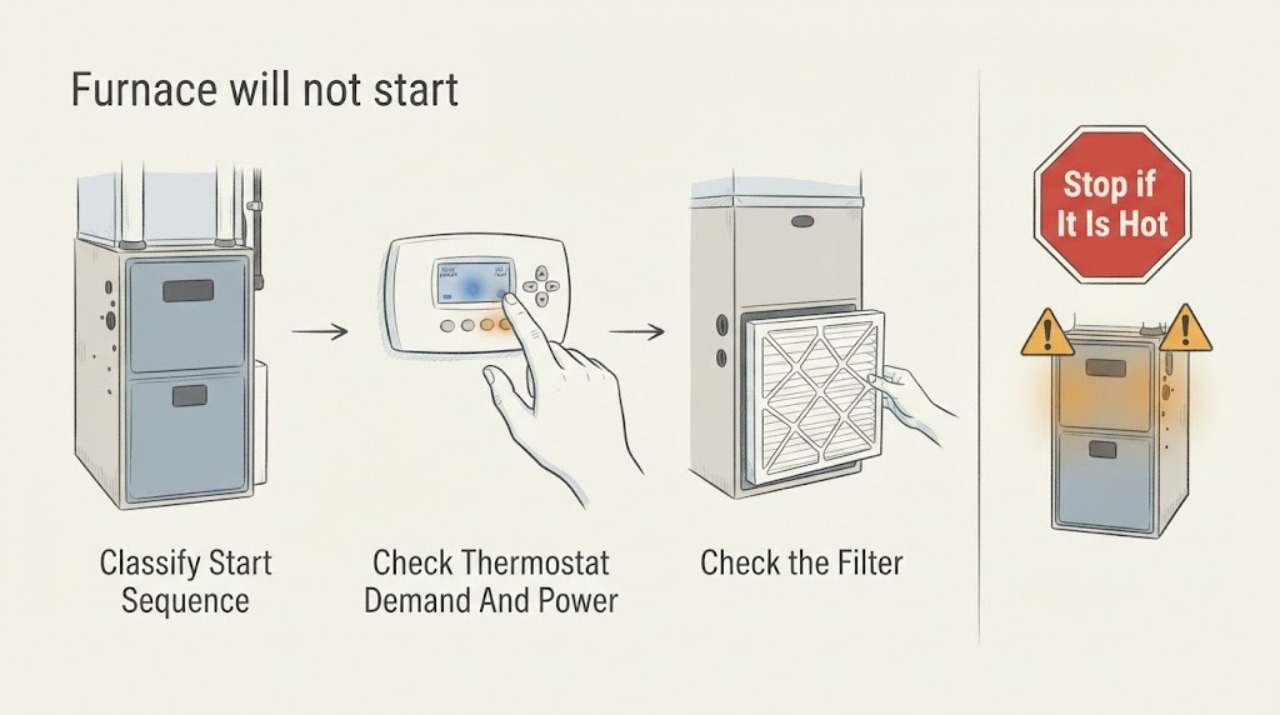
Work through in order
Diagnostic checks
Use only checks that match the exact appliance or system and its official guide.
-
Check 1
If there is no danger sign, make one ordinary heat call and observe from outside the York furnace cabinet. Note whether the thermostat shows a heat demand, whether the furnace is silent, and whether any inducer, igniter, burner, or blower starts before stopping; do not remove a panel to watch the flame.
Expected result: Record no thermostat demand, complete silence, a motor or inducer that starts, an igniter or burner attempt, a burner that lights and drops out, a blower-only run, repeated retries, or a visible status alert.
Next step: Use the matching branch below and stop repeated calls. If the furnace begins a sequence but does not complete it, keep the cabinet closed and arrange qualified York HVAC service after the basic external checks.
Stop if: Stop immediately for gas odor, smoke, burning odor, a carbon-monoxide alarm, loud ignition, visible vent damage, or exposed wiring; leave the area as needed and seek emergency or utility help from a safe location.
Why this matters
Why: No demand or complete silence points toward thermostat, power, switch, breaker, or control input. A partial sequence points toward an ignition, flame-proving, pressure, vent, limit, or control safety path. Repeated retries or lockout means the furnace is protecting itself and should not be forced to restart.
-
Check 2
At the thermostat, select Heat, set the target above the room reading, and confirm the display is powered. Replace batteries only if the thermostat uses them and the holder is accessible. Check the furnace electrical switch and the labeled breaker once, without opening the furnace or repeatedly cycling power.
Expected result: Record a blank display, Heat mode with no demand, a target below room temperature, a normal heat demand with a silent furnace, a switch off, a tripped breaker, or a breaker that trips again.
Next step: Correct only a clear thermostat setting, battery, switch, or one-time breaker position allowed by the owner instructions. If the display remains blank, the furnace remains silent, or the breaker trips again, leave the system off and arrange service.
Stop if: Do not remove thermostat wires, bridge terminals, open electrical covers, reset a recurring breaker, or continue after a burning smell or exposed wiring.
Why this matters
Why: A wrong mode, low battery, target setting, furnace switch, or single tripped breaker can prevent a start. A normal heat demand with no furnace response points toward power delivery, control input, door interlock, or an internal fault. A breaker that trips again is not a reset problem.
-
Check 3
With the York furnace off and cool, inspect the user-accessible filter, return grille, supply grilles, and the space immediately around the unit and furnace door. Replace a visibly dirty or collapsed filter only with the exact size, type, and airflow direction specified for the installed system, and clear furniture or stored items without touching the safety switch.
Expected result: Record a clean filter and open grilles, a packed or backward filter, blocked return air, several closed or covered supply grilles, an obstacle near the furnace door or switch, weak airflow, or a filter that is internal or unsafe to reach.
Next step: Correct a simple filter or grille issue as the York instructions permit, then observe one ordinary call only if no warning sign exists. If there is no start or the sequence still stops, keep the furnace off and request HVAC service.
Stop if: Do not run without a required filter, force a filter into its rack, hold or tape the furnace door safety switch, or open the blower or burner compartment.
Why this matters
Why: Restricted airflow can prevent normal operation or cause a protective shutdown. A filter and grille correction may restore a simple airflow condition, but a clean filter with no obstruction does not clear a blower, limit, ignition, pressure, or control fault.
-
Check 4
From outside the cabinet, inspect any visible exhaust pipe, chimney connection, and combustion-air intake for an obvious gap, rust-through, separation, snow, leaves, or other blockage. Do not remove a cover, disassemble venting, reach into a termination, or attempt to relight the furnace.
Expected result: Record no visible issue, a blocked intake or termination, a loose or damaged exhaust connection, rust or a gap, water or debris near a termination, or an exhaust-like odor or carbon-monoxide alarm.
Next step: Clear only loose material that can be removed without tools and without approaching the furnace opening. For any damaged or questionable vent, alarm, exhaust odor, or continued no-start, leave the furnace off and arrange qualified service; use emergency or utility help for an active hazard.
Stop if: Do not tape, shorten, reroute, cap, drill, detach, or seal vent or intake piping, and do not restart after an alarm or suspected exhaust problem until professionally cleared.
Why this matters
Why: An obvious external obstruction can stop a furnace safety sequence. A damaged, separated, or blocked vent or intake creates a combustion and carbon-monoxide risk, and no visible issue does not rule out an internal pressure, vent, heat-exchanger, or control fault.
-
Check 5
If the York thermostat or furnace has a user-visible status display or light, record the exact alert or blink pattern and when it appears during the start attempt. Read the installed model's owner information without removing a panel; do not enter service mode or reset a fault repeatedly.
Expected result: Record no alert, an ignition or flame-related alert, a limit or airflow-related alert, a pressure or vent-related alert, a door or power alert, repeated retries, or an alert that returns after one reset allowed by the owner instructions.
Next step: Give the exact York model, alert or blink pattern, sequence timing, filter result, thermostat demand, and power observations to a qualified technician. Keep the furnace off for a recurring alert or any fuel, ignition, vent, or safety symptom.
Stop if: Do not bypass a limit, pressure, flame, rollout, door, or other safety; do not jumper controls or open the cabinet to read a board.
Why this matters
Why: The alert can direct a technician toward ignition, flame proving, airflow, limit, pressure, vent, door, power, or control checks, but it does not identify a safe replacement part. A returning alert means the protection is still active.
-
Check 6
Record the York model and serial information if safely visible, fuel type, thermostat demand, switch and breaker result, filter condition, grille and vent observations, exact start sequence, status alert, and any recent maintenance, installation, or power event. Keep the system off if the basic external checks do not restore a normal start.
Expected result: Provide whether the furnace was silent, began an inducer or ignition sequence, lit and stopped, reached the blower stage, retried, locked out, or never responded despite a thermostat heat demand.
Next step: Arrange qualified York HVAC service for a silent furnace after power checks, an incomplete start sequence, repeated retries, a returning alert, weak airflow, or any gas or vent concern. Ask the technician to verify the complete sequence and safety controls before selecting a component.
Stop if: Do not keep cycling the furnace for a recording, remove doors, test live wiring, adjust gas, relight burners, bypass safety controls, or order an igniter, sensor, board, or valve from the symptom alone.
Why this matters
Why: This separates a control or power input problem from an ignition, flame-proving, pressure, vent, airflow, limit, blower, or safety-lockout path. The observations do not prove which internal part failed.
Use your observations
Decision map
Find the observation that best matches what you see, then follow the next safe action.
-
PATH 01Safety boundary
What you see
The thermostat is blank, not in Heat mode, set below room temperature, or the furnace switch or breaker is off; there is no ignition or motor sequence.
Do this next
Correct one clear setting, battery, switch, or breaker condition allowed by the owner instructions. If the display stays blank, the furnace remains silent, or the breaker trips again, arrange qualified York service.
Why this path and its safety boundary
Why it matters: A thermostat demand, accessible battery, switch, breaker, door-interlock, or power-input issue is more likely than a gas or burner failure.
Safety stop: Do not wire around the thermostat, open electrical covers, or repeatedly reset a breaker.
-
PATH 02Safety boundary
What you see
The thermostat continues to call, the filter is packed or backward, return or supply grilles are blocked, airflow is weak, or the furnace starts and stops after warming.
Do this next
Install the exact approved filter and clear accessible grilles. If the York furnace still will not complete a start or airflow remains weak, keep it off and have a technician evaluate airflow, blower operation, temperature protection, and ducts.
Why this path and its safety boundary
Why it matters: Restricted airflow or a protective limit response is more likely, although a corrected filter and open grilles cannot prove the blower, coil, limit, duct system, or control is healthy.
Safety stop: Do not run without a filter, block or hold the safety door switch, open the blower compartment, or force repeated restarts.
-
PATH 03Safety boundary
What you see
The inducer or igniter starts, the burners attempt to light and stop within seconds, the furnace retries or locks out, or a flame or ignition alert appears while the thermostat still calls.
Do this next
Keep the burner compartment closed, record the sequence and alert, and arrange qualified York service. The technician must test ignition and safety operation using the exact model procedure before deciding whether a component needs cleaning, adjustment, or replacement.
Why this path and its safety boundary
Why it matters: Ignition, flame proving, gas delivery, burner, pressure, or control logic is more likely than a thermostat setting or filter alone. The control may be closing fuel because the required sequence was not safely confirmed.
Safety stop: Do not relight burners, adjust gas, clean or bypass a sensor, jumper a safety, or run the furnace with a panel removed.
-
PATH 04Safety boundary
What you see
There is gas odor, smoke, exhaust-like odor, a carbon-monoxide alarm, visible vent separation or blockage, loud ignition, or symptoms while the fuel-burning furnace operates.
Do this next
Leave the area and contact emergency services or the gas utility from a safe location as appropriate. Do not operate switches, use a flame, restart the furnace, or re-enter until the hazard has been addressed and the appliance is professionally cleared.
Why this path and its safety boundary
Why it matters: A gas leak, combustion, vent, heat-exchanger, or other life-safety problem is possible. A furnace that stops on a safety does not make continued restarting safe.
Safety stop: This is an urgent stop boundary; do not troubleshoot inside the cabinet or attempt a vent, gas, burner, or combustion repair.
-
PATH 05Safety boundary
What you see
The thermostat has a heat demand, the switch and breaker are on, the filter and grilles are clear, and no external vent issue is visible, but the York furnace remains silent, retries, locks out, or shows a returning alert.
Do this next
Keep the furnace off and arrange a qualified York HVAC inspection. Supply the model, fuel type, thermostat behavior, sequence timing, filter and airflow results, status alert, and any recent work or power event.
Why this path and its safety boundary
Why it matters: An internal control, door interlock, transformer, ignition, flame-proving, pressure, limit, blower, vent, gas, or model-specific fault remains possible. A normal-looking exterior is not a clearance to keep operating.
Safety stop: Do not select an internal replacement part from the symptom, reset a lockout repeatedly, open the cabinet, jumper controls, or operate with an unsecured access door.
Helpful context
Understand the symptom
Silent and failed-start symptoms are different
A York furnace that is completely silent has a different first path from one whose inducer, igniter, burner, or blower starts and then stops. A thermostat that never sends a heat call, a switched-off furnace, and a tripped breaker can prevent any sequence. If a sequence begins and stops, a safety control, airflow, ignition, flame-proving, pressure, or venting problem becomes more likely. Observe from outside the cabinet and record the order of events.
Start with the controls a homeowner can see
York's troubleshooting guidance recommends checking Heat mode, the room and set-point relationship, thermostat fan behavior, furnace power, the electrical panel, the furnace switch, filter condition, and open grilles. These checks can restore a simple control or airflow condition, but a normal switch and clean filter do not prove that internal controls, ignition, gas, or safeties are healthy.
Airflow and safety switches can stop a start sequence
A blocked filter, covered return grille, closed supply register, or obstacle near the furnace can reduce airflow and cause protective shutdown. York advises clearing obstacles from the furnace and its door safety switch and checking the filter and grilles. Do not hold, tape, or bypass a safety switch; if the furnace still will not start after the external checks, service is the next step.
Fuel-burning equipment has a firm stop boundary
Combustion furnaces must be properly installed and vented. CPSC identifies blocked or disconnected venting and damaged heat exchangers as conditions associated with carbon-monoxide incidents, and DOE explains that combustion products can backdraft into a home. A gas odor, alarm, smoke, exhaust concern, or visible vent separation is not a homeowner ignition test; leave the area as appropriate and obtain urgent help from a safe location.
Safety boundary
Stop conditions
- Turn the furnace off and seek urgent utility or emergency help for gas odor, a carbon-monoxide alarm, smoke, exhaust concern, loud abnormal ignition, visible vent separation, or symptoms associated with combustion.
- Keep the York furnace off for repeated ignition retries or lockout, a returning safety alert, a breaker that trips again, exposed wiring, a burning odor, or a no-start that persists after the accessible thermostat, power, filter, and grille checks.
- Do not open burner or blower compartments, hold or bypass the door safety switch, test live wiring, adjust gas pressure or valves, relight burners, alter venting, or operate with an unsecured access door.
- Do not keep restarting the furnace to reproduce the failure. A temporary response after a reset or filter change does not clear an unresolved ignition, airflow, safety, vent, combustion, or control problem.
Only after diagnosis
Potential parts
- York-compatible furnace air filter
Consider a filter only when the installed filter is visibly dirty, collapsed, damaged, or the wrong size or direction and the York system instructions identify its replacement.
Confirm the exact York model, filter dimensions, approved filtration type, airflow arrow, and any media-cabinet requirements; do not infer fit from a no-start symptom. - York furnace igniter or flame-sensing component
Consider this category only after qualified diagnosis confirms an ignition or flame-proving failure that matches the observed start sequence or alert.
Confirm the exact York model, sensor or igniter geometry, mounting, electrical requirements, and approved service procedure; do not bypass or replace a safety component from timing alone. - York furnace limit, pressure, or door safety component
Consider this category only after airflow, venting, and power inputs are evaluated and qualified testing identifies a failed or incorrectly operating safety device.
Verify the exact model, ratings, mounting, sensing connection, and manufacturer-approved replacement; never defeat a safety to restore operation. - York furnace control board, transformer, or thermostat
Consider this category only when qualified diagnosis confirms missing control input, power conversion, thermostat communication, relay, or board logic fault.
Confirm the exact York furnace configuration, staging, wiring, ratings, and control requirements with service documentation or a technician; do not select a control from silence alone.
When checks do not resolve it
Need a professional?
Arrange qualified York HVAC service when the furnace is silent despite a thermostat heat demand and power checks, when an ignition sequence starts but stops, when a status alert or lockout returns, when airflow is weak, or when the filter and accessible grilles do not restore a normal start. Treat gas odor, carbon-monoxide alarm, smoke, exhaust concern, loud ignition, or visible vent damage as urgent and contact the gas utility or emergency service from a safe location.
Safety scope: This article supports checking thermostat settings and accessible batteries, verifying a switch or one-time breaker position, replacing the exact accessible filter, clearing grilles and loose external obstacles, observing the start sequence from outside the cabinet, and recording visible alerts. A qualified technician must handle burner and blower access, ignition, flame proving, gas, pressure, venting, electrical controls, safety switches, combustion testing, and final clearance.
Common questions
FAQ
What should I check first when my York furnace will not start?
Confirm Heat mode and a set point above room temperature, check thermostat power or batteries if used, verify the furnace switch and breaker, and inspect the accessible filter and grilles. Then note whether the furnace is silent or begins a sequence and stops.
Can a dirty filter keep a York furnace from starting?
A blocked filter can restrict airflow and contribute to a protective shutdown. Replace it only with the exact York-approved size and direction, keep grilles open, and arrange service if the furnace remains silent or does not complete its sequence.
Why does my York furnace start and then stop?
The meaning depends on timing. A sequence that never begins points toward demand or power; a burner attempt that stops quickly can involve ignition or flame proving; a later stop with weak airflow can involve protective temperature or airflow control. Record the sequence and keep the cabinet closed.
Should I reset my York furnace repeatedly if it will not start?
No. A single switch or breaker check may identify a simple power interruption, but a recurring trip, lockout, or returning alert indicates an unresolved fault. Repeated resets can hide the diagnostic pattern; leave the furnace off and arrange service.
When is a York furnace no-start an emergency?
Treat gas odor, a carbon-monoxide alarm, smoke, exhaust concern, loud abnormal ignition, visible vent separation or blockage, or symptoms during fuel-burning operation as urgent. Leave the area as appropriate and contact emergency services or the gas utility from a safe location; do not restart the furnace.
Read the exact guide
Official sources
- YORK HVAC Maintenance TipsYORK · Official one-page YORK maintenance brochure; exact furnace construction and maintenance intervals vary by model.
- HVAC Combustion FurnacesU.S. Department of Energy Building Science Education · Official DOE building-science education; it provides general combustion safety context rather than model-specific repair instructions.
- Gas FurnacesYORK · Official YORK gas-furnace product page; it does not identify the user's unspecified furnace model or a failed component.
- Gas Appliances (CO Sensors)U.S. Consumer Product Safety Commission · Official CPSC safety information about vented gas heating appliances, including furnaces; it does not replace emergency guidance or the installed furnace manual.
- Home HVAC Maintenance TipsYORK · Official YORK homeowner maintenance guidance; installed model manuals and local safety procedures take precedence.
- HVAC Troubleshooting GuideYORK · Official YORK homeowner troubleshooting page; live site routing and exact checks can vary by equipment model and installation.
Community feedback
Share a repair observation
Share a plain-text repair observation. Accepted observations are published automatically; this page may take a moment to update.