
On this page
Start here
Quick answer
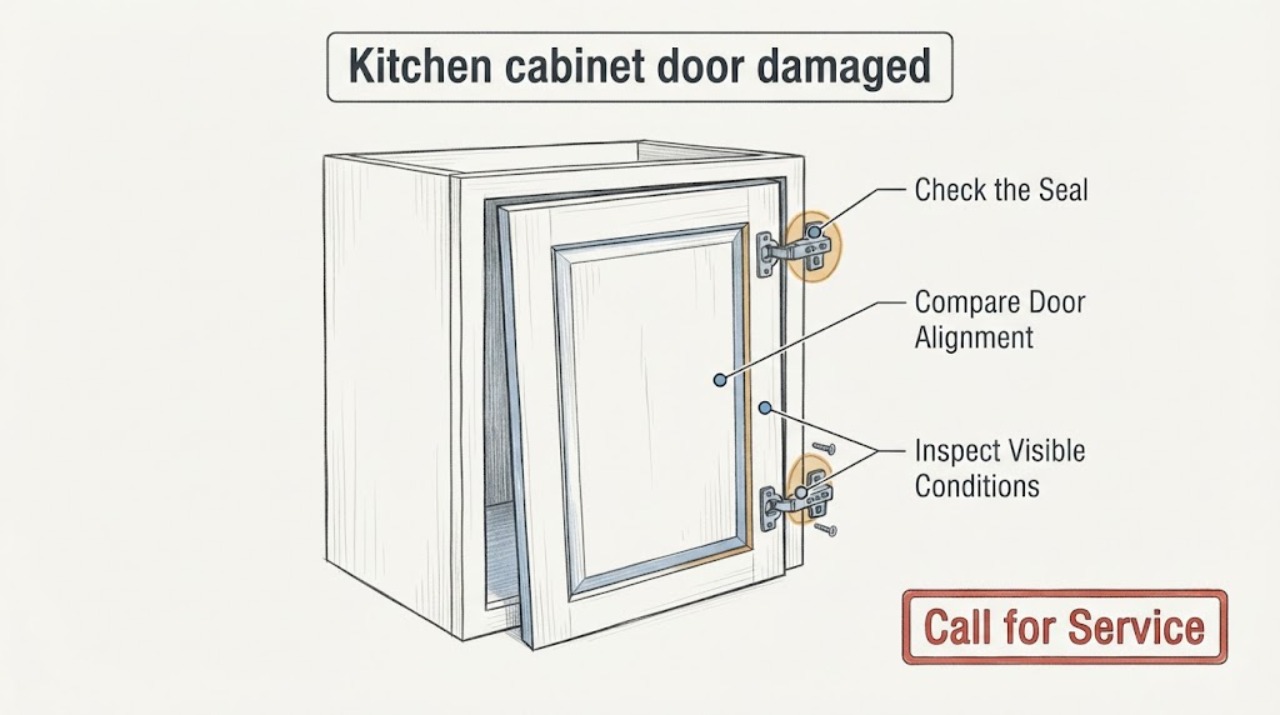
First decide whether the damage is limited to loose or misaligned hinge hardware or whether the door or cabinet material is swollen, split, soft, delaminated, or otherwise deformed. From a normal standing position, photograph the gaps, hinge area, door edges, and any moisture near the sink. A sound door with intact mounting points may only need a manufacturer-approved hinge adjustment; material damage, a pulled-out mounting area, an active leak, musty odor, or mold calls for a cabinet repair or restoration professional. Do not remove the door, cut the cabinet, or attempt demolition just to diagnose it.
Work through in order
Diagnostic checks
Use only checks that match the exact appliance or system and its official guide.
-
Check 1
With the door closed as far as it will go, view the top, bottom, and side gaps from straight on, then take a photo of both hinges and the surrounding cabinet face. Do not push past resistance.
Expected result: A fairly even gap with a door that sits square points toward alignment or hinge movement; a tapered gap, a door corner that stands proud, or a cabinet face that is no longer square indicates a wider alignment or material issue.
Next step: Compare the hinge attachment points and the door edges in the next check; keep the photos for a repair estimate.
Stop if: Stop if the door binds hard, drops, has a sharp broken edge, or appears able to fall. Keep the opening unused until a professional secures it.
Why this matters
Why: If the door and cabinet surfaces look flat and the hinge area is intact, continue with a hardware check. If the door is visibly bowed or the cabinet face is distorted, stop trying to align it and use the professional branch.
-
Check 2
From the front and side, inspect each visible hinge, screw head, mounting plate, and the wood or composite material around it without removing hardware. Gently observe whether a screw head is visibly backed out or whether the mounting area is cracked, enlarged, or pulled away.
Expected result: A loose-looking fastener with solid, flat surrounding material is consistent with a possible hinge adjustment or tightening service; a spinning-looking hole, torn material, cracked rail, or hinge plate separating from the cabinet is mounting damage rather than a simple alignment issue.
Next step: If the attachment area is sound, compare the door material and edges. If the mounting area is damaged, gather close photos and request cabinet repair advice instead of enlarging holes or removing the hinge.
Stop if: Stop if a hinge, door, or mounting piece is loose enough to shift, if sharp fragments are present, or if the cabinet material crumbles when viewed; do not continue operating the door.
Why this matters
Why: Only a clean, intact mounting area justifies checking the cabinet maker's hinge-adjustment instructions. Do not substitute a new hinge based only on appearance or assume a different overlay or mounting pattern will fit.
-
Check 3
Inspect the door face, edge banding, corners, and finish in good light, and compare them with an adjacent undamaged door. Look for swelling, bubbling or lifting laminate, separated veneer, a split, softness, staining, or a newly changed gap.
Expected result: A dry, hard, flat surface with only a shifted gap is more consistent with hardware or alignment. Swelling, a soft edge, lifted surface, staining, or a split indicates material damage that a simple hinge adjustment will not reverse.
Next step: If any material damage is visible, proceed to the moisture and stop checks. If the door remains flat and intact, use the hardware-only branch and follow the maker's instructions for that hinge style.
Stop if: Stop if the door is soft, split through a joint, delaminating, or shedding fragments; keep it supported and arrange professional service.
Why this matters
Why: Do not sand, glue, paint over, or force a swollen or delaminated door as a first response. A cabinet professional can assess whether the door or its mounting area is repairable or needs a matched replacement; fit and finish cannot be assumed from a generic search.
-
Check 4
Look inside and below the affected cabinet from the floor, especially around the sink supply and drain area, and note dampness, water marks, musty odor, condensation, or staining. Do not disconnect a pipe or reach into standing water.
Expected result: No moisture signs make a recent water event less obvious but do not prove that the door damage is hardware-only. Damp material, a musty odor, recurring staining, or an active drip indicates that the water source and the cabinet damage need prompt professional attention.
Next step: If there is an active leak, keep the cabinet closed and contact a qualified plumbing or water-damage professional; then ask a cabinet professional to assess the door and box. If the area is dry and the door is intact, return to the hardware-only branch.
Stop if: Stop immediately for standing water near electrical equipment, sewage or contaminated water, visible mold, a strong persistent musty odor, or material that is wet and soft.
Why this matters
Why: EPA guidance says moisture control is central to mold control and identifies leaking pipes under a kitchen sink as a route to mold around cabinets. Dry, clean, intact material may be monitored after the leak is addressed; porous or mold-affected material may not be safely restored by wiping alone.
Use your observations
Decision map
Find the observation that best matches what you see, then follow the next safe action.
-
PATH 01Next step
What you see
The door is flat, the gaps are only slightly uneven, and the hinge and cabinet mounting material are intact.
Do this next
Use the cabinet maker's instructions for that hinge type to make only the permitted adjustment, one small change at a time, then retest without forcing the door. If the gap will not hold or the hinge moves in the material, stop and call a cabinet professional.
-
PATH 02Next step
What you see
The hinge plate is loose because the surrounding material is cracked, enlarged, soft, or pulled away, or the door is bowed or delaminated.
Do this next
Leave the door in a safe position, photograph the damage, and request cabinet repair or replacement assessment. Provide the photos, cabinet location, door style, and which hinge or edge is affected.
-
PATH 03Next step
What you see
Moisture, active leaking, standing water, mold, or contaminated water is present.
Do this next
Stop cabinet troubleshooting and arrange qualified plumbing, water-damage, or mold guidance as appropriate; cabinet repair comes after the moisture source is controlled.
Helpful context
Understand the symptom
Why a damaged cabinet door stops closing
A door that will not close can have a loose hinge or a changed alignment, but the visible symptom can also come from a swollen edge, a split rail, a delaminated surface, or a cabinet box that has moved after moisture exposure. Treat the first inspection as classification: hardware-only problems are different from damage to the door or cabinet material. Do not force the door against a hard stop; that can enlarge a damaged hinge mounting hole or worsen a split.
Keep the inspection low risk
Use a flashlight and your phone camera while standing on the floor. Open the door only through its normal range if it moves freely, and keep fingers clear of the hinge pinch points. Do not remove the door or fixed cabinet parts, disconnect plumbing, sand damaged material, or disturb suspected mold. The U.S. Environmental Protection Agency identifies leaks under a kitchen sink as a possible source of moisture and mold around cabinets and recommends professional help for water damage or contaminated water.
Only after diagnosis
Potential parts
- cabinet-hinge
Consider this category only if the hinge itself is damaged and the door and cabinet mounting area are confirmed sound by the diagnostic checks or a professional.
Confirm the hinge type, overlay, mounting pattern, opening angle, and cabinet maker's fit information before ordering; a generic hinge may not match the existing door. - cabinet-hardware
Consider this category only when the failure is limited to identifiable hardware and there is no split, swelling, delamination, or weakened mounting material.
Match the existing hardware dimensions and mounting pattern only after the exact cabinet system is identified; do not use a search result as a fit guarantee. - drawer-slide
This is relevant only if inspection shows that the reported damaged front belongs to a drawer rather than a hinged cabinet door; do not order it for a door problem by default.
Confirm that the affected component is actually a drawer slide and record the existing slide type and cabinet dimensions before seeking a matched part.
When checks do not resolve it
Need a professional?
Call a cabinet repair or remodeling professional when the door or cabinet material is swollen, soft, split, delaminated, pulled away at the hinge, or no longer square; when a hinge adjustment does not hold; or when you need a matched door or hardware assessment. If there is an active or contaminated leak, contact a qualified plumbing or water-damage professional first.
Have this ready
- Provide the cabinet location, photos of the closed-door gaps and hinge mounting area, photos of the damaged edge or finish, whether the problem followed a leak or impact, and whether the surrounding cabinet feels dry and solid. Do not promise a replacement fit until the professional confirms the door style and mounting details.
Common questions
FAQ
Can a damaged cabinet door be fixed by adjusting the hinges?
Sometimes, but only when the door is flat, the hinge and mounting area are solid, and the symptom is an uneven gap or alignment shift. Swelling, splits, delamination, soft material, or a pulled-out mounting area needs a professional material assessment rather than repeated adjustment.
Should I remove the cabinet door to inspect it?
No. A floor-level visual inspection and photos of the gap, hinge, edges, and cabinet interior are enough to classify the problem. Removing a damaged or loose door can make it fall, enlarge damaged mounting holes, or hide the evidence a professional needs.
What if the damaged cabinet door is near the kitchen sink?
Look for dampness, staining, musty odor, or a recurring drip without disconnecting plumbing. Control an active leak through a qualified professional, and have the cabinet material assessed if it is wet, soft, or mold-affected before attempting cosmetic repair.
Read the exact guide
Official sources
- Adjusting Cabinet Hinges, Drawers and FrontsKraftMaid · General hinge-adjustment context; the page states that hinge screws can loosen with normal use and directs readers to instructions for their hinge type.
- Interactive Mold House TourU.S. Environmental Protection Agency · The Kitchen Cabinet section identifies leaking pipes under a kitchen sink as a possible source of mold around cabinets and recommends qualified professional repair of leaks.
- What are the basic mold cleanup steps?U.S. Environmental Protection Agency · Supports moisture control, prompt leak repair and drying, caution around porous mold-affected materials, and consulting a specialist when unsure.
Community feedback
Share a repair observation
Share a plain-text repair observation. Accepted observations are published automatically; this page may take a moment to update.