
On this page
Start here
Quick answer
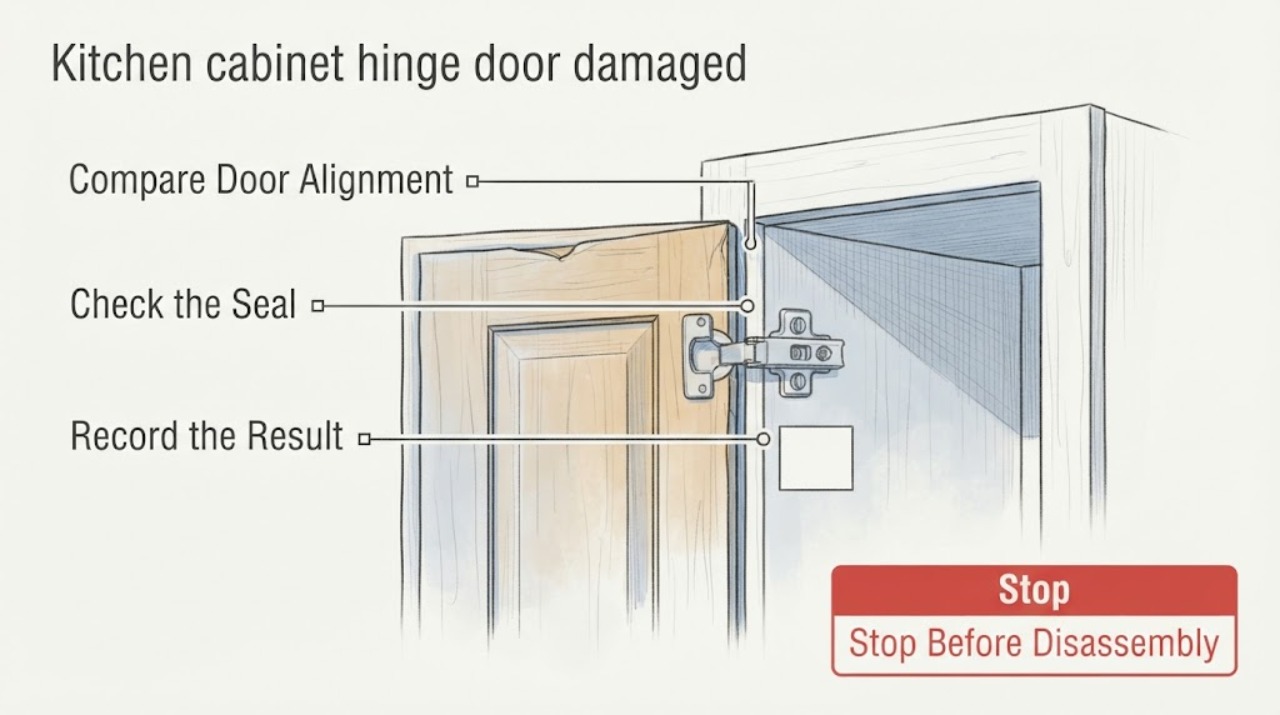
First decide whether the damage is limited to a hinge adjustment or whether the door, hinge cup, mounting plate, cabinet side, or screw holes are cracked, loose, swollen, or pulling away. With the cabinet empty near the door and your hands clear of pinch points, observe the closed-door gaps, hinge movement, and visible mounting surfaces. A stable door with intact hardware may need a small manufacturer-specified adjustment; a sagging, falling, split, swollen, or unstable door should stay closed and be handled by a cabinet professional. Do not remove the door, drill new holes, cut the cabinet, or attempt demolition or electrical work.
Work through in order
Diagnostic checks
Use only checks that match the exact appliance or system and its official guide.
-
Check 1
With the door closed and hands away from the hinge gap, view the door from the front and note whether the top, bottom, and side gaps are even. Look for sagging, a corner that rubs, a door that sits proud of the cabinet, or a split at the hinge-side edge.
Expected result: An even gap with a small alignment change differs from a door that is visibly dropping, twisted, rubbing hard, or separating at the hinge side.
Next step: Photograph the pattern and identify the hinge type before considering any adjustment. Keep the door closed and arrange cabinet service if it is sagging, split, or unstable.
Stop if: Stop if the door shifts unexpectedly, drops, will not stay attached, pinches, or requires holding its weight while you inspect it.
Why this matters
Why: A uniform misalignment may be an adjustment issue; a diagonal gap, split edge, or unstable corner can indicate door or cabinet damage beyond a simple hinge setting.
-
Check 2
Open the door only if it is stable and moves freely, then make one slow normal opening and closing observation while watching the hinge arm, plate, and door edge without placing fingers in the closing path.
Expected result: A smooth movement with a secure-looking hinge differs from clicking, binding, loose-looking movement, a hinge that pulls away, or a door that cannot support its own position.
Next step: Record where the motion changes and stop using the door if the hinge pulls away, the door drops, or movement is rough. Request a cabinet professional when the hardware or mounting surface is not clearly intact.
Stop if: Stop immediately for a drop, crack, sharp exposed metal, binding, a loose hinge arm, or any need to catch or hold the door.
Why this matters
Why: The motion can show whether the hinge is guiding the door or whether the hardware or mounting surface is failing; it does not justify forcing the door or removing hardware.
-
Check 3
From the open position, visually inspect the exposed hinge cup, mounting plate, visible screws, and nearby door and cabinet material for missing hardware, cracks, pulled holes, swelling, staining, rust, or a plate lifting from the side panel; do not pull or tighten anything yet.
Expected result: Intact material and seated hardware support a possible documented adjustment, while stripped holes, split wood, swollen particleboard, or a lifting plate indicate a repair assessment.
Next step: Photograph the hardware and material condition, keep the door unloaded, and ask a cabinet professional to determine whether the hinge, plate, door, or cabinet side needs repair.
Stop if: Do not touch, tighten, remove, glue, fill, drill, or cover a cracked, wet, swollen, or unstable mounting area.
Why this matters
Why: A new hinge cannot reliably hold a damaged substrate, and tightening a fastener into a split or swollen panel can worsen the damage.
-
Check 4
Identify the visible hinge construction and any readable maker or model marking without removing the hinge: concealed cup, face-frame style, overlay or inset door, soft-close or push-to-open feature, and the number and position of hinges.
Expected result: A hinge with a matching instruction sheet or clear marking differs from an unmarked hinge, a specialty angle, a lift mechanism, or a mixed set of hardware.
Next step: Use the identified manufacturer's instructions or a professional measurement to choose a conditional part. Do not order or install based only on color, shape, or a generic description.
Stop if: Stop if identification requires removing a door, loosening a plate, drilling, measuring from an unstable door, or disturbing a nearby utility.
Why this matters
Why: Hinge geometry, mounting plate, overlay, and opening angle affect fit; a similar-looking hinge may not align with the existing holes or door position.
-
Check 5
If the door and mounting surfaces are intact, stable, and supported by their normal hardware, compare the visible gap with the hinge maker's adjustment diagram and note which direction would be needed: side-to-side, height, or depth.
Expected result: A small, clearly described alignment change with intact hardware may match a documented adjustment; a large correction or a gap that returns immediately suggests damage or a loose mounting surface.
Next step: Only if the exact instructions permit it, make at most a small, reversible adjustment with the proper tool while keeping the door supported and fingers clear; otherwise have a cabinet professional do it. Recheck one normal close and stop if the result worsens.
Stop if: Do not adjust if the door is heavy or unstable, the hinge is damaged, the screws spin freely, the panel is split or swollen, the door binds, or the instructions do not match the hardware.
Why this matters
Why: Adjustment is a fine alignment operation, not a substitute for a failed hinge, split material, stripped hole, swollen panel, or distorted door.
Use your observations
Decision map
Find the observation that best matches what you see, then follow the next safe action.
-
PATH 01Next step
What you see
The door is stable, the hinge and mounting material are intact, and the issue is a small visible alignment error
Do this next
Use the exact hinge instructions for a small reversible alignment adjustment, then perform one normal close. Stop if the gap worsens or the door becomes unstable.
-
PATH 02Next step
What you see
The hinge, plate, screw holes, door edge, or cabinet side is cracked, pulled out, swollen, rusted, or loose
Do this next
Keep the door unloaded and closed, avoid tightening or forcing it, and arrange cabinet repair to assess the substrate and select a compatible repair.
-
PATH 03Next step
What you see
The door drops, binds, will not remain attached, pinches, or cannot be safely supported
Do this next
Stop using the cabinet door, keep people clear of its swing path, and call a cabinet professional. Do not remove, catch, or prop the door by the hinge hardware.
-
PATH 04Next step
What you see
Moisture, swelling, nearby plumbing damage, or wiring is visible around the cabinet
Do this next
Do not disturb the damaged area. Address the active building or utility issue through the appropriate professional and have the cabinet assessed after the cause is controlled.
Helpful context
Understand the symptom
A damaged cabinet door can be caused by a loose adjustment, a failed hinge, pulled screws, a split door edge, swollen material, or a cabinet side that no longer holds the mounting plate. The visible gap tells you where to look, but it does not prove that replacing the hinge will correct the underlying damage.
Keep the check low risk. Remove heavy or breakable items from the door shelves if they can be reached without moving an unstable door, keep fingers out of the hinge closing path, and do not support a falling door by its hardware. Do not remove the door, drill, cut, glue a structural split, or disturb nearby wiring or plumbing.
IKEA explains that many cabinet doors can be aligned with hinge screws specified by the hinge instructions. Blum and Hettich documentation likewise describes model-dependent hinge adjustment and different hinge constructions. Those references support identifying the hinge and using its own instructions, not assuming that every concealed hinge adjusts the same way.
Photograph the closed-door gaps, hinge style, visible damage, and any moisture or swelling. Give the cabinet professional the door material, hinge markings, and whether the door remains stable; this is more useful than ordering a visually similar hinge before the mounting pattern is known.
Only after diagnosis
Potential parts
- cabinet hinge
Consider this only after the hinge type, overlay or inset arrangement, opening angle, mounting pattern, and door condition are confirmed.
Match the existing cup, arm, mounting plate, screw pattern, and door application; color or a similar silhouette is not sufficient. - cabinet hardware
Consider this only if a professional or the exact manufacturer instructions show that the plate or fasteners are the failed component and the cabinet substrate is sound.
Confirm the hinge family, plate geometry, screw type, and material suitability before ordering; do not use hardware to mask split or swollen material. - drawer slide
This is relevant only if the reported damage also involves a drawer front or slide rather than the hinged door itself.
Verify the drawer construction, slide length, mounting method, and load application separately; do not substitute a drawer component for a door hinge.
When checks do not resolve it
Need a professional?
Arrange cabinet repair when the hinge or door is unstable, the mounting surface is damaged, the door cannot close safely, or the alignment problem returns after a documented small adjustment.
Have this ready
- Front and hinge-side photographs with the door closed and open only if stable
- Hinge construction, visible maker or model marking, door overlay or inset style, and hinge count
- The gap pattern, movement symptom, cracks, swelling, pulled hardware, or moisture timing
- Whether the door remains stable and whether the issue affects adjacent doors or drawers
Common questions
FAQ
Can I adjust a crooked cabinet door myself?
A small adjustment may be reasonable only when the door is stable and the hinge and mounting material are intact, using the exact hinge instructions. Do not adjust a door that drops, binds, splits, or has a loose or pulled-out plate.
Should I replace the hinge if the door is damaged?
Not automatically. First distinguish a failed hinge from a split door edge, stripped holes, swollen cabinet material, or a distorted door. A new hinge cannot reliably repair a damaged mounting surface.
Is it safe to remove the cabinet door?
Not when the door is unstable, heavy, cracked, or pulling away. Keep it closed and arrange cabinet service rather than trying to catch or support it while removing hardware.
When should I call a cabinet professional?
Call when the door drops, binds, will not stay attached, the hinge or panel is cracked or swollen, the screw holes are stripped, or a small documented adjustment does not hold. Also address any active moisture or nearby utility damage first.
Read the exact guide
Official sources
- TIP-ON for doorsBlum · Illustrates that a specific Blum door mechanism may have its own gap adjustment and adapter requirements
- My doors/cabinet doors are crooked, how do I get them to be straight?IKEA · General alignment principle for IKEA hinges; exact adjustment depends on the hinge and furniture series
- Hinges with snap-on assemblyHettich · General comparison of concealed hinge construction and three-dimensional adjustment; exact model instructions control
Community feedback
Share a repair observation
Share a plain-text repair observation. Accepted observations are published automatically; this page may take a moment to update.