
On this page
Start here
Quick answer
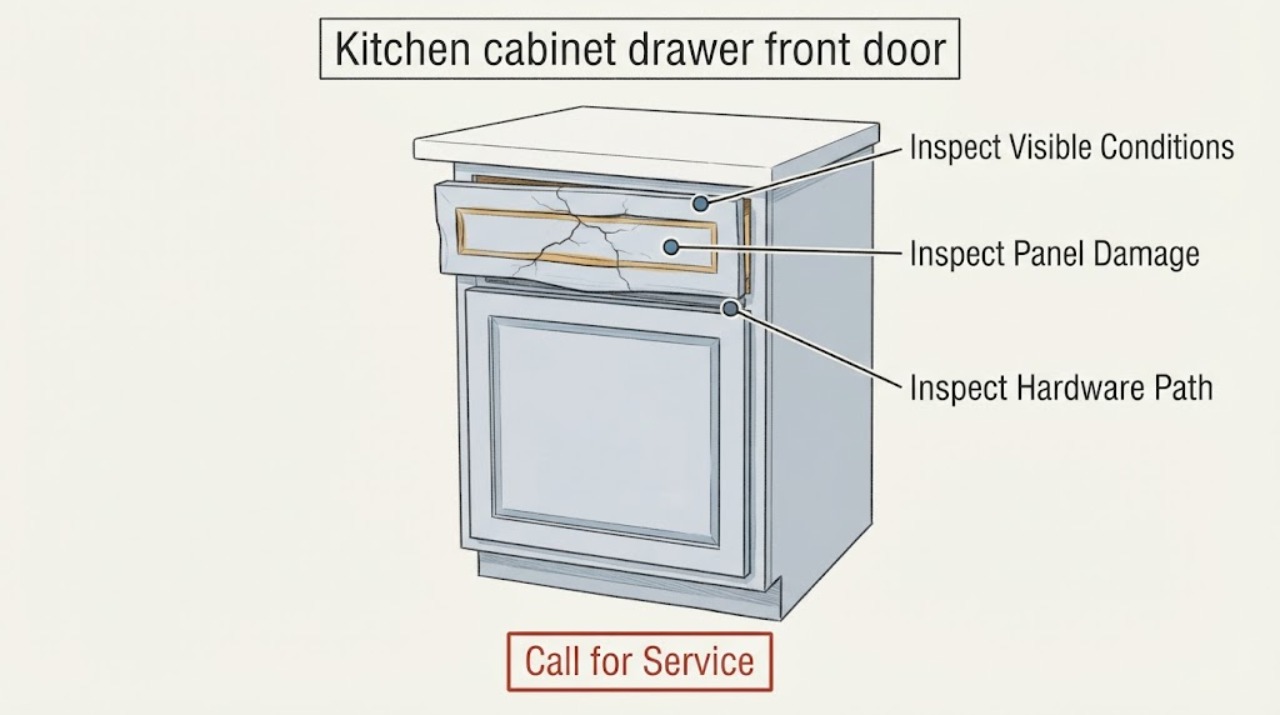
First decide whether the damage is limited to the visible drawer front or door face, or whether the hinge, slide, attachment, or cabinet box has also moved. Unload the drawer or cabinet, inspect from a stable standing position, and look for a tilted or loose front, cracks, sharp fragments, swelling, water staining, displaced hardware, and binding. Do not pull hard, press a crack closed, drill new holes, dismantle the cabinet, or keep using a front that could fall or pinch. A stable cosmetic mark may wait for routine repair; a loose, dropping, sharp, swollen, or structurally affected front needs cabinet service before parts are ordered.
Work through in order
Diagnostic checks
Use only checks that match the exact appliance or system and its official guide.
-
Check 1
From a stable standing position, view the drawer front or adjacent cabinet face with the drawer or door unloaded. Do not tug the front to test looseness.
Expected result: Note whether the front is level with neighboring fronts, evenly gapped, tilted, bowed, pulled away, or visibly loose under its own weight.
Next step: Photograph the front and its gaps, leave it unloaded, and request cabinet repair if alignment or stability is abnormal.
Stop if: Stop and keep the area clear if the front shifts, drops, pinches, or could detach onto a person, foot, or nearby surface.
Why this matters
Why: The alignment pattern helps distinguish a visible front issue from possible slide, hinge, attachment, or cabinet-box movement, but it does not prove which hidden connection has failed.
-
Check 2
Inspect the visible face and edges from a safe position for a hairline crack, split, chipped corner, crushed edge, sharp fragment, swelling, or finish lifting. Do not scrape, sand, pry, press the crack closed, or handle a sharp fragment.
Expected result: A superficial-looking mark differs from a crack that reaches an edge, crosses an attachment area, exposes a sharp edge, or is accompanied by swelling or separation.
Next step: Take a close photo without touching the damage, restrict access to the drawer or door, and arrange repair when the crack affects stability or operation.
Stop if: Stop immediately for a sharp edge, loose fragment, swelling near a fastener, or any sign that the front may fall.
Why this matters
Why: Crack location and associated swelling help a professional judge whether the front can be retained, repaired, or replaced and whether the material or attachment has lost strength.
-
Check 3
From outside the cabinet, look at visible hinges, runners, brackets, handles, and fastener areas without removing covers or hardware. Note a missing piece, displaced bracket, bent-looking component, exposed screw, or attachment that no longer sits flush.
Expected result: Intact, seated visible hardware differs from hardware that is missing, shifted, bent-looking, or pulling away with the front.
Next step: Photograph the hardware and provide the cabinet make or model if known to a cabinet professional; do not tighten, remove, replace, or drill hardware as a diagnostic.
Stop if: Stop and keep the drawer or door closed if hardware is loose, the front is unsupported, a fastener is protruding, or the cabinet box moves.
Why this matters
Why: Visible hardware changes can explain misalignment, but compatibility and safe repair depend on the cabinet system and the condition of the material behind the attachment.
-
Check 4
If the front is stable and the cabinet is unloaded, observe one ordinary open-and-close movement without force, repeated cycling, or reaching into a pinch point.
Expected result: Note scraping, binding, uneven travel, unexpected drop, door interference, or failure to close normally.
Next step: Stop operating it, mark it as out of service, and request cabinet repair with the movement symptom described; do not repeat the cycle to test it.
Stop if: Stop immediately if the front drops, the drawer binds, the door cannot close, fingers could be caught, or the cabinet shifts.
Why this matters
Why: Operation changes can indicate alignment or slide/hinge damage and can turn a cosmetic defect into a pinch, falling-object, or access hazard.
-
Check 5
From the room perimeter, look for water staining, swelling, soft-looking cabinet material, split joints, a sagging cabinet box, or movement shared by neighboring doors and drawers. Do not open the cabinet box, remove the countertop, or probe the material.
Expected result: A dry, firm-looking cabinet differs from one with recurring dampness, swelling, softening, split joints, or several fronts becoming misaligned together.
Next step: Photograph the area and arrange cabinet, plumbing, or water-damage assessment as indicated; keep damaged storage unloaded.
Stop if: Stop and isolate the cabinet if water is active, materials are soft or collapsing, mold-like growth is present, or wiring or an appliance connection is wet nearby.
Why this matters
Why: A broader pattern may point to water damage or cabinet-box movement rather than a replaceable front alone and should be assessed before any cosmetic repair.
Use your observations
Decision map
Find the observation that best matches what you see, then follow the next safe action.
-
PATH 01Safety boundary
What you see
The drawer front or door is loose, dropping, sharp, binding, or cannot close safely.
Do this next
Stop using it, unload and restrict access from a safe position, and request cabinet service; do not pull, force, or dismantle it.
Why this path and its safety boundary
Why it matters: The front is a falling-object or pinch hazard, not a cosmetic repair task.
Safety stop: Keep people away until the front is secured or removed by a qualified professional.
-
PATH 02Safety boundary
What you see
The face has a localized cosmetic mark but remains aligned, stable, dry, and safe to leave unused.
Do this next
Keep it unloaded, document the damage, and schedule routine cabinet repair before choosing any touch-up material.
Why this path and its safety boundary
Why it matters: The visible damage may be limited to the finish or front panel, but the attachment still needs to be checked before touch-up or replacement.
Safety stop: Do not sand, paint, or press the damaged area until the material is confirmed dry and structurally sound.
-
PATH 03Safety boundary
What you see
Visible hardware is shifted or missing, or one ordinary movement binds or scrapes.
Do this next
Request professional cabinet assessment of the front, attachment, and slide or hinge system; do not tighten, drill, or replace parts based only on appearance.
Why this path and its safety boundary
Why it matters: The problem may involve the front attachment, drawer slide, hinge, or cabinet material behind it.
Safety stop: Keep the drawer or door out of use if the front is unsupported or movement could cause a drop.
-
PATH 04Safety boundary
What you see
Swelling, softening, split cabinet joints, active water, mold-like growth, or several misaligned fronts are present.
Do this next
Prioritize cabinet and water-source assessment and keep the cabinet unloaded and isolated; do not open, probe, or attempt structural repair.
Why this path and its safety boundary
Why it matters: The damage may extend into the cabinet box or be driven by a moisture source, so a single replacement front may not solve it.
Safety stop: Stop if moisture is near electrical equipment or an appliance connection and obtain appropriate professional help.
Helpful context
Understand the symptom
A drawer front is not the same as the cabinet box
A drawer front or cabinet door face can be damaged while the drawer box, slide, or cabinet frame remains sound. The reverse is also possible: a shifted slide, hinge, loose attachment, or swollen cabinet side can make an intact front appear misaligned. Treat the visible face, its attachment, and the surrounding cabinet as separate observations before choosing a hinge, slide, or replacement front.
What the visible pattern tells you
A level, stable front with a small finish mark is a different situation from a front that is tilted, separating, cracked through an attachment area, or scraping during movement. A problem shared by several neighboring fronts, soft material, swelling, or water staining points beyond a single replaceable face. Blum's installer guidance treats runner alignment, cabinet squareness, and front adjustment as a system, so a generic part chosen by appearance may not correct the cause.
Protect the area before deciding on repair or replacement
Keep the damaged drawer or door unloaded and restrict access if the front could detach, expose a sharp edge, or pinch fingers. If moisture is present, identify and address the water source before cosmetic work; the EPA notes that leaks and seepage are common moisture sources and that moisture problems can support biological pollutants. A remodel is not the first step for an isolated, stable front, but it may be appropriate when the cabinet box or several units have lost strength.
Safety boundary
Stop conditions
- Stop immediately for a front that drops, shifts, exposes a sharp edge, pinches, or cannot close safely.
- Do not pull hard, force travel, press a crack closed, drill new holes, cut material, dismantle the cabinet box, or remove hardware as a diagnostic.
- Keep children and others away from an unstable or sharp front and keep damaged storage unloaded.
- If active water, soft or collapsing material, mold-like growth, or moisture near electrical equipment is present, isolate the area and obtain appropriate professional help.
Only after diagnosis
Potential parts
- cabinet hinge
Only consider a hinge after a professional confirms that the affected face is a hinged door rather than a drawer front and that the hinge, not the cabinet material, is the failed part.
Overlay, inset, mounting pattern, opening angle, load, and cabinet construction vary; confirm the exact system before ordering or installing. - cabinet attachment hardware
Only consider replacement attachment hardware after the professional identifies the original system and confirms the cabinet material can safely support it.
Hole pattern, fastener size, material thickness, and front-to-box connection vary; hardware cannot compensate for a split, swollen, or weakened cabinet box. - drawer slide
Only consider a slide after a professional confirms that binding or misalignment originates in the slide system and the drawer box and front are sound.
Slide length, clearance, load, extension, mounting style, and front attachment differ by cabinet system; do not force travel or substitute by appearance alone.
When checks do not resolve it
Need a professional?
Call a cabinet repair professional when a drawer front is loose, cracked through, misaligned, binding, or unsafe to operate. Escalate promptly for cabinet-box movement, water damage, soft material, mold-like growth, active leaks, or moisture near electrical equipment.
Have this ready
- Cabinet and drawer or door location
- Alignment and operation symptoms
- Photos of cracks, edges, visible hardware, and gaps
- Whether the issue is isolated or repeated across neighboring fronts
- Any water, swelling, or soft-material clues
- Whether children or a high-traffic route are affected
- What was not opened, moved, tightened, or adjusted
Common questions
FAQ
Can I keep using a damaged cabinet drawer front if it still opens?
Not if it is loose, dropping, cracked through, sharp, binding, or unable to close safely. Unload it, restrict access, document the condition, and arrange cabinet repair.
Should I tighten the visible screw or drill a new hole?
Do not use tightening or drilling as a diagnostic. The material behind the attachment may be split or swollen, and the correct hardware depends on the cabinet system and its preparation.
How can I tell whether the cabinet box is also damaged?
Look for water staining, swelling, softening, split joints, sagging, movement, or several neighboring fronts changing alignment. Do not probe or open the box; provide photos to a cabinet or water-damage professional.
When is a damaged drawer front or cabinet door urgent?
Treat falling or sharp material, pinch risk, blocked access, active water, soft or collapsing cabinet structure, mold-like growth, or moisture near electrical equipment as reasons to stop use and seek prompt professional help.
Is replacing the front always better than repairing it?
No. A stable finish mark may need only routine repair, while a split attachment, swollen panel, damaged slide or hinge, or weakened cabinet box may require a different repair or replacement decision after inspection.
Read the exact guide
Official sources
- What are the main ways to control moisture in your home?U.S. Environmental Protection Agency · Federal guidance used for the moisture branch when cabinet swelling, dampness, or water staining is present.
- MOVENTO Installer’s GuideBlum · Manufacturer guidance used to explain why drawer-front alignment and runner or cabinet condition must be considered together; it does not establish fitment for an unspecified cabinet system.
- Childproofing Your Home - Several Safety Devices to Help Protect Your Children from Home HazardsU.S. Consumer Product Safety Commission · Federal safety guidance used to support restricting access to an unstable or sharp damaged cabinet front, especially in child-accessible areas.
Community feedback
Share a repair observation
Share a plain-text repair observation. Accepted observations are published automatically; this page may take a moment to update.