
On this page
Start here
Quick answer
First determine whether the failure is limited to the seal at the countertop-to-backsplash joint or whether the countertop, backsplash, cabinet support, or surrounding area is cracked, loose, swollen, or repeatedly wet. From a dry, normal-access position, photograph the joint, note its length and movement, stop splash and wipe the area dry, and do not cut the countertop, remove cabinets, or force the backsplash. A clean open bead in an otherwise stable joint may be suitable for professional resealing; a cracked or moving countertop, water damage, or unstable support points toward a broader countertop or remodeling assessment and quote.
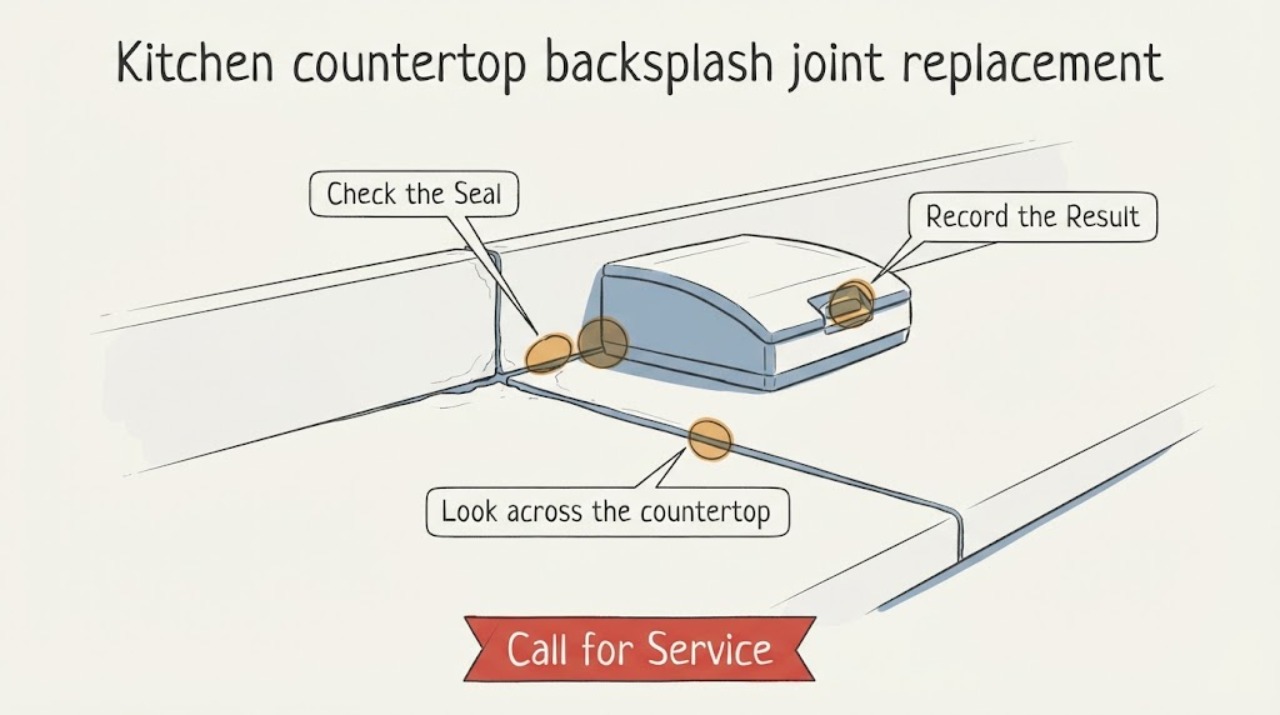
Work through in order
Diagnostic checks
Use only checks that match the exact appliance or system and its official guide.
-
Check 1
After the counter and backsplash are dry, inspect the full visible joint with normal lighting without scraping, cutting, prying, or pulling the sealant or backsplash.
Expected result: Record whether the joint has a narrow open section, peeled or missing sealant, discoloration, a crack in the countertop or backsplash, or a visible gap that continues behind a fixture.
Next step: Photograph the joint from several angles and mark its approximate visible extent on a sketch. Keep the area dry and give the images to a qualified countertop or remodeling professional.
Stop if: Stop if the surface sheds material, has a sharp edge, exposes a hidden cavity, or inspection would require removing trim, fixtures, backsplash, or countertop material.
Why this matters
Why: A localized open bead with stable surfaces may be a joint-seal repair; a crack through the countertop or backsplash, a widening gap, or separation that continues out of view requires a broader material and installation assessment.
-
Check 2
Look across the countertop and along the backsplash from standing height, using the existing edges and grout or pattern lines as visual references; do not press down, lift, or test the pieces for movement.
Expected result: Note a level-looking stable surface versus a visible step, bow, lifted corner, separated end, or change in alignment at the backsplash joint.
Next step: Keep heavy loads and standing water away from the area, photograph the alignment change, and request an in-person assessment before choosing a repair kit or replacement scope.
Stop if: Stop and keep people away from the counter if a section is loose, unstable, sharp, or at risk of falling.
Why this matters
Why: A stable surface supports a possible seal-only scope, while misalignment or a lifted or moving surface can indicate substrate, installation, or material damage that caulk alone will not correct.
-
Check 3
Review when the joint becomes wet during ordinary sink or counter use and, only from a dry position, inspect afterward for new water at the seam or on the accessible wall and cabinet surfaces; do not deliberately flood the joint.
Expected result: Record whether moisture is limited to splash at the bead, returns at the same point, appears below the counter, or is present even when the area has not been used.
Next step: Stop the nearby source if it is safely identifiable and accessible, dry the area, and give the timing and locations to the professional. Do not open the wall, remove the cabinet, or apply a cosmetic patch over active moisture.
Stop if: Stop using the sink or affected counter and arrange prompt service for active leaks, persistent dampness, swelling, odor, visible mold-like growth, or water near electrical equipment.
Why this matters
Why: A repeatable wet path suggests failed sealing or an upstream splash or plumbing source; moisture below the top, swelling, or persistent dampness raises concern for concealed damage and a larger scope.
-
Check 4
If the cabinet interior or adjacent wall area is already open and safely accessible without removing anything, look for existing water marks, swelling, softened material, staining, or fastener pull-out below the backsplash joint.
Expected result: Distinguish a dry, hard, unchanged support area from discolored, swollen, soft-looking, or repeatedly damp material; do not probe or remove panels to reach concealed areas.
Next step: Photograph the accessible condition and request a professional scope that addresses the moisture source and support before any surface replacement is selected.
Stop if: Stop for soft or collapsing material, suspected mold, exposed wiring, active water, or any need to dismantle cabinets or walls.
Why this matters
Why: A dry support area makes a limited visible-joint repair more plausible, while water-damaged or unstable support can make a countertop replacement or associated remediation necessary.
-
Check 5
Prepare a quote record from safe, accessible information: countertop and backsplash material or brand if known, overall run and joint location, sink and appliance positions, visible crack or water-damage extent, and photos with a common object for scale.
Expected result: Record what is known and what is hidden or uncertain; note whether fixtures remain stable and whether the issue is localized or repeated along multiple joints.
Next step: Send the record to a qualified countertop or kitchen-remodeling professional and ask them to separate resealing, surface repair, and full replacement options after inspection.
Stop if: Stop collecting measurements if doing so requires moving appliances, disconnecting plumbing or electrical equipment, removing cabinets, cutting material, or standing on the counter.
Why this matters
Why: A localized stable seal failure may need a different scope from a cracked top, loose backsplash, damaged cabinet support, or replacement constrained by installed fixtures.
Use your observations
Decision map
Find the observation that best matches what you see, then follow the next safe action.
-
PATH 01Next step
What you see
Only a localized seal bead is open and the countertop and backsplash look stable, dry, and uncracked.
Do this next
Request a professional joint-seal assessment. Do not assume a generic sealant or color match is suitable for the surface, and do not apply over damp or contaminated material.
-
PATH 02Next step
What you see
The countertop or backsplash itself is cracked, lifted, shifting, or visibly out of alignment.
Do this next
Treat it as a material or installation assessment rather than a simple caulk replacement. Keep loads and water away and obtain a professional repair-versus-replacement scope.
-
PATH 03Next step
What you see
Water marks, swelling, soft-looking support, odor, or recurring dampness extends below or behind the joint.
Do this next
Stop using the affected sink or counter as needed, control the visible source, and request professional evaluation of concealed damage before sealing or replacing the surface.
-
PATH 04Next step
What you see
The joint is near a sink, appliance, or plumbing/electrical connection and the source cannot be isolated safely.
Do this next
Do not disconnect, move, cut, or open anything. Keep the area dry and have the appropriate qualified professional identify the source and safe repair scope.
-
PATH 05Next step
What you see
The user cannot safely inspect the joint without climbing, reaching behind fixtures, or disturbing the countertop or cabinets.
Do this next
Stop at the accessible visual record and arrange an in-person professional assessment.
Helpful context
Understand the symptom
A joint failure is not automatically a full countertop replacement
The visible line where a backsplash meets a countertop can be a flexible seal or part of a particular surface system. Manufacturer fabrication guidance distinguishes backsplash attachment and sealing from hard seams in solid-surface work, while the correct treatment depends on the material and installation. A separated bead, a surface crack, and movement of the top are different findings, so record them separately before requesting work.
Control moisture while deciding
Keep water, cleaning spray, and food residue away from the open joint and wipe spills dry with a soft cloth. Do not cover an actively wet, soft, mold-smelling, or moving area with a new sealant bead; that can hide the extent of damage. If the sink or nearby plumbing is leaking, stop using the affected fixture and have the source addressed by an appropriate professional.
Only after diagnosis
Potential parts
- silicone-caulk
Consider this category only if a qualified professional confirms that the failure is limited to a compatible, stable, dry joint seal and not a cracked surface, moving backsplash, or water-damaged support.
Confirm the countertop and backsplash material, joint exposure, color, and sealant requirements; do not assume a generic product is compatible. - countertop-repair-kit
Consider this category only after inspection confirms a localized repairable surface defect and rules out movement, active moisture, cabinet damage, and a replacement-level crack.
Match the exact countertop material, finish, color, and damage type; a repair kit is not a substitute for correcting unstable support or concealed water damage.
When checks do not resolve it
Need a professional?
Arrange a qualified countertop or kitchen-remodeling assessment for a failed backsplash joint, recurring moisture, visible countertop or backsplash cracking, movement, swelling, odor, unstable support, or any uncertainty about whether resealing or full replacement is appropriate.
Have this ready
- Provide material or brand information if known, photographs of the full joint and close-ups, approximate visible extent, sink and appliance proximity, water timing, accessible cabinet or wall observations, and whether the issue is recurring or changing.
Common questions
FAQ
Does an open backsplash joint mean the whole countertop must be replaced?
Not necessarily. A stable, dry, localized seal failure may have a narrower scope, while cracking, movement, swelling, recurring moisture, or damaged support can require broader repair or replacement. A professional should distinguish these conditions in person.
Can I apply new caulk over the failed joint now?
Do not cover an actively wet, soft, cracked, moving, or contaminated joint. Record the condition and obtain a material-compatible professional assessment; a cosmetic bead can hide the source or extent of damage.
What should I do if the joint is near the sink and keeps getting wet?
Limit splash, wipe the area dry, and stop using the affected fixture if there is an active leak or water below the counter. Do not move the sink, disconnect plumbing, or open the cabinet to perform a repair.
What information helps obtain a countertop replacement quote?
Provide material or brand if known, photos of the full joint and damage, its approximate extent, sink and appliance locations, visible support or water damage, and the timing of recurring moisture. Ask the professional to separate resealing, localized repair, and full replacement scopes.
Read the exact guide
Official sources
- Wilsonart Solid Surface Fabrication ManualWilsonart · Manufacturer fabrication guidance for Wilsonart solid-surface products; installed material and model-specific requirements may differ.
- Use & CareCorian · Manufacturer care guidance for Corian solid-surface products; other countertop materials need their own care instructions.
Community feedback
Share a repair observation
Share a plain-text repair observation. Accepted observations are published automatically; this page may take a moment to update.