
On this page
Start here
Quick answer
Finish wear does not automatically mean a kitchen countertop needs full replacement. First identify the material and finish, then distinguish removable residue or normal patina from etching, deep scratches, chips, delamination, swelling, cracks, movement, or damage around a sink or appliance cutout. Use only the material manufacturer's approved mild-cleaning method on a small inconspicuous area; do not sand, acid-clean, seal, paint, or apply an overlay by guesswork. A stable, localized cosmetic mark may be cleanable or professionally refinished, while broad wear, damaged laminate, deep stone damage, substrate swelling, movement, or moisture requires a countertop professional to assess repair, resurfacing, or replacement and the condition of the cabinets below.
Before you begin
Safety first
- The professional determines whether cleaning, repair, refinishing, resurfacing, or replacement is appropriate, verifies substrate and cabinet support, corrects moisture or installation causes, and handles templating, fabrication, removal, and installation.
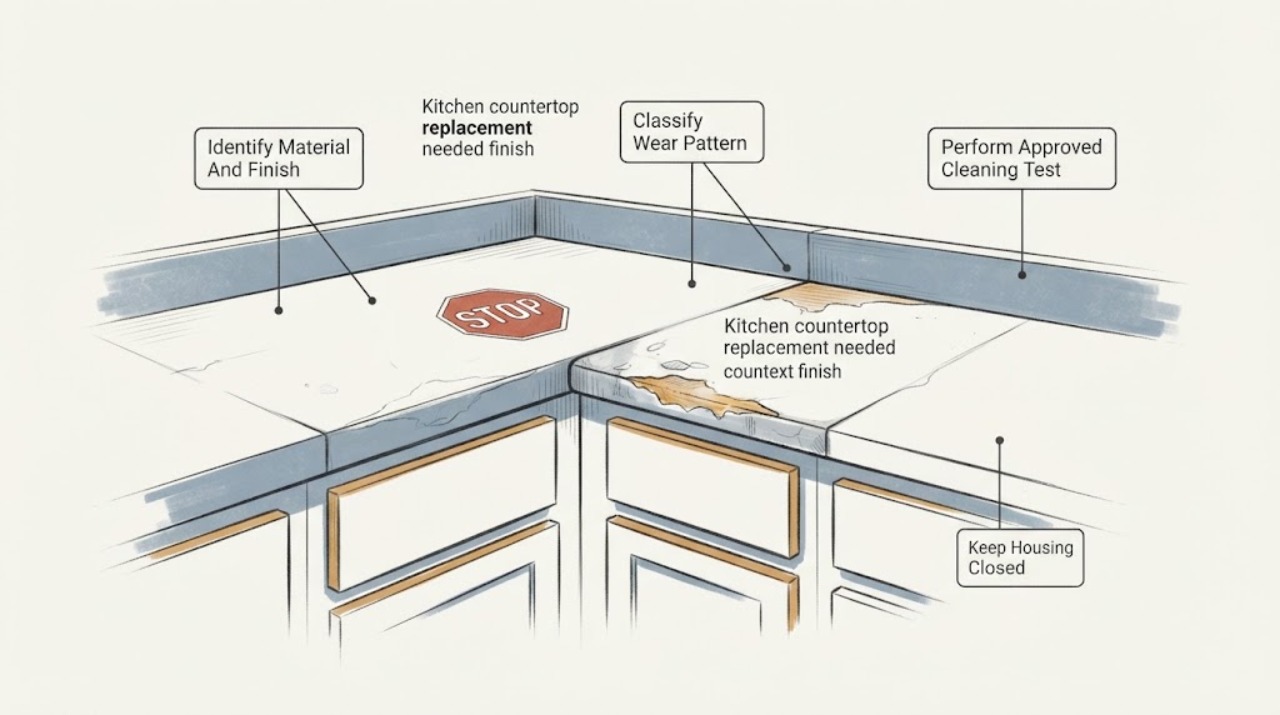
Work through in order
Diagnostic checks
Use only checks that match the exact appliance or system and its official guide.
-
Check 1
From normal standing access, photograph the countertop's full run, edge profile, sink and cooktop cutouts, seams, backsplash junction, and underside edge where visible; locate the material name, installer record, finish, thickness, and approximate installation date without lifting or removing anything.
Expected result: Classify the surface as known quartz, natural stone, laminate, solid surface, wood, porcelain, or unknown, and record whether it is polished, honed, matte, textured, or a decorative laminate layer.
Next step: Keep the photographs and product information for a countertop fabricator, installer, or restoration professional; do not order a replacement based only on a color photograph.
Stop if: Stop if identification requires moving the slab, disconnecting a sink or appliance, opening cabinetry, entering a tight space, or handling plumbing or electrical connections.
Why this matters
Why: Cleaner, sealer, polishing, and resurfacing methods are material-specific. An unknown surface should be treated as unconfirmed rather than as stone or laminate, because a method safe for one finish can permanently dull or damage another.
-
Check 2
View the worn area in ordinary daylight and from several directions without rubbing or scraping it, and map its position relative to the sink, cooktop, cutting area, appliance edge, seam, and backsplash.
Expected result: Record whether the change is a removable-looking film or residue, a broad change in sheen, an acid-like cloudy or rough patch, a scratch, a chip, a crack, a lifted edge, a swollen area, an open seam, or a stain that returns after cleaning.
Next step: Take close and wide photos with a ruler beside, not on, the damage and record when it began, what was spilled or heated, and whether it is spreading; use the matching branch before attempting treatment.
Stop if: Do not drag objects across the surface, probe a crack, pry a lifted edge, or apply a chemical to identify the damage.
Why this matters
Why: A broad sheen change or light surface mark can be patina or residue; a rough or cloudy boundary suggests etching; a chip or crack is physical damage; lifted laminate or swelling indicates a layer or substrate problem. A pattern concentrated at a wet joint or cutout raises a moisture or support question rather than a cosmetic-only replacement decision.
-
Check 3
Only when the exact material guide allows it, clean a small inconspicuous section with the specified mild cleaner, soft cloth, and rinse-and-dry method; do not use an abrasive pad, acid, solvent, sealer, polish, or abrasive tool as a trial.
Expected result: After the test dries, note whether the mark disappears, the sheen becomes even, the patch remains rough or cloudy, or a new dull or sticky film appears.
Next step: If the approved method improves the finish, repeat only as directed and keep liquids wiped dry. If it does not, preserve the test result and ask a qualified fabricator or stone restorer whether localized repair or replacement is appropriate.
Stop if: Never mix cleaners. Stop immediately for fumes, skin or eye irritation, discoloration, a spreading mark, or any need to sand, grind, strip, or polish the countertop.
Why this matters
Why: Improvement supports surface residue or routine soiling. No change after the approved method makes etching, embedded staining, physical wear, or a non-surface problem more likely; a new dull area suggests product incompatibility and is a reason to stop.
-
Check 4
From dry, accessible positions, inspect the front and exposed edges, sink and dishwasher edges, seams, backsplash joint, and cabinet-facing underside for chips, separation, swelling, staining, or visible moisture; do not remove caulk or disconnect fixtures.
Expected result: Record whether the damage is only on the top face, follows an edge or seam, is concentrated around a sink or dishwasher, shows swollen or darkened substrate, or is accompanied by current or recurring moisture.
Next step: Keep the area dry, avoid placing weight on a damaged edge, and send the location and moisture timeline to a countertop professional and, when needed, a plumber or cabinet professional.
Stop if: Stop for active leaks, sagging or moving countertop, exposed sharp substrate, unstable cabinets, water near electrical equipment, or any need to crawl under cabinets or disconnect plumbing.
Why this matters
Why: A face-only cosmetic mark may be a candidate for cleaning or professional refinishing. Edge chips, open seams, lifted laminate, swelling, or moisture at a cutout can compromise the layer or support and may require repair, replacement, or correction of the water source before any new top is installed.
-
Check 5
Without leaning on or loading the countertop, compare visible overhangs, seam alignment, backsplash gaps, cabinet faces, and the top's apparent level from a normal standing position; do not lift the top or place a level across a cracked or unstable area.
Expected result: Note whether the top appears stable and supported, has new gaps or uneven overhang, has a seam that has opened, or moves, rocks, or sags during ordinary use.
Next step: Photograph the gaps and cabinet context and request a site assessment that includes cabinet support, wall condition, cutout dimensions, and access; do not try to level or shim the top yourself.
Stop if: Stop using the affected area for heavy items and keep people clear if the top moves, a crack is growing, a cabinet is unstable, or the only inspection route requires lifting or dismantling.
Why this matters
Why: A stable top with localized finish wear supports a cosmetic repair or replacement comparison. New gaps, movement, sagging, or inconsistent support indicate an installation or cabinet condition that must be addressed before resurfacing or installing a replacement surface.
-
Check 6
Use the material identity, wear pattern, approved-cleaning result, moisture findings, support condition, and affected area to request separate repair, professional refinishing, resurfacing, and full-replacement options; do not commit to a material or overlay from appearance alone.
Expected result: Classify the scope as localized and superficial, localized but etched or chipped, broad finish wear on a sound top, damaged laminate or substrate, or structural or moisture-related damage.
Next step: Give the provider photos, material records, dimensions if already documented, sink and appliance details, finish preference, and access limits, and ask what must be corrected before templating or fabrication.
Stop if: Do not sand, grind, cut, remove the sink, detach the countertop, cover damaged material, or install a peel-and-stick or bonded layer until the surface is confirmed clean, dry, level, and structurally sound.
Why this matters
Why: Superficial isolated wear may not justify replacement; deeper stone damage may need professional repair or repolishing; broad cosmetic wear may justify resurfacing or replacement; delamination, swelling, movement, or moisture may require substrate, cabinet, plumbing, and top work together. The least expensive visible treatment is not necessarily compatible with the existing material.
Use your observations
Decision map
Find the observation that best matches what you see, then follow the next safe action.
-
PATH 01Safety boundary
What you see
The material is known, the top is stable and dry, and a small manufacturer-approved cleaning test removes the film or evens the sheen without damage.
Do this next
Continue only the approved care routine, wipe spills dry, and use trivets and cutting boards as directed; replacement is not established by this observation.
Why this path and its safety boundary
Why it matters: The finding is more consistent with residue, routine soiling, or normal finish aging than with a replacement-level defect.
Safety stop: Stop if the mark returns, cleaning changes the sheen, or the surface becomes rough, cloudy, sticky, or discolored.
-
PATH 02Safety boundary
What you see
Wear is localized but remains after approved cleaning, or there is a shallow etch, scratch, nick, or edge chip while the top and cabinets remain stable and dry.
Do this next
Ask a fabricator or stone/surface restorer whether the exact material and finish can be repaired without creating a visible mismatch, and obtain a replacement comparison if repair is not durable.
Why this path and its safety boundary
Why it matters: A professional repair, refinishing, or repolishing assessment may preserve the existing top; full replacement cannot be selected from the visible spot alone.
Safety stop: Do not sand, polish, fill, or color-match the area with a DIY kit.
-
PATH 03Safety boundary
What you see
Finish wear is broad or the owner wants a different surface, but the existing top is dry, stable, level, and structurally sound with no swollen or damaged substrate.
Do this next
Request a written scope comparing professional resurfacing with replacement and confirming whether the existing surface meets the chosen system's clean, dry, and sound requirements.
Why this path and its safety boundary
Why it matters: Resurfacing or full replacement may both be viable; selection depends on material compatibility, edge and seam requirements, cutouts, desired life, and access.
Safety stop: Do not bond an overlay over uneven, damaged, wet, or unstable material.
-
PATH 04Safety boundary
What you see
Laminate is lifting, the substrate is swollen or darkened, a seam or sink joint is open, or moisture recurs around a cutout, backsplash, dishwasher, or plumbing fixture.
Do this next
Keep the area dry and request coordinated countertop, cabinet, and plumbing assessment before choosing a top or overlay.
Why this path and its safety boundary
Why it matters: The visible finish is not the whole problem. A replacement top or resurfacing layer may fail unless the moisture source, substrate, cabinet support, and joint details are corrected first.
Safety stop: Stop using the affected section for heavy loads and do not pry the laminate, inject adhesive, or seal over active moisture.
-
PATH 05Safety boundary
What you see
The countertop moves or sags, a crack is opening, an edge is unstable or sharp, cabinets are shifting, or water is near electrical equipment.
Do this next
Stop loading the area, keep people clear without approaching the hazard, and arrange prompt qualified countertop and cabinet assessment; address any leak or electrical hazard through the appropriate professional.
Why this path and its safety boundary
Why it matters: This is a support, structural, or safety issue rather than ordinary finish wear. Continued use can worsen damage or expose people to injury.
Safety stop: No lifting, shimming, cutting, fixture removal, or attempt to stabilize the top with household materials.
Helpful context
Understand the symptom
Identify the surface before choosing a treatment
A kitchen countertop may be quartz, natural stone, solid surface, laminate, porcelain, wood, or another composite, and the same dull patch can mean residue, a changed sheen, an acid etch, a worn decorative layer, or moisture damage below the surface. Find the installer paperwork, material label, or original product information and photograph the whole run, edge profile, seams, sink area, and cutouts. Do not choose a cleaner, sealer, repair kit, or replacement sheet until the material and finish are known.
Finish wear is different from structural or moisture damage
Fine marks, fingerprints, light residue, and a gradual change in sheen can be maintenance or normal aging. A sharp boundary, rough or cloudy etch, chipped edge, open seam, lifted laminate, swelling, crack, movement, or a stain that follows a sink or backsplash joint changes the scope. Those patterns can involve the decorative layer, slab, adhesive, substrate, cabinets, or moisture source, so polishing the visible spot may conceal rather than correct the problem.
Replacement is a design and support decision, not just a color match
A replacement or resurfacing proposal has to account for the exact material, thickness, edge, seams, sink and cooktop openings, backsplash, appliances, cabinet support, plumbing, and access path. Wilsonart's resurfacing guidance, for example, requires a clean, dry, structurally sound surface and does not recommend covering uneven or damaged surfaces until they are repaired and leveled. Quartz and stone manufacturers likewise note that support and installation preparation affect fit and damage risk.
Safety boundary
Stop conditions
- Do not sand, grind, acid-clean, strip, polish, cut, pry, or apply a sealer, adhesive, filler, or overlay by guesswork.
- Stop for active leaks, recurring moisture, swollen substrate, movement, sagging, an opening crack, unstable or sharp edges, or water near electrical equipment.
- Do not lift or remove the countertop, disconnect sinks or appliances, enter restricted cabinet spaces, or alter plumbing, electrical, or cabinet supports.
- Do not mix cleaners or continue a product test after fumes, irritation, discoloration, roughness, or a spreading mark appears.
Only after diagnosis
Potential parts
- replacement countertop slab or laminate sheet
Consider this only after a professional confirms that repair or resurfacing is unsuitable and verifies the template, material, thickness, edge, seam, cutouts, and support.
A color sample does not establish an exact match; confirm the original material, finish, dimensions, sink and appliance openings, and installation requirements. - countertop edge or seam repair material
Consider this only when a fabricator identifies a localized chip, seam, or edge repair that is technically suitable for the installed surface.
Match the substrate, color, sheen, edge profile, and food-preparation-area requirements; do not use a generic filler as a structural repair. - countertop resurfacing overlay
Consider this only for a confirmed sound, dry, level existing top and an overlay system approved for that material; it is not a remedy for swelling, movement, or hidden moisture.
Verify manufacturer-approved substrates, edge treatment, seams, sink cutouts, heat exposure, and professional installation requirements before ordering.
When checks do not resolve it
Need a professional?
Arrange a qualified countertop fabricator, installer, or surface-restoration assessment when finish wear remains after the exact approved cleaning method, is widespread, includes etching, scratches, chips, delamination, open seams, or damaged cutouts, or when replacement or resurfacing is being considered. Request prompt service for movement, sagging, a growing crack, unstable edges, active moisture, swollen substrate, or water near electrical equipment.
Safety scope: The professional determines whether cleaning, repair, refinishing, resurfacing, or replacement is appropriate, verifies substrate and cabinet support, corrects moisture or installation causes, and handles templating, fabrication, removal, and installation.
Have this ready
- Material name, finish, thickness, edge profile, installer record, and approximate installation date
- Wide and close photos showing the wear, seams, cutouts, backsplash, edges, cabinets, and access path
- Timeline, spill or heat event, cleaning products used, recurrence, and whether the area is spreading
- Moisture, leak, swelling, movement, crack, seam, and cabinet-support observations
- Sink, cooktop, dishwasher, appliance, backsplash, plumbing, and finish constraints that may affect the scope
Common questions
FAQ
Does worn countertop finish mean I need a full replacement?
Not necessarily. A removable film or normal patina may respond to the exact material's approved care, while a localized etch or chip may be professionally repaired. Broad wear, delamination, swelling, movement, deep damage, or an unsound substrate makes resurfacing or replacement more likely.
How can I tell a stain from an etched or worn finish?
From safe viewing, note whether the mark changes the surface texture or sheen, has a sharp boundary, follows a spill or wet joint, or remains after an approved small cleaning test. A rough or cloudy area can be etching, but do not use acid or abrasive products to test it; ask the material specialist.
Can I polish or sand a dull kitchen countertop?
Do not polish or sand by guesswork. Quartz, natural stone, laminate, solid surface, and matte finishes have different constructions and care limits. An abrasive or chemical trial can create a larger mismatch or permanent damage; use the exact manufacturer guidance or a qualified restorer.
When is resurfacing a reasonable alternative to replacement?
Resurfacing is a possibility only when the existing top is the right substrate and is clean, dry, level, and structurally sound. It is not a substitute for correcting swelling, moisture, movement, an unstable cabinet, or an uneven damaged surface.
What should I send a countertop professional?
Send material and finish information, wide and close photos, dimensions if already documented, the wear timeline, cleaning or heat exposure, seam and cutout details, moisture or movement observations, cabinet context, and any access limits. Ask the provider to compare repair, refinishing, resurfacing, and replacement scopes.
Read the exact guide
Official sources
- Care & Cleaning of Natural StoneNatural Stone Institute · Supports identifying stone composition, avoiding inappropriate acids and abrasives, and referring deep scratches, etching, and persistent moisture to a stone professional.
- Cambria Quartz Product CareCambria · Supports the examples of chips, scratches, heat damage, non-sealing care, and the need for sound cabinet and wall preparation; exact guidance remains model-specific.
- Care and Maintain for Fusion, Mineral & Quartz SurfacesCaesarstone US · Supports distinguishing patina and residue from damage and using mild, non-abrasive, material-approved care for quartz-like surfaces; it is not universal for every countertop.
- Re-Cover™ Peel-and-Stick High Pressure LaminateWilsonart · Supports the conditional resurfacing branch only: an overlay requires a clean, dry, structurally sound surface and is not recommended over uneven or damaged surfaces.
Community feedback
Share a repair observation
Share a plain-text repair observation. Accepted observations are published automatically; this page may take a moment to update.