
On this page
Start here
Quick answer
A countertop that is badly damaged, swollen, separating at seams, or no longer fits the sink or appliances usually needs an on-site replacement assessment rather than a quick patch. Before requesting a quote, document the visible material and finish, safe overall dimensions, openings and appliance relationships, cabinet-support symptoms, and any moisture near the sink. Do not remove the counter, cut an opening, disturb cabinets, disconnect plumbing or electricity, or load a suspect surface; a qualified countertop or remodeling professional should confirm the template, support, material, and replacement sequence.
Before you begin
Safety first
- Do not remove the countertop, cut or grind material, demolish cabinets, disconnect plumbing, gas, or electricity, or disturb a wet or unstable area as part of this assessment.
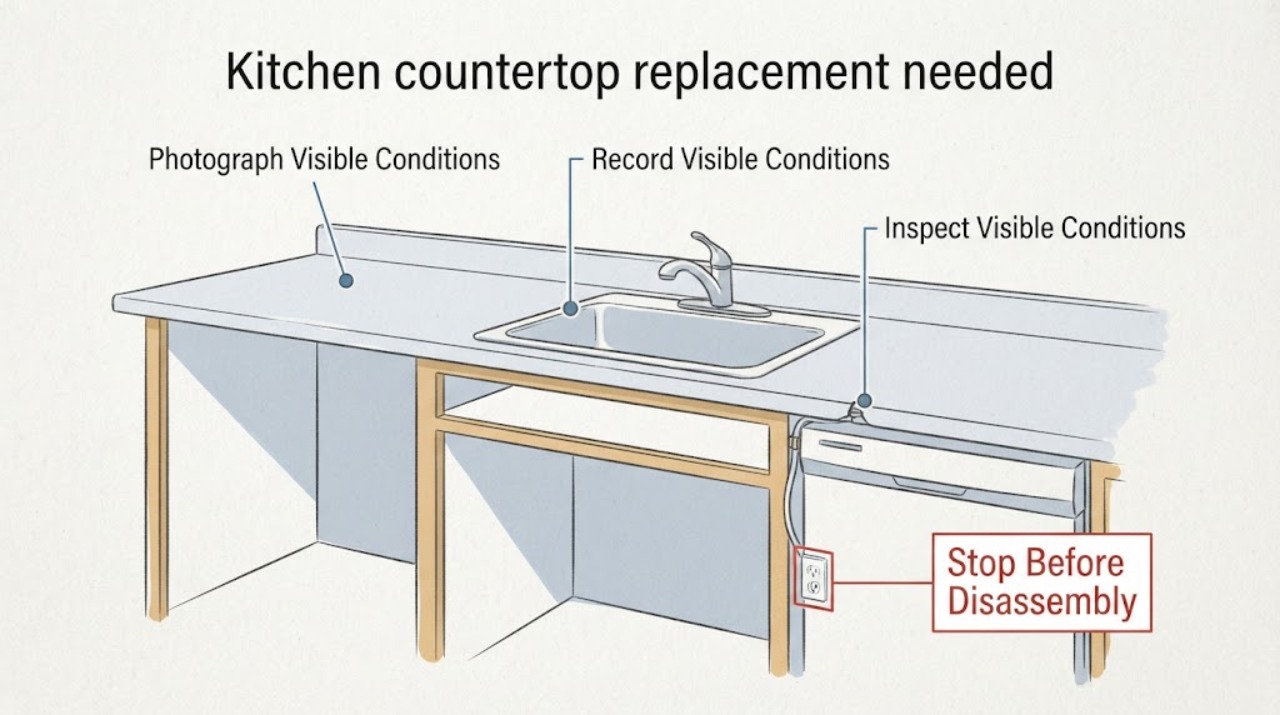
Work through in order
Diagnostic checks
Use only checks that match the exact appliance or system and its official guide.
-
Check 1
From a standing position, identify the visible countertop material if you know it and photograph the finish, edges, seams, chips, burns, scratches, staining, swelling, or delamination without scraping, pressing, or moving the surface.
Expected result: Record whether the surface appears to be laminate, solid surface, stone, engineered stone, tile, wood, or unknown, and whether the damage is cosmetic, spread along a seam, associated with swelling, or accompanied by cracking or movement.
Next step: Send wide and close photographs plus the material information or uncertainty to the countertop professional; ask them to confirm whether the visible issue can be repaired or requires replacement.
Stop if: Stop if the surface moves, a crack opens, a sharp edge is exposed, or the substrate appears unstable; keep people away from the area and request professional assessment.
Why this matters
Why: Material and damage pattern determine whether a repair assessment is plausible or a replacement and fabrication visit is more likely. An unknown material must remain unknown rather than being guessed from appearance.
-
Check 2
Using only safe, accessible edges and a tape measure held without forcing anything, record approximate overall run, depth, backsplash presence, seam locations, and the visible positions of sink and cooktop openings; do not remove fixtures or make a cutout template.
Expected result: Mark each dimension as approximate or verified, and note obstructions, angled corners, changes in depth, overhangs, and any opening whose edge cannot be seen clearly.
Next step: Provide the sketch, photographs, and uncertainty notes for an on-site measurement and final template before material fabrication is authorized.
Stop if: Stop measuring if reaching, climbing, leaning across the counter, shifting an appliance, or moving a sink or backsplash would be required.
Why this matters
Why: Approximate dimensions help a professional scope a visit but cannot replace an on-site template. Unseen edges, irregular walls, or uncertain openings increase the chance that the quote or final material plan will change.
-
Check 3
Observe the cabinet fronts and the countertop from normal use positions: look for doors or drawers that have become misaligned, visible gaps, a sagging line, uneven seams, or movement during ordinary light contact; do not sit, kneel, load, lift, or pry the counter.
Expected result: Record whether the cabinets appear level and stable, whether a gap or sag is localized or runs along the cabinet line, and whether the symptom is known to have followed a leak or remodel change.
Next step: Ask the countertop installer or remodeling professional to include cabinet support, leveling, and any required reinforcement in the site assessment; do not assume a new surface will correct the cause.
Stop if: Stop if the cabinet or counter shifts, a gap is widening, or there is a risk of collapse; keep weight off the area and arrange prompt professional service.
Why this matters
Why: A support or cabinet problem can make a new top crack, move, or fail even when the selected material is suitable. The support condition must be assessed before the replacement scope is finalized.
-
Check 4
Document the sink, faucet, backsplash, cooktop, dishwasher, range, and nearby appliance relationships from the room without disconnecting plumbing, gas, wiring, or appliances.
Expected result: Record sink style if visible (top-mount, undermount, or integrated/uncertain), faucet-hole count, whether the backsplash meets the top, which appliances touch or sit below the counter, and whether any fixture is already loose or difficult to access.
Next step: Include model information and clear photographs when available, and request that the installer confirm fixture compatibility, access, and responsibility for any plumbing or electrical coordination before scheduling.
Stop if: Stop if water, gas, electrical conductors, or an appliance connection is exposed or damaged; do not touch it and use the appropriate licensed professional.
Why this matters
Why: Opening, edge, and clearance choices are dependent on the actual fixture and appliance arrangement. A professional may need a coordinated sequence and a verified template, especially when an integrated sink or fixed appliance limits access.
-
Check 5
Inspect visible areas around the sink, seams, backsplash, cabinet top, and cabinet base for current moisture, water marks, swelling, soft-looking finishes, odor, or a history of repeated spills or leaks without probing or opening concealed areas.
Expected result: Record whether the area is dry and stable, recently wet, actively leaking, swollen, stained, or odorous, and whether the source appears to be the sink area, a supply or drain connection, a wall, or an unknown location.
Next step: If moisture is present, limit use of the affected fixture and arrange plumber or water-damage assessment before the countertop scope is closed; provide dates, photos, and the suspected source.
Stop if: Stop immediately for active leaking, standing water near electricity, severe swelling, sewage odor, visible mold growth, or an unstable cabinet; keep clear and request appropriate professional service.
Why this matters
Why: A dry cosmetic issue may proceed to replacement planning, but active or recurring moisture can damage cabinets and walls and should be corrected before a new top hides the source. EPA guidance notes that leaks under a sink can contribute to moisture and mold in nearby cabinets or walls.
Use your observations
Decision map
Find the observation that best matches what you see, then follow the next safe action.
-
PATH 01Safety boundary
What you see
The surface is stable, dry, and the damage is localized or the replacement reason is mainly age or design.
Do this next
Proceed with a professional site visit for verified measurements, material and edge options, fixture coordination, support review, and a written replacement scope.
Why this path and its safety boundary
Safety stop: Do not authorize fabrication from approximate measurements alone.
-
PATH 02Safety boundary
What you see
The counter or cabinet shows movement, sagging, swelling, or a spreading seam or crack.
Do this next
Request a cabinet and countertop assessment before choosing material or scheduling replacement; the support or substrate scope may need to be included.
Why this path and its safety boundary
Safety stop: Keep weight and impact away from the area and stop if movement increases.
-
PATH 03Safety boundary
What you see
There is active or recurring water at the sink, backsplash, cabinet, or wall.
Do this next
Address the water source with the appropriate plumbing or water-damage professional before enclosing it under a new countertop.
Why this path and its safety boundary
Safety stop: Do not use or disconnect a leaking fixture when water could contact electrical equipment.
-
PATH 04Safety boundary
What you see
The sink, cooktop, backsplash, or appliance relationship is uncertain or an opening is partly hidden.
Do this next
Book an on-site template and coordination review; give the professional photographs and any fixture documentation without removing anything.
Why this path and its safety boundary
Safety stop: Do not cut, drill, or enlarge an opening to make an uncertain fixture fit.
-
PATH 05Safety boundary
What you see
The selected material will require stone or engineered-stone fabrication or dust-producing modification.
Do this next
Use a qualified fabricator with appropriate silica-dust controls and have them confirm the final template and handling plan.
Why this path and its safety boundary
Safety stop: Do not attempt countertop cutting, grinding, drilling, or dry sweeping at home.
Helpful context
Understand the symptom
The useful first decision is whether this is a replacement project, a localized repair, or a moisture-and-cabinet problem that must be addressed before new material is ordered. A chip or cosmetic mark on a stable surface can have a different scope from swelling at a seam, a moving sink, or cabinets that no longer support the counter evenly. Treat every observation below as information for a professional quote, not as an installation template.
Keep the existing counter and fixtures in place while documenting the room. A fabricator can verify the final template, overhangs, sink and cooktop openings, edge profile, joints, and support after an on-site review. If stone or engineered stone will be fabricated, do not attempt cutting, grinding, drilling, or dry cleanup; OSHA identifies countertop manufacturing and stone cutting as activities that can create respirable crystalline silica exposure.
Photograph the whole run and each damaged area in ordinary light, and note what is known versus uncertain. A replacement quote may change if the sink, faucet, backsplash, cooktop, dishwasher, or range must be coordinated, or if hidden moisture has affected the cabinet or wall. Keep the area dry and stop using a fixture that is actively leaking until the water source is handled by the appropriate professional.
Do not promise that a sealant or repair kit will solve a structural, support, or water-damage issue. Those items are only conditional possibilities after the material, substrate, joint, and cause of damage are identified and the professional confirms that repair is appropriate.
Only after diagnosis
Potential parts
- silicone caulk
Consider this only if a professional identifies a compatible, localized joint or seam finish on a stable, dry surface and confirms that sealing—not replacement or source repair—is the correct scope.
Confirm the countertop material, sink style, joint location, and manufacturer-approved sealant before use; do not apply sealant to a moving sink, wet substrate, or moving door-like surface. - countertop repair kit
Consider this only after the material and damage are identified and a professional confirms that a localized cosmetic repair is preferable to replacement.
Match the repair system to the exact material and finish; a kit cannot correct cabinet movement, swollen substrate, active leaks, or a failed sink opening.
When checks do not resolve it
Need a professional?
Call a countertop installer or kitchen remodeling professional when replacement is being considered, the material or opening is uncertain, the counter or cabinet moves, or any moisture or fixture coordination is involved.
Safety scope: Do not remove the countertop, cut or grind material, demolish cabinets, disconnect plumbing, gas, or electricity, or disturb a wet or unstable area as part of this assessment.
Have this ready
- Provide the whole-run and close-up photos, approximate dimensions labeled as unverified, material and finish information, sink and appliance relationship, cabinet/support observations, moisture history, and the desired replacement scope.
Common questions
FAQ
Can I use my approximate measurements to order a replacement countertop?
Use them to explain the project and request an estimate, but not as the final fabrication template. Corners, walls, seams, overhangs, sink and cooktop openings, and fixture access should be verified on site before fabrication.
Does a swollen area near the sink mean I only need new caulk?
Not necessarily. Swelling can indicate water reached a substrate or cabinet, so the leak source and affected support need assessment before a joint is resealed or a new top hides the damage.
Can I cut the sink opening myself after the countertop arrives?
Do not assume that is safe or suitable. Cutting stone or engineered stone can create respirable silica dust, and an inaccurate opening can damage the top or make the sink unsafe. Have the fabricator verify the template and perform controlled fabrication.
Read the exact guide
Official sources
- Interactive Mold House TourU.S. Environmental Protection Agency · Used for the branch that separates active or recurring moisture from a dry countertop replacement assessment.
- Use & CareCorian · Used to show why a known material and finish should be confirmed before considering a repair kit or sealant; it is not generalized to stone, laminate, or other surfaces.
- Laminate Cleaning and MaintenanceFormica Corporation · Used only as a material-specific example that the identified material and seam condition matter; it is not treated as universal advice for every countertop.
- Silica, Crystalline - OverviewOccupational Safety and Health Administration · Used to keep the reader out of DIY cutting or grinding and to support referral of fabrication work to a qualified professional.
Community feedback
Share a repair observation
Share a plain-text repair observation. Accepted observations are published automatically; this page may take a moment to update.