
On this page
Start here
Quick answer
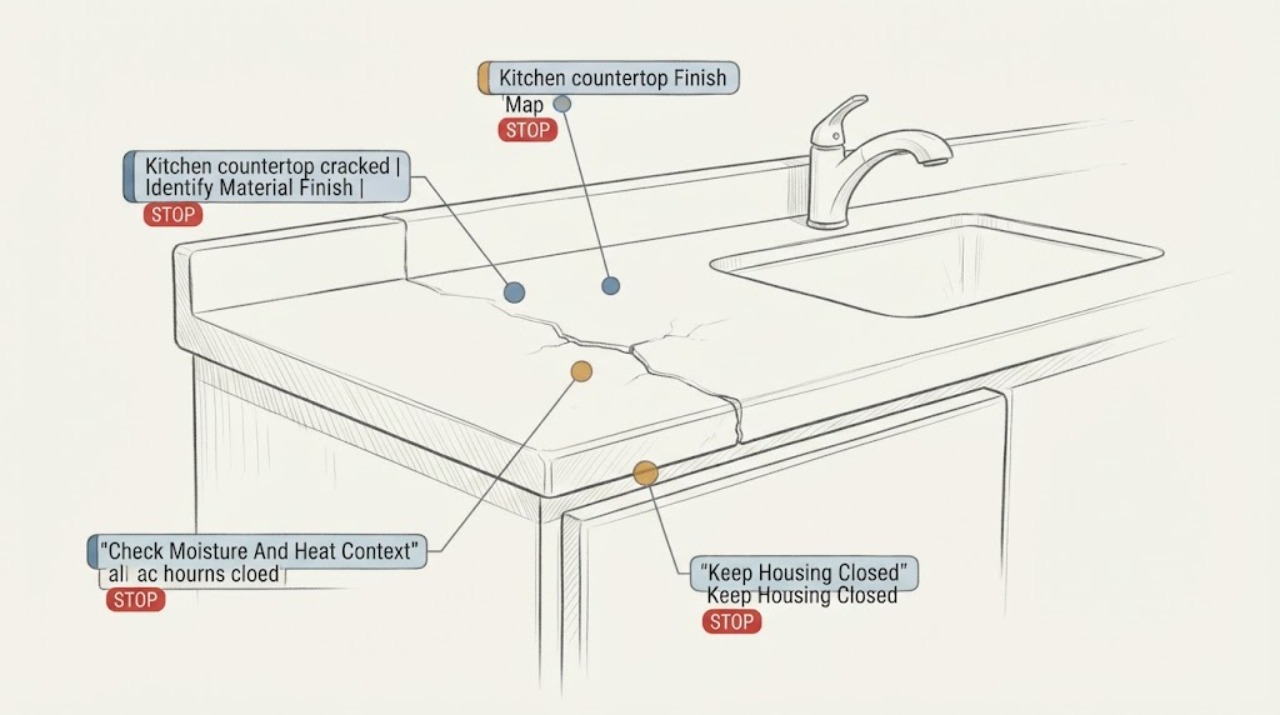
Do not fill or sand a cracked countertop until you know what the crack is traveling through. First photograph it, clean and dry the area with a material-appropriate mild method, and trace whether it is a short surface mark, an opened seam, a crack from a sink or cooktop opening, an edge impact, or a line that continues across the slab. Also look for a nearby wet area, heat source, cabinet movement, or visible loss of support without lifting or shifting the top. A crack at an opening, a widening or displaced crack, a loose or rocking top, moisture in the cabinet, or unknown material should be left in place and assessed by the countertop fabricator or a qualified remodeling professional. A small, stable surface defect may have a material-specific repair path, but the correct filler and finish depend on the countertop material and the exact damage.
Work through in order
Diagnostic checks
Use only checks that match the exact appliance or system and its official guide.
-
Check 1
Photograph the full countertop run and the crack close up, then trace its visible path without pressing on it or trying to widen it.
Expected result: Note whether it is a short surface line, an opened seam, an edge chip or impact mark, a line that begins at a sink or cooktop opening, or a crack that continues across the slab. Record whether the two sides are flush or displaced and whether the line appears to be changing.
Next step: Keep the area unloaded, save the photographs, and move to material and moisture checks. If the crack is spreading, displaced, sharp, or unstable, stop the inspection and contact a countertop fabricator or remodeling professional.
Stop if: Stop if the slab shifts, an edge is loose or sharp, the crack opens under ordinary use, or any person would need to pry, lift, drill, cut, or remove the countertop to see more.
Why this matters
Why: A surface-only mark has a different decision path from a seam failure, an opening-related crack, or movement between pieces. A displaced, spreading, or opening-related line needs professional assessment before any cosmetic repair is considered.
-
Check 2
Identify the countertop material and finish from installation records, a readily visible label, or the installer or manufacturer information; do not scrape a hidden area to make a test.
Expected result: Record whether the top is quartz or another stone, solid surface, laminate, tile, or unknown, and note a polished, matte, textured, or patterned finish. Look for a visible seam, edge profile, or repair history without removing trim or fixtures.
Next step: Use the identified material and pattern location to request a material-specific assessment. If the material cannot be confirmed, send the photos and dimensions as observations only and do not choose a filler or sealer based on appearance alone.
Stop if: Stop before applying solvent, abrasive, sealer, adhesive, or filler when the material, finish, or compatibility is unknown, or when the proposed method would alter the finish.
Why this matters
Why: Repair compounds, heat and chemical precautions, color matching, and finishing expectations are material-specific. Manufacturer guidance may support repairability for one material while another requires a fabricator, so a generic crack kit is not automatically suitable.
-
Check 3
Visually check the cabinet below and the nearby sink, dishwasher, cooktop, backsplash, and heat-producing appliances for active moisture, staining, swelling, scorching, or a recent impact; do not open walls or disturb the countertop.
Expected result: Record dry cabinetry versus dampness, a plumbing drip, swelling, a heat mark, an impact point, or no nearby event. Note whether the crack is at a seam or opening and whether the cabinet faces and visible supports appear to have moved, without trying to level or tighten anything.
Next step: If there is active water, stop using the nearby fixture if safe and arrange plumbing or water-damage assessment. If there is heat or impact damage, record it and keep the source away. If support or cabinet movement is suspected, request an in-person countertop and cabinet assessment.
Stop if: Stop if water is active, cabinetry is swollen, a nearby electrical area is wet, heat damage is ongoing, or the cabinet or countertop appears unstable. Do not touch wet energized equipment or attempt cabinet or structural work.
Why this matters
Why: Moisture, heat, impact, or support movement can be a contributing condition that a cosmetic fill would not address. A dry, stable area with no related event may still need a material-specific repair, but it is a narrower request for the professional.
-
Check 4
Compare current photographs with any earlier installation or damage records and mark only the date and visible change; do not load the crack to test it.
Expected result: Classify the condition as unchanged, newly visible, longer or wider, newly displaced, or unknown. Note recent remodeling, appliance movement, plumbing work, temperature event, or impact only if you know it occurred.
Next step: Give the timeline, photographs, material information, and moisture or heat observations to the installer, fabricator, or qualified remodeling professional. Keep heavy or hot items away while waiting.
Stop if: Stop if you cannot safely observe without moving appliances or the top, if the crack changes while being observed, or if the timeline suggests active movement or water damage.
Why this matters
Why: A documented change or displacement raises the need for a prompt professional inspection. An unchanged, stable surface mark can support a planned material-specific evaluation, but stability does not prove that a repair product is compatible.
-
Check 5
Decide whether the material, crack path, condition, and surrounding area are all clearly understood before considering any repair product.
Expected result: Answer yes only when the crack is stable and visible, the material and finish are confirmed, there is no active moisture or heat issue, the surface is not displaced, and no cutting, demolition, removal, or pressurized or structural work would be needed. Answer no for any unknown, opening-related, spreading, displaced, wet, unstable, or support-related condition.
Next step: For yes, provide the material, finish, crack location, photos, and dimensions to a qualified repair provider for confirmation. For no, protect the area, address any urgent water or electrical hazard through the appropriate professional, and request a countertop assessment.
Stop if: Do not proceed with filler, adhesive, sealant, sanding, polishing, cutting, demolition, or countertop removal when any answer is unknown or no.
Why this matters
Why: Yes supports a focused conversation with the material manufacturer or fabricator about an appropriate repair; it does not authorize a generic kit or guarantee an invisible result. No means the next step is professional diagnosis and source correction, not a cosmetic patch.
Use your observations
Decision map
Find the observation that best matches what you see, then follow the next safe action.
-
PATH 01Safety boundary
What you see
The line is short and surface-level, the slab is flush and stable, the material and finish are confirmed, and there is no moisture, heat, or support concern.
Do this next
Ask the material manufacturer or fabricator whether a repair is appropriate for that exact finish and follow only the approved material-specific method. Keep the area unloaded until confirmed.
Why this path and its safety boundary
Safety stop: Stop if the line deepens, spreads, changes color with moisture, or the proposed method requires an unknown chemical, abrasive, or fabrication step.
-
PATH 02Safety boundary
What you see
The crack follows a seam or begins at a sink or cooktop opening, or the two sides are no longer flush.
Do this next
Treat it as a fabrication, installation, or support question and contact the original installer, fabricator, or qualified remodeling professional with full-run photographs and the cabinet and moisture observations.
Why this path and its safety boundary
Safety stop: Do not clamp, pry, lift, cut, drill, remove fixtures, or attempt to recreate a seam or opening.
-
PATH 03Safety boundary
What you see
There is active or previous water, heat exposure, an impact point, swollen cabinetry, or a nearby wet electrical area.
Do this next
Stop using the affected area if safe, arrange plumbing or electrical assessment for the hazard, and then have the countertop and cabinets assessed for the contributing condition before repair.
Why this path and its safety boundary
Safety stop: Do not touch wet energized equipment, continue using a leaking fixture, apply heat, or cover active damage with filler or sealant.
-
PATH 04Safety boundary
What you see
The material is unknown, the crack is widening or displaced, the countertop feels unstable, or the history cannot be established.
Do this next
Leave the countertop undisturbed and request an in-person evaluation from a countertop fabricator or qualified remodeling professional. Provide photos, location, timeline, and any water, heat, or impact observations.
Why this path and its safety boundary
Safety stop: Stop all troubleshooting that would require moving the top, opening cabinetry, changing supports, or testing the crack with weight.
Helpful context
Understand the symptom
Start with location, not a repair product
A countertop crack is a symptom, not a diagnosis. Photograph the whole run and a close view, then note whether the line starts at an edge, seam, sink or cooktop opening, backsplash, or an area that carries an appliance overhang. Do not pry the crack open, scrape it deeper, or put weight on the area while investigating.
Material and finish change the safe answer
Quartz, natural stone, solid surface, laminate, and tiled tops do not share the same repair products or finishing methods. Find the installer paperwork, a slab or care label, or the manufacturer name if it is readily available. If the material is unknown, treat the repair method as unknown and provide photos and the material description to a professional instead of guessing.
Protect the area while you arrange the next step
Keep liquids, hot cookware, heavy appliances, and impact away from the crack. Do not remove the countertop, alter cabinets, or attempt fabrication work as a homeowner observation step. If water is entering cabinetry or a nearby outlet or appliance area is wet, stop using the affected area and arrange the appropriate plumbing or electrical assessment.
Only after diagnosis
Potential parts
- countertop repair kit
Consider this category only after the countertop material, finish, crack location, and professional or manufacturer guidance identify a compatible cosmetic repair path.
Confirm material, color, finish, cure requirements, and use location with the manufacturer or fabricator; do not assume a kit suits quartz, natural stone, solid surface, laminate, or tile. - countertop silicone caulk
Consider a sealant only when a professional identifies a compatible non-structural joint or perimeter gap and the underlying crack or moisture source has been addressed.
Confirm the surface material, finish, joint location, and manufacturer's cure and cleanup requirements; sealant is not a structural crack repair.
When checks do not resolve it
Need a professional?
Call a countertop fabricator or qualified remodeling professional for a crack at a seam or sink/cooktop opening, any spreading or displaced crack, unknown material, visible support or cabinet movement, active or past water or heat damage, a loose edge, or any repair that would require fabrication, removal, or structural work.
Have this ready
- Provide the manufacturer or material if known, finish, full-run and close photographs, crack location and approximate visible length, whether the surfaces are flush, timeline, recent impact or remodeling, nearby water or heat observations, and whether cabinetry appears dry and stable.
Common questions
FAQ
Can I fill a cracked kitchen countertop right away?
Not safely as a first step. Identify the material and crack pattern, check for moisture, heat, impact, movement, and support concerns, then confirm a compatible material-specific method with the manufacturer or a fabricator. A filler can hide an active or installation-related problem.
What does a crack near a sink or cooktop mean?
A crack that starts at an opening or follows a seam deserves professional assessment because fabrication, installation, support, or movement may be involved. Photograph it without prying or altering the opening and keep weight and heat away.
Does a wet cabinet below the crack matter?
Yes. Active or previous water can contribute to cabinet or support changes and needs to be addressed before a cosmetic countertop repair. Stop using the affected fixture if safe and arrange the appropriate plumbing or water-damage assessment.
When should I call a countertop professional?
Call for any spreading, displaced, unstable, sharp, seam-related, opening-related, or unknown-material crack, and whenever the area has water, heat, cabinet movement, or a nearby wet electrical hazard. Provide photos, material information, location, timeline, and what you observed.
Read the exact guide
Official sources
- Use & CareCorian / DuPont · Applies specifically to Corian solid-surface products; do not generalize its repair or finish guidance to other countertop materials.
- Cambria Quartz Product CareCambria · Applies specifically to Cambria quartz products; use only as a material-specific example and confirm the installed product before applying any care guidance.
- Common Mistakes GuideCaesarstone Master of Stone United States · Applies to Caesarstone surfaces and professional fabrication or installation context; it is used here to identify patterns that warrant assessment, not to prescribe homeowner fabrication work.
Community feedback
Share a repair observation
Share a plain-text repair observation. Accepted observations are published automatically; this page may take a moment to update.