
On this page
Start here
Quick answer
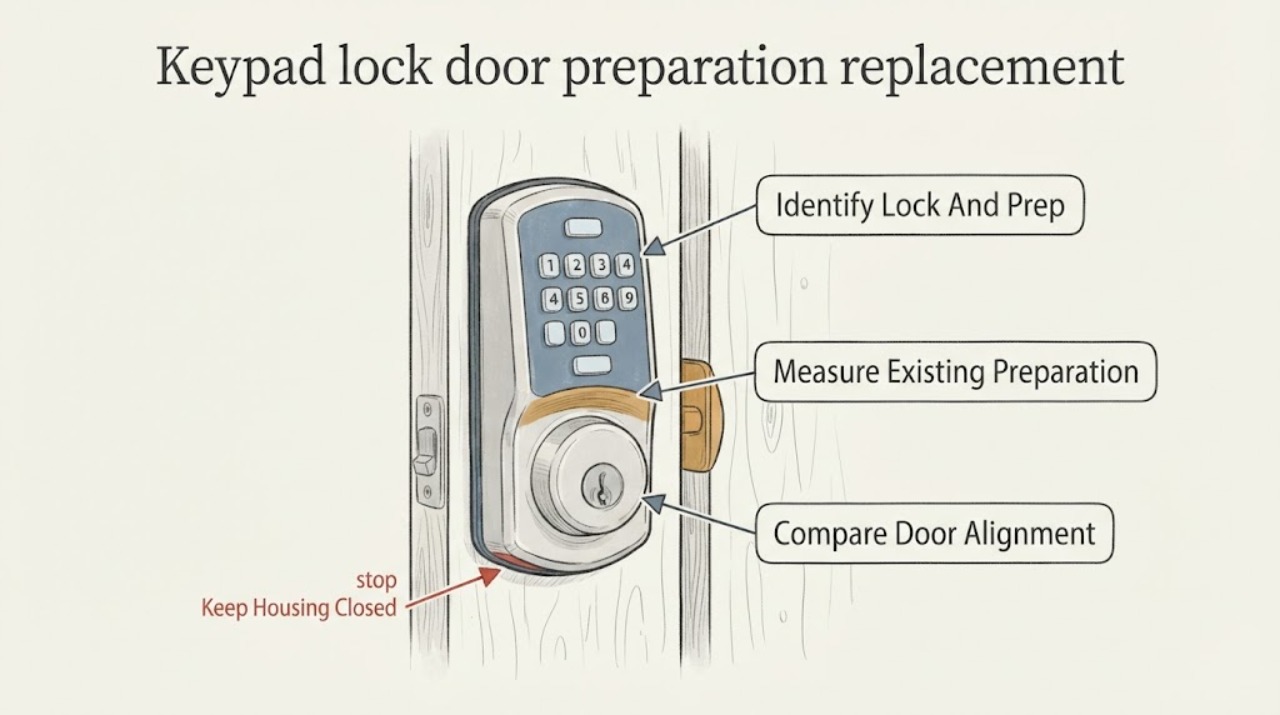
Before buying or drilling for a replacement keypad lock, compare the existing door preparation with the exact replacement's installation guide. Record the lock type, cross-bore and edge-bore size, backset, door thickness, faceplate or drive-in style, and strike location. Then test alignment with the door closed: a lock that works while open but binds when closed usually points to the door, frame, or strike rather than proving the keypad unit needs replacement. If a dimension is outside the manufacturer's range, the door is cracked, warped, hollow or damaged, the old holes are oversized, or changing the preparation would affect security, stop and have a locksmith assess the fit. Do not bypass, force, or remove the only working lock before a compatible replacement and a safe access plan are confirmed.
Work through in order
Diagnostic checks
Use only checks that match the exact appliance or system and its official guide.
-
Check 1
From the secure side of the door, identify whether the keypad lock is a deadbolt or a lever/knob, and photograph the exterior trim, interior turnpiece, door edge, faceplate, strike, and any visible model label without removing the lock.
Expected result: The unit is a keypad deadbolt, a keypad lever or knob, a retrofit over an existing cylinder, or the model and lock type are unclear.
Next step: Save the exact model and the manufacturer's installation guide or template. If the label is missing or the assembly is unusual, give the photos to a locksmith before ordering or removing anything.
Stop if: Stop if identification would require disassembly, bypassing, picking, forced entry, or leaving the door unsecured.
Why this matters
Why: Different lock forms use different door-edge, cross-bore, strike, and clearance requirements. An unclear identity is a fitment question, not evidence that a generic replacement will work.
-
Check 2
With the lock left in place, measure only the accessible preparation: cross-bore diameter on the door face, distance from the door edge to the bore center, edge-bore diameter, door thickness, and the faceplate or drive-in style. Record the door material and whether old holes are enlarged or overlapping.
Expected result: The measurements match the replacement guide, differ from it, fall between published options, or cannot be measured without removing hardware.
Next step: Compare every measurement with the exact replacement manual, not a listing or a different brand's template. If any dimension is outside the guide or the old hole is damaged, pause the purchase and ask a locksmith to select the compatible path.
Stop if: Do not enlarge holes, drill, chisel, pry trim, or remove the only working lock as part of this check.
Why this matters
Why: Manufacturer examples commonly distinguish cross-bore, backset, edge bore, and door-thickness ranges, but those values are product-specific. A mismatch or an unmeasurable preparation means compatibility is unconfirmed.
-
Check 3
Using the existing lock normally and without forcing it, compare the bolt or latch behavior with the door open and with the door gently closed. Note whether the door locks without lifting, pulling, or pushing and whether the bolt meets the strike cleanly.
Expected result: The lock operates in both positions, works open but binds closed, requires pressure or lifting, or cannot reach the strike.
Next step: If it binds only when closed, document the strike and frame and arrange alignment or locksmith assessment before buying a keypad replacement. If it fails in both positions, stop repeated cycling and provide the behavior and photos to the locksmith.
Stop if: Stop immediately if the door will not secure, the bolt must be forced, the frame moves, or testing would risk being locked out.
Why this matters
Why: A difference between open and closed operation points more toward strike alignment, frame movement, hinges, or a warped door than toward door preparation alone. A lock that cannot operate even when open may have a lock or latch issue, but it still does not prove which replacement fits.
-
Check 4
Inspect the visible door face, edge, jamb, strike area, and surrounding trim for cracks, splitting, warping, loose material, oversized prior holes, a shallow or damaged mortise, or a strike that is no longer firmly supported.
Expected result: The door and frame are sound, or the preparation is cracked, distorted, weakened, or made from a material not covered by the replacement guide.
Next step: Photograph the defect and have a locksmith or qualified door professional choose between repair, a different lock format, a reinforcement solution, or door replacement. Do not hide a structural defect behind a larger trim plate.
Stop if: Stop if the door cannot be closed and secured, the jamb is splitting, the hardware is loose in the wood or metal, or repair would require cutting structural material.
Why this matters
Why: A sound standard preparation may support a compatible retrofit. Damage, warping, or unsupported construction can prevent secure installation even when the bore diameter appears correct.
-
Check 5
Place the exact replacement's paper template or installation diagram against the existing door without marking or cutting, and compare the centerline, edge clearance, faceplate footprint, interior clearance, strike position, and any required cable path.
Expected result: The template overlays the existing preparation, overlaps an old hole, requires a different centerline or strike, or cannot be evaluated because the exact guide is unavailable.
Next step: Use the model-specific guide to confirm fit. If the overlay conflicts or a new bore, mortise, reinforcement, or cable route would be needed, stop and use a locksmith rather than improvising a modification.
Stop if: Do not drill, cut, chisel, route wires, or remove security hardware to make the template fit during this observation.
Why this matters
Why: A visual overlay can reveal a preparation mismatch before purchase, but it cannot verify hidden reinforcement, wiring, or the final security of a modified door. A missing guide leaves fitment unresolved.
-
Check 6
Before ordering or removing anything, confirm that the existing key, code, interior release, and a backup way to secure the door are known and usable, and record whether the door is an entry, bedroom, garage, or other access-critical door.
Expected result: A reliable access and locking method remains available, or the keypad is the only usable entry or security method.
Next step: Keep the old lock installed until the replacement and fit are confirmed. Request a locksmith visit when the current lock is the only safe access method, the door cannot be left open, or the preparation requires alteration.
Stop if: Do not remove the only working lock, disable the latch, or start work that could lock occupants out or leave the property unsecured.
Why this matters
Why: A compatible replacement can be planned when access is preserved. If the door is access-critical or cannot be left secure, the risk is operational and security-related rather than a simple measurement problem.
Use your observations
Decision map
Find the observation that best matches what you see, then follow the next safe action.
-
PATH 01Next step
What you see
The lock type and model are known, every measured dimension is within the exact replacement guide, the door and jamb are sound, and the bolt aligns without force when closed.
Do this next
Confirm the model-specific template, included latch and strike arrangement, and access plan. If any installation step involves altering the door or frame and you are not comfortable with it, use a locksmith.
Why this path and its safety boundary
Why it matters: A compatible replacement path is plausible, and the remaining risk is following the exact manufacturer instructions rather than repairing an unidentified door problem.
-
PATH 02Next step
What you see
The existing lock moves freely with the door open but binds, misses the strike, or needs lifting, pushing, or pulling when the door is closed.
Do this next
Arrange a locksmith or door-alignment assessment and do not keep forcing the keypad or bolt. Recheck replacement compatibility only after the door closes and aligns normally.
Why this path and its safety boundary
Why it matters: Door or frame alignment, hinges, seasonal movement, or warping is more likely than an unproven keypad replacement need.
-
PATH 03Next step
What you see
The cross-bore, backset, edge bore, door thickness, faceplate, strike, or template does not match the exact replacement guide, or an old hole is oversized or overlapping.
Do this next
Stop ordering and drilling. Give the measurements and photos to a locksmith or the lock manufacturer so the compatible option and any required door work are confirmed.
Why this path and its safety boundary
Why it matters: The replacement is not confirmed to fit. A different lock, a model-specific kit, professional door preparation, or a replacement door may be needed; a generic trim plate does not resolve the mismatch.
-
PATH 04Next step
What you see
The door or jamb is cracked, warped, hollow or unsupported for the guide, cannot be left secure, or the keypad is the only reliable access method.
Do this next
Keep the existing hardware in place when possible and call a locksmith or qualified door professional for an access-preserving assessment.
Why this path and its safety boundary
Why it matters: A fitment measurement cannot establish safe security. Altering the preparation could weaken the door or create lockout risk.
Helpful context
Understand the symptom
Door preparation is a fit question, not only a lock question
A keypad deadbolt or lever has to sit in the existing cross-bore, edge bore, and doorjamb preparation while the bolt lines up with the strike. The same symptom can come from a mismatched backset, a door that is too thick or thin for the model, an edge faceplate that does not match, an oversized old hole, or a door that shifts against the frame. Manufacturer guides and templates are the authority for the particular lock; general measurements are only a screening check.
Separate preparation from alignment
If the bolt moves when the door is open but binds after the door closes, the strike position, frame, hinges, seasonal movement, or door warping deserves attention before replacing the keypad. If the holes or door thickness do not match the replacement guide, the lock may require a different model, a manufacturer-specific kit, or professional door work. Do not enlarge a bore or chisel a jamb based on a generic dimension when the result could weaken the door or leave it unsecured.
Keep access and security intact while you decide
Keep the existing lock installed and preserve a known way to enter and secure the door until fitment is confirmed. A locksmith is the right next step when the preparation is nonstandard, prior holes overlap, the door or frame is damaged, or the replacement would require drilling, mortising, structural repair, or work on a door that cannot be left unsecured.
Safety boundary
Stop conditions
- Do not bypass, pick, force, pry, or defeat the keypad lock or door hardware.
- Do not drill, enlarge a bore, chisel a mortise, cut a cable path, or alter a strike based on a generic template or guessed dimension.
- Do not remove the only working lock or leave an access-critical door unsecured while waiting for a replacement.
- Stop if the door, jamb, or strike is cracked, splitting, warped, loose, or unable to secure normally.
- Use a locksmith when the exact model, fitment, access plan, or security boundary is uncertain.
Only after diagnosis
Potential parts
- model-specific keypad lock or deadbolt assembly
Consider this category only after the lock type, exact model requirements, door thickness, bore dimensions, backset, and strike alignment have been confirmed.
Verify the manufacturer's installation guide, included latch and strike arrangement, door material, access method, and any model-specific kit before ordering. - compatible latch or bolt assembly
Consider this category only when the existing preparation fits the model and the manufacturer or locksmith identifies the latch or bolt as the failed part rather than the door or frame.
Match the exact lock model, backset, edge-bore and faceplate or drive-in style; do not substitute a visually similar latch. - compatible strike or reinforcement plate
Consider this category only when the door aligns and the model guide or locksmith confirms that the strike or reinforcement plate is damaged or incompatible.
Confirm the jamb material, existing mortise, screw pattern, bolt path, and security requirements before changing the strike.
When checks do not resolve it
Need a professional?
Call a locksmith before ordering or altering the door when any measured preparation differs from the exact replacement guide, the lock binds only when closed, the door or jamb is cracked or warped, old holes are oversized, the model is unknown, or the door cannot be left unsecured. Use prompt service if the door will not lock, the only access method is failing, or testing would require bypassing, forcing, drilling, mortising, or removing the only working lock.
Common questions
FAQ
What door measurements matter for a keypad-lock replacement?
Record the cross-bore, backset, edge-bore, door thickness, faceplate or drive-in style, and strike position, then compare them with the exact replacement's manual. Published dimensions are product-specific; a common measurement is not proof of compatibility.
If the keypad lock works with the door open, does the lock need replacement?
Not necessarily. If it binds only when the door is closed, the strike, frame, hinges, seasonal movement, or door warping may be the real issue. Arrange alignment or locksmith assessment before replacing the keypad.
Can I enlarge the existing door bore to fit a new keypad lock?
Do not enlarge or redrill the door as a generic fix. Compare the exact model template first; if it conflicts with the existing preparation, ask a locksmith to assess door strength, alignment, security, and whether another lock or professional preparation is appropriate.
Should I remove the old keypad lock before the replacement arrives?
Keep the existing hardware installed when possible. Removing the only working lock can create a lockout or leave the door unsecured, and the replacement may not fit the existing preparation.
When should a locksmith handle the door preparation?
Use a locksmith when measurements do not match the model guide, the door or jamb is damaged or warped, old holes overlap, the door cannot be left secure, the model is unknown, or the next step requires bypassing, drilling, mortising, reinforcement, or removal of the only working lock.
Read the exact guide
Official sources
- Install door hardware with ease with this door prep checklist.Schlage · Schlage's consumer checklist for screening cross-bore, backset, latch bore, door thickness, jamb preparation, and alignment before installing door hardware.
- Support for Door PreparationKwikset · Kwikset support answers showing that door-preparation dimensions and thick-door options vary by product and should be checked against the specific model.
- Schlage Encode: Door Preparation Instructions for Door with No HolesSchlage · An opened manufacturer PDF showing how one keypad deadbolt family defines door thickness, backset, cross bore, edge bore, faceplate, strike, and a locksmith escalation option.
- Parts of a door lock and door hardware terms defined.Schlage · Schlage terminology for chassis, faceplate, strike plate, backset, cross bore, and latch bore used to identify the existing preparation.
- Schlage Keypad lock FAQsSchlage · Schlage's keypad-lock support page listing product-specific installation instructions, programming guides, and door-preparation guides for existing and new holes.
Community feedback
Share a repair observation
Share a plain-text repair observation. Accepted observations are published automatically; this page may take a moment to update.