
On this page
Start here
Quick answer
A musty basement odor near flooring is a moisture-investigation problem, not a cue to lift the floor or spray it. From a safe, well-lit position, record where the odor is strongest, whether flooring looks stained, swollen, soft, damp, or detached, and whether the pattern follows rain, a leak, condensation, or a recent spill. Do not lift carpet or flooring, scrape, drill, sample, spray chemicals, mix bleach, or disturb suspected material. Keep people away from standing water, softened flooring, widespread growth, and any area near electrical equipment; ask an experienced mold or water-damage professional to locate the moisture source and assess the flooring and hidden layers. Leave the area and seek medical advice for concerning breathing symptoms, with urgent help for severe breathing difficulty or an immediate electrical or water hazard.
Before you begin
Safety first
- The professional must handle flooring access, moisture detection, sampling decisions, containment, mold cleanup, removal or replacement, electrical or water hazards, and reoccupancy guidance. The reader should not lift flooring, sample, scrape, spray, mix bleach, disturb material, or enter restricted spaces.
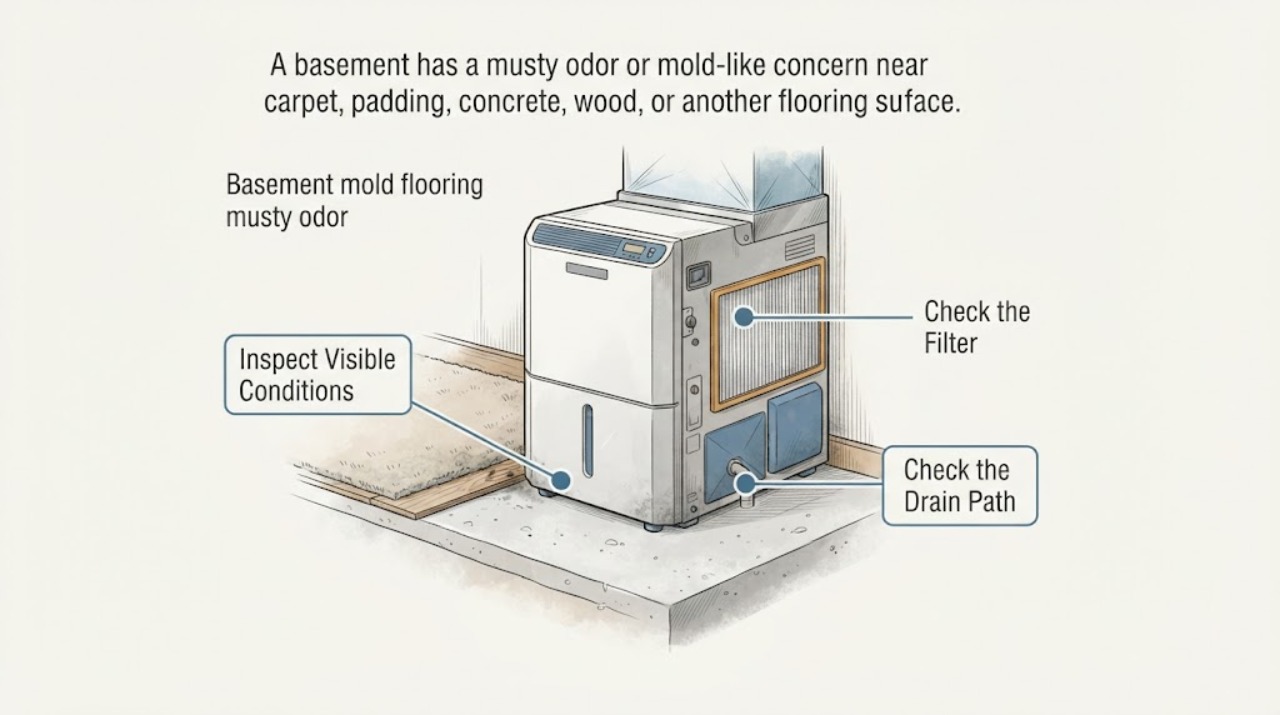
Work through in order
Diagnostic checks
Use only checks that match the exact appliance or system and its official guide.
-
Check 1
From a safe position, move only through clearly dry and stable parts of the basement and note where the musty odor is strongest without lifting, shifting, or opening flooring materials.
Expected result: Record whether the odor is strongest over one carpeted area, along a wall or floor edge, near a drain or utility line, across the room, or not reproducible; note whether it changes after rain or when the basement is closed.
Next step: Make a simple room map and provide the location and timing to an experienced mold or water-damage professional; do not chase the odor by opening concealed areas.
Stop if: Stop if the route is wet, unstable, poorly ventilated, electrically unsafe, or causes coughing, wheezing, eye irritation, or other concerning symptoms.
Why this matters
Why: A localized odor helps a professional prioritize the floor or an adjacent moisture source, while a broad or changing odor may involve more than one area. Odor alone cannot identify mold or its extent.
-
Check 2
Look at the flooring surface, baseboard edge, and nearby wall from above and from a safe distance without lifting, pressing, probing, scraping, or removing anything.
Expected result: Record visible staining, discoloration, swelling, buckling, rippling, edge separation, softened-looking material, dampness, or no visible change; note whether the change is isolated or spreading.
Next step: Photograph the change with its room location and give it to the professional; keep people and pets off a soft, buckled, or unstable section.
Stop if: Stop immediately for a soft or collapsing floor, active seepage, standing water, exposed wiring, or any need to disturb the floor to see more.
Why this matters
Why: Surface change supports a moisture or material assessment, but hidden pad, subfloor, slab, or wall conditions may be affected even when the surface appears normal.
-
Check 3
From safe, dry areas, look for visible condensation, water marks, seepage at the wall-floor joint, plumbing drips, drain overflow, recent flooding, or damp storage near the odor without moving wet items or opening finishes.
Expected result: Record whether the moisture appears current or historical, whether it follows rainfall or plumbing use, and whether it is near the suspect flooring or a different part of the basement.
Next step: Share the moisture timeline and safe-view photographs and request an assessment that addresses the water source before any flooring or mold cleanup decision.
Stop if: Stop and leave the area for standing water, active flooding, a ceiling or wall leak near electrical equipment, a sewage concern, or an unsafe walking surface.
Why this matters
Why: The timing and location can point a professional toward seepage, a leak, condensation, or a spill, while a dry day does not rule out hidden or intermittent moisture.
-
Check 4
From occupied rooms and the basement entrance, note whether the musty odor or irritation is present only near the floor or travels to stairs, living areas, storage rooms, or HVAC supply and return locations without operating equipment to spread or reproduce it.
Expected result: Record the rooms affected, whether the odor is stronger after the HVAC or basement door has been used, and whether anyone reports symptoms; do not infer a medical cause or a confirmed mold route from this pattern.
Next step: Keep people with respiratory sensitivity away from the area as practical, avoid operating a system that could distribute suspected contamination, and provide the room pattern to the professional.
Stop if: Stop if anyone has severe breathing difficulty, faintness, rapidly worsening symptoms, or if investigating would require entering a restricted or poorly ventilated space.
Why this matters
Why: Spread through several rooms raises the priority of professional assessment and occupant-exposure planning, while a localized odor may still involve hidden layers.
-
Check 5
Compare dated photographs and household records for prior leaks, floods, carpet installation, drying, cleaning, or odor recurrence without opening the flooring or testing the material.
Expected result: Record whether the odor returns after rain, seasonal humidity, a plumbing event, or prior cleanup, and whether visible changes persist or recur in the same spot.
Next step: Give the timeline to an experienced mold or water-damage professional and ask them to assess the floor assembly and underlying moisture path before any repair or replacement decision.
Stop if: Stop if further history gathering would require disturbing contaminated material, moving soaked items, sampling, chemical treatment, or entering an attic, crawl space, or other restricted area.
Why this matters
Why: Recurrence after cleanup suggests the moisture source or hidden material may not have been resolved, but the history does not establish the cause without professional assessment.
Use your observations
Decision map
Find the observation that best matches what you see, then follow the next safe action.
-
PATH 01Safety boundary
What you see
There is standing or rapidly rising water, water near electrical equipment, a soft or collapsing floor, sewage concern, severe breathing difficulty, or another immediate hazard.
Do this next
Leave the area, keep people and pets away, and seek emergency or qualified help as appropriate; obtain urgent medical help for severe breathing difficulty.
Why this path and its safety boundary
Safety stop: Stop all observation until the hazard is addressed.
-
PATH 02Safety boundary
What you see
Staining, swelling, buckling, dampness, or a recurring odor is visible near the flooring without an immediate emergency.
Do this next
Keep the area clear and request a professional moisture and mold assessment that includes flooring layers and adjacent sources.
Why this path and its safety boundary
Safety stop: Do not lift, cut, probe, scrape, sample, spray, or apply a sealant or bleach mixture.
-
PATH 03Safety boundary
What you see
The odor reaches multiple rooms, the HVAC path may be involved, or an occupant reports symptoms or has significant respiratory sensitivity.
Do this next
Reduce exposure by keeping people away as practical and arrange prompt professional assessment; seek medical guidance for symptoms.
Why this path and its safety boundary
Safety stop: Stop if symptoms become severe or if investigating would disturb material or enter a restricted space.
-
PATH 04Safety boundary
What you see
The basement has a persistent localized musty odor but no visible flooring or moisture change can be confirmed safely.
Do this next
Document the odor pattern and arrange professional advice rather than lifting the floor or ordering a DIY test.
Why this path and its safety boundary
Safety stop: Stop if a check requires sampling, destructive access, chemical treatment, or entry into a restricted space.
Helpful context
Understand the symptom
Why flooring can hold the clue
Basement moisture can come from seepage through the slab, leaks, condensation, flooding, or damp air. Carpet, pad, wood, and other flooring layers can hide moisture or growth underneath, so a clean-looking top surface does not clear the floor assembly. A musty odor helps locate a concern but does not prove the material or source by itself.
Observe without disturbing the layers
Use photographs, notes, and a room sketch from a safe location. Do not lift flooring, cut into it, scrape growth, collect a sample, spray a cleaner, or run equipment in a way that could spread particles. If the basement has standing water or electrical equipment is wet, leave the area and get qualified help.
What a professional needs to know
Share the strongest odor location, visible surface changes, the moisture or weather timeline, the flooring type if known, and whether the odor reaches other rooms. The professional can determine whether the source is the floor, a wall or pipe, a drain, the HVAC system, or a hidden layer and plan safe assessment and remediation.
Only after diagnosis
Potential parts
- humidity meter
A humidity meter may help document general basement conditions when a professional is investigating a moisture pattern, but it cannot locate hidden mold or clear the flooring.
Treat readings as supplemental, location-dependent observations and do not use one reading as a remediation or reoccupancy decision. - moisture meter
A professional may choose a suitable moisture meter to assess flooring or adjacent materials without immediately opening them; it is not a reason for the reader to probe or sample.
The material, surface, and instrument method affect readings; have a qualified assessor select and interpret it. - dehumidifier
A dehumidifier may be considered after a professional confirms it is safe and appropriate for general moisture control, not as a substitute for fixing a leak or remediating contaminated flooring.
Confirm capacity, drainage, electrical safety, and placement for the specific basement; do not operate equipment in standing water or near unsafe wiring.
When checks do not resolve it
Need a professional?
Request an experienced mold or water-damage professional for a persistent basement musty odor, visible flooring change, prior flood or leak, recurring dampness, broad odor spread, or hidden-floor concern. Escalate urgently for standing water, sewage, a soft or collapsing floor, wet electrical equipment, severe breathing difficulty, or widespread contamination.
Safety scope: The professional must handle flooring access, moisture detection, sampling decisions, containment, mold cleanup, removal or replacement, electrical or water hazards, and reoccupancy guidance. The reader should not lift flooring, sample, scrape, spray, mix bleach, disturb material, or enter restricted spaces.
Common questions
FAQ
Does a musty basement odor prove that the floor has mold?
No. It is a useful clue that moisture or a hidden source may be present, but the odor may come from flooring, a wall, a drain, or another area. Document it and request professional assessment.
Should I lift the carpet or flooring to look underneath?
No. Do not lift, cut, scrape, sample, or disturb the flooring. Hidden layers can release particles or expose unsafe moisture, and a professional should plan the access and containment.
Can I spray bleach on the basement floor?
Do not spray or mix chemicals in this observation-only workflow. Chemical treatment cannot replace moisture correction or safe assessment of carpet, pad, subfloor, concrete, or hidden contamination.
When is a basement floor concern urgent?
Leave and seek urgent help for standing or sewage water, a soft or collapsing floor, water near electrical equipment, severe breathing difficulty, or widespread contamination. Keep people and pets away until qualified personnel assess the area.
Read the exact guide
Official sources
- MoldCenters for Disease Control and Prevention · Supports the relationship between moisture and mold, possible musty odor and health effects, the concern with damp basement carpeting, and the need to address moisture rather than self-diagnose by testing.
- Mold Course Chapter 3: Finding Mold and MoistureU.S. Environmental Protection Agency · Supports looking in damp or musty areas, recognizing hidden mold beneath carpets and pads, avoiding disturbance, and using experienced professionals for hidden or extensive concerns.
- What are the main ways to control moisture in your home?U.S. Environmental Protection Agency · Supports considering seepage through basement floors, leaks, condensation, carpet over concrete, and the need to address moisture sources; it does not prescribe destructive homeowner access.
Community feedback
Share a repair observation
Share a plain-text repair observation. Accepted observations are published automatically; this page may take a moment to update.