
On this page
Start here
Quick answer
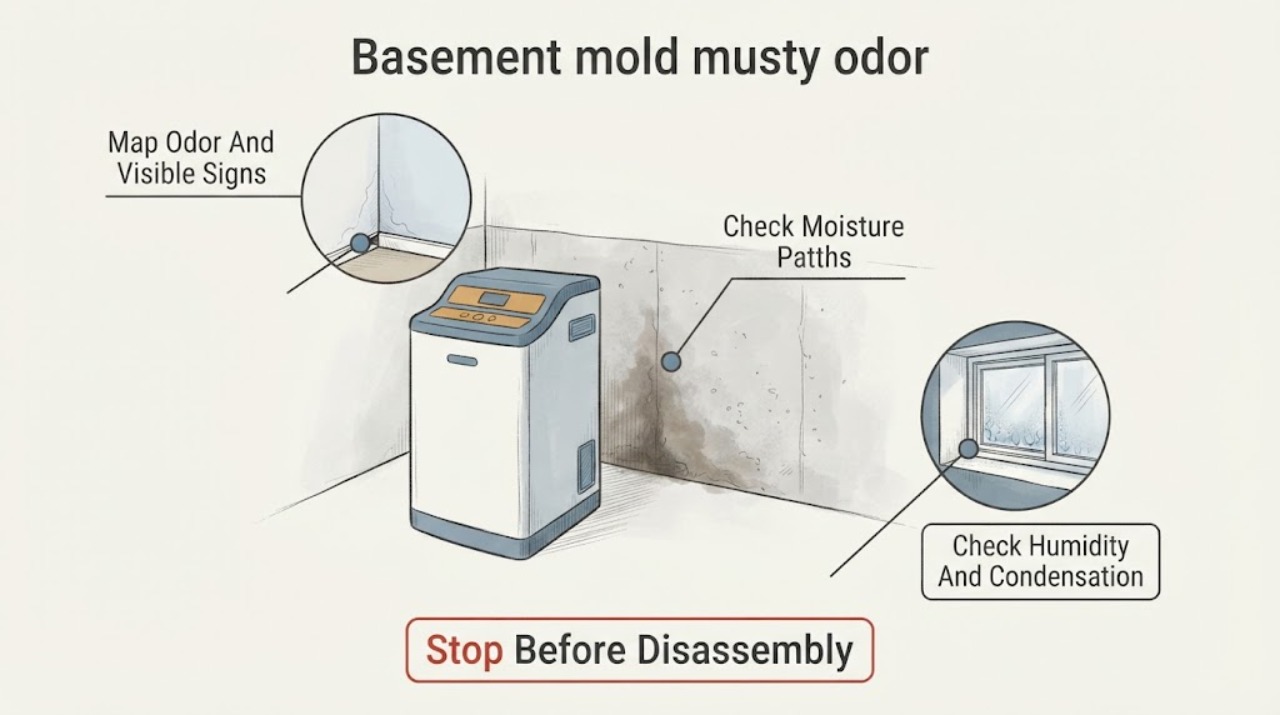
A persistent musty smell in a basement is a moisture warning, not a problem that an air freshener can diagnose. First map where the odor is strongest and look for visible water, condensation, staining, or damp materials without opening walls or disturbing suspected growth. Check and record basement humidity if you have a humidity meter, then check accessible areas around plumbing, windows, foundation walls, carpets, stored items, and HVAC equipment. If the source is hidden, the affected area is extensive, water is still entering, the HVAC system may be involved, or anyone has breathing symptoms, stop investigating and arrange an experienced mold and moisture inspection.
Work through in order
Diagnostic checks
Use only checks that match the exact appliance or system and its official guide.
-
Check 1
Walk the accessible basement perimeter and record where the odor is strongest while looking for dampness, stains, condensation, or affected porous materials; do not open walls or disturb suspected growth.
Expected result: The smell is strongest at a visible damp or stained area, near stored porous materials, or with no visible source and an apparent vent or stairway path.
Next step: Photograph and record the location and whether rain, plumbing use, or HVAC operation changes the odor; use the no-visible-source branch to arrange professional investigation sooner.
Stop if: Stop if locating the source would require opening finishes, moving contaminated materials, entering a confined space, or dismantling HVAC equipment.
Why this matters
Why: A localized damp or porous-material pattern points to a moisture path; an unexplained or air-path odor raises the possibility of hidden growth or an HVAC-related source.
-
Check 2
Visually inspect accessible plumbing, foundation-wall corners, windows, sump or drain areas, floor edges, and exposed stairs for water entry, wetness, tide marks, swelling, rust, or recurring stains; do not touch wet electrical equipment.
Expected result: There is active dripping or standing water, a fresh or recurring stain, or only a dry historical mark while the odor persists.
Next step: Keep the area undisturbed, document the source and timing, and give those observations to a qualified professional if the source is not safely identifiable.
Stop if: Stop for active water near electrical equipment, flooding, unsafe access, or any need to seal, paint, demolish, scrape, or chemically treat a suspect surface.
Why this matters
Why: Active or recurring moisture takes priority and must be identified before cleanup; a dry mark documents history but does not rule out concealed wet material or mold.
-
Check 3
Measure basement relative humidity in the living area and near the strongest odor if practical, and note condensation on pipes, windows, or foundation surfaces together with the time and operating conditions.
Expected result: Humidity is elevated or fluctuates with rain or HVAC operation, condensation is visible, or readings are ordinary while the odor continues.
Next step: Record the locations and readings for an inspector and prioritize a hidden-source assessment if the odor persists at ordinary humidity.
Stop if: Stop if assessing the area would require moving suspect materials, opening a wall or duct, or entering an unsafe or confined space.
Why this matters
Why: Elevated humidity or condensation can support recurring growth; ordinary humidity does not rule out a concealed wet material or past leak.
-
Check 4
Answer yes or no to whether there is extensive visible growth, active water, an unexplained strong odor, a suspected HVAC source, unsafe access, or occupant breathing symptoms.
Expected result: If yes to any item, keep people and pets away from the affected area and stop at safe observation; if no, finish documenting accessible observations without starting remediation.
Next step: Provide the professional with the odor map, photos, water history, humidity readings, HVAC relationship, and occupant symptoms.
Stop if: Stop immediately when any listed escalation condition is present, or if symptoms worsen in the basement.
Why this matters
Why: A yes requires an experienced mold-and-moisture professional; a no does not prove hidden mold is absent.
Helpful context
Understand the symptom
Why the smell matters
Mold-related volatile compounds can produce the musty odor associated with mold growth. The smell does not identify the species, size, or exact location, and it can remain after a leak has dried. The useful first question is where moisture is or was present: a basement wall, floor, stored material, plumbing route, or air-handling path. Moisture control is the decision point; masking the smell or treating an isolated surface does not establish that the source is gone.
What not to do
Do not open drywall, pull up carpet, dismantle ductwork, scrape suspected growth, or enter a crawlspace just to locate the smell. Do not mix bleach with ammonia or other cleaners. A musty odor with hidden-source clues is a reason to arrange an assessment, not a reason to create airborne dust or seal a wet surface behind a new finish.
When the check is complete
You have enough information for the next decision when you can state where the odor is strongest, whether moisture is active or historical, what the humidity readings were, whether HVAC operation changes the odor, and which surfaces or spaces were not safely accessible. If the smell continues after the known moisture source is addressed, visible mold or odor remains, or the same area becomes damp again, treat that as an unresolved moisture problem and arrange follow-up.
Only after diagnosis
Potential parts
- humidity-meter
Useful for documenting basement humidity during the observation step; it does not identify mold or replace a moisture investigation.
- moisture-meter
May help a qualified investigator compare accessible materials, but readings depend on the material and instrument and do not by themselves diagnose mold.
- dehumidifier
Can support humidity control after the water source and safe operating conditions are understood; it is not a substitute for finding a leak or hidden growth.
When checks do not resolve it
Need a professional?
Call for an experienced mold-and-moisture inspection when the odor is persistent or unexplained, moisture is active or recurring, the affected area is not safely accessible, the HVAC path may be involved, visible growth is extensive, or occupants develop symptoms.
Have this ready
- The date the odor began and whether rain, snowmelt, plumbing use, or HVAC operation changes it
- A marked floor-plan or photos showing the strongest odor and any stains, condensation, or damp materials
- Humidity readings with location and time
- Any known leaks, flooding, prior drying, or unfinished and finished basement areas
- Whether anyone has asthma, immune compromise, or new breathing symptoms
Common questions
FAQ
Does a musty basement smell always prove there is mold?
It is a meaningful warning that moisture or mold may be present, but the smell alone cannot identify the source, extent, or type. Map the odor and document moisture clues without opening finishes; persistent or unexplained odor warrants professional investigation.
Should I buy a home mold test kit first?
Routine home sampling is not the first decision when you can see or smell a problem. Finding and correcting the moisture source and assessing the affected area matter more; if sampling would change a specific decision, use a professional with experience designing and interpreting it.
Will a dehumidifier fix the basement odor?
It may help control high humidity after the moisture source and safe operating conditions are understood, but it cannot prove that hidden wet materials or mold are gone. If the odor continues at ordinary humidity, arrange a moisture-and-mold assessment.
When should I stop looking and call someone?
Stop when there is active water, unsafe access, extensive visible growth, a hidden or HVAC-related source, or symptoms that worsen in the basement. Provide the professional with your odor map, photos, water history, humidity readings, and HVAC observations.
Read the exact guide
Official sources
- Mold Course Chapter 3: Finding Mold and MoistureU.S. Environmental Protection Agency · Supports checking damp and musty areas, recognizing hidden locations, noting HVAC pathways, and using professional investigation when disturbance could spread mold.
- A Brief Guide to Mold, Moisture and Your HomeU.S. Environmental Protection Agency · Supports the humidity guidance, hidden-mold cautions, moisture-first approach, and escalation language for residential basements.
- MoldCenters for Disease Control and Prevention · Supports health-related stop conditions, humidity and leak prevention context, and the statement that CDC does not recommend routine home mold testing.
- What does mold smell like?U.S. Environmental Protection Agency · Explains that microbial volatile compounds can produce a musty odor and that moisture control is central to mold control.
Community feedback
Share a repair observation
Share a plain-text repair observation. Accepted observations are published automatically; this page may take a moment to update.