
On this page
Start here
Quick answer
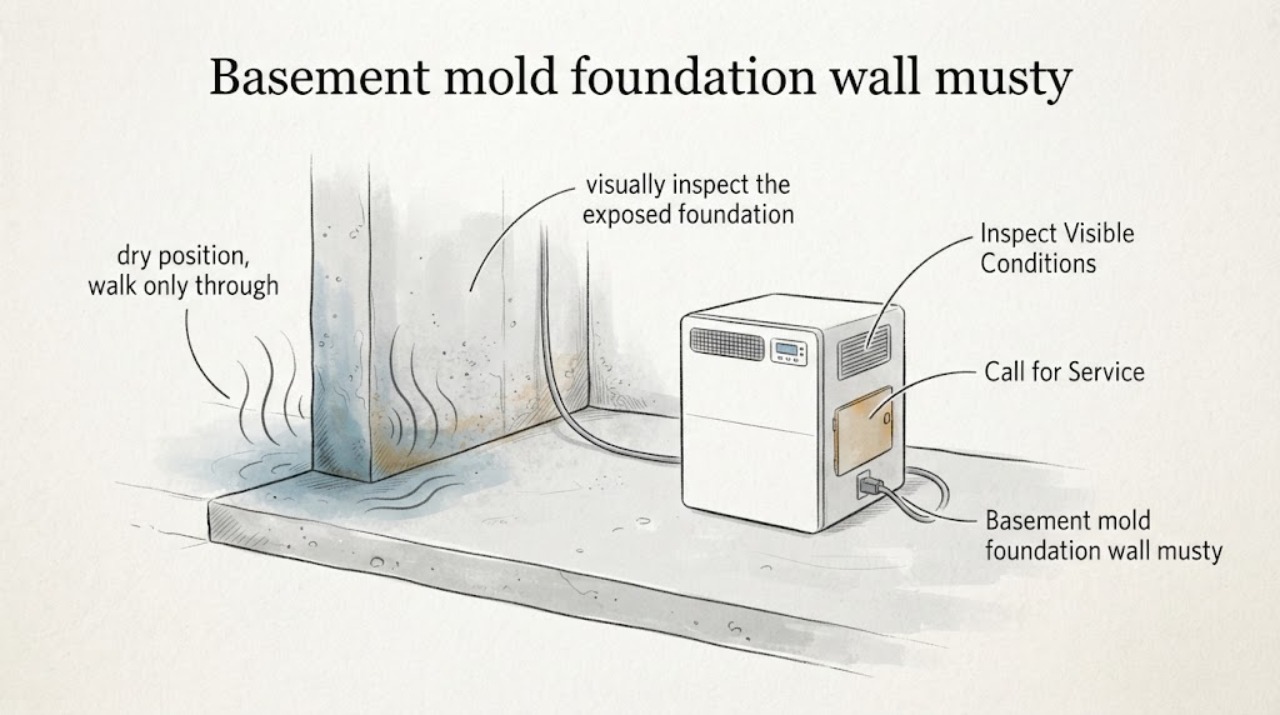
A musty odor near a basement foundation wall is a reason to investigate moisture and possible hidden mold, not to spray or open the wall. From a safe, dry position, map where the odor is strongest, look for staining, condensation, dampness, efflorescence, or soft-looking finishes, and compare the pattern after rain or snowmelt. Do not scrape, sample, spray, remove wall coverings, or perform DIY mold remediation. Keep people with breathing symptoms away and isolate areas with visible mold, standing water, structural softening, or damp electrical equipment. A qualified mold-remediation or building professional should identify the moisture source and assess the wall and concealed materials before cleanup.
Work through in order
Diagnostic checks
Use only checks that match the exact appliance or system and its official guide.
-
Check 1
From a safe, dry position, walk only through clear areas and compare the musty odor at the basement entry, along the foundation wall, near corners, and around visible pipes or windows. Do not enter standing water or lean against the wall.
Expected result: Record whether the odor is absent, localized to one section, strongest at a corner or penetration, or widespread across the basement; note whether it changes with the door or ventilation open under normal safe conditions.
Next step: Mark the locations on a simple room sketch and photograph only visible surfaces. Arrange professional mold/moisture assessment, especially when the odor persists without a visible source.
Stop if: Stop and leave the area if anyone develops coughing, wheezing, eye or throat irritation, dizziness, or other breathing symptoms, or if the odor accompanies sewage, chemicals, or an electrical burning smell.
Why this matters
Why: A localized odor can point a professional toward a moisture path or concealed area, while a widespread odor suggests a broader humidity or contamination concern. Odor alone does not prove the mold type or source.
-
Check 2
From the same dry position, visually inspect the exposed foundation wall and adjacent finish for water stains, damp sheen, condensation, white mineral-like deposits, peeling paint, darkened areas, or mold-like growth. Do not touch, scrape, wipe, or probe the surface.
Expected result: Classify the wall as visibly dry and intact, showing an old-looking stain or deposit, showing current dampness or condensation, or showing visible growth, crumbling finish, or soft-looking material.
Next step: Photograph the wall from a distance with a reference point, record the approximate area, and keep the room and affected wall undisturbed while arranging service. Do not cover the area with paint or caulk.
Stop if: Stop immediately for standing water, a bulging or soft wall, crumbling material, visible widespread growth, or damp electrical equipment. Isolate the area and escalate to qualified remediation, water, structural, or electrical professionals as applicable.
Why this matters
Why: Moisture clues support a water or humidity investigation; mineral deposits can accompany moisture but do not identify the source; visible growth or damaged material increases the need for controlled professional assessment.
-
Check 3
Look from inside the basement and, without excavation or handling materials, observe the visible area outside the foundation near the affected wall for pooling, downspout discharge, snowmelt path, saturated soil, or recent weather-related changes.
Expected result: Record no visible outdoor water pattern, water directed toward the wall, pooling after rain or melt, or an outdoor condition that cannot be safely approached.
Next step: Note the date and weather when the odor or dampness changes and share the pattern with a qualified building or moisture professional. Do not dig, regrade, move soil, or alter drainage as a test.
Stop if: Stop if the ground is unstable, water is moving toward electrical equipment, the foundation appears displaced, or inspection would require entering a hazardous area. Keep clear and arrange professional assessment.
Why this matters
Why: A weather-linked exterior pattern can help a professional investigate drainage or seepage, while no visible pattern does not rule out concealed plumbing, vapor, or condensation. The observation is not a diagnosis of the foundation.
-
Check 4
Observe the basement after ordinary weather changes from a safe location: compare the odor and visible wall condition after dry weather with the condition after rain, snowmelt, or a plumbing event. Do not create a water test or run a suspect appliance.
Expected result: Record a pattern that worsens after rain or melt, follows plumbing use, appears during warm humid weather, or remains unchanged across conditions.
Next step: Give the professional the dates, weather, plumbing events, and photos so they can select a safe moisture investigation. Keep the area dry and avoid disturbing finishes while the cause is unknown.
Stop if: Stop and isolate the area if water becomes active, the wall or floor softens, sewage is suspected, or anyone experiences breathing symptoms.
Why this matters
Why: Weather timing can suggest seepage or surface runoff, plumbing timing can suggest a leak, and warm or humid timing can suggest condensation; the same odor may have more than one contributor.
-
Check 5
From a safe location, note whether the odor or suspected wall area is near a furnace, air handler, return grille, stored porous goods, or a dehumidifier, and record any recent flooding, renovation, or prolonged closure. Do not open equipment or move potentially contaminated contents.
Expected result: Record no nearby equipment, a possible HVAC or stored-material connection, or a history of water damage or renovation that could have concealed moisture.
Next step: Keep suspect HVAC equipment off if contamination is known or strongly suspected, keep occupants out of the area, and tell the remediation or building professional the full history and locations.
Stop if: Stop if the equipment or contents are wet, visibly moldy, electrically unsafe, or would need opening, demolition, or handling to inspect.
Why this matters
Why: Air movement can spread odor beyond its source, and stored porous materials or a past water event can preserve moisture. A nearby HVAC system or concealed cavity needs professional evaluation if contamination is suspected.
Use your observations
Decision map
Find the observation that best matches what you see, then follow the next safe action.
-
PATH 01Safety boundary
What you see
The odor is localized, the visible wall is dry and intact, and there is no active water or visible growth.
Do this next
Document the location and weather pattern and schedule a qualified moisture or mold assessment before making cosmetic changes.
Why this path and its safety boundary
Safety stop: Do not mask the odor with paint, caulk, fragrance, or spray.
-
PATH 02Safety boundary
What you see
The odor worsens after rain or snowmelt and the exterior shows pooling or water directed toward the foundation.
Do this next
Give the professional the weather-linked photos and request evaluation of drainage, seepage, and the foundation-wall finish. Keep the area undisturbed.
Why this path and its safety boundary
Safety stop: Do not excavate, regrade, or alter drainage as a homeowner test.
-
PATH 03Safety boundary
What you see
The wall shows dampness, condensation, staining, efflorescence, crumbling finish, or softening.
Do this next
Isolate the area and request qualified water, building, structural, and mold-remediation assessment as indicated. Address the moisture source before any cleanup or finish replacement.
Why this path and its safety boundary
Safety stop: Do not scrape, sample, spray, open the wall, or touch damp electrical equipment.
-
PATH 04Safety boundary
What you see
Visible mold-like growth is widespread, the odor is strong throughout the basement, or a person has breathing symptoms.
Do this next
Keep occupants, children, and pets away and arrange professional remediation and health guidance. Provide the odor map, photos, symptoms, and any water history.
Why this path and its safety boundary
Safety stop: Do not perform DIY remediation, disturb porous materials, or run HVAC equipment suspected of spreading contamination.
-
PATH 05Safety boundary
What you see
There is standing water, sewage, a chemical odor, active leakage, structural movement, or damp electrical equipment.
Do this next
Leave the hazard area, keep others away, and contact the appropriate emergency, water, electrical, structural, or remediation professional from a safe location.
Why this path and its safety boundary
Safety stop: Do not enter contaminated or electrically unsafe water, operate wet equipment, or attempt cleanup or structural work.
Helpful context
Understand the symptom
Why a musty foundation-wall odor matters
A musty smell can indicate mold growth or moisture that is not visible at the wall surface. Foundation seepage, condensation, plumbing, drainage, and past flooding can create different patterns, and a visual walk-through cannot establish the source or extent. The useful first record is where the odor and visible clues occur, when they change, and whether anyone has symptoms.
Keep the wall and air undisturbed
Do not scrape a stain to identify it, take a do-it-yourself mold sample, spray a biocide, open drywall, or move a suspected contaminated material. Do not run equipment or touch electrical items that are wet. The goal of these checks is to protect occupants and give a qualified professional a safe, specific starting point.
Only after diagnosis
Potential parts
- humidity meter
Consider this only for a noninvasive room-humidity observation when the basement is dry and safe; a reading does not locate a leak or confirm mold.
Choose a device suitable for indoor room readings and interpret it as a screening observation, not a professional moisture or mold diagnosis. - moisture meter
This category is relevant only when a qualified professional confirms that a non-destructive surface reading is appropriate and the wall material is safe to assess.
Readings vary by substrate and instrument; the professional must select the method and interpret results without disturbing suspect material. - dehumidifier
Consider humidity-control equipment only after electrical safety, active water, and the moisture source are assessed; lowering humidity does not remediate hidden mold or a leak.
Confirm safe placement, drainage, capacity, and electrical conditions for the room and follow the manufacturer’s instructions.
When checks do not resolve it
Need a professional?
Call a qualified mold-remediation or building/moisture professional for persistent musty odor, visible growth, wall dampness, recurring stains, or a hidden source. Involve water, plumbing, structural, or electrical professionals when those conditions are suspected. Breathing symptoms, broad growth, standing water, structural softening, sewage, or damp electrical equipment require prompt escalation.
Have this ready
- Provide the odor map, safe-viewpoint photographs, wall condition and stain locations, weather and plumbing timing, visible exterior drainage pattern, room humidity if safely observed, water or renovation history, affected occupants, and any nearby HVAC or stored-material concern.
Common questions
FAQ
Does a musty basement odor prove there is mold?
No, but it is a meaningful reason to investigate moisture and possible hidden mold. Map the odor and look for visible moisture clues from a safe position; do not open walls or sample material yourself.
Can I spray the foundation wall with bleach or another product?
Do not spray or perform DIY mold remediation for this observation-only situation. Spraying can disturb material, mask the source, and fail to address hidden moisture. Arrange qualified assessment, especially when the wall is damp, soft, or visibly affected.
What basement clues suggest a foundation moisture problem?
Weather-linked odor or dampness, pooling outside the affected wall, staining, condensation, mineral-like deposits, and recurring changes after rain or snowmelt are useful clues. They do not prove the source; a professional should evaluate drainage, seepage, plumbing, and condensation.
When should I leave the basement and call for help?
Leave or isolate the area for breathing symptoms, widespread growth, standing water, sewage, structural softening or movement, active leakage, chemical odor, or damp electrical equipment. Keep others away and contact the appropriate emergency, water, structural, electrical, or remediation professional.
Read the exact guide
Official sources
- Mold Course Chapter 4: General Remediation IssuesU.S. Environmental Protection Agency · Used here for escalation logic and assessment questions, not as a DIY remediation procedure.
- A Brief Guide to Mold, Moisture and Your HomeU.S. Environmental Protection Agency · Relevant to basement and foundation-wall observation and escalation; the article follows the assigned non-invasive observation boundary rather than EPA cleanup procedures.
- What does mold smell like?U.S. Environmental Protection Agency · Relevant to residential musty odor observations; an odor does not by itself identify the source, type, or extent of mold.
Community feedback
Share a repair observation
Share a plain-text repair observation. Accepted observations are published automatically; this page may take a moment to update.