
On this page
Start here
Quick answer
For basement mold in a crawlspace when high humidity is suspected, start from a safe standing position or doorway: record humidity if a gauge is already available, look for condensation, standing water, wet soil, staining, or visible growth, and note when it appears. Do not enter a crawlspace, disturb mold or insulation, mix cleaners, or use a ladder. High humidity can support mold growth even without a visible leak; stop and request qualified mold-remediation service when the area is inaccessible, contaminated, structurally wet, or the problem recurs.
Before you begin
Safety first
- Do not enter the crawlspace, climb, disturb mold or insulation, clean contaminated material, mix chemicals, open concealed assemblies, or work near exposed utilities.
Work through in order
Diagnostic checks
Use only checks that match the exact appliance or system and its official guide.
-
Check 1
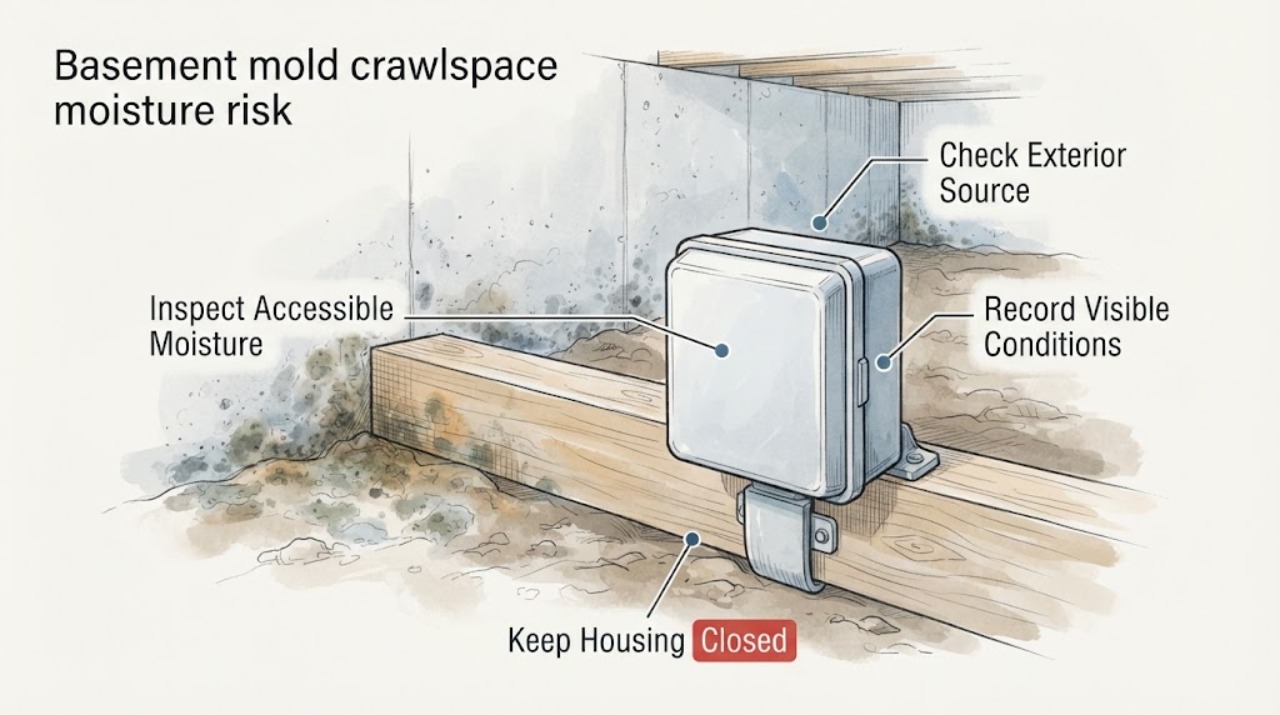
From a doorway or another stable area without entering the crawlspace, visually inspect accessible foundation edges, floor or wall joints, ducts, pipes, insulation, and framing for condensation, staining, pooled water, damp soil, or visible mold. Do not move material.
Expected result: The accessible area may be dry, show condensation, show staining or damp materials, contain pooled water, or be impossible to inspect safely.
Next step: Photograph each finding from a safe viewpoint and record its location, material, and whether it appeared after rain or equipment use.
Stop if: Stop if inspection requires entering the crawlspace, moving insulation, touching mold or waste, climbing, or approaching unstable or energized equipment.
Why this matters
Why: Condensation on a cold surface supports a high-humidity or cold-surface pathway; pooled water, damp soil, or wet materials suggest an active moisture source. A dry-looking surface does not rule out hidden or intermittent moisture.
-
Check 2
If a humidity gauge or meter is already available at ordinary standing height, record the relative-humidity reading at the doorway or accessible area without entering, relocating material, or creating a new test setup.
Expected result: The reading may be persistently high, vary with weather or HVAC operation, appear normal, or be unavailable.
Next step: Record the reading, time, weather, and location for the professional; do not buy or install equipment solely from one reading.
Stop if: Stop if taking the reading requires crawlspace entry, contact with wet or contaminated material, or unsafe access.
Why this matters
Why: A persistently high reading supports a humidity-control assessment; a normal reading at one time does not clear a recurring or weather-dependent moisture problem.
-
Check 3
From ground level, observe the exterior around the foundation for downspouts discharging toward the building, poor drainage, standing water, wet soil, or recent runoff; do not climb or dig.
Expected result: The exterior may be dry, show runoff toward the foundation, show ponding, or be obscured or inaccessible.
Next step: Photograph the discharge or wet area and correlate it with the interior location and rainfall timing.
Stop if: Stop for unstable ground, floodwater, electrical hazards, structural movement, or any need to climb or excavate.
Why this matters
Why: A repeatable exterior pattern after rain points to a water-entry or drainage assessment, while interior condensation without runoff keeps humidity or cold-surface causes in consideration.
-
Check 4
Review when the odor, visible growth, condensation, or dampness appears in relation to rain, temperature changes, HVAC operation, plumbing use, or a prior leak, using notes rather than repeated exposure.
Expected result: The issue may follow rain, cold weather, HVAC cycles, plumbing events, or have no clear trigger.
Next step: Send the timeline with photos and humidity readings, if any, to a qualified mold-remediation or building-moisture professional.
Stop if: Stop if occupants develop breathing or allergy symptoms, the area is contaminated, or the check requires entry or cleaning.
Why this matters
Why: A weather-linked pattern favors water-entry investigation; a pattern linked to cold surfaces or HVAC operation favors a humidity, condensation, or ventilation assessment. Timing alone does not identify the mold species or repair.
-
Check 5
Record the location and apparent extent of visible mold or odor from outside the affected area, including whether it involves wood, insulation, drywall, ductwork, or stored items; do not scrape, vacuum, spray, or disturb it.
Expected result: The concern may be an odor without visible growth, a localized spot, widespread growth, affected porous material, or suspected hidden growth.
Next step: Keep people and pets away as appropriate and provide the material, location, photos, and any health or access concern to the professional.
Stop if: Stop immediately for health symptoms, sewage or flood contamination, structural damage, unsafe access, or any request to handle or clean the material.
Why this matters
Why: Mold on porous materials, in insulation or ductwork, or across a broad area may need professional scope and source correction; a small visible spot still does not prove the underlying moisture is resolved.
Use your observations
Decision map
Find the observation that best matches what you see, then follow the next safe action.
-
PATH 01Safety boundary
What you see
A humidity reading is persistently high or condensation appears on cold surfaces, but no active leak is visible from a safe viewpoint.
Do this next
Arrange professional assessment of humidity control, ventilation, insulation, and the crawlspace moisture pathway before selecting equipment.
Why this path and its safety boundary
Why it matters: Humidity or condensation may be supplying moisture even without an obvious plumbing leak.
Safety stop: Do not enter the crawlspace or install a dehumidifier as a substitute for finding the moisture source.
-
PATH 02Safety boundary
What you see
Standing water, damp soil, wet insulation, staining, or recurring moisture appears after rain or runoff.
Do this next
Arrange prompt moisture-source and building assessment; provide the exterior and interior timing record.
Why this path and its safety boundary
Why it matters: An exterior drainage, groundwater, plumbing, or building-envelope source may be feeding the mold risk.
Safety stop: Stay out of floodwater and unstable areas, and do not dig, pump, or remove wet materials as an experiment.
-
PATH 03Safety boundary
What you see
Visible mold, musty odor, or suspected growth involves porous materials, insulation, ductwork, or a broad or hidden area.
Do this next
Keep the area undisturbed and request qualified mold-remediation assessment and source correction.
Why this path and its safety boundary
Why it matters: Surface appearance cannot establish the full extent or whether HVAC components or building materials are affected.
Safety stop: Do not scrape, vacuum, spray biocides, mix bleach, or enter the crawlspace.
-
PATH 04Safety boundary
What you see
The crawlspace is inaccessible, requires entry or elevated access, or has contamination, structural damage, or exposed utilities.
Do this next
Stop the inspection, keep people and pets clear, and arrange qualified service.
Why this path and its safety boundary
Why it matters: The stated safety boundary is observation-only; additional access can expose the reader to fall, structural, electrical, or contamination hazards.
Safety stop: Do not cross the boundary for a better photo or measurement.
-
PATH 05Safety boundary
What you see
Safe observations show no abnormal moisture, but the high-humidity concern, odor, or mold risk recurs.
Do this next
Provide the timing log and arrange professional diagnosis rather than treating the surface symptom alone.
Why this path and its safety boundary
Why it matters: Intermittent condensation or concealed moisture can be missed by a single dry observation.
Safety stop: Stop repeated exposure or testing if symptoms, contamination, or unsafe access appears.
Helpful context
Understand the symptom
Start with the moisture pattern
For a crawlspace moisture and mold concern, humidity is a condition to document, not a diagnosis by itself. Condensation, damp soil, standing water, and wet building materials point to different moisture paths. Begin from a safe viewpoint and record timing before any repair decision.
Separate humidity from the source
High humidity can support mold growth through condensation even when no plumbing leak is visible. A crawlspace can also receive moisture from soil, groundwater, runoff, or building leaks, so a dry surface at one moment does not prove the area is dry.
Keep the crawlspace undisturbed
This page is observation-only. Do not enter the crawlspace, disturb mold or insulation, clean contaminated material, mix chemicals, climb, or open concealed building and HVAC assemblies. Qualified service should determine the source, affected materials, and drying or remediation plan.
Only after diagnosis
Potential parts
- humidity-meter
Consider this only when a professional or the documented pattern indicates that ongoing humidity monitoring will help manage the confirmed moisture pathway.
Confirm the space, drainage arrangement, electrical requirements, capacity, and professional recommendation before ordering; equipment cannot replace correction of a water source. - moisture-meter
Consider this only after a qualified assessment identifies a safe material and measurement purpose; do not use it to justify crawlspace entry or contact with mold.
Use only for accessible, non-contaminated materials and confirm the material, measurement method, and professional interpretation before purchase. - crawlspace-dehumidifier
Consider this only after the moisture source, access, drainage, and safe installation plan are confirmed; humidity control alone may not resolve active water entry.
Confirm sizing, drainage, power, clearances, condensate management, and the professional moisture-control plan before ordering.
When checks do not resolve it
Need a professional?
Call qualified mold-remediation or building-moisture service when high humidity or mold concern recurs, moisture or contamination is visible, the source is unknown, or safe observation cannot reach the affected area.
Safety scope: Do not enter the crawlspace, climb, disturb mold or insulation, clean contaminated material, mix chemicals, open concealed assemblies, or work near exposed utilities.
Have this ready
- Provide safe photos, exact location and materials, humidity readings and times if available, weather/HVAC/plumbing timing, exterior drainage observations, odor or health concerns, and access limitations.
Common questions
FAQ
What is the first safe check for high humidity and crawlspace mold risk?
From a doorway or stable standing position, record any humidity reading already available and look for condensation, standing water, damp soil, staining, odor, or visible growth without entering or touching the area.
Can high humidity cause mold without an obvious leak?
Yes. High humidity can create condensation on cold surfaces and provide enough moisture for mold growth, so the absence of a visible plumbing leak does not settle the cause.
Should I clean the crawlspace mold myself?
Do not enter the crawlspace or scrape, vacuum, spray, or disturb suspected mold. Request qualified assessment, especially for porous materials, insulation, ductwork, broad growth, or contamination.
What should I tell the mold-remediation professional?
Provide the location and material, photos from safe viewpoints, humidity readings and times if available, weather or HVAC timing, exterior drainage observations, odor or health concerns, and access limits.
When should I stop checking?
Stop for unsafe access, standing or contaminated water, structural movement, exposed utilities, health symptoms, visible spread, or any task that requires entry, chemicals, cleaning, or concealed work.
Read the exact guide
Official sources
- Mold Course Chapter 2:U.S. Environmental Protection Agency · General official EPA guidance; site-specific source correction and remediation require qualified assessment.
- Mold Course Chapter 1:U.S. Environmental Protection Agency · General official EPA guidance; site-specific source correction and remediation require qualified assessment.
- Mold and Your HomeU.S. Environmental Protection Agency · General official EPA guidance; site-specific source correction and remediation require qualified assessment.
Community feedback
Share a repair observation
Share a plain-text repair observation. Accepted observations are published automatically; this page may take a moment to update.