
On this page
Start here
Quick answer
Do not enter the crawlspace or disturb moldy joists to diagnose this condition. From a dry, safe area, document where the musty odor, staining, condensation, or visible growth appears and whether it follows rain, plumbing use, or seasonal humidity. Crawlspace moisture can move into the basement and mold can weaken wet wood, so active water, widespread growth, soft or sagging joists, standing water, sewage, or symptoms require prompt assessment by a qualified mold and moisture professional.
Before you begin
Safety first
- Do not enter the crawlspace, disturb or sample mold, move insulation or stored materials, mix bleach or other cleaners, open walls, probe or cut joists, contact contaminated water, or work near wet electrical equipment.
Work through in order
Diagnostic checks
Use only checks that match the exact appliance or system and its official guide.
-
Check 1
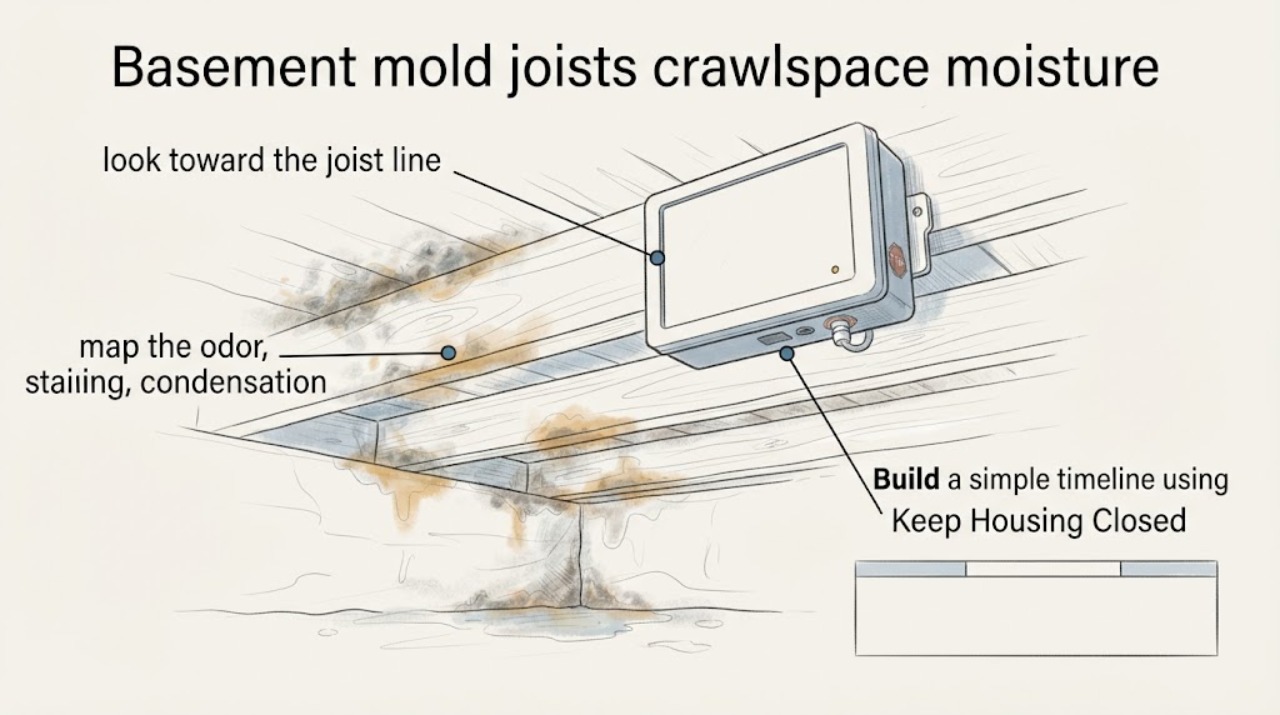
From the basement or another dry area, look toward the joist line and crawlspace access without entering, reaching in, moving insulation, or shifting stored items.
Expected result: Note whether you can safely see isolated discoloration, fuzzy or spotty growth, wet wood, dripping, pooled water, or no visible change. Record the location with a photo and do not touch the joists.
Next step: Give the location and photos to a qualified mold and moisture professional for an assessment; keep the area undisturbed while arranging it.
Stop if: Stop immediately and keep people away if there is standing water, a sagging or collapsing area, unstable material, sewage, or any electrical equipment that may be wet.
Why this matters
Why: Visible growth or wet wood confirms a moisture-related building concern but does not identify the source or whether the wood is structurally sound. No visible growth does not rule out hidden dampness.
-
Check 2
From an occupied basement area, map the odor, staining, condensation, or damp-feeling air by room and height without opening finishes or entering the crawlspace.
Expected result: Compare the joist-side area with the foundation wall, floor edge, utility penetrations, and nearby HVAC or plumbing locations. Record whether the pattern is localized, follows a wall or corner, or is spread across the room.
Next step: Share the map and dates with the professional; do not seal, paint, caulk, or cover suspected mold or damp wood before the source and extent are evaluated.
Stop if: Stop the observation and leave the area if breathing symptoms, eye irritation, strong odors, active dripping, or contact with contaminated water occurs.
Why this matters
Why: A localized pattern may point to one leak or seepage path, while a broad or recurring pattern is consistent with a moisture or humidity condition that needs a building-level assessment. The pattern alone cannot distinguish condensation from leakage.
-
Check 3
Build a simple timeline using safe observations: note whether the odor or dampness changes after rain, snowmelt, plumbing use, a high-humidity spell, or a basement HVAC cycle.
Expected result: Record the date, weather or event, room and joist-area location, visible water, and whether the condition persists when the event ends. Do not create a leak test or run appliances solely to reproduce the problem.
Next step: Provide the timeline to a qualified professional so the inspection can prioritize the likely moisture pathway and check concealed areas safely.
Stop if: Stop and seek urgent professional help if the timeline reveals active water entry, a rapidly expanding wet area, sewage or flood contamination, or water near energized equipment.
Why this matters
Why: A rain or snowmelt relationship raises concern about exterior drainage or seepage; a plumbing relationship raises concern about a leak; persistence through dry weather is compatible with stored moisture, condensation, or crawlspace humidity. These are clues, not a diagnosis.
-
Check 4
Without entering or touching the crawlspace, record the apparent extent and material condition from safe viewpoints, including whether the issue is limited to one joist area or appears across multiple bays.
Expected result: Note any bowed or sagging visible wood, widespread staining, crumbling or missing surfaces, wet insulation, or growth near air returns or other building systems. Do not press, probe, scrape, or remove anything to verify it.
Next step: Limit access to the affected area and provide the observations to a mold remediation professional; ask them to coordinate structural or HVAC specialists when indicated.
Stop if: Do not continue observing if material appears unstable, the floor or ceiling is sagging, a crawlspace entry is required, or dust or odor is spreading into occupied rooms.
Why this matters
Why: Multiple affected areas, deteriorated wood, or a pattern near air-handling equipment increases the need for prompt professional containment and may require structural or HVAC expertise. A small visible patch still needs its moisture source addressed.
-
Check 5
Ask whether anyone in the home has developed or worsened respiratory, allergy, eye, or other symptoms when spending time near the basement, without attempting to identify a mold species or perform air sampling.
Expected result: Record the symptom timing and the affected area for the professional, while recognizing that symptoms have many possible causes. Do not use a home air test as a substitute for a building inspection.
Next step: Keep vulnerable occupants away from the suspected area and arrange qualified mold/moisture assessment; seek medical advice for health symptoms from an appropriate clinician.
Stop if: Stop access immediately for breathing difficulty, severe irritation, dizziness, visible widespread growth, or a need to enter contaminated or confined space.
Why this matters
Why: Symptoms or a vulnerable occupant increase the urgency of reducing exposure and getting qualified advice. A negative or low short-term air sample would not establish that the joists or hidden spaces are safe.
Use your observations
Decision map
Find the observation that best matches what you see, then follow the next safe action.
-
PATH 01Next step
What you see
Active water, standing water, sewage, or wet electrical equipment is present.
Do this next
Provide photos and the source timeline from a dry location; treat the water and electrical hazard as higher priority than cosmetic cleanup.
Why this path and its safety boundary
Why it matters: Keep everyone out of the affected area, avoid contact with water or electrical equipment, and arrange urgent water, electrical, and mold-related professional help as applicable. Do not enter the crawlspace.
-
PATH 02Next step
What you see
The joist area is visibly moldy or damp but no active water is visible.
Do this next
Share the location map, photos, weather timeline, and any odor recurrence with the assessor.
Why this path and its safety boundary
Why it matters: The absence of dripping does not rule out stored moisture, condensation, or a concealed leak. Keep the area undisturbed and obtain a professional moisture and mold assessment.
-
PATH 03Next step
What you see
Wood appears bowed, sagging, soft-looking, crumbled, or broadly deteriorated.
Do this next
Restrict access and request coordinated mold and structural evaluation before repairs or re-occupancy decisions.
Why this path and its safety boundary
Why it matters: Treat this as a possible structural concern, not a cleaning task. Do not load, brace, probe, cut, or remove the material yourself.
-
PATH 04Next step
What you see
The pattern returns after rain or snowmelt, or follows a plumbing event.
Do this next
Give the timeline to the professional so exterior drainage, foundation seepage, and plumbing can be evaluated safely.
Why this path and its safety boundary
Why it matters: The timing supports an active moisture pathway, but it does not prove which component is leaking. Record the event rather than attempting a reproduction test.
-
PATH 05Next step
What you see
No visible growth is found from safe viewpoints and the odor does not recur.
Do this next
Keep monitoring from occupied, dry areas and escalate if odor, staining, humidity, or symptoms return; do not enter the crawlspace to obtain reassurance.
Why this path and its safety boundary
Why it matters: This lowers the visible evidence but does not rule out hidden mold or intermittent moisture, especially when there has been a known water event.
Helpful context
Understand the symptom
Why joists and crawlspaces can stay damp
A crawlspace with a bare or damp ground surface can add moisture to the air, and that moisture can migrate through cracks or openings into other parts of a building. Joists are organic wood, so persistent dampness can support mold and eventually affect the material. The visible mark is not enough to identify the source: seepage, plumbing leaks, condensation, drainage, and humidity can look similar from a finished basement.
Keep the inspection observational
This topic is a professional-service assessment, not a crawlspace cleanup recipe. Stay out of the crawlspace, do not move insulation or stored items, scrape or sample growth, spray chemicals, mix bleach with anything, open walls, or test structural members by touch. Photos taken from a safe, dry location and a short timeline of rain, odors, leaks, and occupant symptoms are more useful to the professional than a risky close inspection.
What a useful assessment should establish
The next decision is whether the joists are being affected by an active moisture source, a high-humidity environment, or an older dried event with remaining material damage. A qualified assessor can evaluate the crawlspace and concealed conditions, identify the moisture pathway, determine whether structural expertise is needed, and set a containment and remediation plan appropriate to the extent of affected material.
Only after diagnosis
Potential parts
- humidity meter
Only consider a basic room-side humidity reading if a professional or building plan calls for a non-invasive observation; a reading cannot diagnose joist mold or replace an inspection.
Use only as an accessible-area observation and follow the device instructions; do not carry it into a crawlspace or treat an unsupported threshold as a clearance decision. - wood moisture meter
Only consider this when a qualified assessor specifies a suitable non-destructive measurement plan; do not probe, scrape, or puncture suspect joists yourself.
Confirm the instrument and method are appropriate for the material and professional assessment; a single reading does not establish structural safety or mold extent. - crawlspace dehumidifier
Only consider moisture-control equipment after the water pathway, electrical conditions, drainage, and required capacity have been assessed by a qualified professional.
Do not install or place equipment in a confined or contaminated space without professional direction; confirm site, drainage, power, and manufacturer requirements first.
When checks do not resolve it
Need a professional?
Call a qualified mold and moisture professional promptly when joist growth, recurring dampness, active water, widespread odor, or suspected structural damage is present. Request urgent coordination for standing water, sewage, wet electrical equipment, unstable materials, or symptoms.
Safety scope: Do not enter the crawlspace, disturb or sample mold, move insulation or stored materials, mix bleach or other cleaners, open walls, probe or cut joists, contact contaminated water, or work near wet electrical equipment.
Have this ready
- Provide the canonical topic, safe-location photos, the affected joist and room locations, a rain/plumbing/humidity timeline, visible water or staining, any access limitations, and occupant symptom timing. Do not enter the crawlspace or disturb materials to collect more evidence.
Common questions
FAQ
Can I enter the crawlspace to check the joists myself?
No. This topic is limited to safe observation from occupied, dry areas. Crawlspaces can contain confined-space, contamination, unstable-material, electrical, and respiratory hazards; have a qualified professional inspect the joists and moisture conditions.
Does a musty smell prove that the joists have mold?
No. A musty odor is a useful clue for dampness or hidden growth, but it does not identify the material, source, or extent. Record where and when it occurs and arrange an assessment rather than trying to confirm it by disturbing materials.
Should I spray or paint the joists?
Do not spray, scrape, paint, caulk, or cover suspected mold or damp wood before the moisture source and extent are evaluated. Covering a problem can leave the source and damaged material in place; a qualified remediation plan should address containment and cleanup.
When is this urgent?
Seek prompt professional help for active water, sewage, standing water, wet electrical equipment, widespread growth, deteriorated or sagging wood, odor spreading into living areas, or respiratory symptoms. Keep people out of the affected area and do not enter the crawlspace while arranging help.
Read the exact guide
Official sources
- Mold Course Chapter 2: Why and Where Mold GrowsU.S. Environmental Protection Agency · Used for crawlspace moisture migration, wet wood risk, the limits of visible inspection, and escalation when structural integrity may be affected.
- Mold and Your HomeU.S. Environmental Protection Agency · Used for the distinction between water entry, condensation, and moisture control in a basement context.
- Mold, Testing, and RemediationNational Institute for Occupational Safety and Health, CDC · Used to explain why musty odor and visual inspection are useful clues, why short-term air sampling cannot determine health risk, and why water repair and containment require appropriate remediation.
Community feedback
Share a repair observation
Share a plain-text repair observation. Accepted observations are published automatically; this page may take a moment to update.