
On this page
Start here
Quick answer
Visible mold on basement insulation should be treated as a professional-remediation issue, not a bleach or scrubbing project. From a safe position, document where the growth is, whether insulation looks wet or disturbed, what moisture event may have preceded it, and whether air-handling equipment or occupied rooms could be affected. Keep people and pets away, do not touch or move the insulation, do not open walls, mix cleaners, or run a suspected contaminated HVAC system, and arrange an experienced mold and moisture assessment. The professional should identify and correct the moisture source, determine whether porous insulation can be salvaged, and plan containment and removal.
Before you begin
Safety first
- Do not touch, brush, vacuum, bag, cut, or remove moldy insulation; do not open walls or HVAC panels, mix bleach or cleaners, paint or caulk over mold, run a suspected contaminated HVAC system, or perform DIY mold remediation.
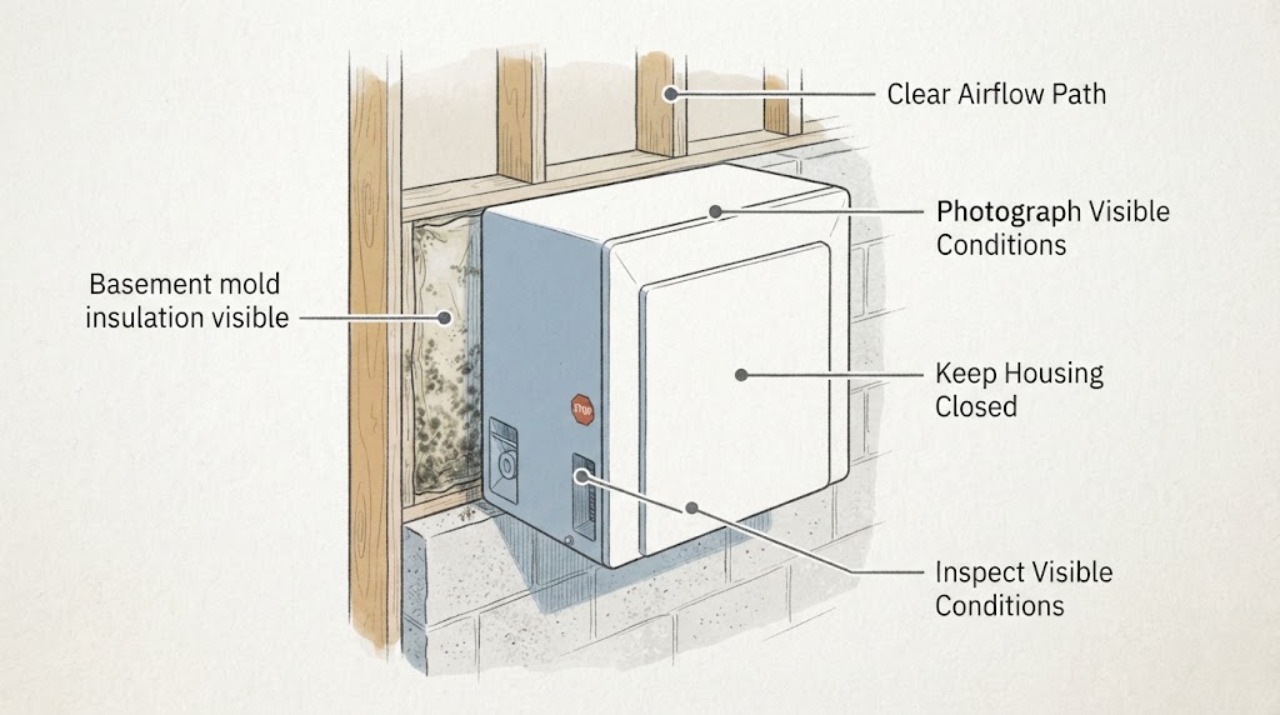
Work through in order
Diagnostic checks
Use only checks that match the exact appliance or system and its official guide.
-
Check 1
From a safe, dry position, photograph and describe the visible mold on the insulation and surrounding surfaces without touching, brushing, pulling, or moving any insulation.
Expected result: Record the location, color and texture as a description rather than a species claim, apparent spread across insulation or framing, visible dampness, staining, sagging, gaps, and any nearby water marks.
Next step: Keep the area isolated and send the photos and location notes to an experienced mold-remediation or water-damage professional for an on-site plan.
Stop if: Stop observing if the insulation is loose or falling, the ceiling or framing appears unstable, particles become airborne, or access requires crawling, climbing, or disturbing the material.
Why this matters
Why: Visible growth on porous insulation does not show how far contamination extends inside the material. It supports professional assessment and a containment decision rather than a surface-cleaning shortcut.
-
Check 2
From normal accessible positions, look for a possible moisture source without opening walls, lifting insulation, probing surfaces, or dismantling plumbing or HVAC equipment.
Expected result: Note visible pipe condensation or leaks, foundation seepage, water stains, sump or drain events, recent flooding, humid air, or a musty odor that changes with weather or equipment operation.
Next step: Record the timing and location and arrange the appropriate qualified plumbing, waterproofing, HVAC, or remediation assessment; do not attempt the repair from inside the affected area.
Stop if: Stop if water is active near electrical equipment, the floor is wet or slippery, a gas odor is present, or investigating would require opening a wall or entering an unsafe space.
Why this matters
Why: Mold control depends on correcting moisture. A continuing leak, condensation path, or drainage problem can make cleanup fail or cause recurrence even if the visible patch is removed.
-
Check 3
From outside the affected area, identify whether a furnace, air handler, return grille, supply duct, or other HVAC intake is near the visible mold without opening or cleaning the equipment.
Expected result: Note whether the mold is near an air path, whether a musty odor is being carried into occupied rooms, and whether the system has been running while the condition was present.
Next step: Tell the remediator and HVAC professional what you observed. Do not run a system suspected of contamination as a drying experiment and do not remove filters or panels in the affected area.
Stop if: Stop if the HVAC equipment is wet, sparking, emitting smoke or a burning odor, or if checking it would require opening a panel or entering the moldy space.
Why this matters
Why: Suspected HVAC involvement can distribute contaminants beyond the basement and changes the assessment scope. The absence of an obvious nearby grille does not rule out hidden pathways.
-
Check 4
From a safe location, note who uses the basement and whether occupants have reported new irritation, coughing, allergy symptoms, or odor concerns, without diagnosing a medical cause.
Expected result: Record which rooms are occupied, whether symptoms or odor seem linked to time in the area, and whether anyone is medically vulnerable or unable to avoid the basement.
Next step: Keep affected occupants out and advise anyone with health concerns to consult a health professional. Give the remediator the access and occupancy information before work begins.
Stop if: Seek urgent medical help for severe breathing difficulty or other emergency symptoms, and do not re-enter the affected area to gather more information.
Why this matters
Why: Occupant health and access needs affect isolation, scheduling, and whether temporary relocation or medical advice should be considered. Symptoms alone cannot identify mold species or prove causation.
-
Check 5
Assemble a timeline from existing records and safe observations, including leaks, flooding, seasonal condensation, plumbing work, HVAC changes, or prior cleanup, without disturbing the basement materials.
Expected result: Note when the odor or visible growth was first noticed, whether it expanded, whether the moisture source was repaired, and which surfaces or rooms were affected at the same time.
Next step: Provide the timeline, photographs, and any prior reports to the remediation professional; let them decide whether moisture mapping, sampling, containment, or material removal is appropriate.
Stop if: Stop if gathering records would tempt you to reopen a sealed area, move contaminated belongings, or handle moldy or wet material.
Why this matters
Why: The timeline helps the professional distinguish an active moisture problem from a residual condition and identify areas that may be hidden behind or beside the insulation.
Use your observations
Decision map
Find the observation that best matches what you see, then follow the next safe action.
-
PATH 01Next step
What you see
Mold is visible on insulation, insulation is wet or sagging, or the affected extent is unclear
Do this next
Keep the basement isolated and arrange an experienced professional mold and moisture assessment. Do not handle, bag, cut, or remove the insulation yourself.
-
PATH 02Next step
What you see
A continuing leak, seepage, condensation, or other moisture source is visible
Do this next
Request the appropriate qualified plumbing, waterproofing, HVAC, or building professional to correct the source as part of the remediation plan. Do not cover the mold or paint over it.
-
PATH 03Next step
What you see
Mold or odor is near an HVAC intake or may be entering occupied rooms
Do this next
Keep the suspected system from spreading the condition and obtain coordinated HVAC and mold-remediation guidance. Do not open the equipment or use it as a drying fan.
-
PATH 04Next step
What you see
A household member has significant respiratory or immune-related health concerns
Do this next
Keep that person away from the affected area and consult a health professional about exposure concerns while arranging professional assessment.
-
PATH 05Next step
What you see
The visible mark may be dirt or staining and no moisture or musty odor is evident
Do this next
Do not declare it safe from appearance alone. Photograph it, leave the insulation undisturbed, and have a qualified professional identify the material and moisture history before cleaning or sealing.
Helpful context
Understand the symptom
Why visible mold on insulation needs escalation
Insulation is porous and can hold moisture and mold within fibers or cavities that are not visible from the room. EPA guidance emphasizes moisture control, professional judgment, protection from exposure, and careful handling of mold-damaged porous materials. A visual record is useful; disturbing the insulation can spread particles and hide the extent of the problem.
Isolate before the assessment
Close off casual access to the basement area, keep children and pets away, and consider the needs of anyone with respiratory or immune-related health concerns when arranging the visit. Do not use a household fan, vacuum, or chemical treatment to chase the odor or dry the insulation before the professional has evaluated the air and moisture path.
Only after diagnosis
Potential parts
- humidity-meter
A humidity meter may support a professional's moisture investigation after safe access is established; it does not identify mold, replace a moisture-source diagnosis, or authorize entry into the affected area.
Use the remediation professional's selected instrument and interpretation rather than treating a consumer reading as clearance. - dehumidifier
A dehumidifier may be part of a professional drying plan only after the moisture source, electrical safety, and possible HVAC spread are assessed; it cannot remediate moldy insulation by itself.
Confirm safe placement, drainage, electrical supply, and operating plan with the remediation or HVAC professional. - HEPA-air-purifier
Air cleaning may be considered by a professional for occupied areas or containment support, but it is not a substitute for source correction, containment, or removal of mold-damaged porous insulation.
The professional should select equipment and placement based on room layout, HVAC interaction, filter handling, and the remediation plan.
When checks do not resolve it
Need a professional?
Arrange urgent professional mold and moisture assessment for visible mold on basement insulation, especially when the material is wet, the extent is unclear, an HVAC path is nearby, water damage is substantial, or vulnerable occupants may be exposed. Use emergency services for fire, gas odor, electrical arcing, structural collapse, or severe breathing difficulty.
Safety scope: Do not touch, brush, vacuum, bag, cut, or remove moldy insulation; do not open walls or HVAC panels, mix bleach or cleaners, paint or caulk over mold, run a suspected contaminated HVAC system, or perform DIY mold remediation.
Have this ready
- Share safe-distance photos, location and extent descriptions, moisture and odor timeline, visible leak or condensation observations, HVAC proximity, occupant access needs, and any prior water or remediation records.
Common questions
FAQ
Can I wipe or spray the mold off basement insulation?
Do not handle or spray moldy insulation. Insulation is porous, and disturbance can spread particles or leave hidden contamination. Keep the area isolated and have an experienced remediation professional assess the material and moisture source.
Should I mix bleach to kill the visible mold?
No. Do not mix bleach or other cleaners, and do not use a chemical treatment as a substitute for remediation. The professional should decide the safe method based on the material, extent, moisture cause, and occupants.
Can I remove the moldy insulation or open the basement wall?
No. Removing porous material or opening a wall can release particles and reveal a larger hidden problem. Leave the material undisturbed and let the remediation professional plan containment and removal.
Should I run the HVAC or a fan to dry the basement?
Do not run an HVAC system suspected of contamination, and do not use a fan to spread air through the affected area before assessment. Ask the remediation and HVAC professionals to establish a safe drying and air-handling plan.
Read the exact guide
Official sources
- Who can test my home or clean, fix and remediate my home for mold?U.S. Environmental Protection Agency · Government guidance for choosing an experienced assessor or remediator and for treating visual assessment and moisture investigation as more useful than unsupported certainty from a home test.
- Mold Remediation in Schools and Commercial Buildings Guide: Chapter 3U.S. Environmental Protection Agency · Professional remediation guidance applied here only to explain why visible mold on porous insulation needs containment and an assessed plan; homeowners should not reproduce the remediation methods.
- Mold Cleanup in Your HomeU.S. Environmental Protection Agency · Government guidance used for the conservative no-disturbance and professional-remediation boundary around moldy basement insulation; it does not authorize this user to handle insulation.
Community feedback
Share a repair observation
Share a plain-text repair observation. Accepted observations are published automatically; this page may take a moment to update.