
On this page
Start here
Quick answer
Visible basement mold together with a musty odor should be treated as a moisture-source and potential hidden-growth problem, not as a color-identification problem. From a safe, dry location, document where the growth is, whether the odor is local or travels through the house, what materials are affected, and whether the pattern follows rain, plumbing use, or HVAC operation. Do not scrape, sand, open walls, move contaminated porous materials, or run a possibly contaminated HVAC system. Arrange qualified mold and moisture assessment when the source is active or hidden, the area is more than a small isolated patch, porous materials or sewage are involved, the odor spreads, or a vulnerable occupant is exposed.
Before you begin
Safety first
- Qualified professionals determine containment, PPE, moisture correction, cleaning or removal of porous materials, HVAC involvement, and post-remediation verification. This article does not diagnose mold species or replace medical advice.
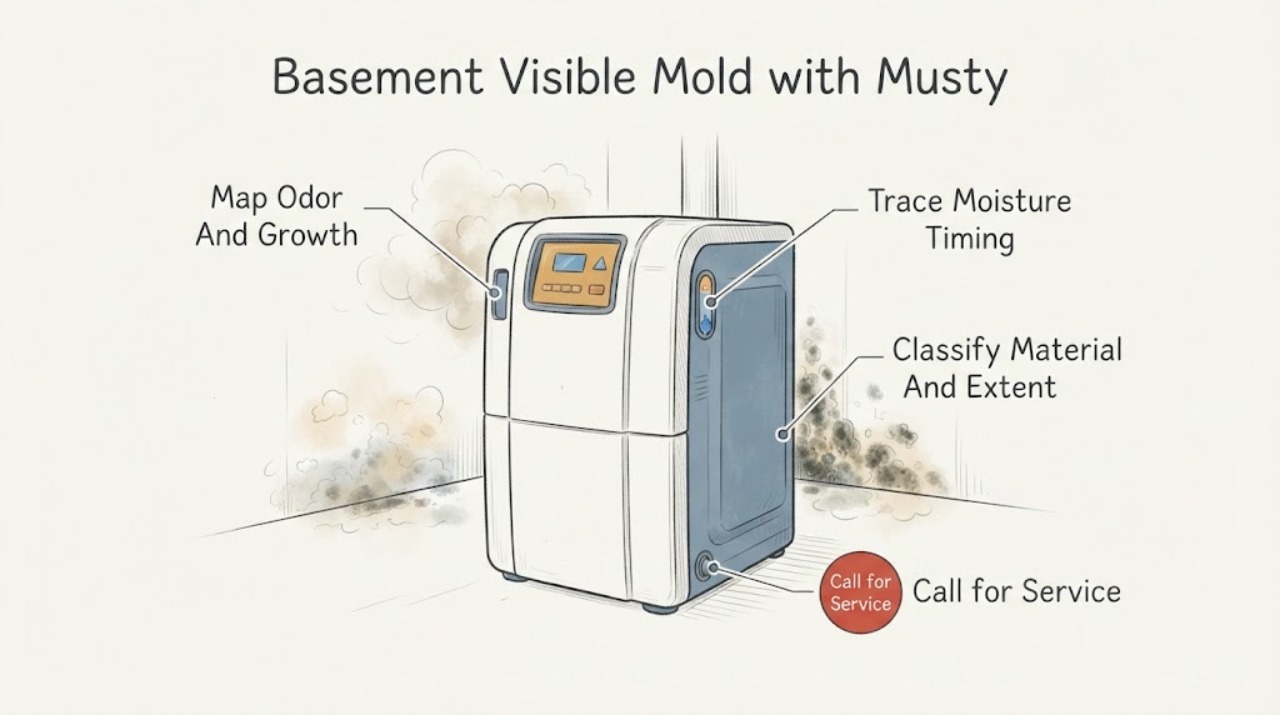
Work through in order
Diagnostic checks
Use only checks that match the exact appliance or system and its official guide.
-
Check 1
From the basement doorway or another dry, stable location, photograph the visible growth and note where the musty odor is strongest: at the patch, near stored items or finishes, at stairs, or at a supply or return vent. Do not brush, scrape, vacuum, spray, or move the affected material.
Expected result: The odor is confined to the visible patch; it is stronger around porous contents or a wall/ceiling edge; it travels beyond the basement; or it changes when the HVAC system runs.
Next step: Make a dated room map and give the photos, odor locations, and HVAC timing to a qualified remediation professional. Keep the area separated and avoid disturbing the source.
Stop if: Stop if documenting would require entering pooled or contaminated water, moving unstable materials, approaching exposed electrical equipment, opening a wall, or causing visible material to shed.
Why this matters
Why: A localized odor supports a focused moisture and material assessment, while odor around porous materials, outside the basement, or linked to airflow raises concern for concealed moisture or spread. Neither odor nor appearance identifies the mold species.
-
Check 2
Record whether the odor or visible growth changes after rain, snowmelt, plumbing use, a leak, a closed-up period, or a change in basement humidity. Look only for accessible signs such as seepage, condensation, damp flooring, wet boxes, or a plumbing or foundation location; do not open finishes or enter standing water.
Expected result: There is active water; the odor returns after a repeatable event; the area is damp with no visible source; or the surface appears dry but the odor persists.
Next step: Keep a short timeline with dates and weather or plumbing events, and request a moisture assessment that includes hidden-source evaluation when the odor persists.
Stop if: Stop and arrange prompt professional help for flooding, sewage or other contaminated water, water near electricity, structural damage, or any need to cut, drill, pry, or dismantle a finish.
Why this matters
Why: Active or event-linked moisture makes the water source the first service priority. A dry surface does not rule out retained moisture behind a finish or an intermittent leak, so persistent odor without a visible source should not be treated as a cleaning-only problem.
-
Check 3
Without disturbing the area, record the approximate affected extent and material: hard non-porous surface, finished wood, carpet or upholstery, cardboard or paper, drywall, insulation, or another porous finish. Note whether growth is one small exposed patch or appears across connected materials, behind contents, or along a wall cavity.
Expected result: Growth is limited to a small hard surface; porous material is visibly damp or affected; the area is broad or connected; or the extent cannot be seen safely.
Next step: Give the material and extent record to the professional and keep porous contents in place unless the professional provides a safe handling plan. Do not measure by scraping or pulling apart finishes.
Stop if: Do not remove drywall, insulation, carpet padding, ceiling tile, or heavily affected contents as a home test; stop for a broad area, unstable materials, or any dust-generating work.
Why this matters
Why: Hard surfaces may be assessable for controlled cleaning, but mold in wet porous materials can be difficult or impossible to remove completely. Broad, connected, concealed, or damaged-material conditions need a remediation plan rather than repeated surface treatment.
-
Check 4
From outside the affected area, note whether the basement contains or is connected to the furnace, air handler, return grille, supply ducts, or shared air path, and whether the odor is noticed upstairs when the system operates. Do not open ductwork, remove insulation, or use the HVAC system to test odor movement.
Expected result: There is no nearby air-handling equipment and the odor stays in the basement; odor follows HVAC operation; visible growth is inside a duct or on HVAC components; or the path cannot be inspected.
Next step: Tell the remediation professional and HVAC specialist exactly which rooms and vents are affected. If contamination of the system is suspected, stop using the affected system when safe and obtain professional direction before restarting it.
Stop if: Do not enter or dismantle an air handler, duct, or confined space to look for mold; stop immediately if the suspected system is needed for safe heating or cooling and request professional guidance.
Why this matters
Why: An HVAC-linked or inaccessible pattern can spread contamination beyond the visible patch. EPA says mold remediation involving HVAC systems should be performed by experienced professionals, and a contaminated system should not be used until it has been assessed and remediated.
-
Check 5
Before anyone enters for inspection or cleanup, record whether the basement has had floodwater, sewage, chemical contamination, or a significant water event, and whether children, people with asthma or allergies, people with COPD or other lung disease, or immunocompromised occupants may be exposed. Do not send a vulnerable or symptomatic person to investigate.
Expected result: The water may be contaminated; a vulnerable person uses the area; someone develops breathing, eye, skin, or other symptoms; or none of these concerns is present.
Next step: Keep people out of the affected area, disclose the contamination and occupant information to the remediation professional, and seek medical guidance for symptoms. Do not start fans or cleanup until the water is known to be clean and the work plan is appropriate.
Stop if: Stop all DIY cleanup for sewage or other contaminated water, health-sensitive occupants, symptoms, or any work requiring demolition, containment, or prolonged respirator use.
Why this matters
Why: Contaminated water and vulnerable occupants change the PPE, containment, and urgency requirements. Symptoms do not prove that mold caused them, but they are a reason to reduce exposure and obtain appropriate medical and professional guidance.
-
Check 6
After qualified remediation and moisture correction, revisit the basement from a safe location and compare the same mapped areas: visible growth, dampness, odor, and recurrence after rain or HVAC operation. Do not declare the work complete solely because the exposed stain has been painted or the odor temporarily fades.
Expected result: The area is dry, no visible mold or mold-damaged material remains, the musty odor is absent, and no recurrence appears; or odor, dampness, growth, or symptoms remain.
Next step: Document the comparison and ask the remediation professional to reassess the moisture source, porous materials, hidden spaces, or HVAC path when any sign returns.
Stop if: Do not re-enter or resume normal use if the area remains damp, odor returns with symptoms, or the next step requires opening or disturbing building materials.
Why this matters
Why: The first pattern is consistent with a completed assessment only when the moisture correction and remediation plan are also complete. Persistent odor, renewed dampness, or renewed growth means the source or affected materials may not have been resolved.
Use your observations
Decision map
Find the observation that best matches what you see, then follow the next safe action.
-
PATH 01Safety boundary
What you see
Active seepage, flooding, sewage, chemical contamination, or water near electrical equipment is present.
Do this next
Keep people out, avoid contact, and arrange qualified water-damage and mold-remediation service. Provide the water history and electrical or structural hazards.
Why this path and its safety boundary
Why it matters: This is a moisture and contamination response, not a surface-cleaning task. Fans, movement, or ordinary cleanup can spread contaminants or create another hazard.
Safety stop: No entry into contaminated water, no fan use until water is known to be clean, and no handling of electrical equipment in the affected area.
-
PATH 02Safety boundary
What you see
The visible growth and odor stay localized, the material is a small exposed hard surface, and no active water, health concern, or HVAC connection is found.
Do this next
Keep the record and arrange an assessment that confirms the surface, moisture source, and safe cleanup boundary.
Why this path and its safety boundary
Why it matters: The issue may be limited, but the moisture cause still needs to be identified before a cleaning decision. A localized appearance does not justify scraping, painting over, or guessing the organism.
Safety stop: Stop if the material becomes loose or damp, the odor spreads, or a cleaning step would disturb growth or release dust.
-
PATH 03Safety boundary
What you see
The basement looks mostly dry but the odor persists, returns after rain or closure, or is strongest around a wall edge, stored porous items, or another inaccessible space.
Do this next
Request moisture and hidden-source assessment and provide the odor timeline; do not open the wall or move contents to search behind them.
Why this path and its safety boundary
Why it matters: An intermittent leak, retained moisture, damp porous material, or concealed growth is more likely than a simple exposed-surface stain. Repeated deodorizing can hide the diagnostic pattern.
Safety stop: No demolition, drilling, pulling carpet or insulation, or dry sweeping as an investigation method.
-
PATH 04Safety boundary
What you see
Odor appears in other rooms, changes when the HVAC runs, or visible growth is suspected in a duct or air-handling component.
Do this next
Stop using the suspected contaminated system when safe and arrange experienced HVAC/mold assessment before restarting or cleaning ductwork.
Why this path and its safety boundary
Why it matters: The affected boundary may be larger than the visible basement patch, and ordinary room cleaning cannot establish whether the system is contaminated.
Safety stop: Do not open ductwork or enter a confined mechanical space; do not use the system to circulate air as a test.
-
PATH 05Safety boundary
What you see
A vulnerable occupant is exposed, symptoms occur, growth involves porous or broad materials, or cleanup would require containment, demolition, or prolonged PPE.
Do this next
Keep occupants away, seek appropriate medical guidance for symptoms, and arrange qualified remediation that addresses containment, moisture correction, material handling, and post-fix verification.
Why this path and its safety boundary
Why it matters: The risk and work boundary exceed a casual household inspection. The person, material, and building conditions require a coordinated professional response.
Safety stop: Do not assign cleanup to people with asthma, COPD, immune suppression, or significant mold sensitivity, and do not improvise demolition or chemical treatment.
Helpful context
Understand the symptom
Why visible growth and odor need to be checked together
The visible patch and the smell answer different questions. The patch shows where growth is exposed; the musty odor can indicate continuing moisture, concealed growth, damp porous contents, or air movement from another area. Smell alone cannot locate growth or identify its type, and the absence of smell does not prove that a wall cavity or duct is clear. A useful record connects odor timing and location to moisture, materials, and airflow without disturbing the site.
The moisture fix comes before the cosmetic fix
EPA guidance treats moisture control as the central mold-control step. A basement can look dry while an intermittent leak, condensation, seepage, or damp wall cavity continues to feed growth. Wiping a visible surface or painting over it without correcting the source leaves the odor and recurrence question unanswered. Record the pattern and let the assessment determine containment, drying, cleaning, or material removal.
What a complete resolution should look like
After remediation, the moisture problem should be corrected, visible mold and mold-damaged material should no longer be present, and the musty odor should not persist. The area should be revisited for renewed dampness or growth. A lingering odor after surface cleaning is a reason to investigate the moisture, porous materials, hidden spaces, and air-handling path rather than repeatedly applying a product.
Safety boundary
Stop conditions
- Stop and seek qualified help for active flooding, sewage or chemical contamination, water near electricity, unstable building materials, suspected HVAC contamination, confined-space access, vulnerable occupants, or symptoms.
- Do not scrape, sand, dry-sweep, open walls, remove insulation or drywall, mix cleaning products, or operate a suspected contaminated HVAC system as a diagnostic test.
When checks do not resolve it
Need a professional?
Arrange qualified mold-remediation and moisture assessment for active or contaminated water, persistent or spreading odor, hidden or broad growth, damp or moldy porous materials, suspected HVAC involvement, vulnerable occupants, symptoms, or any work that would disturb building materials. A planned assessment is still appropriate for a small visible patch when the moisture source and odor do not have a clear safe explanation.
Safety scope: Qualified professionals determine containment, PPE, moisture correction, cleaning or removal of porous materials, HVAC involvement, and post-remediation verification. This article does not diagnose mold species or replace medical advice.
Have this ready
- Dated photos and a map of visible growth, strongest odor locations, rooms affected, and access limits
- Odor and dampness timing after rain, snowmelt, plumbing use, leaks, or HVAC operation
- Material type and approximate extent, including drywall, insulation, carpet, paper, wood, or stored porous contents
- Any floodwater, sewage, chemical, electrical, structural, or confined-space concern
- Occupant vulnerability, symptoms, and whether odor or symptoms occur outside the basement
Common questions
FAQ
Does a musty smell mean the visible basement mold is spreading?
Not necessarily. The smell may come from the visible patch, damp porous contents, concealed moisture, or air movement from another area. Record where and when it is strongest and whether HVAC operation changes it; do not use odor alone to identify or map hidden mold.
Should I run the dehumidifier or HVAC to test the odor?
Do not use the HVAC system to circulate air as a test, especially when contamination of a duct or air handler is possible. Moisture control is important, but active leaks, contaminated water, and HVAC involvement need professional direction before equipment is operated or cleaned.
Can I clean a small visible patch if the basement still smells musty?
Do not assume a surface treatment solves the problem. A persistent odor means the moisture source, porous materials, hidden spaces, and airflow path should be assessed; stop if cleaning would disturb growth or require moving damaged materials.
When should a basement mold and odor problem be handled professionally?
Arrange qualified help for active or contaminated water, broad or hidden growth, damp or moldy porous materials, suspected HVAC spread, recurring odor or growth, symptoms, vulnerable occupants, or any work involving demolition, containment, or prolonged PPE.
How do I know the mold remediation addressed the odor?
The moisture source should be corrected, visible mold and mold-damaged material should be absent, the musty odor should not persist, and the area should remain dry and clear on follow-up. If odor or growth returns, request reassessment instead of repeatedly deodorizing the room.
Read the exact guide
Official sources
- Mold Clean Up Guidelines and RecommendationsCenters for Disease Control and Prevention · Supports keeping people with allergies, asthma, COPD, lung disease, or immune suppression away from cleanup, and using respiratory, skin, and eye protection when cleanup is undertaken by appropriate people.
- Mold Course Chapter 7: Evaluating the RemediationU.S. Environmental Protection Agency · Supports verifying that the moisture problem is fixed, visible mold and mold-damaged material are absent, musty odor is absent, and the area remains clear on follow-up.
- Should I have the air ducts in my home cleaned?U.S. Environmental Protection Agency · Supports checking for substantial visible mold in hard-surface ducts or HVAC components through a provider, recognizing inaccessible sections, replacing wet moldy insulation, and correcting the moisture cause.
- Mold Course Chapter 4: General Remediation IssuesU.S. Environmental Protection Agency · Supports tracing continuing moisture, assessing size and material type, avoiding disturbance, stopping for sewage or contaminated water, and using professional judgment for remediation planning.
- Mold Course Chapter 5: Large Areas and Other Special ConcernsU.S. Environmental Protection Agency · Supports professional HVAC remediation, avoiding use of a mold-contaminated system, and not opening or investigating ducts or confined mechanical spaces as a casual test.
Community feedback
Share a repair observation
Share a plain-text repair observation. Accepted observations are published automatically; this page may take a moment to update.