
On this page
Start here
Quick answer
Visible mold in a basement is a moisture and exposure problem, not a spot to scrub, paint over, or disturb before the situation is assessed. From a safe position, document where it is, whether the area is expanding, what materials are affected, and whether there is active water, a musty odor, or an HVAC intake nearby. Keep people and pets away, do not touch or sample it, and arrange a qualified mold-and-moisture professional—especially if the affected area is broad, porous materials are involved, the source is hidden, the water was contaminated, or anyone has breathing symptoms.
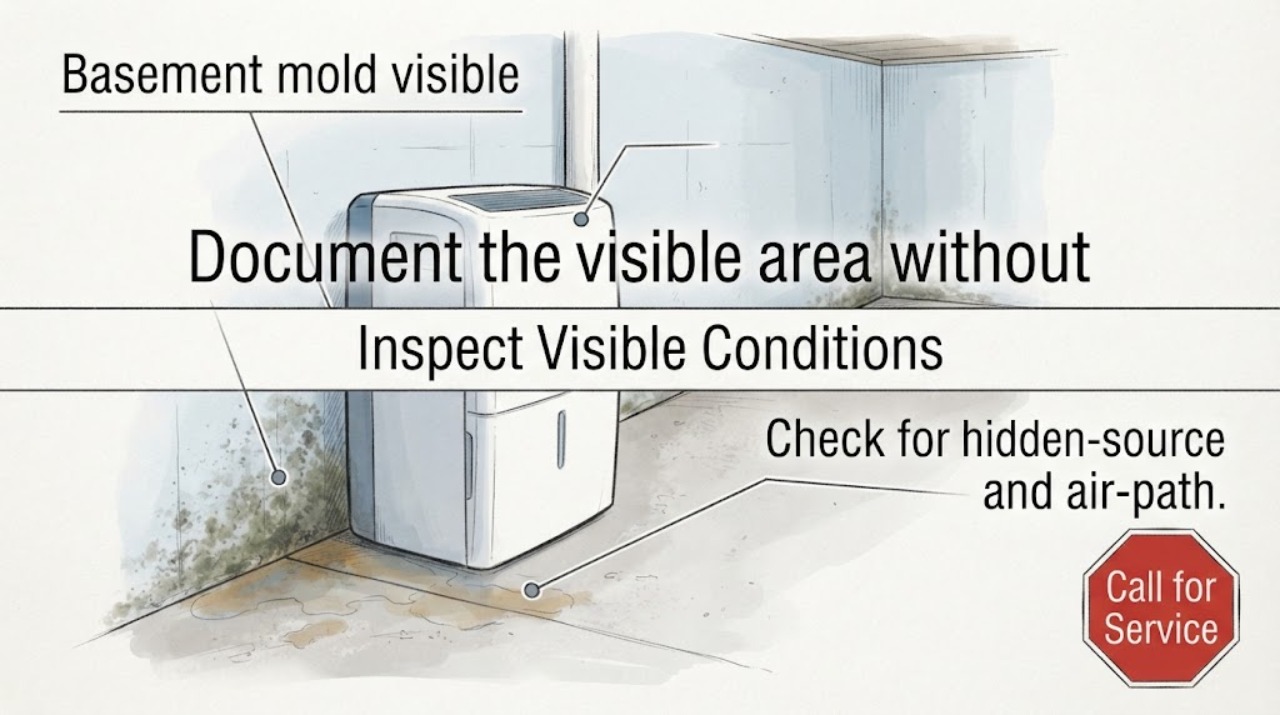
Work through in order
Diagnostic checks
Use only checks that match the exact appliance or system and its official guide.
-
1. Document the visible area without disturbing it
From the doorway or another safe position, photograph the visible growth and sketch its location relative to foundation walls, windows, plumbing, floors, stored items, and HVAC equipment. Estimate whether it is isolated or spread across connected surfaces, but do not touch, scrape, brush, vacuum, sample, or move moldy items.
Expected result: The growth is on a hard-looking surface, porous material, stored cardboard or fabric, carpet, drywall, wood, or around a vent or air-handling intake; it is localized or broad.
Next step: Keep the photos, date, and location notes for the remediation professional. Leave the area undisturbed and limit access while the moisture-source check is made from safe, accessible locations.
Stop if: Stop observing and leave the space if the air causes coughing, wheezing, eye irritation, dizziness, or other symptoms, or if observing requires entering a confined or contaminated area.
Why this matters
Why: Material and extent affect how a professional plans containment and removal. Porous materials can hold growth in spaces that are difficult to clean, and growth near an air path can spread contamination beyond the visible patch. Appearance or color does not identify the type or risk.
-
2. Look for the moisture source from a safe position
Visually inspect accessible plumbing, foundation-wall corners, windows, floor drains, sump areas, exposed pipes, and the area near the outside foundation for dripping, standing water, condensation, dampness, staining, or a recent flood or leak. Do not open walls, lift carpet, move moldy objects, or touch wet electrical equipment.
Expected result: Water is active or recurring; the surface is dry but stained; condensation or high humidity is visible; or no source can be seen.
Next step: Record the source, timing, weather or plumbing connection, and any humidity reading taken without disturbing materials. Give the information to the professional rather than sealing, painting, or chemically treating the area.
Stop if: Stop for standing water, sewage or unknown contaminated water, wet electrical equipment, unstable materials, or any investigation that would require opening or removing building components.
Why this matters
Why: Active or recurring moisture must be controlled before remediation can be complete. A dry stain can mark a concealed or intermittent path. No visible source does not rule out hidden moisture behind finishes, below flooring, in a crawlspace, or in ductwork.
-
3. Check for hidden-source and air-path clues
Without moving furniture or stored items, note whether the visible growth is near a wall cavity, pipe chase, carpet edge, ceiling or wall finish, crawlspace access, duct, return, or air-handler intake. Record a musty odor, occupant reports of symptoms, and whether the smell or dust seems to travel beyond the basement.
Expected result: The visible patch has nearby water damage, the source is hidden, mold is near an HVAC intake or duct, the odor travels to living areas, or none of these clues is present.
Next step: Keep the HVAC off if it is known or suspected to be contaminated, keep occupants away, and request a professional scope assessment. Do not open ducts, air handlers, walls, ceilings, or flooring to search.
Stop if: Stop immediately if the next step would disturb a suspect surface, start airflow through a contaminated system, or expose a person with asthma, immune compromise, chronic lung disease, or new respiratory symptoms.
Why this matters
Why: Hidden or air-path clues increase the chance that the visible patch is only part of the affected area. A professional may need to assess the entire moisture path and HVAC relationship without spreading spores. The absence of a visible clue does not establish that hidden growth is absent.
-
4. Decide whether to arrange urgent professional service
Answer yes or no: Is the visible area broad or spreading, are porous or water-damaged materials involved, is the source hidden or recurring, is sewage or contaminated water involved, could HVAC be affected, or is anyone having symptoms or medically vulnerable to mold exposure?
Expected result: If yes to any item, keep the space unoccupied as practical and arrange qualified mold-and-moisture service. If no, still do not disturb the visible growth; preserve the documentation and obtain a professional plan before cleanup.
Next step: Provide the professional with photos, the estimated extent, affected materials, water history, odor and HVAC observations, occupant symptoms, and any humidity or moisture readings.
Stop if: Stop all investigation if symptoms occur, the source involves contaminated water, visible growth is spreading, or any proposed action includes cleaning, demolition, sampling, or chemical treatment by an untrained person.
Why this matters
Why: A yes means the project needs exposure control, source correction, and extent assessment beyond a generic surface treatment. A no only means no listed escalation clue was observed from the safe position; it does not prove the patch is harmless or isolated.
Use your observations
Decision map
Find the observation that best matches what you see, then follow the next safe action.
-
PATH 01Safety boundary
What you see
Water is active, recurring, or the visible growth follows a recent leak, flood, condensation, or high-humidity event.
Do this next
Prioritize safe source control and a professional moisture assessment. Record the timing and source, keep people away, and do not seal or paint over the affected materials.
Why this path and its safety boundary
Safety stop: Do not enter standing or contaminated water, touch wet electrical equipment, or open surfaces to trace the path.
-
PATH 02Safety boundary
What you see
Growth is broad, spreading, on porous materials, behind finishes, or near a crawlspace, wall cavity, or HVAC intake.
Do this next
Arrange professional mold remediation and moisture-source assessment. The visible patch may not represent the full affected area, and disturbing porous or hidden materials can spread spores.
Why this path and its safety boundary
Safety stop: Do not scrub, vacuum, scrape, pull up carpet, remove drywall, open ducts, or use bleach or other chemical mixtures.
-
PATH 03Safety boundary
What you see
Anyone develops coughing, wheezing, eye irritation, skin symptoms, or other concerns in the space, or an occupant is medically vulnerable.
Do this next
Leave the affected area, keep the person away, and seek appropriate health advice while arranging professional assessment.
Why this path and its safety boundary
Safety stop: Do not ask a symptomatic or medically vulnerable person to inspect, sample, clean, or move affected items.
Helpful context
Understand the symptom
Why visible mold changes the decision
Visible growth is enough to establish that a moisture problem needs attention; identifying a mold species is not the first decision. Water may have entered through plumbing, a foundation, a window, condensation, a flood, or a hidden cavity. The visible patch can also sit beside affected porous materials or an air path. The safe sequence is to document, limit exposure, identify the source, and have the extent assessed before remediation.
What not to do
Do not touch or disturb visible growth, move moldy belongings, run a suspected contaminated HVAC system, open walls or ducts, pull up carpet, scrape, vacuum, sample, paint, or caulk the area. Do not mix bleach with other cleaning products. These actions can spread material or hide the moisture source; a professional should define containment and cleanup when the situation is broad, hidden, contaminated, or health-sensitive.
What to give the remediation professional
Provide dated photos, the approximate affected area, the material types, when the growth was first seen, any leak or flood history, humidity or moisture readings, odor and HVAC observations, and occupant symptoms. Ask how the professional will locate and correct the moisture source, assess hidden areas, protect occupants, and verify that the problem is not returning.
Only after diagnosis
Potential parts
- humidity meter
Useful only for documenting room conditions and supporting a moisture assessment; it cannot identify mold or determine the remediation scope.
Choose a device with clear instructions for indoor relative humidity and use it without placing it on wet or visibly contaminated materials. - dehumidifier
May support humidity control after a professional or property manager addresses the water source and confirms that operating it will not spread contamination.
Confirm capacity, drainage, electrical safety, and operating instructions for the space; it is not a substitute for remediation or leak repair. - HEPA air purifier
May be considered as an auxiliary air-quality measure only after the affected area and HVAC relationship are assessed; it does not remove mold from materials.
Confirm the device is appropriate for the room and safe to operate near moisture; do not use airflow to disturb or spread visible growth.
When checks do not resolve it
Need a professional?
Arrange qualified mold-remediation and moisture-source service for visible basement growth, especially when the area is broad or spreading, porous materials are involved, water is recurring or contaminated, the source is hidden, HVAC may be affected, or anyone has symptoms.
Have this ready
- Dated photos and an approximate map of the visible growth
- Affected materials such as drywall, carpet, wood, cardboard, fabric, or stored items
- Leak, flood, condensation, humidity, plumbing, or foundation history
- Musty odor, HVAC intake or duct relationship, and whether the smell travels upstairs
- Occupant symptoms and whether anyone has asthma, immune compromise, chronic lung disease, or another health concern
Common questions
FAQ
Should I scrub visible basement mold right away?
Do not disturb it while you are still determining the source and extent. Photograph it from a safe position, keep people and pets away, and arrange professional assessment when the area is broad, porous, hidden, contaminated, near HVAC, or health-sensitive.
Does visible mold mean I need a mold test?
Not necessarily. When growth is visible, the more useful decisions are correcting moisture and assessing the affected extent. Sampling is a professional decision only when its result would change a specific plan.
Can I paint over visible mold after the basement dries?
No. Paint or caulk can hide the condition without correcting the source, and coatings over moldy surfaces may peel. Have the moisture and remediation plan completed before any finish work.
When should I leave the basement?
Leave and keep others away if the air causes coughing, wheezing, eye or skin symptoms, if water is contaminated or active, if the growth is spreading or near HVAC, or if an occupant is medically vulnerable. Seek health advice as appropriate and arrange professional assessment.
Read the exact guide
Official sources
- MoldCenters for Disease Control and Prevention · Supports symptom-based stop conditions, vulnerable-occupant caution, moisture-source correction, and the limits of relying on home mold testing.
- A Brief Guide to Mold, Moisture and Your HomeU.S. Environmental Protection Agency · Supports the moisture-first approach, hidden-mold caution, exposure limits, and professional assessment when visible growth or hidden sites are present.
- Mold Course Chapter 3: Finding Mold and MoistureU.S. Environmental Protection Agency · Supports documenting visible extent, tracing water and moisture, recognizing hidden and HVAC pathways, and stopping before disturbing suspect areas.
Community feedback
Share a repair observation
Share a plain-text repair observation. Accepted observations are published automatically; this page may take a moment to update.