
On this page
Start here
Quick answer
Visible mold on a basement joist should be treated as a moisture and building-condition problem, not a bleach or scraping project. From a safe, dry location, isolate the area, photograph the visible growth and surrounding moisture signs, and record whether the joist looks soft, cracked, sagging or otherwise damaged. Do not touch or scrape the joist, mix cleaners, open walls or ceilings, run a possibly contaminated HVAC system, or demolish anything. Arrange urgent professional mold-remediation and moisture assessment; add a structural professional if the joist or nearby framing appears compromised, and consult a health professional before exposure if occupants have health concerns.
Before you begin
Safety first
- Do not touch, scrape, sand, cut, drill, demolish, sample, vacuum or chemically treat the joist. Do not mix cleaners or use bleach as a DIY remedy. Keep people out and let qualified professionals set containment, PPE, drying and remediation steps.
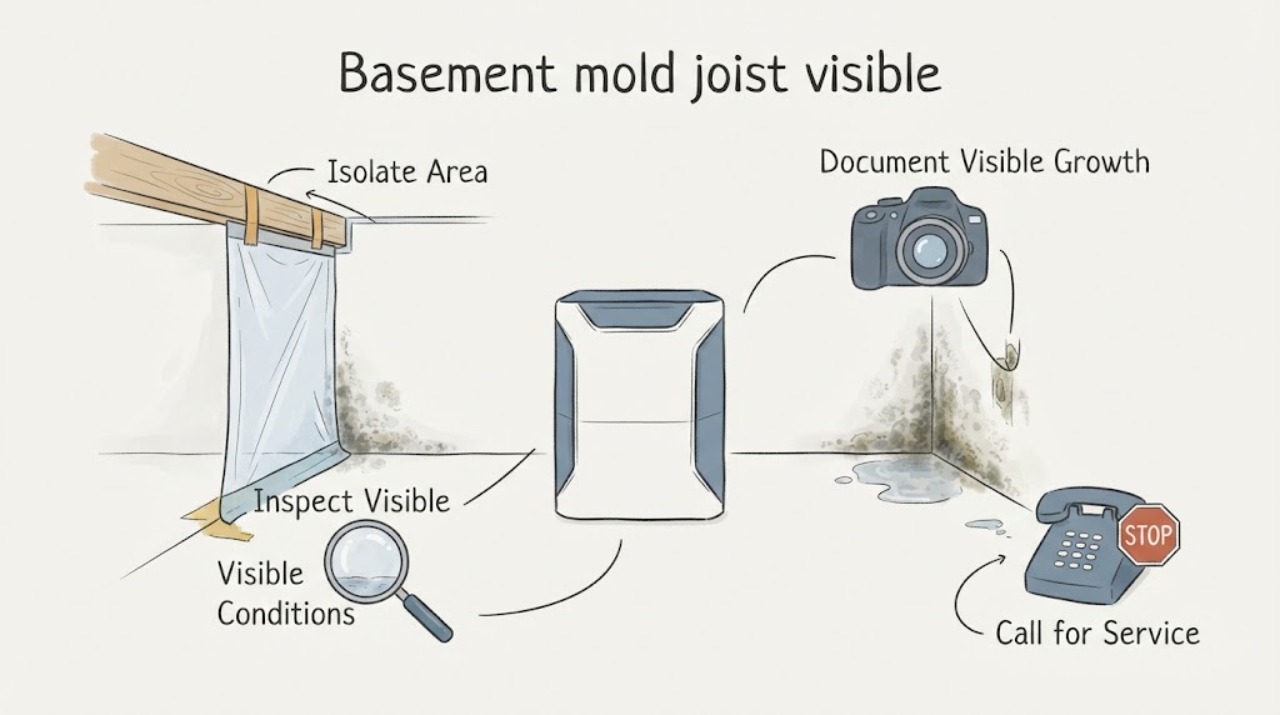
Work through in order
Diagnostic checks
Use only checks that match the exact appliance or system and its official guide.
-
Check 1
From a safe, dry location such as the basement entrance, keep people and pets away and observe whether the visible joist area can be avoided without walking through water, dust or debris.
Expected result: A contained, dry area is different from a basement with standing water, airborne dust, a strong musty odor, or mold extending into a path used by occupants.
Next step: Restrict access, keep the affected room unused, and arrange professional mold-remediation assessment.
Stop if: Stop immediately if there is standing water, a slip or electrical hazard, falling material, severe odor, or any need to step on or near the affected framing.
Why this matters
Why: The second situation increases exposure and property risk and should not be investigated by entering or disturbing the material.
-
Check 2
Use a camera from a safe distance to record the joist, adjacent framing, ceiling and floor without touching, scraping, sampling or moving stored items around the growth.
Expected result: A small visible patch confined to one face differs from growth that continues along the joist, reaches adjacent framing, or appears behind insulation or other materials.
Next step: Keep the photographs for the remediator and note the room, joist location and whether the appearance is changing.
Stop if: Stop documenting if taking a closer photo would require entry, moving materials, disturbing dust, or contacting the joist.
Why this matters
Why: The visible boundary does not establish the full extent; porous or hidden materials may require a professional plan and containment.
-
Check 3
From a normal standing position, look for visible water, condensation, staining, a plumbing route, foundation seepage, exterior drainage issue, or recent flooding near the joist. Do not open finishes or inspect inside a wall or ceiling.
Expected result: An active leak or wet floor is different from an old stain in an otherwise dry area, and both differ from condensation or humidity with no obvious leak.
Next step: Photograph the moisture evidence and tell the remediator when it appeared, whether it followed rain or plumbing use, and whether the source is still active.
Stop if: Stop if water is near electrical equipment, sewage or contaminated water is suspected, or the source cannot be observed without demolition or contact.
Why this matters
Why: Mold will tend to recur if the moisture source is not corrected; the source may require plumbing, foundation, roofing or building-envelope expertise in addition to remediation.
-
Check 4
From a safe distance, visually compare the joist and nearby framing for sagging, bowing, cracking, discolored soft-looking wood, loose connections or material falling away. Do not press, probe, drill, sand, cut or remove any part of the framing.
Expected result: A stable-looking surface differs from visible deflection, separation, extensive decay or a change that appears to be progressing.
Next step: Keep the area unloaded and request assessment by a qualified structural professional as well as a mold-remediation professional.
Stop if: Stop and keep everyone out if the floor or framing appears unsafe, moves, sheds material, or could fall.
Why this matters
Why: Visible movement or decay can indicate a structural concern that mold cleaning alone cannot address.
-
Check 5
Note whether the affected joist is near an HVAC return or duct, whether the basement air is being circulated, and whether occupants report new irritation or breathing concerns. Do not run, clean or open a suspected contaminated HVAC component.
Expected result: A remote joist with no air-distribution connection differs from mold near an intake or duct that could spread particles through the building.
Next step: Keep the affected area isolated, stop use of a suspected contaminated HVAC path, and tell the remediator and health professional what was observed.
Stop if: Stop exposure and leave the area if anyone develops breathing difficulty, severe irritation, or other urgent symptoms; seek medical care as appropriate.
Why this matters
Why: Suspected HVAC involvement changes the containment and inspection plan; occupant symptoms require health guidance rather than a DIY diagnosis.
Use your observations
Decision map
Find the observation that best matches what you see, then follow the next safe action.
-
PATH 01Next step
What you see
If visible growth appears limited but the joist is a structural wood member or the full extent is uncertain
Do this next
Do not treat it as a routine surface-cleaning task. Keep the area isolated and arrange a qualified remediator to assess the wood, moisture and containment needs.
-
PATH 02Next step
What you see
If there is current leakage, condensation, standing water, flooding or a recurring damp condition
Do this next
Arrange the appropriate plumbing, drainage, foundation or building professional to correct the source alongside mold remediation. Do not cover or seal the moldy joist.
-
PATH 03Next step
What you see
If the joist or nearby framing appears sagging, cracked, separated, soft-looking or unstable
Do this next
Keep people out and obtain structural assessment before any remediation work disturbs the area. Do not load, brace, cut or remove the framing yourself.
-
PATH 04Next step
What you see
If mold is near an HVAC intake or duct, or occupants report health concerns
Do this next
Do not run the suspected HVAC path and consult qualified remediation and health professionals. Do not assume that an air cleaner or mask makes disturbance safe.
-
PATH 05Next step
What you see
If sewage, floodwater or another contaminated water source may have reached the joist
Do this next
Keep the area restricted and use a professional experienced with contaminated-water and mold remediation. Do not enter for cleanup or demolition.
Helpful context
Understand the symptom
Why a joist needs professional assessment
A joist is part of the building structure, so visible growth may be accompanied by hidden moisture, decay or a larger affected area. Color and surface appearance cannot identify the mold type or reveal how far moisture has traveled. The safe homeowner role is to keep people away and preserve observations while a qualified remediator investigates the moisture source and the condition of the wood.
Keep the basement isolated
Keep children, pets and sensitive occupants out of the affected area. Do not disturb the growth, sweep or vacuum debris, apply bleach or another biocide, or cover the joist with paint or caulk. If mold may be near an HVAC intake or duct, do not run that system until a qualified professional evaluates it.
Only after diagnosis
Potential parts
- humidity-meter
Consider this category only if a qualified professional confirms that a non-invasive humidity reading would help document the moisture plan; it does not identify mold or make a joist safe to enter.
Choose a device appropriate for room-air measurements and use professional interpretation for structural or remediation decisions. - dehumidifier
Consider this category only after the active water source, electrical safety and remediation plan are assessed; humidity control cannot replace removal of mold or repair of a leak.
Confirm safe placement, drainage and electrical conditions with the professional managing the basement. - HEPA-air-purifier
Consider this category only as a professional-approved supplemental control after the source, containment and HVAC risks are evaluated; it is not a substitute for remediation.
Confirm room suitability and filter maintenance requirements, and do not use it to justify disturbing mold or running a suspected contaminated HVAC system.
When checks do not resolve it
Need a professional?
Arrange urgent mold-remediation service for visible mold on a basement joist, especially when the extent is uncertain, moisture persists, the wood appears damaged, the area is near HVAC, or occupants have health concerns. Add plumbing, drainage, building-envelope or structural expertise when observations point to those causes.
Safety scope: Do not touch, scrape, sand, cut, drill, demolish, sample, vacuum or chemically treat the joist. Do not mix cleaners or use bleach as a DIY remedy. Keep people out and let qualified professionals set containment, PPE, drying and remediation steps.
Have this ready
- Provide safe-distance photographs, the joist and room location, visible extent, moisture history, flooding or sewage information, HVAC proximity, structural observations, occupant concerns, and any access restrictions.
Common questions
FAQ
Can I scrub or spray the mold on the joist myself?
Do not disturb a visible moldy joist in this professional-service scenario. Keep the area isolated and have a qualified remediator assess the wood, moisture source, containment and structural implications.
Does visible mold prove the joist is structurally unsafe?
No, appearance alone cannot determine structural capacity. Sagging, cracking, separation or soft-looking wood are reasons to keep people out and obtain structural assessment before work begins.
Should I use bleach or mix cleaners?
No. Do not mix cleaners or use a bleach recipe as a DIY remedy. EPA advises that routine biocide use is not recommended; a qualified remediator should choose the method after assessing the material and moisture source.
Should I run the basement HVAC or a fan?
If mold may be near an HVAC intake or duct, do not run the suspected system until a professional evaluates it. Do not use airflow to spread particles or justify entering and disturbing the joist.
Read the exact guide
Official sources
- A Brief Guide to Mold, Moisture and Your HomeU.S. Environmental Protection Agency · Mold visible on wood framing or joists in a residential basement
- Mold Course Chapter 2: Why and Where Mold GrowsU.S. Environmental Protection Agency · Visible mold on a basement joist where wood condition or hidden moisture may be involved
- Mold Cleanup in Your HomeU.S. Environmental Protection Agency · Visible basement mold when the affected material, water source or extent is not yet fully assessed
Community feedback
Share a repair observation
Share a plain-text repair observation. Accepted observations are published automatically; this page may take a moment to update.