
On this page
Start here
Quick answer
Visible basement mold with a history of leaks, seepage, condensation, or flooding should be treated as a moisture-control problem, not a color-identification exercise. From outside the affected area, document the location, approximate extent, water source, recurrence, dampness, odor, and materials involved. Do not scrape, sand, paint over, or disturb suspected hidden growth. EPA says a small visible area may sometimes be handled under its cleanup guidance, but extensive water damage, growth over about 10 square feet, porous or hidden materials, contaminated water, suspected HVAC contamination, health concerns, or a recurring water source call for experienced professional assessment. Correct the moisture problem and dry the building before deciding that cleanup is complete.
Work through in order
Diagnostic checks
Use only checks that match the exact appliance or system and its official guide.
-
Check 1
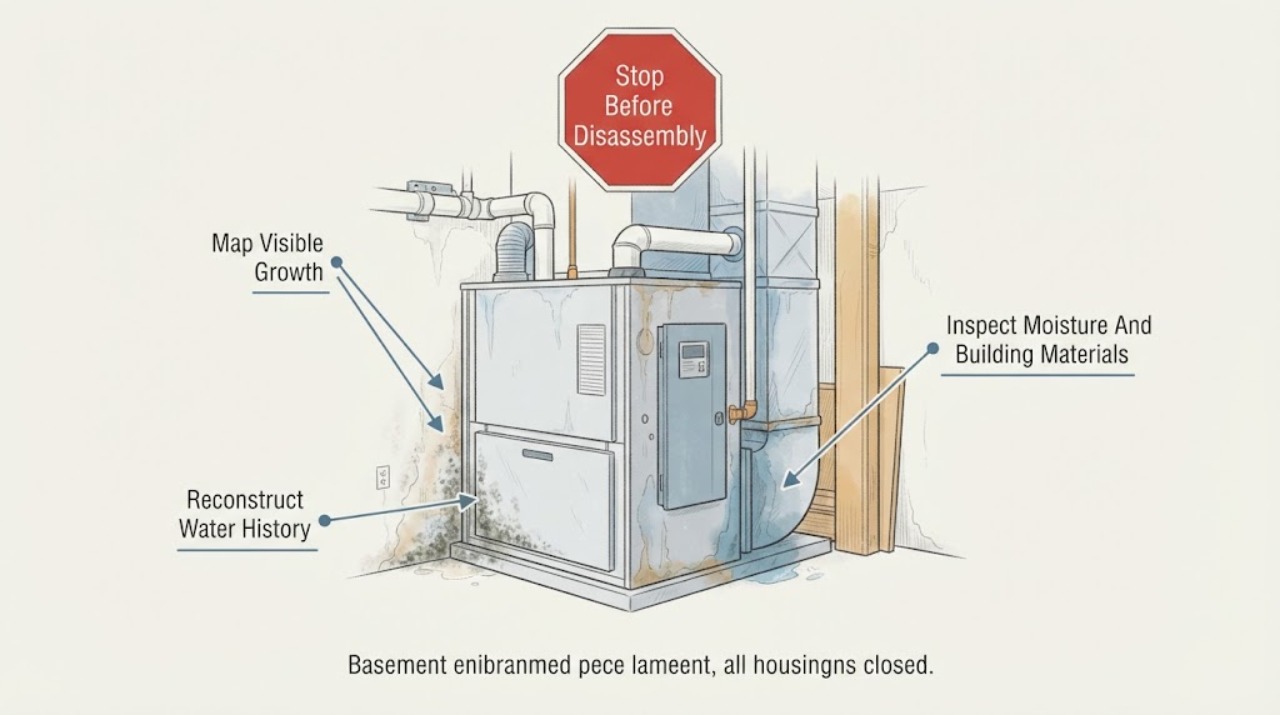
From the basement entry or another dry, stable position, photograph the visible growth and map its room, wall, floor, ceiling, and nearby contents. Estimate the affected area without touching, scraping, vacuuming, moving heavy items, or opening a finish.
Expected result: Growth is one small localized patch, several separated patches, a broad area, recurring in a line or corner, or visible on porous materials such as drywall, carpet, insulation, cardboard, or upholstered contents.
Next step: Keep dated photos and an approximate map for the remediation professional; leave the area undisturbed while the water history is reconstructed.
Stop if: Stop for loose or falling material, standing water, electrical exposure, strong odor with symptoms, unstable flooring, or any need to enter a confined or hidden space.
Why this matters
Why: Size and material change the cleanup path. EPA uses about 10 square feet as a point at which professional remediation guidance should be consulted, and porous or concealed materials can retain growth even when the surface looks cleaner.
-
Check 2
Write down when the basement became wet, what caused it if known, how long materials stayed damp, whether the event followed rain, snowmelt, plumbing use, condensation, or a flood, and what drying or covering work happened afterward. Use records and safe visual evidence rather than opening walls.
Expected result: The source is repaired and the area stayed dry; moisture returns after weather or plumbing use; the duration is unknown; or the water may have contained sewage, chemicals, or other contaminants.
Next step: Give the timeline, photos, invoices, insurance records, and known water quality to an experienced remediation or water-damage professional before disturbing materials.
Stop if: Do not enter contaminated water, handle saturated materials, or restart cleanup if the source is active, the water quality is unknown, or electrical equipment may be wet.
Why this matters
Why: A repaired source with dry materials supports a bounded assessment, but recurrence or an unknown drying interval keeps hidden damage and regrowth possible. Contaminated water changes the protective and cleanup requirements and should not be treated as ordinary clean-water work.
-
Check 3
From outside the affected area, look for current dampness, condensation on pipes or walls, water staining, swollen drywall, peeling finishes, soft or warped materials, musty odor, and moisture entering at the foundation, window, floor, drain, or plumbing route. Do not probe, peel, or seal the surface.
Expected result: The area is visibly dry and stable; a leak or condensation source is active or recurring; materials are swollen or porous; or a musty odor remains with no visible source.
Next step: Record the exact location and timing of moisture or odor, correct the source with qualified help, and request moisture and building-material assessment before painting, caulking, or rebuilding.
Stop if: Stop for active seepage, sewage, contaminated water, structural movement, exposed wiring, falling drywall, or symptoms that begin or worsen in the basement.
Why this matters
Why: Dry appearance does not prove that a cavity or porous material is dry. EPA states that cleanup is not complete until the moisture problem is fixed and that hidden mold investigation requires caution when a site would be disturbed.
-
Check 4
From a clean, safe position, note whether the basement HVAC intake, return path, ducts, or equipment is near the water-damaged or moldy area, and record whether anyone reports eye, skin, throat, breathing, allergy, or asthma symptoms after time there. Do not run a system suspected of contamination and do not ask a symptomatic or medically vulnerable person to inspect.
Expected result: The HVAC system is outside the affected area with no suspected contamination; mold or moisture is near an intake or duct; symptoms occur in the basement; or a child, older adult, allergic, immunocompromised, asthmatic, or otherwise vulnerable occupant is exposed.
Next step: Keep exposed occupants away, arrange experienced HVAC and remediation assessment when contamination is suspected, and seek medical advice for symptoms rather than using the basement as a test site.
Stop if: Leave the area if breathing difficulty, severe irritation, dizziness, or other concerning symptoms occur; do not switch on a potentially contaminated HVAC system.
Why this matters
Why: Suspected HVAC contamination can spread material through the building, and occupant vulnerability changes the exposure decision. Symptoms do not identify mold as the cause, but they are a reason to reduce exposure and seek appropriate health and remediation guidance.
-
Check 5
Combine the mapped extent, water quality and history, material type, hidden-space possibility, HVAC relationship, and occupant context to choose a limited cleanup-guidance path or professional remediation. Do not use sampling or a cosmetic paint test to decide whether the source is fixed.
Expected result: The visible area is small and accessible with no active moisture, contamination, HVAC concern, or health concern; the area is larger or porous/hidden; the source recurs; or the water was contaminated.
Next step: For a bounded small area, follow current EPA cleanup guidance only if the person doing the work is healthy and the site is safe; otherwise use an experienced remediation professional and require the water source to be corrected before rebuilding.
Stop if: Stop all DIY cleanup for extensive growth, substantial water damage, contaminated water, suspected HVAC spread, hidden cavities, vulnerable occupants, or uncertainty about safe containment.
Why this matters
Why: Visible mold usually provides enough evidence to begin a careful scope decision; EPA says sampling is generally unnecessary when visible growth is present. Larger, recurring, hidden, porous, contaminated, or HVAC-linked conditions need experienced assessment and containment.
Use your observations
Decision map
Find the observation that best matches what you see, then follow the next safe action.
-
PATH 01Next step
What you see
The visible growth is a small, accessible area, the water source is fixed, the material can be safely assessed without opening a cavity, and there is no contamination, HVAC concern, or occupant health concern.
Do this next
Use current EPA cleanup guidance, protect the worker and occupants, dry the area completely, and reassess for recurrence; use professional help if any condition changes.
Why this path and its safety boundary
Why it matters: This is the narrow situation in which EPA says a homeowner may in many cases follow its small-area cleanup guidance. The water history still needs to be documented because a dry-looking surface does not prove hidden materials are dry.
-
PATH 02Next step
What you see
Growth is over about 10 square feet, spread across rooms, present on porous materials, or associated with substantial water damage.
Do this next
Keep the area isolated and hire an experienced remediation professional who can assess extent, materials, moisture, and safe containment before removal.
Why this path and its safety boundary
Why it matters: The containment, removal, drying, and verification problem is broader than a surface wipe. Porous materials can hold growth in spaces that are difficult to clean completely.
-
PATH 03Next step
What you see
Growth, odor, dampness, or staining returns after rain, snowmelt, plumbing use, condensation, or a previous cleanup.
Do this next
Stop cosmetic repair, trace and correct the water source with qualified help, and have the affected materials reassessed before rebuilding or reoccupying the area.
Why this path and its safety boundary
Why it matters: The moisture pathway remains active or was not fully corrected. Painting or caulking over the surface can conceal the recurrence without stopping growth or material damage.
-
PATH 04Next step
What you see
The basement was affected by sewage, floodwater, chemicals, or another source whose cleanliness is unknown.
Do this next
Keep people and pets away and call an experienced water-damage or remediation professional; do not use fans or disturb materials until the water and safety conditions are assessed.
Why this path and its safety boundary
Why it matters: Contaminated water requires additional protective controls and can make ordinary household cleanup unsafe. Do not treat it as a routine visible-mold patch.
-
PATH 05Next step
What you see
Mold or moisture is near an HVAC intake or duct, or a vulnerable or symptomatic occupant is exposed to the basement.
Do this next
Keep the occupant away, do not run a suspected contaminated HVAC system, and obtain experienced remediation/HVAC and appropriate health guidance.
Why this path and its safety boundary
Why it matters: The potential exposure extends beyond one visible patch and can affect building air or health decisions. Symptoms do not prove causation, but continued exposure should not be used as a diagnostic test.
Helpful context
Understand the symptom
Water history changes the first decision
A basement stain or musty smell after an old leak does not tell you whether the source is fixed, whether materials remained wet, or whether growth is hidden behind a wall or finish. The useful record is the sequence: what got wet, how long it stayed wet, whether the source recurred, what was removed or covered, and whether the area still smells or changes after rain.
Visible mold is not a safe invitation to investigate deeper
EPA notes that opening wallpaper, drywall, paneling, carpet, or other suspected sites can release spores and that porous materials may be difficult or impossible to clean completely. Keep the inspection non-contact, isolate the area as practical, and use experienced remediation help when extent, materials, water quality, or occupant health makes the decision uncertain.
Safety boundary
Stop conditions
- Do not scrape, sand, vacuum, open walls, peel finishes, paint, or caulk over suspected mold or hidden water damage.
- Do not enter sewage, floodwater, or water of unknown cleanliness; do not use fans until water safety and contamination are assessed.
- Do not run an HVAC system known or suspected to be contaminated with mold.
- Stop and leave the area for active water, electrical exposure, structural instability, severe odor or breathing symptoms, or any condition requiring unsafe access.
When checks do not resolve it
Need a professional?
Arrange experienced mold-remediation or water-damage service before disturbing the area when growth is over about 10 square feet, water damage was substantial, materials are porous or hidden, the source recurs, the water may be contaminated, HVAC contamination is possible, or occupants have health concerns. Keep people and pets away and seek appropriate medical advice for symptoms. Stop immediately for active flooding, sewage, electrical exposure, structural instability, falling material, severe breathing difficulty, or any need to open a hidden cavity.
Common questions
FAQ
Does a past basement leak mean the visible mold is still active?
Not by itself. The useful evidence is whether moisture, odor, staining, or growth returns; whether materials stayed wet; and whether hidden or porous materials were affected. A dry-looking surface does not prove the water path or cavity is resolved.
How much visible basement mold should a professional handle?
EPA says that more than about 10 square feet of growth or substantial water damage warrants consulting professional remediation guidance. Porous or hidden materials, recurring moisture, contaminated water, HVAC concerns, and health concerns are also reasons to use experienced help even when the visible patch looks smaller.
Should I test the mold before deciding what to do?
EPA says sampling is generally unnecessary when visible mold is present and there are no federal mold limits for building compliance. Document the visible condition, extent, materials, moisture history, and occupant context instead; use professional assessment when the scope or safety is uncertain.
Can I paint over a basement mold stain after the leak is repaired?
No. Fix the water problem, clean or remove affected materials as appropriate, and dry the area before painting or caulking. Covering mold can conceal recurrence and paint applied over moldy surfaces is likely to peel.
What if the basement mold is near the HVAC system?
Do not run a system known or suspected to be contaminated, because it can spread mold through the building. Keep people away and arrange experienced remediation and HVAC assessment before normal operation resumes.
Who should not clean visible basement mold?
CDC identifies people with allergies, immune suppression, underlying lung disease, asthma, or chronic obstructive pulmonary disease as being at higher risk from mold exposure. They should not take part in cleanup; seek appropriate health and professional remediation advice.
Read the exact guide
Official sources
- A Brief Guide to Mold, Moisture and Your HomeU.S. Environmental Protection Agency · General U.S. homeowner and renter guidance; it does not diagnose an individual building or health condition.
- Remodeling Your Home and Indoor Air QualityU.S. Environmental Protection Agency · General U.S. basement remodeling and indoor-air guidance; local building and project-specific requirements control.
- Mold Cleanup in Your HomeU.S. Environmental Protection Agency · General U.S. residential mold-cleanup guidance; building conditions and local/professional requirements control.
- Mold Clean Up Guidelines and RecommendationsCenters for Disease Control and Prevention · General U.S. public-health guidance; it does not replace a site-specific remediation plan or medical advice.
- Mold Course Chapter 4:U.S. Environmental Protection Agency · EPA technical guidance for assessing water and mold damage; professional judgment is needed for complex residential conditions.
Community feedback
Share a repair observation
Share a plain-text repair observation. Accepted observations are published automatically; this page may take a moment to update.