
On this page
Start here
Quick answer
Mold that returns at a bathroom caulk joint after cleaning usually means moisture is still reaching the joint, the ventilation is not removing enough moisture, or growth extends into a porous or concealed material. Do not keep painting or caulking over it, mix cleaning products, scrape or sample the area, open the wall, or treat this as solved by a surface wipe. From a safe position, record the exact joint, when it reappears relative to showers, condensation, or leaks, whether the fan runs and appears to exhaust, and whether staining or growth extends beyond the caulk. Keep the area isolated from unnecessary disturbance and arrange professional moisture-source inspection and mold remediation, with plumbing, building-envelope, or ventilation repair as indicated.
Before you begin
Safety first
- Do not mix bleach or other cleaners, paint or caulk over visible mold, scrape or sample it, remove caulk, open walls or ceilings, dismantle a fan or duct, or perform DIY remediation. Isolate active hazards and leave source control, concealed-material assessment, and remediation to qualified professionals.
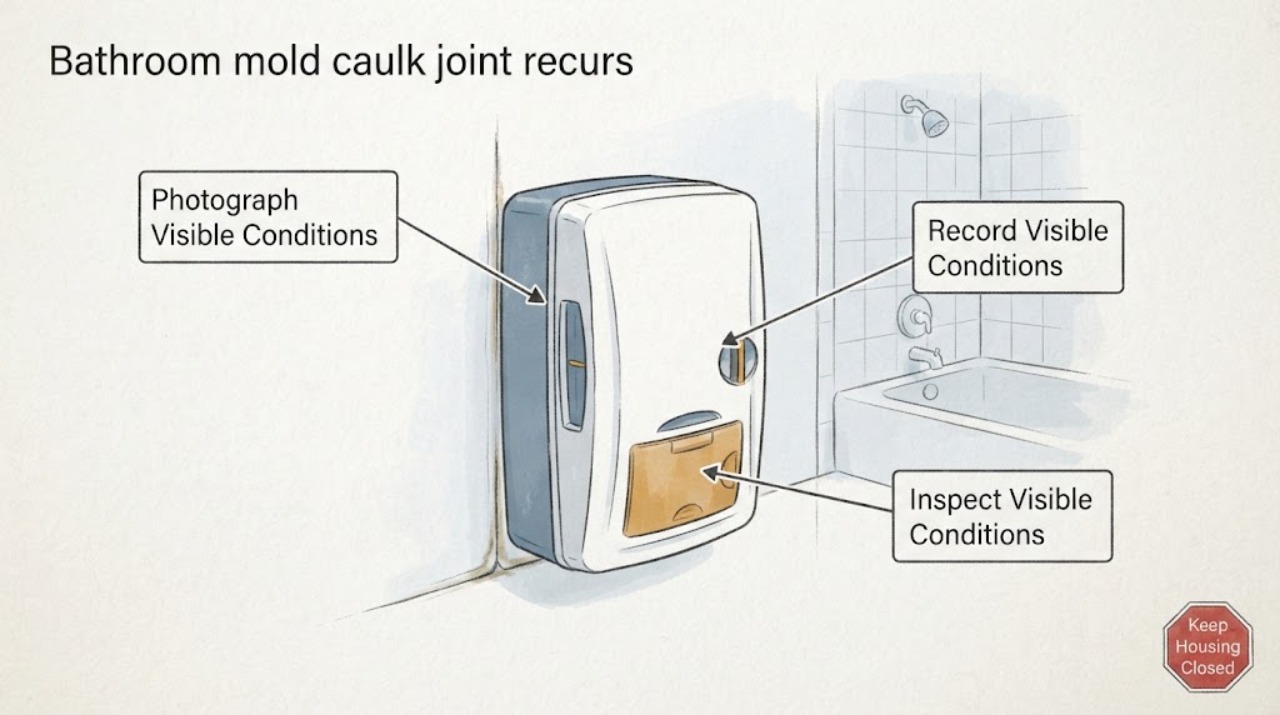
Work through in order
Diagnostic checks
Use only checks that match the exact appliance or system and its official guide.
-
Check 1
From a dry, safe position, photograph and map the exact caulk joint where growth returned, noting whether it is at a shower, tub, sink, toilet, backsplash, floor transition, or another wet-area junction; do not touch, scrape, sample, or remove the caulk.
Expected result: The recurrence may be confined to one short joint, follow the full wet-area perimeter, or extend onto grout, wall, trim, ceiling, or floor surfaces.
Next step: Keep the area undisturbed and give the dated photos and boundary description to a qualified mold-remediation or moisture professional.
Stop if: Stop immediately if the material is soft, crumbling, wet, visibly extensive, or likely to release debris; do not disturb it or attempt another cleaning.
Why this matters
Why: A localized line can still have moisture behind it, while growth beyond the joint raises concern for a broader or porous-material problem that surface cleaning cannot resolve.
-
Check 2
Record when the joint becomes damp or the growth returns in relation to showers, baths, sink use, condensation, or cleaning, and note whether the area appears dry between uses; do not perform a prolonged water test or spray the joint.
Expected result: Recurrence may follow routine bathing, persist regardless of use, appear after rain or a plumbing event, or have no clear timing.
Next step: Share the timeline with the professional and avoid repeated surface treatments while the source is unresolved.
Stop if: Stop and escalate promptly for active dripping, pooling, a sagging ceiling, spreading dampness, sewage, or water near electrical equipment.
Why this matters
Why: Use-related recurrence can point toward bathroom humidity or splash; persistence or weather- or plumbing-related timing supports investigation of a leak, condensation path, or concealed moisture source.
-
Check 3
From room level, observe whether the bathroom exhaust fan runs during normal use, whether airflow seems present at the grille, and whether condensation remains afterward; do not remove the grille, open the duct, rewire the fan, or enter an attic or crawlspace.
Expected result: The fan may run and appear to move air, run weakly or noisily, fail to start, or be followed by persistent condensation.
Next step: Record the fan behavior and request a qualified ventilation or building professional to inspect the system and moisture path.
Stop if: Stop if the fan or switch is hot, damaged, sparking, wet, or requires electrical access; isolate the hazard and call the appropriate professional.
Why this matters
Why: Poor or uncertain moisture removal can contribute to recurrence, but a room-level airflow impression cannot confirm duct routing or fan performance. A fan that exhausts into an unconditioned space can create a separate moisture problem.
-
Check 4
Without opening surfaces, inspect adjacent visible wall, ceiling, floor, fixture base, and trim areas for staining, swelling, soft-looking finishes, odor, or a pattern that follows plumbing or an outside wall; do not press on, drill, cut, or remove material.
Expected result: There may be no adjacent sign, a narrow moisture pattern, widespread staining, or visible damage around a fixture or building boundary.
Next step: Photograph the pattern and arrange coordinated moisture-source inspection and professional remediation; report plumbing or building leaks promptly.
Stop if: Stop and keep people out of the area for active leaks, soft or sagging materials, sewage, extensive growth, or suspected hidden contamination.
Why this matters
Why: A broader pattern or damaged finish suggests the caulk joint may be a symptom of a plumbing, envelope, condensation, or concealed-material problem rather than an isolated surface issue.
-
Check 5
Decide whether to leave the joint untouched and schedule professional assessment rather than applying more caulk or cleaner; do not mix cleaning products, disturb moldy material, or open a wall to investigate.
Expected result: The area may be a small recurring surface sign with no active leak, or it may involve persistent dampness, porous materials, hidden growth, a ventilation concern, or a larger spread.
Next step: Provide the location map, timing log, fan observations, visible extent, leak history, and household health concerns to the remediation and source-control professionals.
Stop if: Stop all DIY activity and escalate for active water, extensive or concealed growth, sewage, HVAC involvement, structural damage, electrical danger, or respiratory symptoms.
Why this matters
Why: Even a small recurring sign needs its moisture cause addressed before cosmetic resealing. Larger, concealed, persistent, or health-sensitive situations need professional remediation planning.
Use your observations
Decision map
Find the observation that best matches what you see, then follow the next safe action.
-
PATH 01Next step
What you see
Growth returns only at a caulk joint after showers and there is no visible spread.
Do this next
Document the timing and ventilation behavior and request professional moisture-source and remediation assessment before any resealing.
-
PATH 02Next step
What you see
Condensation persists or the exhaust fan is weak, noisy, absent, or uncertain.
Do this next
Arrange qualified ventilation or building inspection; do not open the fan, duct, ceiling, or attic to trace it yourself.
-
PATH 03Next step
What you see
Staining, swelling, soft finishes, odor, or growth appears near plumbing, a ceiling, an outside wall, flooring, or porous material.
Do this next
Keep the area undisturbed and request coordinated moisture-source inspection and professional mold remediation.
-
PATH 04Next step
What you see
There is active water, sewage, extensive or concealed growth, electrical exposure, structural damage, HVAC involvement, or respiratory symptoms.
Do this next
Isolate the area, stop DIY work, and obtain prompt qualified remediation, plumbing, building, electrical, HVAC, medical, or emergency help as applicable.
Helpful context
Understand the symptom
Recurring growth is a moisture clue
A clean-looking caulk line can become affected again when shower moisture, condensation, a plumbing leak, or water behind the joint remains unresolved. The joint may also be masking damage in a porous backing material. The useful question is not which cleaner to try next, but whether the moisture source and the full affected extent have been assessed.
Observe without disturbing the joint
From the bathroom floor, note the location, color or staining pattern, timing, odor, and whether the change is limited to the seal or extends onto grout, drywall, trim, ceiling, or flooring. Do not scrape, cut, sample, pull the caulk, remove the wall, or handle suspected mold. Photographs taken without contact can help a professional plan the assessment.
Ventilation and leaks need separate checks
Record whether recurrence follows showers, whether condensation remains on surfaces, and whether the bathroom fan sounds and appears to move air during normal use. Also note any plumbing, ceiling, wall, or floor staining. Do not open the fan, duct, fixture, wall, or ceiling; persistent moisture requires the relevant qualified professional.
Do not use new caulk as a cover
Painting or caulking over mold does not correct the water problem and can conceal the boundary of affected material. A professional should decide whether the visible caulk is the whole issue, whether porous backing is involved, and how source control, remediation, drying, and any replacement should be sequenced.
Only after diagnosis
Potential parts
- humidity-meter
A humidity meter may help a professional or occupant document a moisture pattern, but it does not diagnose the source or determine mold remediation scope.
Use the instrument only as supplementary observation and follow the professional's assessment; do not treat a reading as a clearance or health determination. - moisture-meter
A moisture meter is relevant only when a qualified assessment determines that non-destructive moisture mapping is appropriate near the recurring joint.
Surface, substrate, calibration, and material affect readings; do not drill or probe the joint and do not infer hidden conditions from an unverified reading. - bathroom-exhaust-fan
A replacement fan may be relevant only if a qualified ventilation or electrical assessment confirms the existing fan is inadequate or defective.
Confirm opening, duct route, exterior termination, electrical requirements, and local professional installation needs; do not select or install a fan from recurrence alone.
When checks do not resolve it
Need a professional?
Arrange professional mold-remediation and moisture-source assessment when caulk-joint growth recurs after cleaning, especially with persistent dampness, condensation, visible spread, porous or concealed materials, plumbing or building leaks, inadequate ventilation, or household health concerns. Add qualified plumbing, ventilation, building, electrical, or HVAC service when the observations point there.
Safety scope: Do not mix bleach or other cleaners, paint or caulk over visible mold, scrape or sample it, remove caulk, open walls or ceilings, dismantle a fan or duct, or perform DIY remediation. Isolate active hazards and leave source control, concealed-material assessment, and remediation to qualified professionals.
Have this ready
- Provide dated photos, exact joint location, recurrence timing, shower and cleaning relation, fan behavior, condensation, visible staining or spread, leak history, material type, any sewage or electrical concern, and relevant household health limitations.
Common questions
FAQ
Why does mold return on bathroom caulk after I clean it?
The joint may still receive shower moisture or condensation, or a leak, ventilation problem, or porous backing may remain affected. Repeated surface cleaning does not establish that the moisture source or full material extent is resolved.
Should I apply new caulk over the recurring mold?
No. Do not cover a moldy joint with new caulk. A professional should assess the moisture source and affected material before deciding how remediation, drying, and any resealing should be sequenced.
Can I open the wall or remove the old caulk to see what is behind it?
Not in this observation-only workflow. Cutting, scraping, or opening can disturb concealed contamination and may damage plumbing or wiring. Photograph the boundary and arrange professional assessment.
How can I tell whether the bathroom fan is part of the problem?
Record whether it starts, sounds normal, appears to move air, and is followed by persistent condensation during ordinary use. Do not remove the grille or open the duct; a qualified professional must verify the route and performance.
Read the exact guide
Official sources
- Mold Clean Up Guidelines and RecommendationsCenters for Disease Control and Prevention · Supports avoiding exposure and chemical mixing and using professional judgment for cleanup; this article intentionally provides no DIY remediation procedure.
- Mold, Testing, and RemediationNational Institute for Occupational Safety and Health · Supports treating building mold as a moisture problem and using professional assessment for concealed or consequential conditions.
- Install Exhaust Fan Flex Duct (Bath Fan Only)U.S. Department of Energy · Supports why bathroom exhaust should terminate outdoors and why attic or crawlspace discharge can create mold and rot; no homeowner duct-installation procedure is provided here.
- A Brief Guide to Mold, Moisture and Your HomeU.S. Environmental Protection Agency · Supports prioritizing moisture control, not covering mold, professional assessment for hidden or larger problems, and bathroom ventilation observations.
Community feedback
Share a repair observation
Share a plain-text repair observation. Accepted observations are published automatically; this page may take a moment to update.