
On this page
Start here
Quick answer
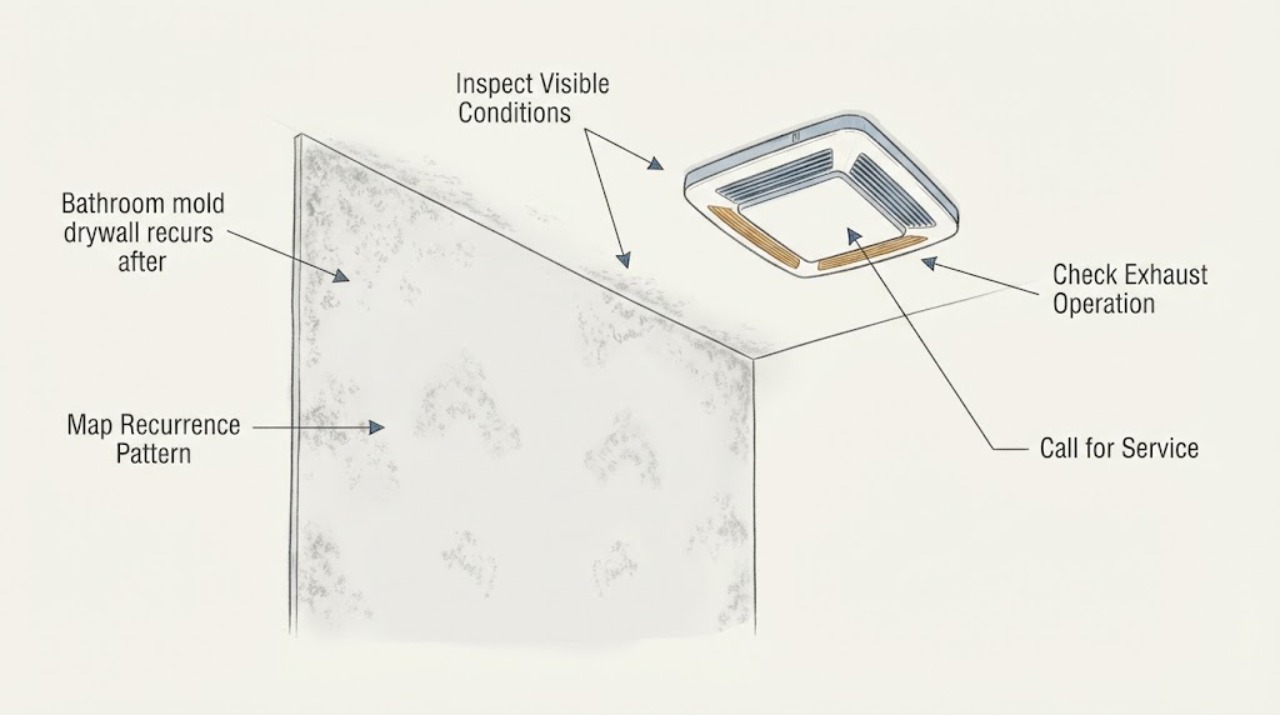
Mold that returns on bathroom drywall usually means the moisture condition was not corrected, the drywall or cavity stayed damp, or condensation and ventilation remain uncontrolled. From a safe position, record when and where it returns, look for plumbing or shower moisture, observe whether the exhaust fan actually moves air outdoors, and note soft, swollen, bubbling, stained, or musty drywall. Do not scrape, sand, paint over, spray chemicals, mix bleach, open the wall, or attempt DIY remediation. Repeated growth, soft or damaged drywall, hidden moisture, a large area, or health symptoms calls for an experienced mold and water-damage professional.
Work through in order
Diagnostic checks
Use only checks that match the exact appliance or system and its official guide.
-
Check 1
From a safe, dry position, map exactly where the mold-like appearance returns on the bathroom drywall and record the time since the last cleaning or visible drying.
Expected result: Note whether it returns at a corner, ceiling line, shower-adjacent wall, plumbing wall, baseboard, or the same repaired patch, and whether the area is expanding or recurring after every shower.
Next step: Keep the area undisturbed, photograph it from a safe distance, and give the pattern and timeline to a qualified mold and moisture professional.
Stop if: Stop if observing would require scraping, sampling, peeling, drilling, moving wet materials, or standing in a damp or contaminated area.
Why this matters
Why: A repeatable location or short recurrence interval supports an unresolved moisture source or damp wall assembly rather than a one-time surface mark.
-
Check 2
Visually review accessible shower, tub, sink, toilet, pipe, ceiling, and wall areas for water or condensation without removing fixtures, caulk, drywall, or access panels.
Expected result: Look for fresh dampness, water marks, peeling finish, recurring condensation, a plumbing drip, or a pattern that follows shower use, while noting whether the drywall stays visibly dry between uses.
Next step: Limit use that worsens the wet area, record the timing, and arrange the appropriate qualified plumbing, building-envelope, or moisture professional.
Stop if: Stop if water is active, the wall is soft, electrical equipment is wet, or the source cannot be assessed without opening the wall.
Why this matters
Why: Moisture tied to a fixture or use pattern points toward plumbing, enclosure, or ventilation investigation; persistent dampness with no visible source may indicate concealed moisture.
-
Check 3
From outside the shower and without removing the grille, observe whether the bathroom exhaust fan starts normally and whether airflow appears to leave the room during ordinary shower use.
Expected result: Note a fan that is silent, weak, delayed, noisy, blocked-looking from the room, or apparently venting moisture back into the bathroom rather than outdoors.
Next step: Report the fan behavior and suspected outlet route to a qualified ventilation or building professional; use normal ventilation while waiting if it is safe and functional.
Stop if: Do not remove the fan cover, reach into the duct, climb, alter wiring, or continue if the fan smells burned or shows electrical damage.
Why this matters
Why: Insufficient or misdirected ventilation can leave bathroom humidity high and contribute to recurring surface growth, but fan operation alone does not rule out a leak or damp wall cavity.
-
Check 4
From a normal standing position, visually assess the drywall surface and finish without pressing, scraping, sanding, or puncturing it.
Expected result: Look for bubbling paint, swelling, soft-looking areas, cracked joints, sagging, staining, delamination, or a musty odor that extends beyond the visible patch.
Next step: Keep people away from the area and request a professional moisture and material assessment before any cleanup or replacement decision.
Stop if: Stop immediately if the wall moves, sheds material, has widespread growth, or is adjacent to wet electrical equipment.
Why this matters
Why: Soft, swollen, bubbling, sagging, or extensively stained drywall may have absorbed moisture or contain hidden growth and should not be treated as a cosmetic cleaning job.
-
Check 5
From a clean location, note bathroom humidity or condensation with an available room hygrometer and record any occupant symptoms without disturbing the wall or mold-like material.
Expected result: Note persistent high humidity, condensation after ordinary use, musty odor, coughing, wheezing, eye irritation, skin irritation, or symptoms that improve away from the room.
Next step: Keep the area ventilated only through safe normal operation, restrict access as practical, and share the readings and symptom context with the professional.
Stop if: Stop inspection and seek medical advice for breathing difficulty or significant symptoms; do not clean, spray, sample, or disturb the material.
Why this matters
Why: Persistent humidity supports a ventilation or moisture-control problem; symptoms or vulnerable occupants increase the need to avoid exposure and obtain professional and medical advice.
Use your observations
Decision map
Find the observation that best matches what you see, then follow the next safe action.
-
PATH 01Safety boundary
What you see
Return appears after showering or near a plumbing fixture, stain, or condensation path.
Do this next
Arrange qualified plumbing or moisture-source investigation and keep the affected area as dry and unused as practical.
Why this path and its safety boundary
Safety stop: Do not open the wall, remove caulk, or continue using a fixture that creates active wetting.
-
PATH 02Safety boundary
What you see
The fan is weak, does not run, or appears not to exhaust outdoors and condensation persists.
Do this next
Request professional ventilation or electrical assessment and use only normal safe ventilation while waiting.
Why this path and its safety boundary
Safety stop: Do not remove the grille, alter wiring, climb, or modify the duct yourself.
-
PATH 03Safety boundary
What you see
Drywall is soft, swollen, bubbling, sagging, extensively stained, or repeatedly wet.
Do this next
Treat it as possible water-damaged or porous material and arrange professional mold and moisture assessment.
Why this path and its safety boundary
Safety stop: Do not scrape, sand, paint, caulk, cut, or remove the drywall.
-
PATH 04Safety boundary
What you see
Musty odor extends beyond the patch, growth is widespread, or the moisture source is not visible.
Do this next
Request an experienced professional investigation for hidden moisture or growth and keep occupants away as practical.
Why this path and its safety boundary
Safety stop: Do not probe, drill, sample, open cavities, or attempt DIY remediation.
-
PATH 05Safety boundary
What you see
Someone has breathing symptoms, is medically vulnerable, or the HVAC intake or air path may be contaminated.
Do this next
Leave the affected area as practical, seek medical advice for symptoms, and obtain professional assessment before disturbing materials or operating a potentially affected air system.
Why this path and its safety boundary
Safety stop: Do not clean, spray chemicals, or run a suspected contaminated air path to test it.
Helpful context
Understand the symptom
Recurrence points to moisture, not just surface appearance
Cleaning can remove visible growth while leaving the water source, damp backing, or humid conditions unchanged. Bathroom steam can condense on cooler wall surfaces, while a plumbing or shower leak can wet the back of drywall. The goal of a safe homeowner observation is to describe the pattern and protect the area, not to disturb the wall.
Improve airflow without opening the wall
Use the bathroom exhaust fan as designed and confirm, from a safe location, whether it runs and appears to discharge outdoors. Keep the room door or window position consistent when comparing ordinary use, and reduce avoidable moisture. Do not remove a fan cover, enter a ceiling cavity, or alter ducting as part of this check.
Do not seal in a wet or damaged surface
Paint, caulk, or a new surface coating over visible mold or wet drywall can hide the condition while moisture continues. EPA guidance emphasizes fixing the water problem and drying before cleanup is considered complete; porous materials may not be fully cleanable once growth has entered them.
Only after diagnosis
Potential parts
- humidity meter
Consider only as an observation aid if persistent humidity or condensation is suspected; a reading does not identify or repair the moisture source.
Use according to the meter instructions in a clean, accessible location and do not treat a reading as a mold-remediation clearance. - moisture meter
Consider only when a qualified professional recommends it for locating damp areas without disturbing suspected growth; it cannot confirm mold or replace an inspection.
Check the meter's material and surface limitations and keep probes out of suspected mold or damaged drywall unless a trained professional directs otherwise. - bathroom exhaust fan
Consider only after a professional confirms that the fan, duct route, electrical supply, and outlet are suitable for replacement; recurring mold may still have another moisture source.
Confirm opening, duct, electrical, and ventilation requirements with the professional and do not use a replacement as a DIY wiring or ceiling-access project.
When checks do not resolve it
Need a professional?
Request high-priority professional service when mold returns after cleaning, the source is not obvious, drywall is soft or swollen, the affected area is broad or recurring, the exhaust path is uncertain, or water damage may be hidden. Seek medical advice for symptoms and urgent help for an active leak near electrical equipment.
Common questions
FAQ
Why does mold keep coming back on bathroom drywall?
The wall may still be receiving water, staying humid, experiencing condensation, or retaining damp material behind the surface. Repeated return is a reason to investigate the moisture condition rather than repeatedly clean the same patch.
Should I paint over recurring bathroom mold?
No. Do not paint or caulk over moldy or wet drywall. The water or humidity problem should be corrected and the material professionally assessed first.
Can a bathroom fan prevent mold recurrence?
Adequate ventilation can help reduce bathroom humidity, but a fan that is weak, not exhausting outdoors, or unrelated to a plumbing leak will not solve every cause. Observe its operation safely and have the system assessed when recurrence continues.
When is recurring drywall mold a professional job?
Choose professional assessment for soft or swollen drywall, hidden or widespread growth, repeated recurrence, significant water damage, uncertain ventilation, vulnerable occupants, or any symptoms. Do not open or disturb the wall to investigate.
Read the exact guide
Official sources
- A Brief Guide to Mold, Moisture and Your HomeU.S. Environmental Protection Agency · Understanding why recurring bathroom mold requires moisture control and why damp or porous drywall may need professional evaluation
- Mold Course Chapter 3: Finding Mold and MoistureU.S. Environmental Protection Agency · Distinguishing visible recurrence from possible hidden mold or damp drywall without opening or disturbing the wall
- MoldCenters for Disease Control and Prevention · Recognizing health symptoms and the role of humidity, bathroom exhaust, and leak correction in preventing recurring mold
Community feedback
Share a repair observation
Share a plain-text repair observation. Accepted observations are published automatically; this page may take a moment to update.