
On this page
Start here
Quick answer
If mold or mildew keeps returning near a bathroom ceiling grille and the exhaust seems weak, first determine whether the fan starts, whether air movement is actually noticeable from the room, and whether moisture remains on the ceiling after normal bathing. A grille that looks clean does not prove that the fan exhausts outdoors or that the duct path is clear. Make only safe observations from the floor: do not open the grille or duct, rewire the fan, climb, or disturb mold. If airflow is weak or absent, condensation persists, the grille or ceiling is stained, or mold keeps returning, arrange qualified ventilation or mold service.
Before you begin
Safety first
- Use only safe floor-level and ground-level observation with normal controls. Do not climb, remove the grille, open ductwork, rewire or open the fan, scrape or clean suspected mold, or perform destructive inspection. Stop for heat, arcing, smoke, active water, ceiling damage, or unsafe access.
Work through in order
Diagnostic checks
Use only checks that match the exact appliance or system and its official guide.
-
Check 1
From a stable floor position, use the existing bathroom switch normally and observe the ceiling grille without touching or removing it. Note whether the fan starts, whether its sound changes, and whether air movement is noticeable at room level without a ladder or test instrument.
Expected result: Record a fan that is silent, starts but sounds strained, runs with little noticeable air movement, or sounds normal while moisture and mold still persist.
Next step: Stop trying the control if it behaves abnormally and request qualified ventilation or electrical service; otherwise document the observation for a professional airflow and installation assessment.
Stop if: Stop immediately for buzzing, arcing, burning odor, heat, smoke, a loose grille, or any need to touch wiring or reach into the fan.
Why this matters
Why: No sound suggests a control or power issue; sound without useful room-level airflow can indicate an installed airflow or duct problem. A normal sound does not prove adequate exhaust.
-
Check 2
After ordinary bathing has occurred, observe the bathroom from the floor and note whether condensation remains on the mirror, ceiling, or nearby surfaces, whether the room feels persistently damp, and whether the fan is routinely used. Do not create extra steam as a test.
Expected result: Compare a room that clears moisture normally with one where condensation, damp surfaces, musty odor, or mold-like growth remains or returns around the grille and ceiling.
Next step: Photograph the pattern and arrange a professional assessment of ventilation and moisture; do not compensate by opening the fan or changing wiring.
Stop if: Stop and isolate the area if the ceiling is sagging, actively wet, visibly damaged, or mold-like material would need to be touched or disturbed.
Why this matters
Why: Persistent moisture supports an unresolved ventilation or moisture-source concern, but it does not identify whether the fan, duct, termination, room layout, or another source is responsible.
-
Check 3
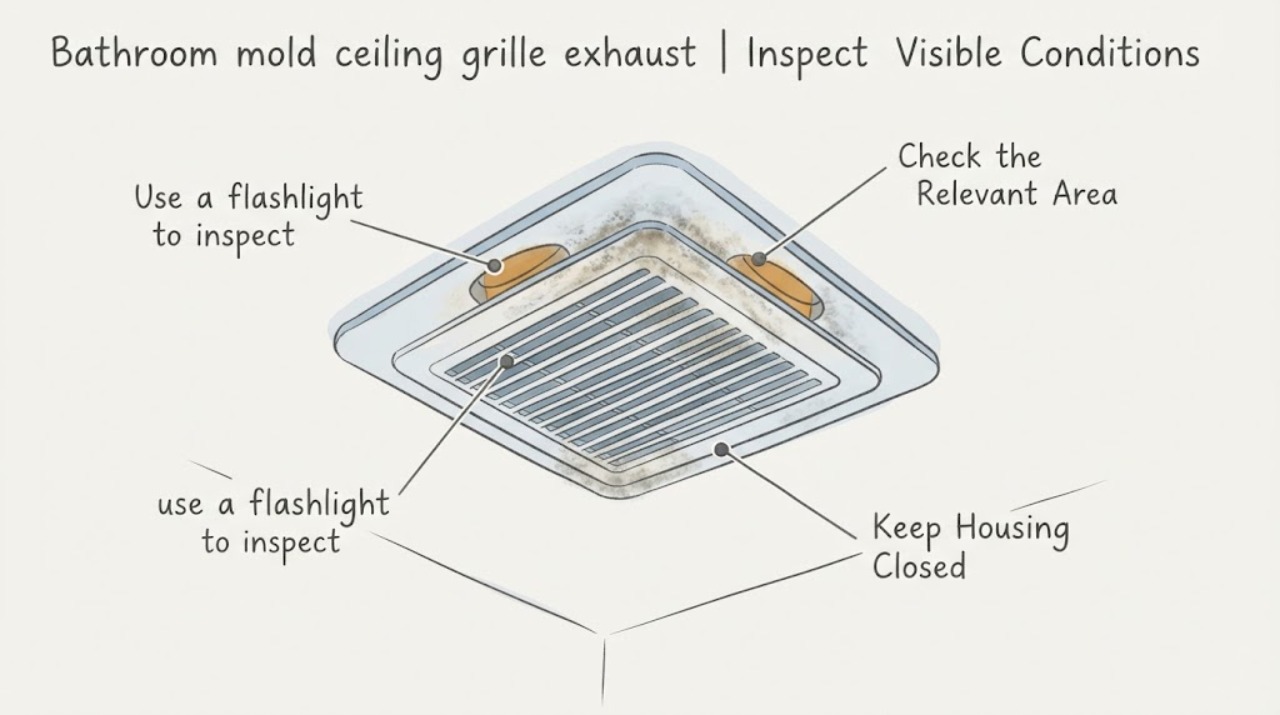
From the floor, use a flashlight to inspect the visible grille and surrounding ceiling. Do not remove the grille, brush it, scrape growth, or insert anything into the opening.
Expected result: Note heavy visible dust, discoloration, rust-like staining, a loose or sagging grille, mold-like growth, peeling finish, or a ceiling pattern that extends beyond the grille.
Next step: Keep the area undisturbed, keep occupants with sensitivities away, and provide the photos to a qualified mold or ventilation professional.
Stop if: Stop if material is falling, the ceiling is soft or sagging, there is active dripping, or inspection would require a ladder, contact, or opening the grille.
Why this matters
Why: The visible pattern can show that moisture or contamination is concentrated at the grille or ceiling, but it cannot distinguish surface mold from hidden growth or prove the duct condition.
-
Check 4
From a safe ground-level location outside, only if the exhaust termination is already visible without climbing or approaching an unsafe area, observe whether it is visibly obstructed or whether airflow is apparent while the fan is normally running. Do not open, clean, or reach into the termination.
Expected result: Record a termination that is not visible, appears blocked, shows staining or moisture, or has no obvious outward airflow during normal operation.
Next step: Report the observation and the termination location to a ventilation professional; do not open the duct or attempt exterior work.
Stop if: Stop if the termination requires a ladder, roof access, weather exposure, contact with wildlife, or proximity to electrical equipment.
Why this matters
Why: A ground-level observation can help a professional locate the next check, but absence of visible airflow is not a definitive performance test and a hidden duct route remains unknown.
-
Check 5
Review the history of the bathroom mold and grille symptom: note when it began, whether it follows showers, whether it returns after cleaning, whether the fan or ceiling was remodeled, and whether other moisture sources are present. Use a room humidity meter only if it is already available and can be read safely without climbing or electrical work.
Expected result: A recurring pattern after bathing differs from growth that appears without bathing, a recent fan change, a persistent musty odor, or a ceiling stain that is enlarging.
Next step: Give the timeline, photos, and any safely observed readings to a qualified mold or ventilation professional; do not perform DIY mold remediation or alter the fan system.
Stop if: Stop and escalate if the source is uncertain, the ceiling is damaged, mold is widespread or hidden, or anyone has a health concern associated with the area.
Why this matters
Why: The timeline helps separate a ventilation symptom from a leak or concealed moisture concern, while recurrence after cleaning indicates that moisture control has not been resolved.
Use your observations
Decision map
Find the observation that best matches what you see, then follow the next safe action.
-
PATH 01Next step
What you see
The fan starts, room moisture clears normally, and there is no recurring mold or ceiling damage.
Do this next
Continue observing normal bathroom moisture and follow the exact fan manual for routine owner care; do not open the grille simply to inspect the duct.
-
PATH 02Next step
What you see
The fan is silent, has abnormal noise, or has heat, arcing, or a burning odor.
Do this next
Stop using the fan and arrange qualified electrical or ventilation service. Do not rewire, open the housing, or repeatedly energize it.
-
PATH 03Next step
What you see
The fan runs but airflow seems weak, condensation remains, or the exterior termination appears obstructed from a safe ground-level view.
Do this next
Request a professional airflow and duct-route assessment. Do not open ductwork, climb, or attempt to clear the termination.
-
PATH 04Next step
What you see
Mold-like growth recurs, a musty odor persists, or the ceiling is stained, peeling, damp, or damaged.
Do this next
Do not scrape, bleach, paint over, or disturb the area. Isolate it and arrange experienced mold and moisture assessment.
-
PATH 05Next step
What you see
The cause is hidden or would require a ladder, grille removal, electrical work, or duct opening.
Do this next
Stop the user inspection and have a qualified ventilation or mold professional investigate the system and building materials.
Helpful context
Understand the symptom
Why a noisy fan may still be insufficient
A bathroom exhaust system has more than a visible grille. The motor may run while the installed airflow is restricted, the outlet may not discharge outdoors, or the room may still be receiving more moisture than the system removes. EPA guidance says bathroom ventilation should remove unwanted moisture and that a fan needs to exhaust sufficient air directly outdoors; the exact installation and performance depend on the home and the fan model.
Keep the inspection at user level
Use a stable floor position, normal room controls, a flashlight, and photos. Do not climb to the ceiling, remove the grille, reach into the fan housing, open ductwork, alter wiring, or scrape mold. A professional can inspect the fan, electrical supply, duct route, termination, and mold or moisture conditions safely.
Solve moisture and mold together
EPA identifies moisture control as central to mold control and recommends fixing the water or moisture problem rather than covering mold. Persistent growth around a bathroom ceiling grille can therefore be evidence of a ventilation or moisture issue, not just a surface-cleaning problem.
Only after diagnosis
Potential parts
- bathroom exhaust fan
Only consider a replacement fan after a qualified professional confirms the existing fan is inadequate or failed and checks the housing, electrical supply, duct route, and outdoor termination.
Match the exact housing, mounting, control, electrical requirements, and duct configuration; do not select a fan solely by appearance or sound rating. - humidity meter
Only use this as an optional observation aid when it can be read from a safe location; a room reading does not diagnose fan airflow, duct restriction, or hidden moisture.
Treat readings as context for a professional assessment rather than a pass or fail test. - duct cleaning tool
Only consider professional duct inspection or cleaning if a qualified technician confirms a duct-path issue; do not open or clean the duct as a homeowner mold response.
The technician must confirm the duct material, route, termination, and system design before selecting any equipment or method.
When checks do not resolve it
Need a professional?
Arrange qualified ventilation service when the fan is silent or abnormal, airflow appears weak, moisture does not clear, or an exterior termination appears obstructed. Arrange experienced mold or moisture service for recurring growth, musty odor, ceiling staining, dampness, hidden damage, or uncertain cause.
Safety scope: Use only safe floor-level and ground-level observation with normal controls. Do not climb, remove the grille, open ductwork, rewire or open the fan, scrape or clean suspected mold, or perform destructive inspection. Stop for heat, arcing, smoke, active water, ceiling damage, or unsafe access.
Have this ready
- Provide photos of the grille and ceiling, fan sound and room-level airflow observations, condensation pattern, safe exterior-termination observations, symptom timeline, any safely observed humidity context, and the exact fan or home model information if available.
Common questions
FAQ
If the bathroom exhaust fan makes noise, is it working well enough?
Not necessarily. A motor can run while installed airflow is restricted or the exhaust does not reach outdoors. Observe moisture clearance from the floor and have a professional assess actual airflow and the duct route.
Can I remove the ceiling grille to clean or inspect it?
This page is limited to user observation. Do not remove the grille, reach into the fan, open ductwork, or perform electrical work. Arrange qualified ventilation or mold service when the visible condition is abnormal.
Why does mold return after I clean the ceiling?
Recurring mold-like growth often means the moisture condition has not been resolved. Do not disturb or cover the area; have ventilation, leaks, ceiling materials, and hidden moisture assessed professionally.
Should I climb up to check the roof vent or duct?
No. Observe an exterior termination only from a safe ground-level location if it is already visible. Ladder, roof, duct-opening, and electrical work belong to qualified professionals.
Read the exact guide
Official sources
- A Brief Guide to Mold, Moisture and Your HomeU.S. Environmental Protection Agency · Bathroom mold that recurs around a ceiling grille or other damp area
- Remodeling Your Home and Indoor Air QualityU.S. Environmental Protection Agency · Bathroom ceiling grille and exhaust symptoms where moisture, mold, damp finishes, or concealed wall and ceiling cavities may be involved
Community feedback
Share a repair observation
Share a plain-text repair observation. Accepted observations are published automatically; this page may take a moment to update.