
On this page
Start here
Quick answer
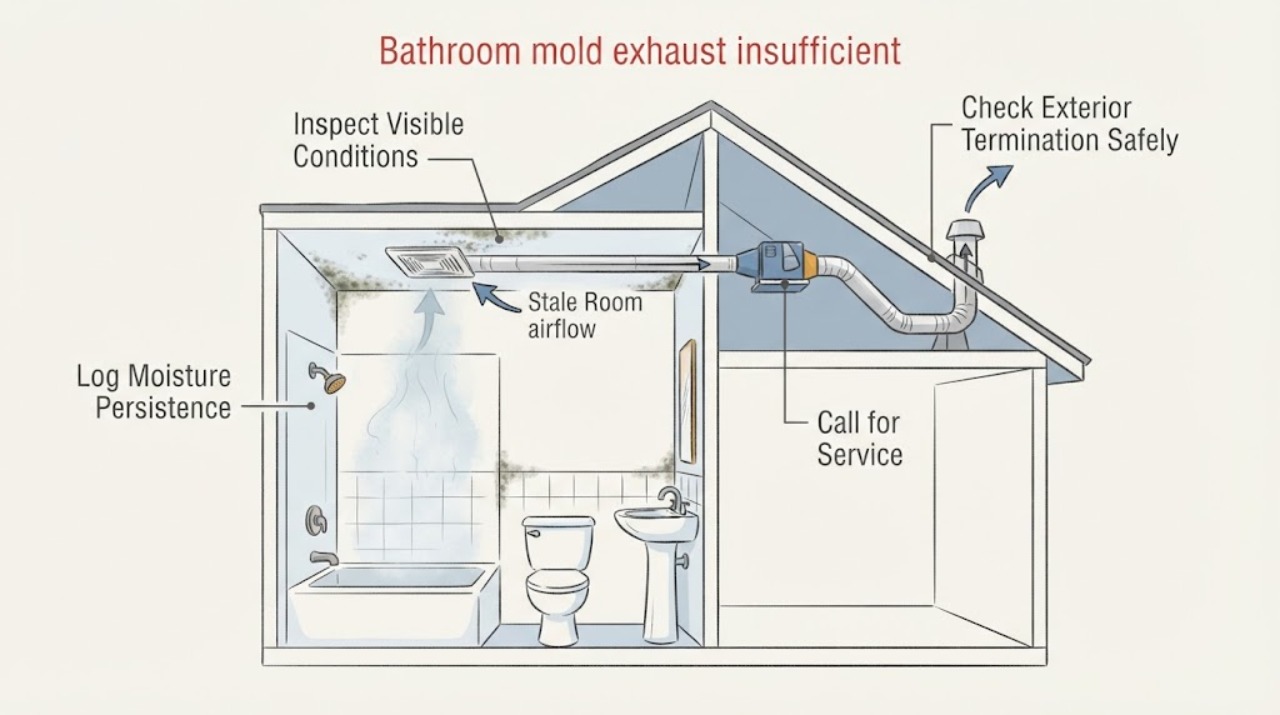
Treat recurring bathroom mold or condensation as a moisture-control problem, not simply a noisy fan problem. From a safe room-level position, record whether the fan starts, whether it produces meaningful air movement, whether moisture remains on surfaces after bathing, and whether the fan is supposed to discharge outdoors. Do not remove the grille, open a ceiling or duct, rewire the fan, or disturb visible mold. A fan can make noise yet move too little air, and a fan that does not discharge outdoors can leave moisture in the building. If moisture or mold keeps returning, the fan is silent or weak, the exterior termination is inaccessible or questionable, water is leaking, or the affected area is extensive or hidden, stop troubleshooting and arrange a qualified ventilation or mold-moisture assessment.
Work through in order
Diagnostic checks
Use only checks that match the exact appliance or system and its official guide.
-
Check 1
From the bathroom doorway or another safe standing position, record when showering or bathing occurs and whether condensation, damp surfaces, musty odor, or visible mold returns afterward; do not touch or disturb the affected material.
Expected result: Note whether moisture clears normally, lingers on mirrors and hard surfaces, collects on walls or ceiling, or returns in the same location after the room appears dry. Record any plumbing drip, wet joint, or water entry you can see without opening finishes.
Next step: Keep a short dated log and continue to the safe fan check. If there is active water, a wet ceiling, soft material, or a rapidly growing area, stop and arrange a plumbing, building, or mold-moisture assessment.
Stop if: Stop if observing would require touching mold, opening a wall or ceiling, moving wet materials, or entering a wet electrical area.
Why this matters
Why: Persistent or localized moisture may involve inadequate exhaust, a leak, condensation, or moisture entering a cavity. Recurrence after apparent cleaning means the moisture source has not been resolved; it is not proof that a replacement fan alone will solve the problem.
-
Check 2
From floor level or the doorway, switch the bathroom fan on using its normal control and observe the sound and any gentle air movement without removing the grille, using a ladder, or reaching into the ceiling.
Expected result: Record fan silent, motor sound with little apparent air movement, steady air movement, rattling or scraping, or an uncertain result. If a lightweight tissue can be held near the grille without reaching or touching it, note whether it is gently drawn toward the grille; otherwise record airflow as unknown.
Next step: Leave the grille and wiring untouched, record the result and fan control behavior, and request a qualified ventilation inspection if movement is weak, noisy, intermittent, or unknown. Do not treat a running motor as permission to clean mold or open the assembly.
Stop if: Stop immediately for sparking, burning odor, water near the fan or switch, exposed wiring, a loose ceiling assembly, or any need to remove the grille or access the housing.
Why this matters
Why: Noise alone does not establish adequate exhaust. Weak or uncertain movement can indicate a fan, airflow-path, or termination problem, while rattling suggests a condition that should not be investigated by opening the housing. A normal room-level indication still does not confirm outdoor discharge or adequate flow.
-
Check 3
Only from ground level and without a ladder, roof access, duct opening, or disassembly, look for a visible exterior bathroom exhaust termination and note whether it appears to discharge outdoors when the fan is running.
Expected result: Record visible outdoor discharge, no visible termination, a closed or obstructed-looking cover, or an inaccessible or uncertain route. Do not reach into the termination, remove a cover, enter an attic, or inspect inside a wall or ceiling.
Next step: Photograph only what is visible from a safe location and provide the result to the professional. If the termination looks damaged or the fan exhausts toward an occupied or enclosed area, stop using assumptions about performance and arrange an inspection.
Stop if: Stop if the exterior point requires climbing, roof or attic access, opening ductwork, moving a cover, or working near power lines, traffic, or unstable ground.
Why this matters
Why: Bathroom air should exhaust directly outdoors rather than into an attic or another enclosed space. No visible or uncertain termination means the route cannot be confirmed by this observation and may require a qualified ventilation or building professional.
-
Check 4
Over several ordinary bathroom uses, compare the moisture log with condensation, odor, and mold recurrence in the same room without cleaning or disturbing the growth.
Expected result: Classify the pattern as moisture only after bathing, moisture that persists between uses, recurrent growth in one location, recurrent growth in several locations, or a pattern that cannot be established. Note whether the room has a window or another normal ventilation control, without changing wiring or dismantling equipment.
Next step: Share the dated observations and photographs with a qualified ventilation, plumbing, or mold-moisture professional. Follow their plan for moisture correction and any remediation; do not use recurrence as a reason to try a stronger cleaner or open a duct.
Stop if: Stop if odor or growth suggests hidden moisture, the ceiling or wall is soft or stained, symptoms are occurring, or the observation would require disturbing building materials.
Why this matters
Why: A repeatable post-shower pattern points to local moisture removal or airflow; persistent or widespread moisture raises the possibility of a leak, cavity moisture, or broader ventilation issue. A symptom pattern alone cannot diagnose mold type or air quality.
-
Check 5
Decide whether the cause is clear and safely observable without touching the fan, wiring, grille, duct, ceiling, or moldy material.
Expected result: Answer yes only when the fan behavior, visible moisture pattern, and outdoor route are all clear, there is no active leak or electrical hazard, and no mold or building material needs to be disturbed. Answer no for a silent or weak fan, uncertain route, recurrence, visible water damage, hidden-mold concern, or any unsafe access.
Next step: For yes, keep the observation log and use the fan only through its normal control while avoiding mold disturbance. For no, stop at the safe observations and contact the appropriate ventilation, plumbing, building, or mold professional with the recorded evidence.
Stop if: Do not proceed to electrical, ceiling, grille, duct, mold-cleanup, or structural work as a homeowner troubleshooting step.
Why this matters
Why: Yes supports a focused conversation about routine moisture-control use and a planned professional check if the problem continues. No means the next step is qualified diagnosis and source correction, not a replacement part, rewiring, duct opening, or DIY remediation.
Use your observations
Decision map
Find the observation that best matches what you see, then follow the next safe action.
-
PATH 01Safety boundary
What you see
The fan is silent, intermittent, noisy, or produces little or uncertain room-level air movement.
Do this next
Leave the assembly closed and request a qualified ventilation or electrical inspection. Provide the control behavior, sound, visible moisture pattern, and whether a safe exterior termination was seen.
Why this path and its safety boundary
Safety stop: Do not remove the grille, access wiring, rewire, lubricate, or force the fan while power or moisture conditions are unknown.
-
PATH 02Safety boundary
What you see
The exterior termination cannot be seen safely, appears obstructed or damaged, or the route may discharge into an attic or enclosed space.
Do this next
Arrange a qualified ventilation or building inspection to verify the route and airflow. Keep the record focused on visible evidence and do not open the duct or ceiling.
Why this path and its safety boundary
Safety stop: Do not climb, enter an attic, open ductwork, remove exterior covers, or alter the route as a homeowner check.
-
PATH 03Safety boundary
What you see
Condensation, musty odor, or visible mold returns, persists between uses, or appears in multiple or hidden-looking areas.
Do this next
Address any visible plumbing or building moisture source through the appropriate professional and arrange a mold-moisture assessment. Follow a professional cleanup plan rather than disturbing the growth.
Why this path and its safety boundary
Safety stop: Do not scrape, sand, spray, bleach, mix cleaners, open cavities, or claim that a fan replacement alone resolves the mold condition.
-
PATH 04Safety boundary
What you see
There is water near electrical equipment, a soft or stained ceiling, active leakage, loose building material, or a health concern associated with the affected area.
Do this next
Leave the area as safe as possible, avoid the wet electrical equipment, and contact the appropriate emergency, electrical, plumbing, building, or health professional based on the observed hazard.
Why this path and its safety boundary
Safety stop: Stop all fan testing and mold troubleshooting in the affected area until the hazard is made safe by a qualified person.
Helpful context
Understand the symptom
Observe moisture before blaming the motor
A bathroom exhaust system only helps when air is actually removed from the room and the moisture source is controlled. Keep a simple record of shower or bath conditions, visible condensation, musty odor, and whether the same wall, ceiling, grout, or trim area becomes damp again. This is an observation log, not a mold-cleanup procedure.
Sound is not proof of ventilation
A running motor can still have poor airflow because of a blocked path, an ineffective termination, a loose or disconnected route, or an undersized or worn fan. EPA guidance distinguishes a fan that makes noise from one that exhausts a sufficient amount of air. Confirming the cause may require a professional who can inspect and measure the system without unsafe homeowner access.
Keep mold and electrical work out of the DIY check
Do not scrape, bleach, sand, brush, or otherwise disturb visible mold as part of this fan diagnosis, and never open the fan housing or wiring. If the bathroom has a leak, wet electrical equipment, ceiling damage, hidden-mold signs, or a vulnerable occupant with symptoms, use the appropriate professional assessment.
Only after diagnosis
Potential parts
- bathroom exhaust fan
Consider this category only if a qualified inspection identifies the fan assembly as the cause and confirms that replacement is appropriate for the existing installation.
Confirm model, electrical rating, housing, mounting, airflow requirements, controls, and outdoor-termination arrangement before ordering or installing; do not select a fan from sound alone. - humidity meter
Consider this category only as an optional observation aid when a professional or household moisture log would benefit from trend information; it does not diagnose mold or prove fan performance.
Use it as a room-level trend indicator according to its instructions and do not treat one reading as an air-quality or remediation decision. - exhaust duct cleaning tool
Consider this category only when a qualified ventilation professional identifies an accessible airflow-path issue and specifies a suitable method; duct opening or cleaning is outside safe homeowner observation.
Confirm duct material, route, termination, access, and safety procedure with the professional; do not insert tools through a grille or exterior termination yourself.
When checks do not resolve it
Need a professional?
Call a qualified ventilation or electrical professional for a silent, weak, noisy, intermittent, or inaccessible fan; an uncertain or non-outdoor termination; any wiring or ceiling access; or a fan that runs but does not resolve recurring moisture. Call plumbing, building, or mold-moisture professionals when there is a leak, soft or stained material, hidden-mold concern, widespread recurrence, or an occupant health concern.
Have this ready
- Provide the bathroom location, fan control behavior and sound, safe room-level airflow observation, visible exterior termination observation, dated moisture and recurrence log, photographs from undisturbed areas, any plumbing or condensation history, and whether wiring, ceiling, mold, or duct access was intentionally not attempted.
Common questions
FAQ
Can a bathroom fan make noise and still be ineffective?
Yes. Sound only shows that a motor or component is operating; it does not prove that enough air is being exhausted or that the route terminates outdoors. Observe only from a safe room-level position and request a qualified airflow and route inspection when moisture persists.
What does recurring bathroom mold say about the exhaust fan?
Recurrence says that moisture remains available, but it does not identify whether the cause is weak exhaust, an indoor leak, condensation, or hidden moisture. Keep a dated observation log and address the source with the appropriate professional rather than disturbing the mold.
Should I remove the bathroom fan grille to check airflow?
Not for this safe observation workflow. Do not remove the grille, enter the ceiling, open a duct, or touch wiring. Record sound and any gentle room-level airflow indication from the floor or doorway and arrange a qualified inspection if the result is weak or uncertain.
When should I call a mold or ventilation professional?
Call when the fan is silent, weak, noisy, or intermittent; the exhaust route is unknown; moisture or mold returns; there is a leak or soft ceiling; or any inspection would involve electrical, duct, ceiling, or mold disturbance. Provide photos and the moisture and fan observations.
Read the exact guide
Official sources
- Remodeling Your Home and Indoor Air QualityU.S. Environmental Protection Agency · General EPA homeowner and remodeling guidance; fan capacity, installation, and building conditions vary and require an applicable professional assessment.
- MoldCenters for Disease Control and Prevention · General CDC information about indoor mold and moisture; individual health questions and remediation decisions require appropriate professionals.
- A Brief Guide to Mold, Moisture and Your HomeU.S. Environmental Protection Agency · General residential mold and moisture guidance; it does not diagnose the cause of a particular bathroom exhaust problem or authorize DIY remediation.
Community feedback
Share a repair observation
Share a plain-text repair observation. Accepted observations are published automatically; this page may take a moment to update.