
On this page
Start here
Quick answer
Treat weak bathroom exhaust and recurring mold as a moisture-control problem that needs observation first and professional assessment when it persists. From the room floor, note whether the fan starts, whether airflow is detectable without touching the grille, how long condensation remains after a shower, and whether the exterior outlet appears to discharge air when viewed safely from ground level. Do not open the duct, rewire the fan, remove ceiling parts, or disturb mold. If the fan is silent, airflow is weak, moisture keeps returning, the outlet cannot be confirmed, or growth is broad or recurring, stop experimenting and call a qualified ventilation or mold professional.
Before you begin
Safety first
- Do not rewire, open the duct, remove the grille or ceiling, climb to an exterior termination, disturb or sample mold, spray chemicals, or perform large-area cleanup. Keep the room dry and isolated as practical until a qualified person assesses the moisture and ventilation path.
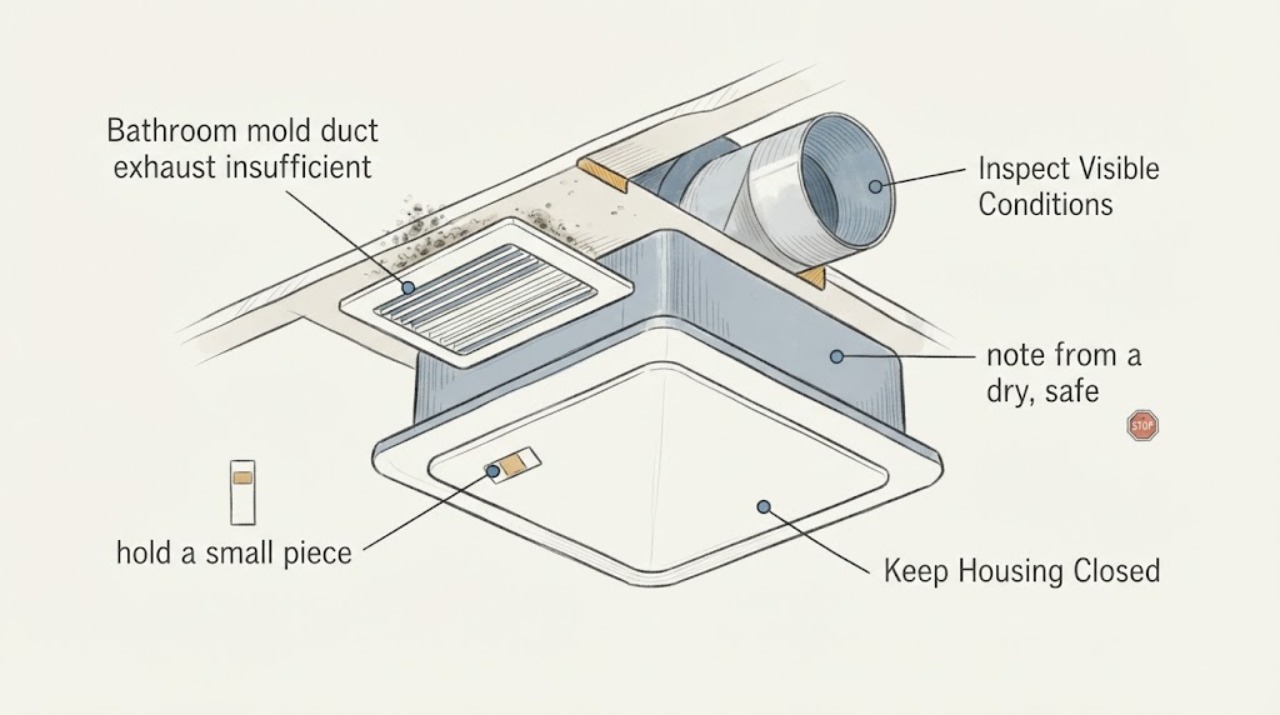
Work through in order
Diagnostic checks
Use only checks that match the exact appliance or system and its official guide.
-
Check 1
From the bathroom floor, turn the wall control on once and observe whether the exhaust fan starts, remains running, and sounds normal. Do not remove the grille or touch the fan housing, switch wiring, or ceiling.
Expected result: No start, intermittent operation, a new rattle, or an unusually strained sound suggests a fan or control issue. A normal sound only shows that the motor is operating; it does not confirm adequate airflow through the duct.
Next step: Record the control position, start behavior, sound change, and whether the fan stops unexpectedly. Arrange professional service if it does not run normally.
Stop if: Stop immediately for a burning smell, heat, smoke, sparking, water at the fixture, or a need to touch electrical parts.
Why this matters
Why: The sound and start behavior separates an obvious control or fan symptom from a possible airflow-path problem without opening the assembly.
-
Check 2
With the fan running, hold a small piece of tissue near the grille from a stable floor position without covering the grille or touching the ceiling. Note whether it is gently drawn toward the grille, unchanged, or pushed away.
Expected result: Little or no movement suggests weak room-side draw or a fan that is not delivering useful airflow. Noticeable draw is evidence of room-side movement only and does not prove that the duct is connected, clear, or vented outdoors.
Next step: Photograph the grille and record the observation. Do not increase the test by blocking openings, removing the grille, or reaching into the duct; request a professional airflow and duct assessment.
Stop if: Stop if the tissue contacts the grille, the fan becomes hot or noisy, condensation drips near the fixture, or the check would require a ladder or reaching overhead.
Why this matters
Why: This safe observation helps distinguish no apparent airflow from a moisture problem that may be farther along the exhaust path; it is not a measured airflow test.
-
Check 3
After an ordinary shower, note from a dry, safe position how long visible mirror or wall condensation remains and whether the room develops a musty odor or new visible spots. Do not touch, scrape, sample, or spray suspected growth.
Expected result: Condensation that persists, a recurring odor, or spots that return after prior cleaning indicates unresolved moisture or a concealed affected area. A clear mirror does not prove that humidity or hidden materials are normal.
Next step: Keep a dated timeline of shower end time, fan use, condensation, odor, and visible changes. Ask a qualified professional to identify and correct the moisture source and assess any affected area.
Stop if: Stop observing and isolate the room if growth is widespread, materials are visibly water-damaged, occupants develop breathing or eye symptoms, or contamination would need to be disturbed.
Why this matters
Why: The moisture and recurrence pattern is more useful for triage than an unsupported air-quality claim or a one-time visual impression.
-
Check 4
From ground level or a safe existing window view, look toward the exterior exhaust termination while the fan runs. Note whether the flap or grille appears to discharge air, is visibly blocked, or cannot be seen; do not climb, reach, remove a cover, or inspect a roof termination.
Expected result: No visible discharge or a blocked-looking termination raises concern about the outlet or duct path, but wind and viewing angle can make this observation inconclusive. A visible flap movement confirms only that some air reaches that point at that moment.
Next step: Record the location and view with a photograph from the ground or existing window. Have a qualified ventilation professional inspect the duct and termination; do not open the duct or attempt a reattachment.
Stop if: Stop if the termination is at roof height, near a power line, inaccessible without a ladder, or surrounded by visible damage or contamination.
Why this matters
Why: The exterior observation helps a professional focus on the termination and duct route without exposing the occupant to ladder, roof, or high-level work.
-
Check 5
From safe room-level positions, map the visible location and recurrence of mold or dampness without moving furniture, opening a wall or duct, or disturbing the surface. Note whether it is limited to a shower surface, near the fan, on the ceiling, or spreading beyond the bathroom.
Expected result: Growth near the fan or ceiling, spread beyond wet shower surfaces, repeated recurrence, or a musty odor without a visible source increases concern for hidden moisture or a ventilation-path problem. A small isolated visible spot still does not establish that the duct is adequate.
Next step: Photograph without touching and provide the location, recurrence history, moisture timeline, and fan observations to a qualified professional. Keep the area undisturbed until the scope is assessed.
Stop if: Stop and keep occupants away if the area is broad, materials are soft or damaged, contamination is in the duct or ceiling, or anyone has symptoms associated with the space.
Why this matters
Why: The extent and pattern determine whether professional mold and moisture assessment is needed in addition to fan service.
Use your observations
Decision map
Find the observation that best matches what you see, then follow the next safe action.
-
PATH 01Next step
What you see
The fan does not start, stops unexpectedly, is hot, or produces burning odor, smoke, or sparking.
Do this next
Stop use, keep the area dry and clear, and call a qualified electrician or ventilation professional. Do not open the fixture or rewire it.
Why this path and its safety boundary
Why it matters: The fixture may have an electrical or equipment hazard.
-
PATH 02Next step
What you see
The fan runs but room-side airflow is weak or the exterior discharge cannot be confirmed from a safe position.
Do this next
Request professional airflow and duct-path assessment; do not open, clean, reconnect, or modify the duct yourself.
Why this path and its safety boundary
Why it matters: The duct, termination, fan performance, or installation path may be restricting exhaust.
-
PATH 03Next step
What you see
Condensation persists after ordinary bathroom use or mold and musty odor recur.
Do this next
Provide the moisture timeline and recurrence photographs to a mold/moisture professional and have the source and affected materials assessed.
Why this path and its safety boundary
Why it matters: Moisture control is unresolved even if the fan sounds normal.
-
PATH 04Next step
What you see
Growth is broad, extends onto ceiling or wall materials, appears connected to a duct or cavity, or occupants report symptoms.
Do this next
Isolate the area and obtain professional mold and moisture assessment; do not scrape, spray, sample, remove, or paint over the affected material.
Why this path and its safety boundary
Why it matters: Disturbance could spread contamination or expose occupants.
-
PATH 05Next step
What you see
The fan runs, airflow seems present, condensation clears, and no recurrence or spread is observed.
Do this next
Keep the dated record and recheck only from safe positions; call for service if moisture, odor, or visible growth returns.
Why this path and its safety boundary
Why it matters: No urgent external symptom is reproduced, but a single observation does not certify duct performance.
Helpful context
Understand the symptom
Why a bathroom can stay damp even when the fan runs
A bathroom exhaust system has to move moisture away from the room and discharge it to a suitable exterior location. Weak airflow can reflect a fan problem, a blocked or disconnected duct, a restrictive termination, or an installation and makeup-air issue. A fan that makes noise is not proof that it is delivering useful airflow.
Use moisture and recurrence as the signal
Watch the room after ordinary shower use without touching the fan or wet surfaces. Persistent condensation, a musty odor, or mold that returns after cleaning indicates that the moisture source or ventilation path has not been resolved. Keep a simple timeline of shower end time, visible condensation, fan behavior, and recurrence so a professional can compare conditions.
Keep the duct and ceiling closed
Duct openings, ceiling cavities, and visibly affected materials can hide contamination or electrical hazards. External observations are enough to decide whether the system needs service. Do not remove the grille, probe the duct, spray growth, or disturb a ceiling or wall to look for a cause.
What a professional needs to know
Share the fan start and sound, the safe airflow observation, the moisture timeline, any visible exterior termination, and the location and recurrence pattern of growth. A qualified person can then assess the fan, duct route, termination, electrical condition, and moisture damage within the proper safety controls.
Only after diagnosis
Potential parts
- bathroom exhaust fan
Consider only after a professional confirms that the fan itself is underperforming and the duct route, termination, electrical supply, and housing fit have been assessed.
Confirm housing dimensions, electrical requirements, control type, and tested installed airflow for the specific installation; no universal replacement is assumed. - humidity meter
Consider only as an observation aid when a professional wants a time-series indication of moisture conditions; it does not diagnose mold or duct performance.
Use and interpret the instrument according to its instructions and location; readings vary with placement and do not replace a building assessment. - duct cleaning tool
Consider only when a qualified ventilation professional confirms that the duct path is accessible, safe, and actually requires cleaning after inspection.
Duct construction, termination, contamination, and access determine the appropriate method; do not open or brush a duct as a homeowner experiment.
When checks do not resolve it
Need a professional?
Call a qualified ventilation or mold/moisture professional when airflow is weak, the fan is silent or abnormal, the exterior discharge is uncertain, condensation persists, mold or odor recurs, growth is broad or near a ceiling or duct, or the system may be electrically unsafe. Escalate urgently for heat, smoke, sparks, or occupants with significant symptoms.
Safety scope: Do not rewire, open the duct, remove the grille or ceiling, climb to an exterior termination, disturb or sample mold, spray chemicals, or perform large-area cleanup. Keep the room dry and isolated as practical until a qualified person assesses the moisture and ventilation path.
Have this ready
- Provide the fan start and sound behavior, the safe grille-airflow observation, shower end times and condensation timeline, visible exterior termination observations, photos of the growth pattern, recurrence history, and any electrical or health concerns.
Common questions
FAQ
Does a bathroom fan running prove the duct is working?
No. A running motor or normal sound does not prove that the duct is clear, connected, vented outdoors, or delivering its intended airflow. Use only safe room-level and ground-level observations, then request professional assessment when moisture persists.
How can I check airflow without opening the fan?
From a stable floor position, observe whether a small tissue is gently drawn toward the grille while the fan runs. This is only a rough observation; do not cover the grille, reach overhead, remove it, or use a ladder.
Should I clean the duct or remove the ceiling grille?
Not under this observation-only scope. Opening the duct or ceiling can expose wiring, hidden contamination, or damage. Have a qualified ventilation professional inspect and service the path.
Why does mold return even when the fan is used?
The fan may have weak delivered airflow, a restricted or disconnected duct, an unsuitable termination, or another moisture source. Persistent condensation, odor, or recurrence should be documented and professionally assessed rather than repeatedly sprayed or disturbed.
Read the exact guide
Official sources
- A Brief Guide to Mold, Moisture and Your HomeU.S. Environmental Protection Agency · Supports observing persistent moisture and recurrence, using bathroom ventilation to reduce moisture, and escalating hidden or broad affected areas.
- Ventilation Fans Key Product CriteriaENERGY STAR · Supports distinguishing fan sound from tested installed airflow and treating fan performance as model- and installation-dependent.
- HVAC Whole-House VentilationU.S. Department of Energy Building Science Education · Supports treating bathroom exhaust as local exhaust ventilation and considering the fan and duct system together without prescribing homeowner duct work.
Community feedback
Share a repair observation
Share a plain-text repair observation. Accepted observations are published automatically; this page may take a moment to update.