
On this page
Start here
Quick answer
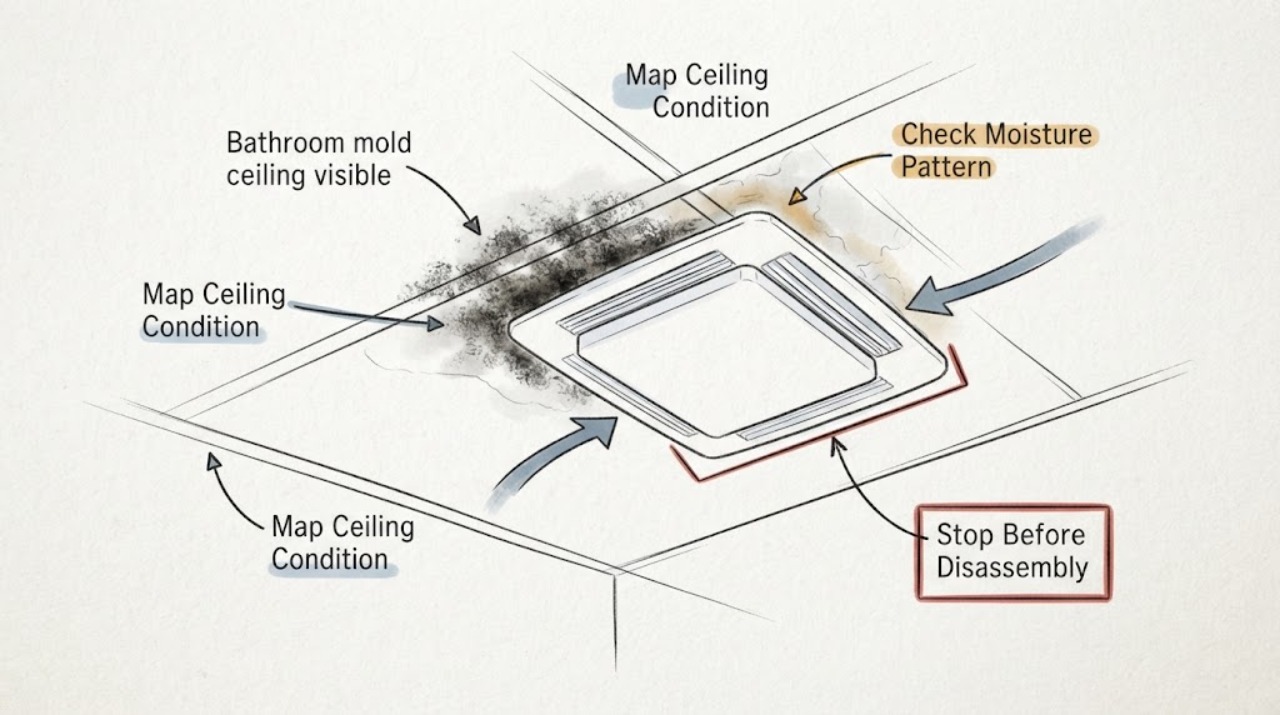
Visible mold or mildew on a bathroom ceiling is a moisture signal, not just a surface-color problem. From the floor or doorway, document whether the patch is actively wet, soft or sagging, spreading, or concentrated around a shower, vent, or light. Check exhaust airflow and room humidity without disturbing the ceiling. A shower-linked pattern may point to condensation or ventilation, while a stain after rain or near plumbing needs a leak investigation. Stop and arrange qualified mold or building help promptly for active leaks, soft or sagging material, a large or recurring area, suspected hidden moisture, nearby electrical fixtures, or anyone with asthma, COPD, immune suppression, or a serious mold allergy. Do not scrape, sand, cut, remove, or paint over the material while the moisture cause is unresolved.
Work through in order
Diagnostic checks
Use only checks that match the exact appliance or system and its official guide.
-
Check 1
From the bathroom doorway or floor, photograph the ceiling and note the patch location, approximate spread, edge shape, and whether there are water stains, peeling, bubbling, sagging, or visible drops. Do not touch or disturb the material.
Expected result: The area is dry and firm; damp or actively dripping; soft, swollen, peeling, or sagging; or spreading beyond the original patch.
Next step: If wet, soft, sagging, spreading, or close to a light or fan, stop inspecting and use the professional branch. If dry and stable, continue with the airflow and humidity checks without trying to clean it.
Stop if: Stop if the ceiling moves, sags, sheds material, drips near an electrical fixture, or cannot be observed safely from the floor.
Why this matters
Why: Dry and stable discoloration may be an old stain or surface growth, while current wetness points to an unresolved moisture source. Softness, swelling, sagging, or rapid spread raises concern for water-damaged porous material and possible hidden moisture.
-
Check 2
Compare the ceiling pattern with recent conditions from the floor: look for a ring or isolated stain below plumbing or the attic or roof line, and note whether the patch is strongest above the shower or across the room. Record whether it appears after rain, after bathing, or all the time; do not open the ceiling or enter a cavity.
Expected result: A localized mark follows rain or a plumbing area; a broad haze or repeated spots follow showers; or there is no clear timing pattern.
Next step: Photograph the pattern and report the timing to a qualified building, plumbing, roofing, or mold professional as appropriate. Do not cover the mark before the source is understood.
Stop if: Stop if checking the suspected source would require opening the ceiling, entering an attic or crawlspace, or moving through water.
Why this matters
Why: A rain- or plumbing-linked mark makes a leak investigation more important. A shower-linked pattern is consistent with condensation or inadequate moisture exhaust, but timing alone does not rule out a concealed leak. An unclear pattern warrants an inspection rather than guessing from color.
-
Check 3
With the room dry and the switch accessible, turn the bathroom exhaust fan on and observe from the floor whether air is drawn at the grille and whether the fan runs normally. Do not remove the grille, reach into the fan, or touch any damp electrical part.
Expected result: Yes: the fan runs and draws air; no: it is silent, weak, rattling, or does not draw air; or the grille or nearby ceiling is wet.
Next step: If airflow is weak or absent, leave the fan intact and arrange a ventilation assessment. If it runs normally, continue by recording room humidity and checking whether the mold recurs after bathing.
Stop if: Stop for water in or around the fan or light, exposed wiring, a burning odor, or an unsafe switch.
Why this matters
Why: Normal operation makes it less likely that a completely failed fan is the main driver, but it does not prove the duct exhausts outdoors or that the room dries adequately. Weak or absent airflow supports a ventilation fault. Wetness near the fan adds an electrical and moisture concern.
-
Check 4
Place a room hygrometer away from shower spray and record relative humidity before bathing and again after bathing on several occasions, while noting whether the exhaust fan was used. Keep the instrument on the floor or another safe, dry location rather than climbing to reach the ceiling.
Expected result: Readings repeatedly remain above 60% or stay elevated long after bathing; readings are generally between 30% and 60%; or no reliable readings are available.
Next step: Use the readings to request a ventilation or moisture assessment, and include the before-and-after context. Do not treat a lower reading as permission to scrape or paint the ceiling.
Stop if: Stop if obtaining a reading would require a ladder, contact with the ceiling, or entry into a wet or electrically unsafe area.
Why this matters
Why: Persistent humidity above 60% supports a moisture-control or ventilation problem and can help explain recurring ceiling growth. A lower reading does not rule out a leak or cold-surface condensation. Missing data means the moisture cause is still uncertain.
-
Check 5
If available, use a moisture meter only on an accessible, intact surface and follow that meter's instructions; compare the ceiling-area reading with an apparently dry nearby area without piercing, drilling, or removing material.
Expected result: The ceiling-area reading is clearly higher than the nearby comparison; readings are similar; or the meter cannot read the finish reliably.
Next step: Photograph or record the comparison and give it to the professional assessing the ceiling. Stop using the meter if the surface is wet near an electrical fixture or if obtaining the reading would require a ladder or opening the ceiling.
Stop if: Do not pierce, drill, open, or remove ceiling material to obtain a reading.
Why this matters
Why: A higher comparison reading supports active or retained moisture, but a consumer meter cannot identify the source or determine the extent behind a ceiling. Similar or unreliable readings do not prove the cavity is dry.
Use your observations
Decision map
Find the observation that best matches what you see, then follow the next safe action.
-
PATH 01Safety boundary
What you see
The ceiling is actively dripping, newly wet, soft, swollen, peeling, sagging, or wet around a light or exhaust fan.
Do this next
Stop the inspection, keep people out of the affected area, avoid the fixture and ceiling, and arrange prompt qualified building or mold assessment and, when indicated, plumbing or roofing assessment.
Why this path and its safety boundary
Why it matters: The issue may involve an active leak, unstable water-damaged material, or an electrical hazard; visual mold color cannot settle that question.
Safety stop: Do not enter pooled water or handle a wet light, fan, switch, or wiring.
-
PATH 02Safety boundary
What you see
The patch follows showers and the fan is silent, weak, rattling, or does not draw air.
Do this next
Arrange a qualified ventilation or building assessment, provide the fan observation and humidity log, and do not remove the grille or alter wiring.
Why this path and its safety boundary
Why it matters: Ventilation or fan and duct performance is a likely contributor, although a leak still needs to be excluded.
Safety stop: Stop if the next step would involve electrical work, duct alteration, or ceiling access.
-
PATH 03Safety boundary
What you see
The mark is localized below plumbing or follows rain, or the moisture-meter comparison is higher at the ceiling.
Do this next
Have the suspected moisture source traced and repaired by the appropriate qualified professional before any ceiling repair or repainting.
Why this path and its safety boundary
Why it matters: A plumbing, roof, or concealed moisture path is more important to investigate than cosmetic treatment.
Safety stop: Do not cover the stain or open the ceiling to trace a leak yourself.
-
PATH 04Safety boundary
What you see
The area is broad, recurring, spreading, difficult to see safely, likely hidden above the ceiling, or occupied by someone with asthma, COPD, immune suppression, or a serious mold allergy.
Do this next
Do not attempt cleanup or demolition; arrange a qualified mold-remediation or building professional and provide photographs, timing, airflow result, and humidity readings.
Why this path and its safety boundary
Why it matters: Disturbing the ceiling could increase exposure or conceal a larger building problem, and the occupants may be more vulnerable.
Safety stop: Keep higher-risk occupants out of the affected area and seek medical guidance for symptoms.
-
PATH 05Safety boundary
What you see
The patch is small, dry, firm, and isolated, with no active leak signs, but the moisture source has not been proven absent.
Do this next
Keep the area undisturbed, continue documenting recurrence and humidity, and arrange an assessment if it returns, spreads, remains musty, or the source cannot be identified.
Why this path and its safety boundary
Why it matters: The immediate structural warning signs are not visible, but visible mold still indicates a moisture condition that can recur.
Safety stop: Do not scrape, paint, or assume the ceiling is repaired until the moisture cause and material condition are understood.
Helpful context
Understand the symptom
What visible ceiling mold can indicate
Repeated shower moisture can condense on a cool bathroom ceiling when ventilation is weak, but a ceiling stain or patch can also follow a plumbing or roof leak. Color alone cannot identify the mold or tell you whether the ceiling cavity is dry. The useful first decision is whether moisture is active and whether the ceiling material is stable.
Keep this inspection observational
Do not scrape, brush, sand, poke, cut, paint over, or remove ceiling material as part of these checks. Do not touch a wet light, fan, or wiring. Stay on the floor; do not use a ladder to reach the patch. People with asthma, COPD, immune suppression, or significant mold sensitivity should stay out of the affected area and have someone else arrange an assessment.
What to do with the result
A dry, firm, isolated discoloration still needs its moisture source addressed before any cosmetic repair. A damp, soft, sagging, spreading, or recurring ceiling finding is a building-moisture problem that should be assessed by a qualified professional. Record photos, the date, recent shower or rain conditions, fan behavior, and any humidity or moisture readings so the person assessing it can start with useful evidence.
Cleaning is not the same as remediation
A small, dry spot on an intact hard surface is a different material and risk question from mold in ceiling tile, drywall, insulation, a cavity, or water-damaged material. Do not assume a ceiling patch can be wiped safely or made sound with paint. A qualified assessor should decide whether the surface can be cleaned, whether porous material must be removed or replaced, and what repair is needed after the leak or humidity problem is corrected. Never mix bleach with ammonia or other cleaning products.
Only after diagnosis
Potential parts
- humidity meter
Consider this only if repeated humidity readings are needed to document a suspected bathroom moisture or ventilation problem.
Choose a device with instructions and a readable relative-humidity display; it is an observation aid, not a mold or leak diagnosis. - bathroom exhaust fan
Consider this only after an inspection confirms that the existing fan or its airflow path is faulty; weak airflow alone does not identify a compatible replacement.
Confirm the housing, electrical requirements, duct size, and local installation requirements with the model and a qualified installer before ordering. - moisture meter
Consider this only when a non-invasive comparison could help document whether the ceiling area is retaining moisture; a reading cannot map hidden damage or identify the source.
Follow the meter's material and finish limitations and do not use it to justify piercing, drilling, or opening a ceiling.
When checks do not resolve it
Need a professional?
Call promptly for active dripping, water near a light or fan, unstable ceiling material, suspected hidden moisture, a broad or recurring area, or occupants with asthma, COPD, immune suppression, or serious mold sensitivity.
Have this ready
- Provide dated photos, the patch location and pattern, whether it follows rain or showers, the exhaust-fan result, humidity readings, any moisture-meter comparison, the ceiling material if known, and whether anyone experienced breathing, eye, or skin symptoms.
Common questions
FAQ
Is black discoloration on a bathroom ceiling enough to identify the mold?
No. Color does not identify a mold species or show whether moisture is still present. Document the location and condition, look for a moisture source, and do not disturb the ceiling while guessing from appearance.
Should I scrape or paint over visible mold on the ceiling?
Not as the first step. Scraping can disturb material and painting can hide a continuing leak or condensation problem. First document the condition and have the moisture source and ceiling stability assessed.
What if the exhaust fan runs but ceiling mold keeps returning?
A running fan does not prove that the duct exhausts properly or that humidity is controlled. Record humidity before and after bathing, note recurrence timing, and arrange a ventilation or building-moisture assessment if the problem persists.
Can I clean a small spot on a bathroom ceiling myself?
Do not decide from size alone. Ceiling tile, drywall, insulation, and other porous or water-damaged materials can require a different response from an intact hard surface. Have the material, moisture source, and spread assessed before disturbing it, and do not mix cleaning products.
When is visible bathroom ceiling mold a professional call?
Call promptly for active dripping, a wet or sagging ceiling, spreading or recurring growth, suspected hidden moisture, mold near electrical fixtures, an unsafe inspection, or an occupant with asthma, COPD, immune suppression, or serious mold sensitivity.
Read the exact guide
Official sources
- How to Use Your N95® RespiratorNational Institute for Occupational Safety and Health, CDC · Safety context only; the article does not direct a higher-risk occupant to clean or disturb ceiling mold.
- Mold Remediation in Schools and Commercial Buildings Guide: Chapter 3U.S. Environmental Protection Agency · Use for the distinction between hard-surface observation and porous ceiling-material or hidden-moisture concerns; this article does not instruct the reader to perform remediation.
- MoldCenters for Disease Control and Prevention · Supports focusing the page on moisture-source observation rather than identifying mold by color or commissioning routine home sampling.
- Mold and Indoor Air Quality in SchoolsU.S. Environmental Protection Agency · Moisture and mold observation principles applied here to a residential bathroom ceiling; the page identifies roof and plumbing leaks, condensation, and excess humidity as moisture sources.
- Mold Clean Up Guidelines and RecommendationsCenters for Disease Control and Prevention · Safety boundary for this observational article, especially occupants with asthma, COPD, immune suppression, or other respiratory risk; it does not authorize disturbing a bathroom ceiling.
Community feedback
Share a repair observation
Share a plain-text repair observation. Accepted observations are published automatically; this page may take a moment to update.