
On this page
Start here
Quick answer
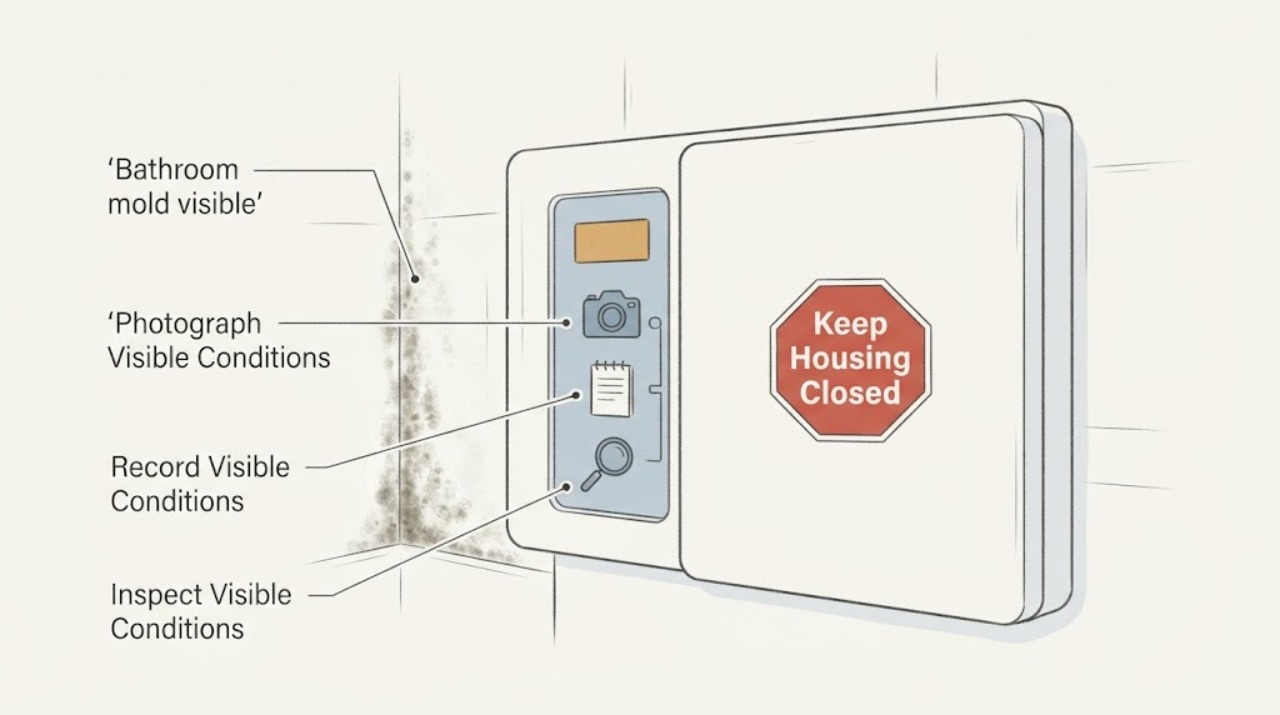
Visible bathroom mold is a moisture and exposure problem, not a color-identification problem. From the doorway or another safe position, document its size, location, surface, recurrence, nearby dampness, and any occupant concerns. Do not disturb it, scrape it, sample it, open the wall, mix or apply bleach, or perform electrical or exhaust-fan work. Stop using or isolating the affected area and arrange professional assessment when the growth is extensive or recurring, involves porous or water-damaged materials, follows a leak, is near HVAC or electrical equipment, or affects someone with asthma, allergies, chronic lung disease, or immune compromise.
Work through in order
Diagnostic checks
Use only checks that match the exact appliance or system and its official guide.
-
Check 1
From the doorway or another stable position, photograph and describe the visible growth's location and approximate spread without touching or disturbing it. Note whether it is on tile, grout, caulk, painted drywall, ceiling material, wood, fabric, or another surface.
Expected result: A small isolated spot on a hard bathroom surface differs from growth spread across a ceiling, wall, cabinet, porous material, or several surfaces. A broad or connected area needs a more cautious professional assessment.
Next step: Keep the area undisturbed and give the photos and surface description to a qualified mold or water-damage professional. Do not make a cleanup decision from color alone.
Stop if: Stop the inspection if getting a closer view requires a ladder, entry into a confined area, moving material, or contact with the growth.
Why this matters
Why: Location and surface type help determine whether the issue may be a cleanable surface condition or a material, moisture, or containment problem. Appearance alone cannot identify mold type or health risk.
-
Check 2
Record when and where the growth returns or becomes more noticeable without wiping it or changing the room. Note whether it follows showers, condensation, a plumbing or roof leak, a wet ceiling, flooding, or a recent repair.
Expected result: Growth that returns after ordinary bathroom use, appears with condensation, or follows a known leak suggests an unresolved moisture source. Growth with no obvious source may still involve hidden dampness or ventilation conditions.
Next step: Write down dates or events, visible dampness, leaks, and any prior work. Arrange plumbing, building-envelope, ventilation, or mold assessment as appropriate without opening the wall.
Stop if: Stop using the affected bathroom or nearby water fixture if water is actively entering, the ceiling is bulging, the wall is soft-looking, or moisture is reaching electrical equipment.
Why this matters
Why: Remediation is unlikely to remain effective if the water or humidity source is not addressed. A recurring pattern raises the need for moisture-source diagnosis rather than repeated surface treatment.
-
Check 3
Observe the surrounding material from a safe distance for swelling, peeling, staining, sagging, soft-looking drywall or ceiling, damaged caulk, or a musty odor. Do not probe, press, lift, or remove any material.
Expected result: Staining, swelling, peeling, sagging, or odor extending beyond the visible spots can indicate a longer-running moisture problem or hidden growth. A clean, hard, isolated surface is a different scope from porous or damaged building material.
Next step: Keep people away from damaged material and include these observations in a professional assessment request. Do not open the wall, ceiling, cabinet, or exhaust duct.
Stop if: Stop and seek prompt help if material is sagging, falling, wet, structurally uncertain, or close to an outlet, light, fan, or other electrical component.
Why this matters
Why: Porous, damaged, or concealed materials may require controlled professional removal or repair; painting over or sealing the visible area can hide the source and worsen the problem.
-
Check 4
From the normal user controls, note whether the bathroom exhaust fan runs, where it appears to vent, and whether condensation remains after bathing. Do not remove the fan cover, access wiring, or alter the duct.
Expected result: A fan that does not run, a room that stays visibly damp, or condensation that repeatedly collects on walls and ceiling suggests ventilation or moisture-control work may be needed. A running fan does not prove that it vents correctly or removes enough moisture.
Next step: Record the fan behavior, condensation pattern, and any accessible documentation, then ask a qualified professional to evaluate the moisture source and ventilation path.
Stop if: Do not remove covers, touch wiring, climb, or continue if the fan or nearby electrical area is wet, damaged, buzzing, or overheating.
Why this matters
Why: Ventilation and moisture control are part of preventing recurrence, but electrical and duct changes require appropriate professional evaluation.
-
Check 5
Consider occupant context without diagnosing illness: note whether anyone using the space has asthma, mold allergies, chronic lung disease, immune compromise, or new symptoms that seem worse in the room. Keep sensitive people away from the affected area.
Expected result: Some people have no symptoms, while others can experience irritation or worsening respiratory or allergic symptoms around damp or moldy environments. A symptom report does not identify the mold or prove causation.
Next step: Ask a healthcare professional about symptoms and inform the remediation provider about sensitive occupants. Do not ask a home mold sample to answer a medical question.
Stop if: Leave the affected area and seek medical help for breathing difficulty or severe symptoms; do not continue an inspection while symptomatic.
Why this matters
Why: Occupant vulnerability changes the urgency and the need for health advice and professional containment, even when the visible area seems limited.
Use your observations
Decision map
Find the observation that best matches what you see, then follow the next safe action.
-
PATH 01Next step
What you see
The visible growth is small, isolated, on a hard surface, and there is no recurring dampness, water damage, or sensitive occupant concern.
Do this next
Document it and address the moisture and ventilation conditions through appropriate guidance. Do not disturb the area or rely on color or a home sample to identify it.
-
PATH 02Next step
What you see
Growth returns, spreads, appears on porous or water-damaged material, or is accompanied by staining, swelling, odor, or an unresolved leak.
Do this next
Stop DIY remediation and arrange professional moisture assessment and remediation planning. Keep the area isolated and do not open walls or ceilings.
-
PATH 03Next step
What you see
The bathroom has active water entry, a sagging ceiling, soft or unstable material, or moisture near electrical equipment.
Do this next
Stop using the affected fixture or room as appropriate, keep people away, and seek prompt plumbing, building, water-damage, or electrical service. Do not touch wet electrical components.
-
PATH 04Next step
What you see
A person with asthma, mold allergy, chronic lung disease, immune compromise, or significant symptoms is exposed to the area.
Do this next
Keep that person away, seek health advice for symptoms, and arrange qualified professional assessment with the occupant context disclosed.
-
PATH 05Next step
What you see
The fan is not operating, condensation persists, or ventilation changes would require wiring, duct, ceiling, or wall access.
Do this next
Arrange qualified ventilation or building service; do not remove the fan cover, access wiring, or open the ceiling to investigate.
Helpful context
Understand the symptom
What visible mold tells you
Mold colors and spot patterns do not reliably identify a species or health risk. Visible growth does show that moisture and a surface capable of supporting growth are present or were present. The useful first record is where it is, how far it extends, what material it is on, whether it returns, and what water or ventilation condition may be feeding it.
Keep the first check non-disturbing
Stay outside the affected area when practical, keep children, pets, and sensitive occupants away, and take photos without touching the surface. Do not scrape, brush, vacuum, paint, caulk, cut, or remove materials to investigate. A professional can decide whether containment, moisture repair, or remediation is needed.
Only after diagnosis
Potential parts
- humidity-meter
Consider a humidity meter only as a planning aid after the area is safe; it can document room conditions but cannot identify mold type or replace a professional moisture assessment.
Use it in a clean, accessible location away from direct spray and electrical hazards; do not use a reading to declare the building safe. - bathroom-exhaust-fan
Consider fan replacement only after a qualified professional confirms that the existing fan, duct path, or ventilation capacity is contributing to recurring moisture.
Confirm housing, electrical, duct, discharge, and ceiling requirements; installation is not a DIY mold-remediation step. - moisture-meter
Consider a moisture meter only as part of a professional assessment plan for suspected damp building materials; a consumer reading cannot establish hidden mold or safety.
Select and interpret the instrument for the material and assessment method; do not puncture, probe, or disturb suspect surfaces.
When checks do not resolve it
Need a professional?
Arrange professional mold or moisture assessment for recurring or spreading visible growth, porous or water-damaged materials, hidden-mold concerns, active leaks, extensive areas, HVAC involvement, or sensitive occupant concerns. Add plumbing, building, ventilation, or electrical professionals when the moisture source requires those trades.
Have this ready
- Provide safe-distance photos, approximate size and locations, surface type, recurrence history, moisture or leak events, fan and condensation observations, prior repairs, affected rooms, and occupant-risk information.
Common questions
FAQ
Can the color of bathroom mold tell me how dangerous it is?
No. Color does not reliably identify the species or health risk. Document location, surface, moisture, recurrence, and occupant context instead of trying to name it from appearance.
Should I test a visible bathroom mold spot?
Routine home sampling is usually not the most useful first step when growth is visible. Focus on the moisture source and professional assessment when scope, materials, recurrence, or occupant risk is uncertain.
Why does bathroom mold keep coming back?
Recurring growth usually means moisture, condensation, leakage, or ventilation conditions remain. Document when it returns and have the moisture source addressed rather than repeatedly covering or treating the visible area.
When should a bathroom mold problem be handled professionally?
Use professional assessment for spreading or recurring growth, porous or water-damaged materials, hidden-mold concerns, active leaks, HVAC involvement, electrical-area moisture, or occupants with significant respiratory vulnerability or symptoms.
Read the exact guide
Official sources
- A Brief Guide to Mold, Moisture and Your HomeU.S. Environmental Protection Agency · Supports controlling moisture, treating recurring bathroom mold as a moisture problem, recognizing porous or hidden material concerns, and referring larger or uncertain work to experienced professionals.
- MoldCenters for Disease Control and Prevention · Supports documenting moisture sources, ventilation, occupant health context, and the limits of home mold testing; it does not identify mold species from color or prescribe this article's inspection boundary.
- Mold, Testing, and RemediationCDC National Institute for Occupational Safety and Health · Supports moisture as the central condition, the limits of routine air sampling, visual and odor observations, and professional remediation when materials or moisture damage require controlled work.
Community feedback
Share a repair observation
Share a plain-text repair observation. Accepted observations are published automatically; this page may take a moment to update.