
On this page
Start here
Quick answer
A musty odor alongside visible bathroom mold is a location-and-moisture investigation, not proof of a particular mold type or contamination. First record where the odor is strongest, when it appears, how far visible growth extends, and whether shower condensation, plumbing moisture, failed caulk or grout, or a damp porous material is present. A smell that stays localized to a visible hard surface may support a focused moisture and ventilation review; an odor that persists with no visible source, follows a wall or ceiling, or accompanies soft or swollen material needs professional hidden-moisture assessment. Do not mix cleaning chemicals or open the wall to chase the odor.
Before you begin
Safety first
- This page covers safe observation and documentation only. Qualified professionals determine hidden-area investigation, containment, moisture correction, cleaning, material removal, and finish repair.
Work through in order
Diagnostic checks
Use only checks that match the exact appliance or system and its official guide.
-
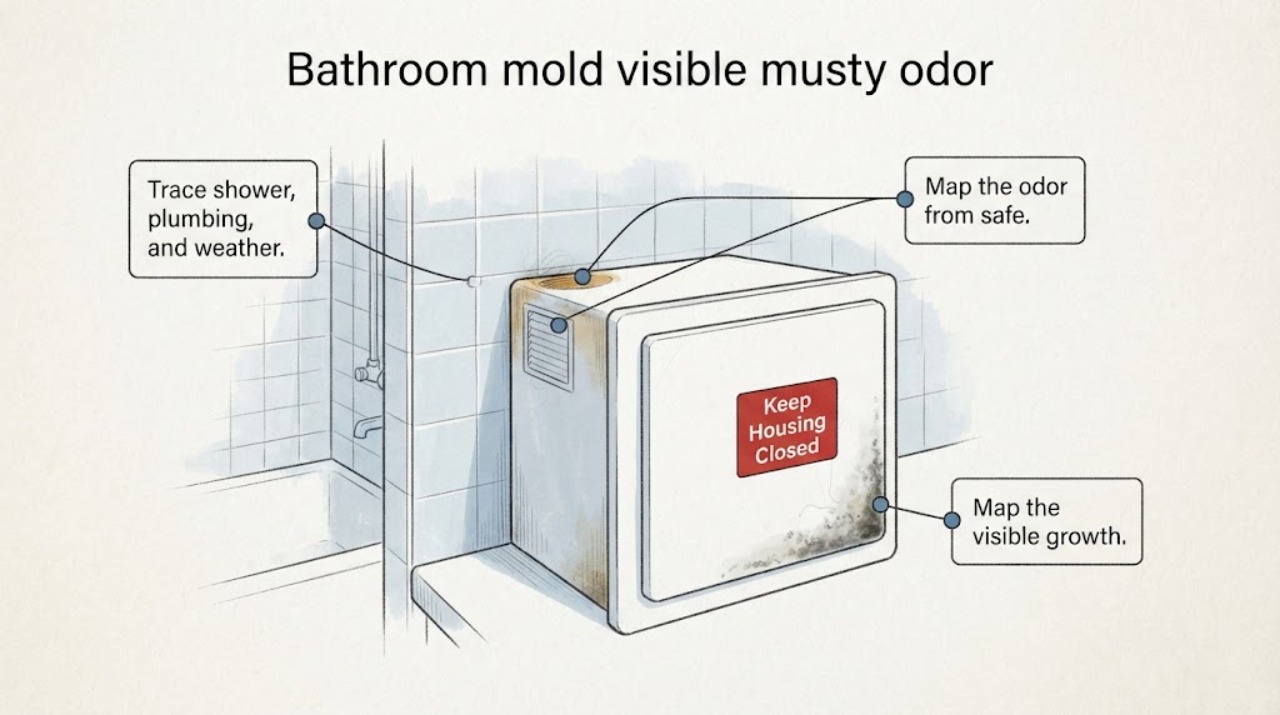
Map the odor from safe positions
From the bathroom doorway and other dry, stable positions, compare where the odor is strongest: shower or tub, vanity, toilet or supply area, wall edge, ceiling, floor, or room doorway. Record whether it is present before showering, immediately afterward, after the room closes, or all the time; do not sniff closely at or touch the material.
Expected result: The odor is strongest at one visible patch, follows a fixture or wall boundary, spreads through the room, or has no repeatable location.
Next step: Mark the strongest locations on a simple room sketch and continue with visible extent and timing observations before requesting service.
Stop if: Stop if anyone develops breathing, eye, skin, or other symptoms, or if locating the odor would require moving fixtures or opening a finish.
Why this matters
Why: A stable odor location helps focus a moisture and material inspection but does not identify the substance. A broad or unlocalizable odor, particularly with no visible source, raises the possibility of concealed dampness or an airflow path.
-
Map the visible growth and material
Photograph the visible area from near and far enough to show its room position, then note whether it is on tile, glass, metal, caulk, grout, painted wall, drywall, wood, ceiling material, or the back of a cabinet already visible. Include nearby surfaces that look clear; do not scrape, wipe, or probe the area.
Expected result: Growth is confined to an intact hard surface, follows a seal or grout line, reaches a porous finish, or appears on several adjoining surfaces.
Next step: Send the photos and material description to the remediation provider; leave porous or concealed boundaries undisturbed.
Stop if: Stop if material is loose, crumbling, swollen, wet enough to drip, or would need to be disturbed to determine its extent.
Why this matters
Why: A confined hard-surface finding supports a targeted moisture and cleaning assessment. Growth on porous material or across adjoining surfaces may extend beyond what is visible and needs a broader professional evaluation.
-
Trace shower, plumbing, and weather timing
For normal bathroom use, record whether condensation remains on the mirror, window, ceiling, or cold pipe after a shower, whether the odor or visible wetness follows toilet, sink, or tub use, and whether rain changes it. Observe the fan from its normal control only; do not open its housing or access the duct.
Expected result: The pattern follows showers and closed-room humidity, follows plumbing use or rain, or has no visible moisture event.
Next step: Record the delay between the event and the odor or growth and request moisture-source assessment when the pattern persists or is unexplained.
Stop if: Stop for active leaking, standing water, sewage, electrical exposure, or any need to access wiring, a ceiling void, or a concealed pipe.
Why this matters
Why: A shower-linked pattern supports a ventilation or humidity contribution. Plumbing- or rain-linked wetness points toward a leak or water-entry source. No visible event does not rule out intermittent leakage or dampness behind a finish.
-
Look for material damage without probing
From a dry position, look for peeling paint, failed caulk, cracked grout, swollen edges, soft-looking drywall or wood, staining around supply lines, and an odor that is strongest behind a vanity or at a wall or ceiling junction. Do not pierce, sand, pull trim, or remove a cabinet back.
Expected result: The visible surface is hard and intact, a seal or finish is failing, or porous material looks swollen, soft, crumbling, or stained.
Next step: Provide close and wide photos, the material type, odor location, and timing; do not cover the area with paint or fresh caulk.
Stop if: Stop if inspection would disturb material, release debris, expose a cavity, or contact an electrical or plumbing component.
Why this matters
Why: An intact hard surface with a localized odor can support a focused moisture and ventilation review. Failed seals can admit water; soft, swollen, crumbling, or concealed material needs professional assessment before cleaning or finish repair.
-
Decide whether the odor needs hidden-moisture assessment
Ask whether the odor persists when the bathroom is dry, has no visible source, extends beyond the visible growth, returns after ventilation and moisture correction, or accompanies porous, swollen, or water-damaged material. Use the location and timeline rather than assigning a mold type from smell or color.
Expected result: Yes: one or more hidden-moisture signs is present. No: the odor and visible growth are small, localized, and tied to a clear, safely observable bathroom moisture pattern.
Next step: Request service with the odor map, visible extent, moisture timing, material boundary, and photos; keep the area undisturbed until the provider sets the next step.
Stop if: Do not open walls, remove fixtures, mix chemicals, sand growth, or continue investigating a symptomatic or contaminated area.
Why this matters
Why: Any yes result makes professional mold and moisture assessment the appropriate next decision. A no result can support a focused service discussion, but it does not authorize chemical experimentation or prove that hidden areas are clear.
Use your observations
Decision map
Find the observation that best matches what you see, then follow the next safe action.
-
PATH 01Safety boundary
What you see
Is the odor strongest at a small visible patch on an intact hard surface after showering?
Do this next
Treat it as a focused ventilation, humidity, and surface-moisture decision; document the timing and correct the moisture condition before any cosmetic resealing.
Why this path and its safety boundary
Safety stop: Do not paint, caulk, or apply a new chemical mixture over active growth or dampness.
-
PATH 02Safety boundary
What you see
Does visible growth or odor involve drywall, wood, ceiling material, vanity backing, soft finishes, or adjoining surfaces?
Do this next
Keep the area undisturbed and arrange professional mold and moisture assessment because porous materials can retain moisture beyond the visible patch.
Why this path and its safety boundary
Safety stop: Do not probe, sand, pull trim, remove a cabinet back, or open a wall to find the boundary.
-
PATH 03Safety boundary
What you see
Does the odor or visible wetness reliably increase after showers or when the bathroom stays closed?
Do this next
Request a bathroom ventilation and humidity review; a normal fan switch result does not confirm that the duct discharges correctly or that all surfaces dry.
Why this path and its safety boundary
Safety stop: Do not open the fan housing, access the duct, or alter wiring as part of these checks.
-
PATH 04Safety boundary
What you see
Is the odor persistent or strongest where no visible growth or moisture source can be seen?
Do this next
Stop at the safe observation boundary and arrange experienced professional hidden-moisture assessment.
Why this path and its safety boundary
Safety stop: Do not open walls, remove fixtures, disturb insulation, or rely on a home test to clear a hidden area.
-
PATH 05Safety boundary
What you see
Does anyone develop symptoms, or is the area affected by sewage, active flooding, electricity, or a vulnerable occupant?
Do this next
Keep people away, seek appropriate medical guidance for symptoms, and request prompt qualified remediation or water-damage help.
Why this path and its safety boundary
Safety stop: Do not ask a symptomatic or vulnerable person to inspect or clean the area.
Helpful context
Understand the symptom
Use the odor as a map, not a diagnosis
Musty odor can be a useful clue that damp material or microbial growth is nearby, but smell alone cannot identify what is present or where it is hidden. Compare the odor at the bathroom doorway, near the shower, around the vanity or toilet, and near the ceiling or wall edge without touching material. Note whether it is strongest immediately after showering, when the door stays closed, after rain, or continuously.
Visible extent and material decide the next boundary
A small patch on an intact hard surface is a different service question from growth on drywall, wood, ceiling material, caulk, grout, or the back of a cabinet. Look for spread beyond the visible patch, peeling or swollen finishes, soft-looking material, and staining around plumbing. Do not infer species from color, and do not paint or caulk over active growth.
Separate bathroom ventilation from water entry
EPA identifies shower moisture and condensation as common contributors and recommends bathroom ventilation during showering. A repeatable pattern after showers favors a humidity or ventilation review; wetness after plumbing use, rain, or behind a finish points toward a water source. A normally running fan does not rule out a blocked duct, poor discharge, leak, or moisture trapped in a porous material.
Hidden moisture is a professional boundary
An odor with no visible source, a recurring smell behind a vanity, or a wall or ceiling that looks swollen may indicate hidden moisture. EPA cautions that disturbing hidden sites can release spores. Keep the area as undisturbed as practical and give the professional the odor map, photos, timing, material observations, and any known leak history.
Safety boundary
Stop conditions
- Stop and keep people away for active water, sewage, electrical exposure, unstable material, or symptoms associated with the bathroom.
- Do not open walls, remove fixtures, pull trim, scrape, sand, or probe to locate hidden growth or dampness.
- Never mix cleaning products, and do not paint or caulk over active growth or damp material.
- Use experienced professional service for persistent or unlocalized odor, porous or concealed growth, broad spread, suspected HVAC involvement, or an unknown moisture source.
Only after diagnosis
Potential parts
- humidity-meter
Consider this only as a documentation aid when shower condensation or room humidity is suspected; it cannot identify the odor source or clear hidden material.
Follow the instrument instructions and keep it away from wet surfaces; do not use one reading to justify covering growth. - bathroom-exhaust-fan
Consider replacement only after the fan, duct route, discharge, electrical condition, and room moisture pattern are assessed; a fan cannot correct a plumbing leak or porous-material damage.
Match the existing opening, electrical connection, discharge arrangement, and manufacturer requirements through a qualified installer; do not open the housing for these checks. - moisture-meter
Consider this only when a qualified professional requests supplemental comparison readings around a suspected wet boundary; it does not identify mold or replace a hidden-moisture assessment.
Confirm material and depth limitations, avoid probing damaged surfaces, and do not treat a dry reading as proof that a wall or ceiling cavity is clear.
When checks do not resolve it
Need a professional?
Request experienced mold-remediation and moisture-source assessment when visible bathroom mold is accompanied by a persistent or unlocalized musty odor, returns after a ventilation or moisture correction, reaches porous or concealed material, spreads beyond the visible patch, follows an unexplained leak, or affects a vulnerable occupant. Arrange prompt help for active water, sewage, electrical exposure, ceiling movement, or symptoms.
Safety scope: This page covers safe observation and documentation only. Qualified professionals determine hidden-area investigation, containment, moisture correction, cleaning, material removal, and finish repair.
Have this ready
- Odor map showing where and when the smell is strongest
- Wide and close photos with the visible growth boundary and material type
- Shower, condensation, plumbing-use, rain, and fan-use timing
- Peeling, swelling, softness, failed caulk or grout, stains, and areas behind or beside fixtures that were not opened
- Any active water, sewage, electrical, occupant-health, access, or prior-cleaning concern
Common questions
FAQ
Does a musty odor prove that bathroom mold is present?
No. It is a clue that damp material or growth may be nearby, but odor cannot identify a substance or its location. Map where and when it is strongest and compare that with visible growth and moisture events.
Why does the bathroom smell musty after a shower?
Shower moisture and condensation can keep surfaces damp, especially when ventilation is inadequate. If the smell follows plumbing use, rain, or a wall or ceiling boundary, arrange a moisture-source assessment rather than assuming humidity is the only cause.
Can I use bleach or another cleaner to remove the odor?
Do not mix cleaning products or use chemicals to mask an unexplained odor. Active growth, dampness, porous material, and hidden areas need the moisture cause and safe cleaning boundary assessed first.
When does visible bathroom mold with odor need a professional?
Call when the odor persists with no visible source, reaches porous or concealed material, spreads beyond a small patch, returns after moisture correction, follows an unexplained leak, or affects a vulnerable occupant.
Should I open the wall to find the source?
No. Do not open walls, remove fixtures, pull trim, or disturb insulation to chase an odor. EPA cautions that disturbing hidden sites can release spores; provide the location map, photos, timing, and leak history to an experienced professional.
Read the exact guide
Official sources
- A Brief Guide to Mold, Moisture and Your HomeU.S. Environmental Protection Agency · Supports the distinction between visible staining and growth, bathroom ventilation, porous-material limits, hidden-mold caution, no routine chemical sterilization, and professional escalation.
- Mold and Your HomeU.S. Environmental Protection Agency · Supports treating shower moisture and condensation as possible contributors without equating odor with a mold type, and supports reducing moisture before deciding on remediation.
Community feedback
Share a repair observation
Share a plain-text repair observation. Accepted observations are published automatically; this page may take a moment to update.