
On this page
Start here
Quick answer
When visible bathroom mold appears with high humidity, first determine whether it is limited to condensation-prone surfaces after showers or whether there are signs of active leaks or hidden moisture. Record humidity, condensation, how the room dries after use, whether the exhaust fan vents outside, and whether staining, swelling, softness, or a musty odor extends beyond the shower area. Improve safe ventilation and drying only when there is no leak or material damage; recurring growth, porous or damaged materials, hidden moisture, or any active leak needs professional assessment. Do not mix cleaners, paint or caulk over mold, open walls, or disturb suspect materials just to investigate.
Before you begin
Safety first
- This article covers safe observation and moisture documentation. A qualified professional should handle hidden-cavity investigation, plumbing or exhaust alteration, contaminated water, material removal, remediation, and permanent finish repair.
Work through in order
Diagnostic checks
Use only checks that match the exact appliance or system and its official guide.
-
Map the mold and the material around it
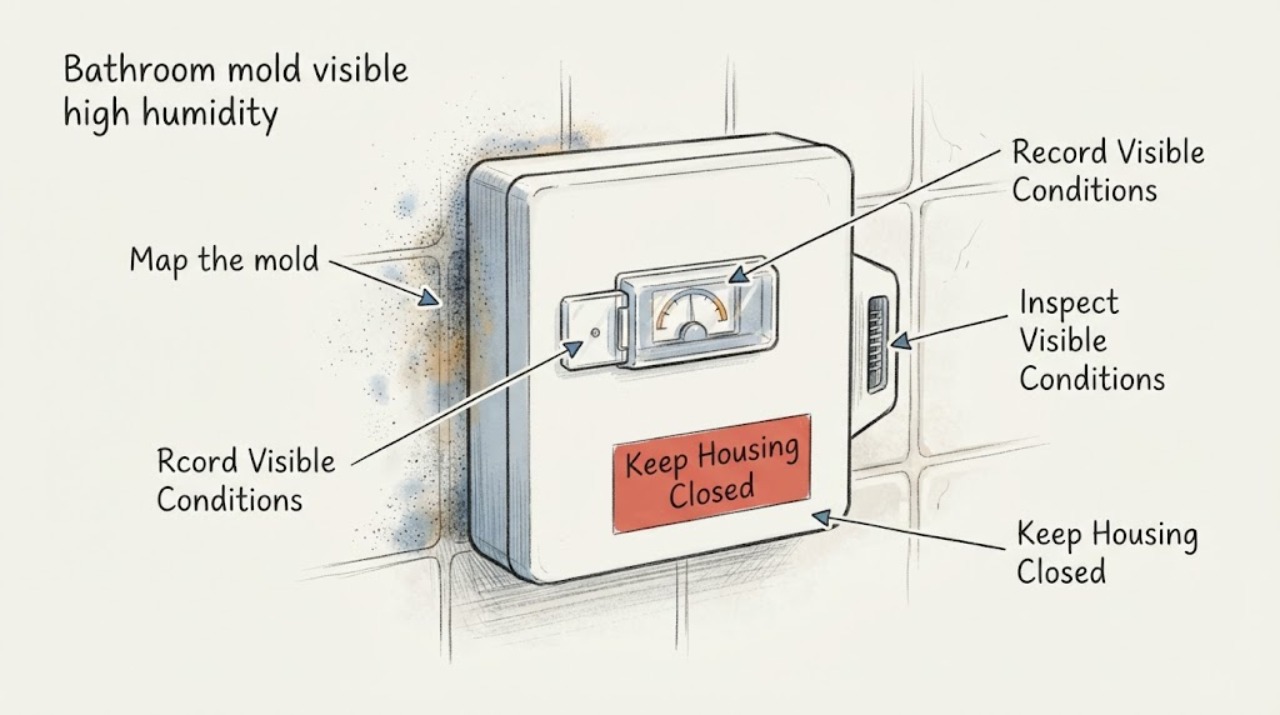
From a safe position, photograph the visible mold and mark whether it is on tile, glass, grout, painted wall, ceiling, wood trim, caulk, cabinet material, or another surface. Note its distance from the shower, sink, toilet, window, and visible pipework.
Expected result: A spot limited to condensation-prone hard surfaces after bathing follows a different path from growth on a ceiling, outside wall, swollen trim, soft drywall, or several separated surfaces.
Next step: Continue to humidity and drying observations when the material is sound and the area is accessible without disturbing it. Escalate the material and location to a professional when it is porous, soft, swollen, stained, or spreading.
Stop if: Do not scrape, cut, pull wallpaper, open a wall, or disturb a material that may release spores or conceal water damage.
Why this matters
Why: Location and material help distinguish a surface humidity pattern from water entering or remaining in an absorbent building material; appearance alone cannot identify the mold source.
-
Record humidity and condensation
If a humidity meter is already available, record the bathroom reading before a shower and again after use; otherwise note visible condensation on the mirror, window, walls, ceiling, or pipes. Do not buy a reading as proof that a leak is absent.
Expected result: Repeatedly high readings or condensation that covers several cold surfaces supports a humidity and ventilation branch. A normal-looking reading with a localized wet stain, damp edge, or musty odor does not rule out a concealed or intermittent source.
Next step: Compare this record with fan operation, shower timing, and the location map. If water evidence is present, move to the leak or hidden-moisture branch regardless of one meter reading.
Stop if: Stop if a meter or observation would require contact with wet electrical equipment, a ladder, a ceiling opening, or another unsafe access step.
Why this matters
Why: Humidity is a contributing condition, not a diagnosis. A leak can occur even when the room happens to be dry during the check.
-
Observe exhaust and post-shower drying
During and after a shower, use the bathroom exhaust fan only through its normal switch and observe whether it runs, appears to move air outdoors, and leaves the room less damp over time. Keep the door or window position and shower duration consistent enough to record a useful comparison.
Expected result: A fan that does not run, vents poorly, or leaves condensation and wet surfaces lingering points toward a ventilation or humidity-control problem. A working fan with persistent dampness in one wall, ceiling edge, or pipe area points toward a separate moisture source.
Next step: Document the fan behavior and drying pattern for service. A qualified professional should handle duct, fan wiring, roof, wall, or plumbing investigation.
Stop if: Do not remove the fan grille, climb to inspect the duct, touch wiring, or alter the exhaust installation during this observation.
Why this matters
Why: The drying pattern connects the high-humidity condition to the visible growth without assuming that the fan can correct a plumbing or building leak.
-
Check for signs of active or hidden moisture
Without opening surfaces, look for a growing water stain, dampness that appears when a fixture is used, peeling or bubbling paint, swollen or soft material, rust at a pipe or fitting, a musty odor outside the shower zone, or moisture on the ceiling below.
Expected result: Yes means the mold cannot be attributed to humidity alone and may involve a leak or concealed moisture. No means only that no external evidence was seen during this check; it does not clear intermittent leaks or moisture behind a finish.
Next step: Leave the affected area undisturbed and arrange professional moisture, plumbing, or building assessment when any sign is present.
Stop if: Do not open the wall or ceiling, remove trim, run water to provoke a leak, or use electrical equipment near water.
Why this matters
Why: Leak or hidden-moisture evidence changes the service boundary: find and stop the water source before any cosmetic treatment, and do not disturb the suspected cavity.
-
Classify the visible and material scope
Record whether growth is one small area or several areas, confined to hard non-absorbent surfaces or present on porous and swollen materials, and whether nearby finishes are stained, loose, or deteriorated.
Expected result: A limited, sound hard-surface pattern can support a moisture-control plan. Multiple rooms or surfaces, porous material, persistent odor, swelling, or visible water damage indicates a wider assessment and possible material removal by a professional.
Next step: Give the professional the area map, material list, photographs, and humidity and drying record when scope is broad, porous, damaged, or uncertain.
Stop if: Do not sand, scrape, vacuum, demolish, paint, or caulk over suspect growth as a way to make the scope look smaller.
Why this matters
Why: The appropriate response depends on material and extent as well as the visible spot; covering or treating one patch cannot resolve moisture inside a porous assembly.
-
Check whether the same area returns
After safe ventilation and drying changes have been in place, compare the photographed area with its prior condition and record whether new growth, dampness, staining, or odor returns in the same place.
Expected result: If it does not return and the area stays dry, humidity and condensation are more plausible contributors, though the moisture source still needs to remain controlled. If it returns, a leak, hidden condensation, inadequate exhaust path, or porous material may remain.
Next step: Arrange professional inspection for recurrence, especially when the return is outside the shower zone, follows fixture use, or involves soft or stained materials.
Stop if: Do not apply multiple chemicals, cover the area, or keep experimenting when growth or moisture returns.
Why this matters
Why: Recurrence is a decision signal: repeating surface treatment without resolving the moisture source is unlikely to be a durable fix.
Use your observations
Decision map
Find the observation that best matches what you see, then follow the next safe action.
-
PATH 01Safety boundary
What you see
Growth is limited to sound hard surfaces near the shower, with condensation and dampness that track bathroom use and no external leak evidence.
Do this next
Record humidity, fan operation, and post-shower drying; improve safe ventilation according to the existing installation and monitor whether the same area recurs.
Why this path and its safety boundary
Why it matters: High humidity and inadequate exhaust or drying are plausible contributors, but the moisture source still needs control.
Safety stop: Do not cover the growth or assume a fan change is sufficient when it returns or material damage appears.
-
PATH 02Safety boundary
What you see
There is a growing stain, fixture-linked dampness, wet ceiling below, swollen or soft material, rust, or another visible sign of water entry.
Do this next
Limit use of the affected fixture when practical and arrange professional moisture or plumbing assessment before cosmetic treatment.
Why this path and its safety boundary
Why it matters: The condition is not explained by high humidity alone and may involve an active plumbing or building leak.
Safety stop: Do not open the wall or ceiling, remove trim, or paint over the wet or moldy material.
-
PATH 03Safety boundary
What you see
A musty odor persists without a visible source, growth is outside the shower zone, or dampness returns in a concealed edge or cavity.
Do this next
Photograph the area and request an experienced professional investigation that can assess the moisture source and material scope.
Why this path and its safety boundary
Why it matters: Hidden mold or condensation around pipes, walls, ceilings, or finishes is possible and cannot be confirmed safely from the surface.
Safety stop: Do not pull wallpaper, cut drywall, remove panels, or run a fan directly at suspect mold to expose the source.
-
PATH 04Safety boundary
What you see
Growth covers several areas or rooms, or porous materials are soft, swollen, stained, persistently damp, or visibly damaged.
Do this next
Keep people away from the affected material as practical and arrange professional remediation and moisture assessment.
Why this path and its safety boundary
Why it matters: Absorbent materials may hold moisture or growth beyond the visible surface, making a patch treatment unreliable.
Safety stop: Do not scrub, sand, vacuum, demolish, or seal broad or damaged material as a user experiment.
-
PATH 05Safety boundary
What you see
The same mold, dampness, stain, or odor returns after safe ventilation and drying observations improve.
Do this next
Provide the before-and-after record to a professional and request source diagnosis before any permanent finish repair.
Why this path and its safety boundary
Why it matters: The underlying moisture source, exhaust path, condensation point, or porous material remains unresolved.
Safety stop: Do not mix cleaners, repeatedly treat the surface, or paint or caulk over recurring growth.
Helpful context
Understand the symptom
Start by separating condensation from a water source
High humidity and condensation commonly leave mold on mirrors, window frames, grout, ceiling areas above a shower, or other cold surfaces after bathroom use. A leak or hidden moisture problem is more concerning when mold is outside the shower zone, a stain grows, paint or drywall swells or feels soft, a pipe or ceiling stays damp, or a musty odor persists when the room is dry. The same dark appearance cannot identify the moisture source by itself.
Use humidity and drying observations as the first branch
If a humidity meter is available, record readings before, during, and after a shower rather than treating one reading as a diagnosis. Note condensation on the mirror, window, walls, or pipes and how long surfaces remain damp after the shower ends. Check from floor level that the bathroom fan runs and appears to exhaust outdoors; do not climb to inspect a duct or open the fan housing.
Match the material and area to the service boundary
Tile, glass, and other hard surfaces present a different observation from swollen drywall, ceiling board, wood trim, insulation, carpet, or other absorbent material. A small surface spot that follows condensation still needs the moisture cause controlled, while porous, soft, stained, spreading, or repeatedly wet material can hide growth and damage. Do not cover it with paint or caulk and do not cut into a wall to look behind it.
Treat recurrence as evidence, not a cleaning failure
After the bathroom has a reasonable opportunity to dry with safe ventilation, record whether the same edge, ceiling area, joint, or wall becomes damp or develops new growth again. Recurrence despite lower humidity and better post-shower drying shifts the decision toward a plumbing leak, building-envelope leak, condensation in a concealed space, or inadequate exhaust path. A professional should investigate before any permanent surface treatment.
Safety boundary
Stop conditions
- Do not mix bleach, ammonia, or other cleaning products, and do not use a chemical as a substitute for finding the moisture source.
- Do not paint, caulk, seal, or otherwise cover visible mold or wet material before the water or humidity problem and the growth have been properly addressed.
- Stop and seek professional help for active leaks, hidden moisture, porous or swollen materials, broad or recurring growth, contaminated water, or health concerns.
- Stay within safe observation: do not open walls or ceilings, remove finishes, climb to inspect exhaust ducts, disturb suspect mold, or alter electrical or plumbing equipment.
Only after diagnosis
Potential parts
- humidity-meter
A meter can document the high-humidity branch but cannot locate hidden moisture or replace professional assessment.
Use only as an observation aid; choose a readable indoor humidity instrument and do not treat a single reading as proof that a leak is absent. - bathroom-exhaust-fan
Consider only when poor exhaust is documented and a professional confirms the fan and duct path are the cause, not as a substitute for repairing a leak.
Match the existing opening, electrical supply, duct route, and manufacturer requirements; installation may require qualified electrical or building work. - moisture-meter
A moisture meter may help document a suspicious area, but it cannot certify that mold or a leak is absent.
Use readings as screening information only and follow the instrument instructions; material type and hidden cavities affect interpretation.
When checks do not resolve it
Need a professional?
Call a qualified mold, moisture, plumbing, or building professional for active or hidden water, porous or damaged materials, broad or recurring growth, contaminated water, suspected HVAC contamination, or health concerns. Arrange assessment before covering or permanently repairing the surface.
Safety scope: This article covers safe observation and moisture documentation. A qualified professional should handle hidden-cavity investigation, plumbing or exhaust alteration, contaminated water, material removal, remediation, and permanent finish repair.
Common questions
FAQ
How can I tell high humidity from a bathroom leak?
Condensation-linked growth on sound hard surfaces that follows showers supports a humidity branch. Growing stains, fixture-linked dampness, soft or swollen materials, musty odor away from the shower, wet areas below, or recurrence despite drying requires leak or hidden-moisture assessment.
Does running the bathroom fan solve recurring mold?
It can reduce shower moisture when it operates and exhausts outdoors, but it cannot repair a plumbing or building leak or dry mold inside porous material. Record fan behavior and recurrence rather than assuming the fan is the whole cause.
Should I paint or caulk over visible bathroom mold?
No. Covering wet or moldy material can hide the moisture problem and does not stop growth. Resolve the moisture source and obtain appropriate assessment before permanent finish work.
Is a humidity or moisture meter enough to diagnose the problem?
No. A meter can document a pattern or help flag an area, but readings vary by material and time. It cannot rule out an intermittent leak, hidden moisture, or growth behind a finish.
Read the exact guide
Official sources
- A Brief Guide to Mold, Moisture and Your HomeU.S. Environmental Protection Agency · The opened EPA guide connects mold control to moisture control, identifies bathroom ventilation and condensation observations, distinguishes porous materials and hidden mold concerns, and warns against routine biocide use and covering unresolved growth.
- Biological Contaminants and Indoor Air QualityU.S. Environmental Protection Agency · The opened EPA guidance supports separating moisture source control from ventilation, observing condensation, drying wet materials, not enclosing wet moldy materials, and never mixing cleaning products.
- 8 Tips to Clean MoldCenters for Disease Control and Prevention · The opened CDC guidance supports drying moisture quickly, not mixing cleaners, and not painting or caulking over mold before the water problem and visible growth are addressed.
Community feedback
Share a repair observation
Share a plain-text repair observation. Accepted observations are published automatically; this page may take a moment to update.