
On this page
Start here
Quick answer
Mold that returns after cleaning usually means the moisture source or the bathroom's drying conditions were not resolved, not that the surface simply needed a stronger chemical. From a safe position, record where it returns, how quickly it comes back, whether condensation or dampness follows showers, and whether the exhaust fan appears to run and vent outdoors. Do not scrape, sand, open walls or ducts, disturb a large area, perform electrical work, or mix or apply cleaning chemicals. Arrange a qualified mold or water-damage assessment promptly, especially when the area is extensive, hidden, connected to a leak, or affecting occupants with respiratory or immune concerns.
Work through in order
Diagnostic checks
Use only checks that match the exact appliance or system and its official guide.
-
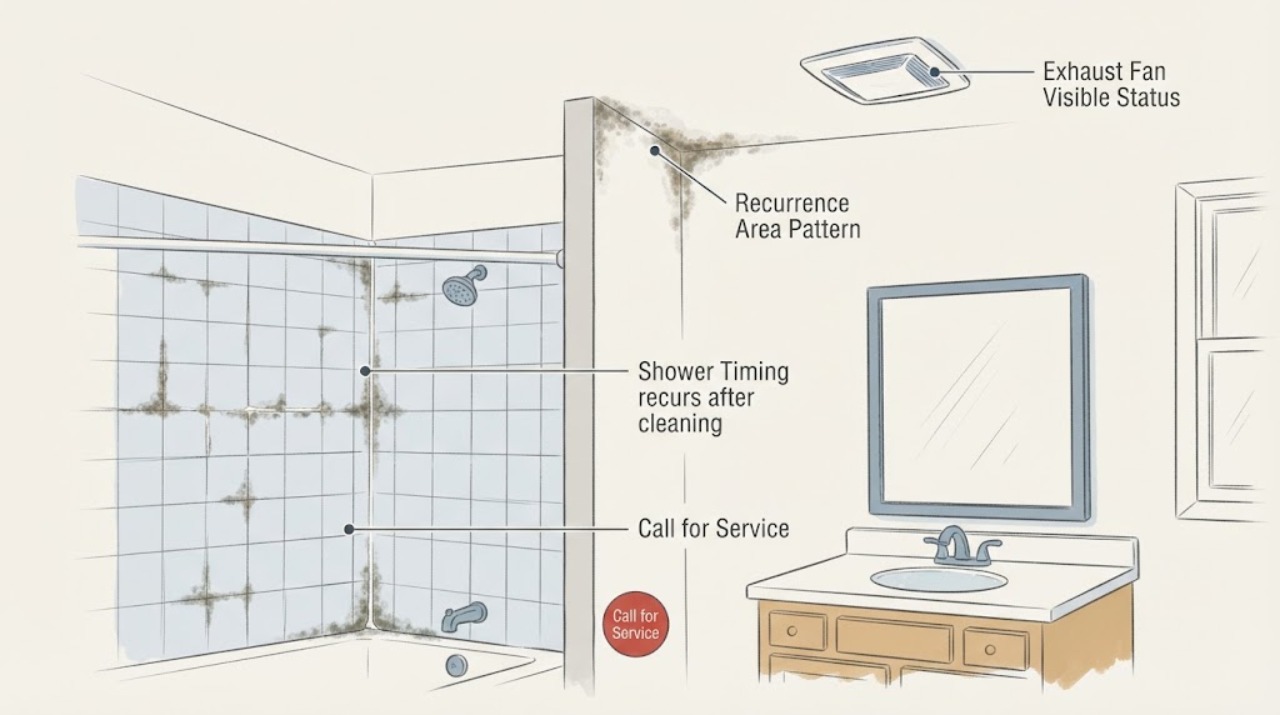
Map exactly where the mold returns
From a safe, dry position, photograph and describe the returning area without scraping, brushing, probing, or removing finishes; include whether it is on grout, paint, ceiling, trim, a cabinet exterior, or another visible surface.
Expected result: Note whether the recurrence is in the same spot, spreading, appearing on several surfaces, near a shower or sink, above a ceiling or wall, or accompanied by a musty odor, bubbling finish, or visible dampness.
Next step: Keep the area undisturbed, save the photos and location description, and request a qualified mold or water-damage assessment. Do not paint, caulk, scrape, sand, or cover the area to hide the recurrence.
Stop if: Stop observation if the surface is wet, crumbling, sagging, near an electrical fixture, or large or rapidly spreading, or if looking closer would require opening or disturbing the surface.
Why this matters
Why: A repeat at the same location may point to a persistent local moisture condition, while several surfaces or a ceiling/wall location raises concern for concealed moisture. The pattern cannot establish the source without a professional assessment.
-
Record the shower and condensation pattern
For ordinary bathroom use, note when condensation, dampness, or the musty odor appears relative to showering and how long the room remains visibly wet; do not intentionally create steam or perform a water test.
Expected result: Record whether moisture collects on mirrors, windows, walls, ceiling, or fixtures, whether the same area dries between uses, and whether the mold returns after a similar number of uses or days.
Next step: Share the timing and visible moisture pattern with the professional. Keep normal ventilation use within manufacturer or household instructions if safe, but do not install, rewire, or alter a fan as a DIY repair.
Stop if: Stop if condensation is accompanied by water entering a fixture, ceiling, wall, or electrical fitting, or if the room causes breathing or irritation symptoms; leave the area and arrange qualified help.
Why this matters
Why: A repeatable shower-related pattern supports a moisture-control or ventilation question. EPA says bathroom ventilation helps remove moisture and that mold can recur where a bathroom is often or always damp; the pattern still does not identify whether a leak is also present.
-
Observe the exhaust fan without electrical work
From the normal user position, note whether the bathroom exhaust fan starts with its ordinary control, whether airflow is perceptible at the room grille, and whether the visible exterior termination appears to be outdoors if it can be seen safely; do not remove the grille, access wiring, or climb to inspect the termination.
Expected result: Record whether the fan is silent, noisy, running but weak, or operating normally by its ordinary indicators, and whether moisture remains after use. A fan making noise is not proof that it exhausts outdoors or moves sufficient air.
Next step: Give the fan observations and bathroom layout to the professional. If the fan is unsafe, hot, sparking, or near water, stop using it and request qualified electrical or HVAC service.
Stop if: Stop if checking the fan requires removing a cover, touching wiring, using a ladder, opening a duct, reaching a roof or attic, or testing an energized component.
Why this matters
Why: EPA says a bathroom fan should exhaust directly outdoors and that merely hearing the motor is not enough to confirm sufficient exhaust. A weak or uncertain result supports professional HVAC, ventilation, or building assessment rather than a DIY electrical repair.
-
Look for visible leak or condensation clues
From safe accessible positions, look at visible plumbing connections, the underside of the sink, the ceiling below the bathroom, and nearby wall or floor finishes without opening, tightening, dismantling, or touching wet materials.
Expected result: Note recurring drips, damp cabinet surfaces, swollen or peeling finishes, water marks below the bathroom, condensation on cold pipes, or no visible source despite repeated mold.
Next step: Photograph the clue from a dry position, avoid using or disturbing the affected area if water is active, and contact the appropriate qualified professional for source assessment and remediation planning.
Stop if: Stop if water is near electrical equipment, a ceiling or wall is bulging, materials are crumbling, or the observation would require opening a wall, ceiling, duct, cabinet, or plumbing connection.
Why this matters
Why: A visible leak or water mark changes the priority toward plumbing or water-damage assessment; no visible source does not rule out concealed moisture. EPA identifies leaks, condensation, and moisture entering wall or ceiling cavities as possible causes that need to be addressed.
Use your observations
Decision map
Find the observation that best matches what you see, then follow the next safe action.
-
PATH 01Next step
What you see
Mold returns in the same visible area after ordinary cleaning or drying.
Do this next
Arrange qualified mold and moisture assessment; do not keep escalating chemical cleaning or cover the area with paint or caulk.
-
PATH 02Next step
What you see
There is an active drip, water mark, damp wall or ceiling, swollen finish, or a suspected concealed leak.
Do this next
Request prompt plumbing, water-damage, or building assessment and keep people away from unsafe materials. Do not open the wall or ceiling to investigate.
-
PATH 03Next step
What you see
The fan is silent, weak, noisy, vents to an unknown location, or the room remains damp after normal use.
Do this next
Ask a qualified HVAC or building professional to assess the ventilation path and equipment. Do not remove the grille, rewire, or alter the duct yourself.
-
PATH 04Next step
What you see
The affected area is extensive, rapidly spreading, hidden, or occupants have asthma, chronic lung disease, immune suppression, or significant symptoms.
Do this next
Leave the area as practical and arrange professional remediation and moisture assessment; ask a healthcare professional about symptoms. Do not disturb the mold.
-
PATH 05Next step
What you see
No source is visible but mold or odor repeatedly returns.
Do this next
Request a professional moisture and ventilation investigation rather than relying on repeated surface cleaning or home chemical experiments.
Helpful context
Understand the symptom
Recurrence points to moisture or ventilation, not just surface appearance
EPA says the water or moisture problem must be fixed before remediation is complete and notes that bathroom mold can recur in areas that stay damp. A returning patch may be associated with shower humidity, condensation, plumbing leakage, or moisture entering a wall or ceiling cavity. The visible patch is a clue, not proof of the source or the full extent.
Keep the assessment observational
Look and record from a safe, dry position. Do not disturb a large area, scrape or sand mold, open a wall or duct, remove caulk or tile, touch wet electrical fixtures, or prepare a chemical mixture. A professional can decide whether the affected material, moisture source, and ventilation path require specialized work.
Protect occupants while arranging service
Keep children and pets away from the affected area and avoid using the room if it causes symptoms. EPA and CDC note that damp or moldy environments can affect people differently, with additional concern for people with asthma, chronic lung disease, or reduced immune defenses. Ask a healthcare professional about symptoms rather than trying to identify a mold type at home.
Only after diagnosis
Potential parts
- Humidity meter
Only consider a humidity indicator if a professional or building manager confirms that tracking room humidity will help document the moisture pattern; it cannot locate a concealed leak or remediate mold.
Use it only as an observational aid according to its instructions. A reading does not establish a health limit, mold type, or acceptable remediation result. - Moisture meter
Only consider this after a qualified professional confirms that a non-invasive reading is appropriate for the visible material and will inform an assessment; do not probe, drill, or remove finishes.
Readings vary with material, surface, and instrument. Treat them as supplemental observations, not a DIY diagnosis or permission to open a wall. - Bathroom exhaust fan
Only consider replacement after a qualified HVAC or electrical professional confirms the existing duct route, outdoor termination, power, housing, and code requirements; recurrence alone does not prove the fan is the cause.
Do not buy or install a fan based only on sound or room size. Confirm the exact installation and electrical compatibility with a qualified professional.
When checks do not resolve it
Need a professional?
Arrange high-priority professional service when mold recurs, the area is large or hidden, moisture or a leak is visible, the fan's exhaust is uncertain, the room affects occupants with respiratory or immune concerns, or the issue returns despite ordinary drying. Use urgent help for active water near electricity, a collapsing ceiling, severe breathing symptoms, or a dangerous chemical exposure.
Common questions
FAQ
Why does bathroom mold come back after cleaning?
The moisture source or drying condition may still be present, such as shower humidity, condensation, a leak, or uncertain exhaust. Recurrence does not prove which cause is responsible, so document the pattern and arrange assessment.
Does a noisy bathroom fan prove it is working?
No. EPA notes that hearing the motor is not enough to show sufficient exhaust or that air reaches outdoors. Observe only from the normal user position and let a qualified professional assess the fan and duct.
Should I scrape the mold or mix a stronger cleaner?
No. Do not disturb a large or recurring area, mix chemicals, open walls or ducts, or perform electrical work. Keep the area clear and ask a qualified professional for a remediation and moisture plan.
When is recurring bathroom mold urgent?
Arrange prompt help when it is spreading, hidden, tied to a leak, or affecting a sensitive occupant. Seek urgent assistance for water near electricity, a failing ceiling, severe breathing symptoms, or chemical exposure.
Read the exact guide
Official sources
- MoldCenters for Disease Control and Prevention · General public-health context for recurring mold and sensitive occupants; it does not identify a mold type or replace professional assessment.
- Remodeling Your Home and Indoor Air QualityU.S. Environmental Protection Agency · Technical context for observing bathroom exhaust and moisture paths; it does not authorize electrical, duct, or wall work by the resident.
- Addressing Indoor Environmental Concerns During RemodelingU.S. Environmental Protection Agency · Context for recognizing condensation, stuffy air, and mold as ventilation or moisture clues; no remodeling procedure is provided here.
- A Brief Guide to Mold, Moisture and Your HomeU.S. Environmental Protection Agency · General moisture and recurring bathroom-mold context; it does not diagnose this bathroom or prescribe DIY remediation.
Community feedback
Share a repair observation
Share a plain-text repair observation. Accepted observations are published automatically; this page may take a moment to update.