
On this page
Start here
Quick answer
Mold that returns after cleaning usually means moisture or a ventilation pathway remains unresolved; cleaning alone does not identify the source. From a safe position, observe whether the bathroom fan actually runs, whether air is exhausted outdoors rather than into an attic or cavity, how quickly visible condensation and humidity settle after a shower, and whether a leak or wet surface remains. Do not open the fan, duct, wall, or ceiling, mix bleach with other products, or perform DIY mold remediation. Have an HVAC or electrical professional inspect a failed fan or duct, and use a qualified mold or water-damage professional for broad, hidden, contaminated, or health-sensitive conditions.
Before you begin
Safety first
- Do not open the fan, wall, ceiling, or duct; enter the attic; rewire or perform live electrical tests; mix bleach or cleaning chemicals; scrape, sample, vacuum, or remediate mold; or paint or caulk over a damp surface before the moisture source is resolved.
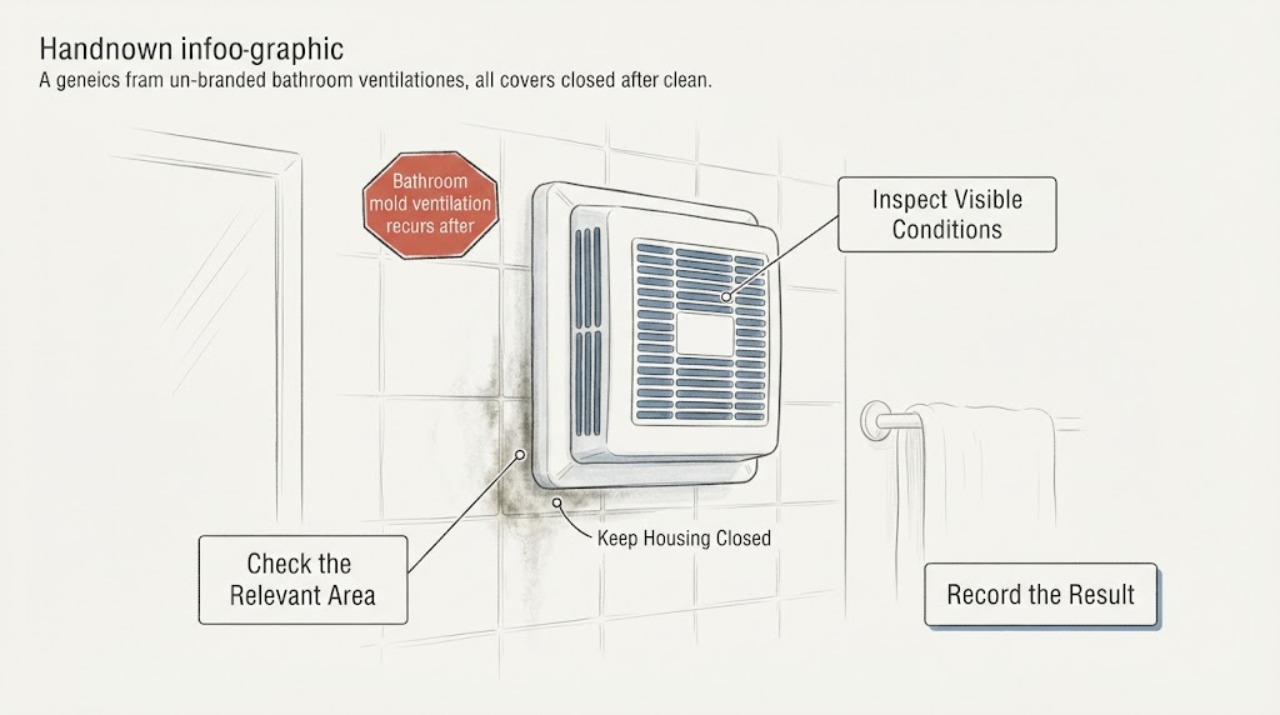
Work through in order
Diagnostic checks
Use only checks that match the exact appliance or system and its official guide.
-
Check 1
From a safe, dry position, keep occupants away from visible mold or wet surfaces and look for immediate hazards without touching, scraping, opening, or cleaning the area.
Expected result: Record whether growth is broad, returns in more than one location, is accompanied by a musty odor or wet material, follows a leak, is near an electrical fixture, or is associated with respiratory or other health concerns.
Next step: Isolate the area as practical, keep children and sensitive occupants away, and arrange qualified mold, water-damage, HVAC, or electrical service according to the observed risk.
Stop if: Stop immediately for electrical contact, active leakage, contaminated water, falling ceiling material, extensive or hidden growth, breathing difficulty, or any need to disturb the mold.
Why this matters
Why: Broad, hidden-looking, contaminated, electrical-adjacent, or health-sensitive conditions need professional assessment rather than another cleaning attempt. A small visible spot still requires the moisture source to be addressed.
-
Check 2
With the bathroom dry and no unsafe electrical condition, switch the existing exhaust fan on using its normal user control and observe the grille from below; do not remove the grille, insert objects, or open the housing.
Expected result: Note whether the fan starts, makes only a hum, has rattling or grinding, has weak or no apparent air movement, or continues to run while moisture remains visible; a running motor alone is not proof of adequate exhaust.
Next step: Record the sound and visible behavior and request HVAC or electrical inspection; do not open the fan, perform live testing, or modify wiring or ductwork.
Stop if: Stop for burning smell, smoke, sparking, heat, water near the fixture, repeated breaker trips, or any need to touch energized or internal parts.
Why this matters
Why: No operation, abnormal noise, or weak airflow can indicate a fan, power, control, obstruction, or duct problem. Continued surface moisture despite normal-sounding operation keeps outdoor termination, airflow capacity, condensation, and other moisture sources in question.
-
Check 3
From the ground or another already safe exterior viewpoint, look for the bathroom exhaust termination and compare it with the indoor fan location; do not enter the attic, climb, reach toward the roof, or open a ceiling or wall.
Expected result: Record whether an exterior termination is visible, whether it appears blocked or damaged, whether it is near the bathroom, and whether the only apparent route disappears into an attic or concealed space.
Next step: Give the location and photos to an HVAC or building professional and ask them to verify the duct route and outdoor discharge safely. Do not enter the attic or clear a high termination yourself.
Stop if: Stop for roof or ladder access, unstable or wet surfaces, suspected concealed mold, damaged exterior material, utility lines, or any need to open or alter the duct.
Why this matters
Why: A fan that discharges into an attic or cavity can leave moisture in the building even when the fan runs. An unseen, blocked, or damaged termination requires professional duct inspection; a ground-level visual cannot establish the full route.
-
Check 4
After ordinary bathroom use, observe from a dry position how condensation on the mirror, walls, ceiling, or fixtures changes over time; use a humidity meter only as a non-destructive record if one is already available and safe to use.
Expected result: Record whether condensation clears normally, remains long after the room is no longer producing steam, returns between uses, or is accompanied by a rising humidity reading, peeling finish, or damp grout and porous material.
Next step: Keep the record and ask an HVAC or water-intrusion professional to evaluate ventilation, condensation, plumbing, and building moisture. Do not remove finishes or apply chemicals to force a result.
Stop if: Stop for active dripping, soft or bulging ceiling material, water near electricity, strong odor, visible hidden-material damage, or any need to open the building enclosure.
Why this matters
Why: Persistent or rapidly returning moisture supports inadequate ventilation, a moisture source, or both. The observation is comparative rather than a universal pass/fail threshold and cannot confirm airflow or a hidden leak by itself.
-
Check 5
From safe accessible locations, compare the recurrence pattern with the shower, tub, sink, toilet, window, ceiling, and adjacent wall without probing or opening any surface.
Expected result: Note whether mold returns only near the shower, around a fixture or pipe, at a cold outside wall or ceiling, near the fan grille, or across several surfaces; record any visible leak or condensation timing.
Next step: Photograph the locations and provide the recurrence history to the appropriate qualified professional; keep wet materials exposed for assessment rather than painting or caulking over them.
Stop if: Stop for active water, structural softness, suspected hidden mold, contaminated material, health symptoms, or any urge to scrape, sample, drill, or remove a surface.
Why this matters
Why: A localized fixture or ceiling pattern can point to plumbing or envelope moisture rather than ventilation alone. A fan-area or broad bathroom pattern keeps airflow and humidity in scope. One visual pattern cannot identify the exact cause.
-
Check 6
Review the cleaning and recurrence history without repeating a chemical treatment: note when the mold was last visible, how soon it returned, whether the fan was used, and whether the room or occupants changed.
Expected result: Record repeated growth after each shower, recurrence after a leak or renovation, fan use with no improvement, a new odor, a new occupant sensitivity, or no clear change in the moisture pattern.
Next step: Share the history with a qualified remediation or building professional and ask them to identify and correct the moisture source before any cosmetic restoration.
Stop if: Stop for symptoms, broad or hidden recurrence, contaminated water, suspected HVAC contamination, or any need to mix chemicals, disturb material, or perform remediation.
Why this matters
Why: Repeated growth despite surface cleaning indicates the water or humidity condition remains active, or material behind the visible surface may be involved. Cleaning frequency alone is not a reliable fix.
Use your observations
Decision map
Find the observation that best matches what you see, then follow the next safe action.
-
PATH 01Next step
What you see
The fan does not run, has burning smell, smoke, sparking, heat, repeated breaker trips, or water near its electrical parts.
Do this next
Stop using the fan and arrange qualified electrical or HVAC service. Do not remove the grille, open the housing, rewire, or perform live testing.
-
PATH 02Next step
What you see
The fan runs but airflow appears weak, moisture lingers, or the exterior termination is blocked, damaged, or not visible.
Do this next
Request professional airflow and duct-route inspection. Do not enter the attic, climb, or open the duct or ceiling.
-
PATH 03Next step
What you see
The exhaust appears to terminate into an attic or another concealed building space.
Do this next
Treat this as a ventilation defect requiring qualified correction; do not enter the attic or modify the duct yourself. Keep the bathroom moisture load low while arranging service if safe.
-
PATH 04Next step
What you see
Mold returns near a fixture, pipe, ceiling, wall, or floor area with visible dampness or a leak.
Do this next
Prioritize a qualified plumbing or water-intrusion assessment. Do not open the wall, caulk over wet material, or assume the fan is the only cause.
-
PATH 05Next step
What you see
Humidity or condensation remains high after normal bathroom use, but no leak is visible.
Do this next
Ask an HVAC or building professional to assess exhaust performance, outdoor termination, room air path, and concealed moisture. A humidity meter can document a pattern but cannot diagnose the cause.
-
PATH 06Next step
What you see
Growth is broad, hidden-looking, repeatedly wet, associated with contaminated water, or accompanied by health concerns.
Do this next
Keep people away and arrange qualified mold or water-damage remediation and moisture assessment. Do not scrape, sample, vacuum, mix chemicals, or perform DIY remediation.
-
PATH 07Next step
What you see
The fan operates normally, moisture clears, no leak or hidden-material concern is visible, and recurrence is limited.
Do this next
Continue safe moisture observation and request professional advice if recurrence continues; do not cover the area cosmetically until the source is understood.
Helpful context
Understand the symptom
Recurring bathroom mold is a moisture-control problem until proven otherwise. A fan can make noise and still move too little air, or it may discharge into an attic or another building cavity instead of outdoors. Condensation, plumbing leakage, wet porous materials, and a fan that is not used or not functioning can all keep the surface damp.
Keep the investigation to user controls and safe visual observations. EPA guidance says bathroom ventilation should remove moisture and that exhaust should go directly outdoors, not merely into an attic or another space. Confirming a ventilation defect may require an HVAC, electrician, or building professional; it does not justify opening a ceiling or duct.
EPA also emphasizes fixing the water problem and drying affected materials before cleanup is considered complete. Repeated growth, an unknown moisture source, extensive or hidden material, contaminated water, or health concerns should be referred to qualified professionals. Avoid masking a wet surface with paint, caulk, or a chemical treatment.
Only after diagnosis
Potential parts
- humidity-meter
Consider this only as a safe documentation aid when recurring mold is being evaluated; it can show a pattern but cannot prove fan capacity, duct routing, or a hidden leak.
Use according to the instrument instructions and keep it away from water and electrical hazards; do not treat a reading as a remediation clearance. - moisture-meter
Consider this only for non-destructive documentation after a professional confirms that the accessible surface is safe; it is not a substitute for opening or assessing concealed construction.
Material and instrument differences affect readings; do not probe suspect mold, wet electrical areas, or unknown finishes. - bathroom-exhaust-fan
Consider this category only if a qualified HVAC or electrical professional confirms that the fan is unsuitable or failed after checking the duct route, controls, and moisture source.
Fan capacity, housing, electrical requirements, duct route, termination, and installation constraints are site-specific; professional fit and outdoor discharge must be confirmed.
When checks do not resolve it
Need a professional?
Arrange HVAC or electrical service for a failed or weak bathroom fan, abnormal fan noise, uncertain or indoor duct termination, electrical symptoms, or any duct modification. Arrange qualified mold or water-damage remediation for recurring broad or hidden growth, persistent dampness, active leaks, contaminated water, suspected HVAC contamination, or health concerns.
Safety scope: Do not open the fan, wall, ceiling, or duct; enter the attic; rewire or perform live electrical tests; mix bleach or cleaning chemicals; scrape, sample, vacuum, or remediate mold; or paint or caulk over a damp surface before the moisture source is resolved.
Have this ready
- Provide recurrence timing, fan switch and airflow observations, safe exterior termination photos, condensation or humidity pattern, mold locations and extent, visible leak or staining, health or occupant sensitivity, and any electrical, attic, ceiling, or access limitation.
Common questions
FAQ
Why does bathroom mold return after I clean it?
Cleaning may remove visible growth without correcting moisture. Recurrence can involve inadequate outdoor exhaust, condensation, a plumbing or roof leak, wet porous material, or hidden moisture. Document the pattern and have the source assessed.
Is a noisy bathroom fan working well enough?
Not necessarily. A motor can run while airflow is weak or the duct terminates in an attic or cavity. Observe safely and ask an HVAC professional to verify airflow and outdoor termination.
Can I check whether the fan vents into the attic?
Do not enter the attic or open a ceiling or duct. From the ground or a safe window, record any visible exterior termination and ask a professional to verify the full route.
Should I use bleach again when mold returns?
Do not use repeated chemical cleaning as a substitute for fixing moisture, and never mix bleach with other products. Under this safety scope, do not disturb the mold; arrange qualified remediation when recurrence, extent, or health risk is uncertain.
When should bathroom mold be handled by a professional?
Escalate for broad or hidden-looking growth, persistent dampness, active leaks, contaminated water, suspected HVAC or duct contamination, electrical or ceiling hazards, health concerns, or a fan or duct defect requiring access or repair.
Read the exact guide
Official sources
- Remodeling Your Home and Indoor Air QualityU.S. Environmental Protection Agency · Applies to bathroom moisture and exhaust observations, including the distinction between an operating fan and adequate outdoor exhaust; it does not authorize fan, duct, electrical, or mold-remediation work by a homeowner.
- Mold Cleanup in Your HomeU.S. Environmental Protection Agency · Applies to recurring bathroom mold and moisture conditions; it supports source correction and professional escalation but is not a DIY remediation plan under this task’s safety scope.
- A Brief Guide to Mold, Moisture and Your HomeU.S. Environmental Protection Agency · Applies to recurring bathroom mold and the need to control moisture; it does not identify the installed fan’s capacity or authorize wall opening or chemical remediation.
Community feedback
Share a repair observation
Share a plain-text repair observation. Accepted observations are published automatically; this page may take a moment to update.