
On this page
Start here
Quick answer
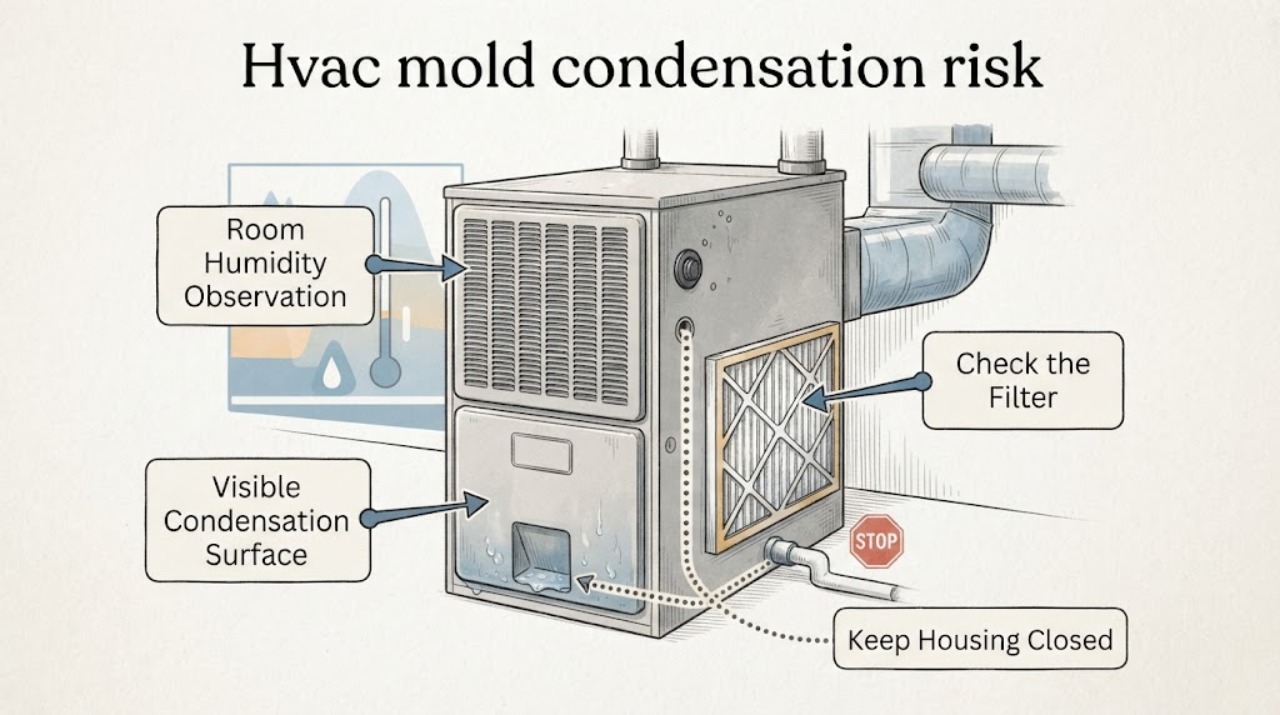
Keep this investigation observational. Record indoor humidity with a normal room humidity meter, look for condensation or dampness on visible grilles and nearby surfaces, inspect only the ordinary user-accessible filter location, and note musty odor or visible growth without touching or disturbing it. Also record when the condition appears relative to cooling cycles, weather, showering, or recent service. Do not open ducts or the air handler, scrape or sample mold, use chemicals or fogging, test electrical or refrigerant parts, or make health claims from an odor or spot. If there is standing water, repeated wetness, visible growth inside a duct or HVAC cabinet, a failed drain indication, or a vulnerable occupant concern, stop using the affected equipment if safe and call a qualified HVAC or mold-moisture professional.
Work through in order
Diagnostic checks
Use only checks that match the exact appliance or system and its official guide.
-
Check 1
Place a normal room humidity meter in the affected living space and record its displayed humidity and temperature at ordinary times, without placing it inside a grille, duct, cabinet, or wet area.
Expected result: Record whether humidity is consistently elevated, changes after showering or cooking, rises when cooling is off, or remains ordinary while condensation persists.
Next step: Keep a short dated log and provide it to an HVAC or mold-moisture professional; do not change refrigerant, electrical controls, or hidden ventilation components.
Stop if: Stop if the area is wet near electrical equipment, the meter or surface becomes hot, or occupants have urgent breathing symptoms; leave the hazard area and seek appropriate professional or medical help.
Why this matters
Why: A persistent high-humidity pattern supports a building-moisture investigation, while condensation with ordinary room readings keeps a cold-surface, insulation, drainage, or equipment issue in consideration. A meter does not diagnose mold.
-
Check 2
From a safe standing position, look at visible supply and return grilles, nearby walls and ceilings, exposed exterior insulation, and the floor around the indoor unit without opening covers, wiping suspected growth, or touching wet electrical parts.
Expected result: Record beads of water, staining, peeling or swollen finishes, rust-like marks, damp insulation, pooling, or a clear absence of visible moisture.
Next step: Photograph the area with a scale-free location note and request a professional HVAC moisture inspection; do not open the ceiling, duct, or air handler to follow the mark.
Stop if: Stop and isolate the area from occupants if water is pooling, a ceiling is sagging, electrical equipment is wet, or the surface appears unstable.
Why this matters
Why: Condensation or pooling identifies a moisture clue that needs source diagnosis. A dry surface does not rule out intermittent or concealed condensation, especially when odor or timing points to the HVAC system.
-
Check 3
If the system has a clearly labeled, ordinary user-accessible filter compartment, observe the filter's condition and fit according to the owner's manual; do not remove equipment panels or reach into the air handler.
Expected result: Record whether the filter is missing, visibly loaded with dust, wet, damaged, or seated with gaps, and whether the filter location itself shows staining or moisture.
Next step: Provide the filter condition and model information to HVAC service; only perform a routine filter change if the manual clearly permits it and the filter is dry and undamaged.
Stop if: Stop if the filter is wet, mold-like growth is present, wiring or moving parts are visible, or access requires tools or force; close the compartment without disturbing material and call a professional.
Why this matters
Why: A wet or poorly fitted filter is evidence for professional moisture and airflow review, not proof that the filter caused mold. A normal filter does not rule out condensate, duct, insulation, or coil problems.
-
Check 4
From the room side of grilles and other visible surfaces, note any musty odor or spot without scraping, brushing, wiping, drilling, opening ductwork, or collecting a sample.
Expected result: Record where the odor or visible material is strongest, whether it is near one grille or spread across rooms, and whether it appears after the system runs or when the room is humid.
Next step: Keep the area undisturbed, photograph it from a safe distance, and request qualified HVAC and mold-moisture assessment when the source may be inside equipment or ducts.
Stop if: Stop if material is disturbed accidentally, occupants develop breathing difficulty or severe symptoms, or the odor accompanies gas, smoke, burning, or chemical fumes; leave and seek appropriate help.
Why this matters
Why: A localized or system-timed pattern can help a professional decide whether HVAC moisture or a nearby building source needs investigation. Appearance and odor cannot identify mold type or establish a health outcome.
-
Check 5
Log when condensation, odor, or visible dampness appears relative to cooling cycles, rain, outdoor humidity, showering, cooking, recent cleaning, or HVAC service, without repeatedly cycling the system to reproduce it.
Expected result: Record whether the issue is continuous, occurs only during or after cooling, follows wet weather or indoor moisture events, or began after a service or construction change.
Next step: Send the dated timeline, humidity readings, photos, and filter observation to an HVAC or mold-moisture professional for a coordinated inspection.
Stop if: Stop operating the affected system if it is producing standing water, spreading a strong odor, or showing a fault, and arrange professional assessment rather than repeated resets.
Why this matters
Why: Timing can separate a general indoor-humidity pattern from an HVAC condensate or insulation concern, but it cannot confirm a hidden leak or mold source.
Use your observations
Decision map
Find the observation that best matches what you see, then follow the next safe action.
-
PATH 01Next step
What you see
Humidity is repeatedly high and condensation appears on visible surfaces without a clear spill or plumbing source.
Do this next
Request an HVAC and building-moisture assessment. Do not open ducts, alter refrigerant or controls, or apply chemicals to surfaces.
-
PATH 02Next step
What you see
The filter is wet or the accessible area shows standing water, staining, or repeated dampness.
Do this next
Stop the affected equipment if doing so is safe and call qualified HVAC service to inspect condensate drainage and equipment; do not open the air handler or clear a concealed drain.
-
PATH 03Next step
What you see
Musty odor or visible material appears at a grille, inside a duct, or around the air handler.
Do this next
Keep the area undisturbed and arrange professional HVAC and mold-moisture investigation. Do not sample, scrape, spray, fog, or attempt DIY remediation.
-
PATH 04Next step
What you see
The pattern follows showering, cooking, rain, or another building-moisture event while the HVAC surfaces remain dry.
Do this next
Record the source and timing and request building-moisture guidance; do not assume the HVAC is the source or make health claims from the symptom.
-
PATH 05Next step
What you see
There is wet electrical equipment, refrigerant concern, gas or burning odor, smoke, a sagging ceiling, or urgent breathing difficulty.
Do this next
Leave the affected area and contact the appropriate emergency, HVAC, or medical service. Do not approach equipment or attempt a reset or repair.
Helpful context
Understand the symptom
Condensation is a moisture clue
Warm humid air contacting a cold surface can create condensation. EPA identifies humidity, wet drain-pan conditions, duct insulation, and cooling-coil drainage as possible moisture paths, but an owner cannot identify a concealed failure from a surface mark alone. The practical goal is to preserve the location, timing, and visible pattern for a professional.
A spot or smell is not a diagnosis
Musty odor or a colored spot can justify a moisture investigation, but neither establishes the mold type, source, extent, or health outcome. Do not disturb the material or collect a home sample. A qualified professional can decide whether HVAC and building-moisture inspection is needed.
Keep HVAC work professional
Filter access may be ordinary owner maintenance when the equipment manual allows it, but the air handler, cooling coil, drain pan, duct liner, electrical parts, and refrigerant circuit are not user-level inspection points here. Avoid sprays, biocides, fogging, duct opening, and any work that could spread contamination or create an electrical or refrigerant hazard.
Only after diagnosis
Potential parts
- HVAC-drain-pan-alarm
Consider this only after a professional confirms a recurring condensate risk and selects an alarm that suits the installed equipment and monitoring plan.
Confirm the equipment, placement, power, and alarm compatibility with the HVAC technician; do not install it inside an air handler as a DIY moisture fix. - humidity-meter
Consider this for documenting room humidity when condensation or dampness is intermittent and a professional needs a time-stamped trend.
Use it only as an ambient room observation tool; readings do not diagnose mold, duct contamination, or a hidden equipment fault. - HVAC-filter
Consider this only when the existing filter is visibly loaded or damaged and the owner manual identifies a routine user-accessible replacement.
Match the equipment and manufacturer-specified filter dimensions and efficiency; a filter change does not correct standing water or mold in ducts.
When checks do not resolve it
Need a professional?
Have this ready
- Provide humidity readings and timing, visible condensation or staining photos, filter condition, odor or visible-material location, cooling-cycle and weather context, recent cleaning or service, and any equipment model information available from safe records.
Common questions
FAQ
Can HVAC condensation cause mold?
Persistent moisture or condensation can create conditions where mold may grow, but a visible spot or odor does not prove the source or extent. Record humidity and moisture patterns and have the HVAC and building-moisture source assessed.
Should I open the air handler to inspect the drain pan?
No. The air handler, cooling coil, drain pan, wiring, and refrigerant circuit are professional inspection points here. Photograph accessible signs of moisture and call qualified HVAC service.
Does a musty smell prove mold is inside the ducts?
No. A musty odor is a reason to investigate moisture and possible hidden growth, not proof of location, type, or health impact. Do not sample or disturb the duct; request professional assessment.
Can changing the HVAC filter solve the condensation risk?
A properly fitted routine filter can be part of maintenance, but it does not resolve standing water, drain, insulation, coil, or hidden duct moisture. A wet filter or repeated condensation needs HVAC diagnosis.
Read the exact guide
Official sources
- MoldCenters for Disease Control and Prevention · CDC states that damp environments can support mold, that health effects vary, and that home testing is not recommended as a substitute for addressing moisture and visible growth safely.
- Mold Course Chapter 2U.S. Environmental Protection Agency · EPA explains that humidity and condensation can support mold growth, identifies HVAC moisture paths, and advises professional judgment when suspected growth involves HVAC systems.
- Should You Have the Air Ducts in Your Home Cleaned?U.S. Environmental Protection Agency · EPA identifies condensation, high humidity, standing water, wet insulation, filter fit, and drain-pan condition as professional maintenance considerations and cautions against unqualified treatments.
- A Brief Guide to Mold, Moisture and Your HomeU.S. Environmental Protection Agency · EPA recommends controlling moisture, keeping HVAC drip pans and drains functioning, recording humidity, and using professionals for hidden mold investigations; it does not support treating a home reading as a mold diagnosis.
Community feedback
Share a repair observation
Share a plain-text repair observation. Accepted observations are published automatically; this page may take a moment to update.