
On this page
Start here
Quick answer
A musty odor that starts when the HVAC fan runs can come from moisture or microbial growth near a condensate drain pan, coil, filter, or duct. Treat this as an inspection problem, not a DIY duct-cleaning job: record when and where the odor appears, inspect only areas already visible without opening the equipment, and arrange qualified HVAC/mold assessment when there is standing water, visible growth, wet insulation, or an odor that persists. Do not cut into ducts, disturb suspected growth, use sprays in the system, or perform refrigerant work.
Work through in order
Diagnostic checks
Use only checks that match the exact appliance or system and its official guide.
-
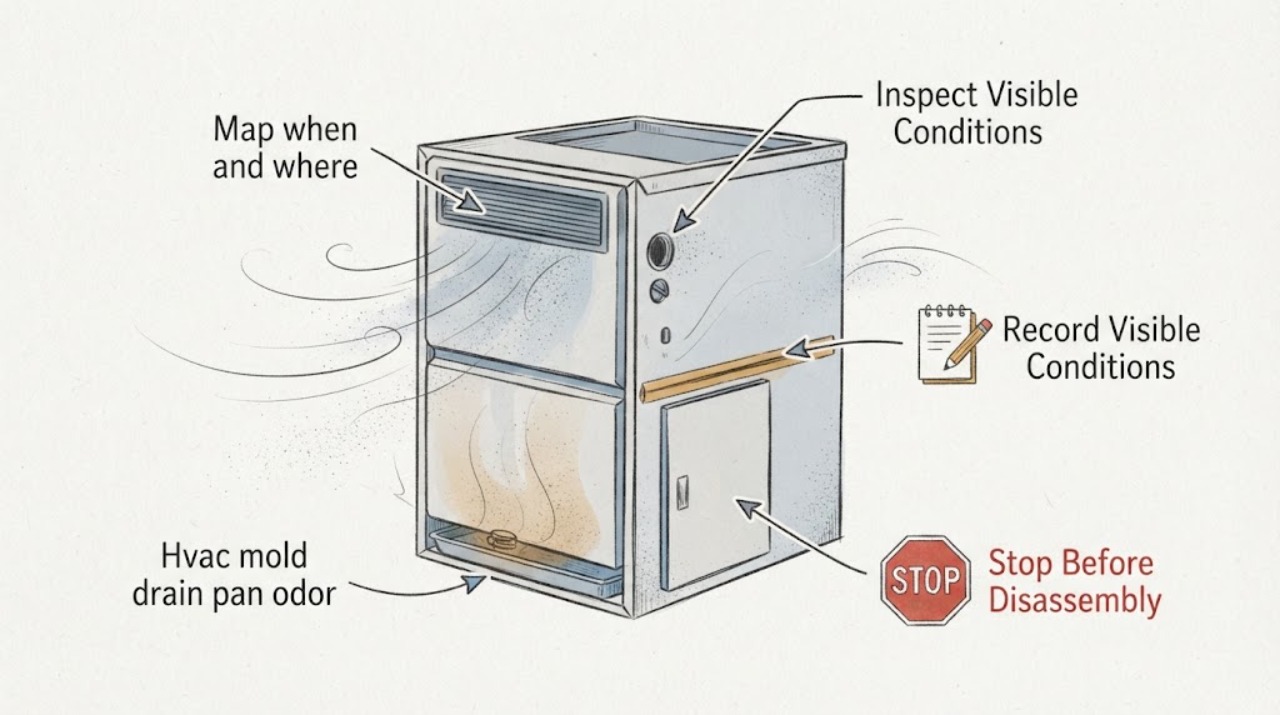
Map when and where the odor appears
Write down whether the smell is present with the system off, begins when the fan starts, appears during cooling only, or is strongest at a return grille, supply grille, air-handler area, closet, attic, or adjacent room. Do not put your face into a vent or remove a grille.
Expected result: Record the first location and operating condition linked to the odor, and whether the smell is musty, sour, damp, or another description without trying to name a mold type.
Next step: Use the timing and location in the professional service request, then inspect only the safely visible areas described in the next actions.
Stop if: Stop the observation and leave the area if the odor is overwhelming, visible dust or growth is being blown out, or anyone experiences wheezing, shortness of breath, or other severe symptoms.
Why this matters
Why: An odor that follows airflow suggests the HVAC system may be distributing a contaminant, while a constant room odor can also come from nearby damp building materials or a drain area. Odor alone cannot confirm mold or locate a drain-pan fault.
-
Look for moisture without opening the equipment
From outside the closed cabinet, inspect the floor, ceiling, wall, insulation surface, and any already exposed condensate tubing or pan edge for water marks, droplets, rust, dampness, overflow, or debris. Do not remove panels or reach into the air handler.
Expected result: Note dry surfaces, active dripping, pooled water, a stained cabinet or finish, a disconnected-looking drain tube, or wet insulation near the unit.
Next step: Photograph the visible condition, keep people away from the wet area, and request HVAC and mold assessment. Do not attempt to unclog, vacuum, or chemically treat the drain from this guide.
Stop if: Stop immediately for active overflow, water near electrical equipment, sagging ceiling material, wet internal insulation, or any need to open the cabinet.
Why this matters
Why: EPA identifies standing water, debris, and poor drain-pan flow as conditions needing immediate attention because moisture supports biological growth. Wet or moldy porous insulation may require replacement by a qualified contractor rather than surface cleaning.
-
Record the filter and airflow condition
If the filter is designed to be viewed or changed without opening the air handler, note its installation date if known, whether it is visibly wet or heavily loaded, whether it fits its frame, and whether air is reaching the affected room. Do not handle a wet or visibly moldy filter unnecessarily.
Expected result: The filter may look dry and seated, clogged or damaged, wet, or visibly contaminated; airflow may feel normal, weak, or absent at the affected register.
Next step: Photograph the filter label and condition for the provider. If it is wet or visibly contaminated, avoid running the system until a qualified provider advises whether operation could distribute material.
Stop if: Stop handling the filter and arrange service if it is wet, visibly moldy, shedding debris, or located where accessing it would expose you to the equipment interior.
Why this matters
Why: EPA recommends keeping filters dry, changing them regularly, and ensuring that air cannot bypass the filter. A contaminated filter or poor airflow can accompany a moisture problem, but a filter change alone does not establish or correct the drain-pan source.
-
Measure the room conditions and document damage
Use a humidity meter in the room and near the air-handler area if those locations are safely reachable. Record the reading, condensation on nearby cold surfaces, recent leaks or flooding, and damage such as peeling paint, staining, or softened materials. A basic air-quality monitor may record trends but cannot diagnose mold.
Expected result: Record a stable reading, elevated humidity, condensation, recent water event, or signs that building materials stayed damp; note the date and location of each observation.
Next step: Share the log with the service provider so the inspection covers the drain-pan system and the surrounding building moisture source rather than treating odor only.
Stop if: Do not enter a damp attic, crawlspace, or equipment enclosure to take a reading, and do not disturb water-damaged or suspected moldy material.
Why this matters
Why: EPA describes moisture control as the central mold-prevention measure and notes that humidity, condensation, and wet materials can support growth. CDC likewise says mold control requires both cleanup and correction of the moisture problem.
-
Choose the professional inspection path
Compile the odor timeline, first location, system mode, visible moisture, filter condition, humidity readings, prior leaks, and photographs. Ask for an inspection of the condensate pan and drain, coil area, filter and cabinet, accessible ductwork, and any wet insulation, with the moisture source addressed before any cleaning proposal.
Expected result: The record should show either a visible moisture problem, a likely airflow-distribution pattern, suspected contamination without a visible source, or no repeatable odor yet.
Next step: Use the service call for any persistent HVAC odor, visible growth, standing water, wet insulation, or suspected contamination. Let the qualified provider determine the inspection and remediation scope.
Stop if: Do not proceed with DIY duct cleaning, mold removal inside the system, chemical spraying, refrigerant work, or demolition.
Why this matters
Why: EPA says the entire system and its components should be considered when contamination is suspected, and that leaving a contaminated component untreated can permit re-contamination. It also warns that porous wet insulation may need replacement and that chemical treatments require careful evaluation.
Use your observations
Decision map
Find the observation that best matches what you see, then follow the next safe action.
-
PATH 01Safety boundary
What you see
Visible water, overflow, debris, or a pan/drain condition is present near the air handler.
Do this next
Stop using the affected equipment if operation could spread material, protect nearby finishes without entering the enclosure, and request prompt HVAC and mold inspection.
Why this path and its safety boundary
Safety stop: Do not open the unit, clear the drain, or touch electrical components.
-
PATH 02Safety boundary
What you see
Growth is visible near the unit or duct, or insulation is wet, moldy, or producing an unacceptable odor.
Do this next
Keep the equipment closed and arrange qualified assessment of the whole affected system and material; provide photographs from a safe distance.
Why this path and its safety boundary
Safety stop: No scraping, vacuuming, cutting, spraying, or removal of insulation is appropriate in this observation guide.
-
PATH 03Safety boundary
What you see
No source is visible, but the odor reliably begins when the fan or cooling cycle runs.
Do this next
Treat the pattern as a possible HVAC distribution issue and request inspection of the pan, coil, filter, cabinet, drain, and accessible ductwork rather than masking the odor.
Why this path and its safety boundary
Safety stop: Stop operating the system if it blows visible debris or occupants develop respiratory symptoms.
-
PATH 04Safety boundary
What you see
The odor is not repeatable and no moisture or growth is visible from outside the equipment.
Do this next
Keep a short log of operating mode, location, humidity, and recent water events; arrange service if the odor returns or any moisture appears.
Why this path and its safety boundary
Safety stop: Do not infer that the system is clean solely because the smell temporarily stops.
Helpful context
Understand the symptom
The drain pan is intended to collect condensate and send it to a drain. EPA guidance says a pan that does not drain, or is not maintained, can let water enter the HVAC system and contaminate ventilation ducts. A musty smell is a useful clue, but it does not identify the material or exact source by itself.
Keep this guide at the observation level. Do not remove an air-handler cover, reach into a blower or coil compartment, scrape growth, cut duct insulation, flush a condensate line, apply a biocide, or open a refrigerant circuit. A qualified provider should inspect the pan, coil, drain, filter, cabinet, and affected ductwork as a connected system.
What to do first
If the odor is strong, the system is visibly wet, or occupants develop breathing symptoms, leave the affected area and arrange prompt professional help. If there is no immediate hazard, gather the observations below while keeping the equipment closed and undisturbed.
Moisture control is the durable fix. EPA and CDC both emphasize fixing the moisture source and preventing damp conditions; cleaning a surface without correcting a blocked drain, leak, condensation problem, or wet insulation can leave the cause in place.
Only after diagnosis
Potential parts
- air-quality-monitor
For trend logging only; a monitor cannot identify mold or replace an HVAC inspection.
- humidity-meter
To document room humidity and condensation patterns from safe, occupied locations.
- HVAC-filter
Only when the system documentation confirms the size and filter can be accessed safely; a filter cannot correct standing water or contaminated insulation.
When checks do not resolve it
Need a professional?
Request HVAC mold inspection promptly for persistent odor, visible growth, standing water, overflow, wet insulation, a contaminated filter, water damage, or an odor that begins whenever the fan runs. Stop DIY work and seek urgent help if the system may be distributing contamination or occupants have serious breathing symptoms.
Common questions
FAQ
Can a dirty HVAC drain pan cause a musty smell?
It can be part of the problem because a pan that holds water or is not maintained can support biological growth and allow moisture into the system. The pan, drain, coil, filter, cabinet, and ducts must be assessed together to find the source.
Should I spray cleaner or a mold product into the air handler?
No. Do not spray, fog, or apply a chemical treatment inside the HVAC system. EPA cautions that chemical treatments in ductwork have uncertain benefits and can distribute material through the system; use qualified assessment instead.
Is changing the HVAC filter enough to remove the odor?
Not if the drain pan, coil, cabinet, duct, or insulation has a moisture or contamination problem. You may record the visible filter condition, but a wet or visibly contaminated filter warrants professional guidance before further operation.
Can I clean the drain pan or unclog the condensate line myself?
This topic is observation-only. Do not open the air handler or work on the drain when mold, standing water, electrical equipment, or concealed damage may be involved. Request qualified HVAC inspection.
When is an HVAC mold odor urgent?
Arrange prompt service for standing water, active overflow, visible growth, wet insulation, odor from every supply, repeated odor after the fan starts, or water damage. Leave the area and seek appropriate medical help for severe breathing symptoms.
Read the exact guide
Official sources
- Should You Have the Air Ducts in Your Home Cleaned?U.S. Environmental Protection Agency · Use for whole-system inspection, standing water, wet insulation, filter maintenance, and cautions about chemical treatments.
- Mold Course Chapter 9U.S. Environmental Protection Agency · Use for condensate-pan drainage, HVAC filter dryness, odor investigation, and moisture control.
- MoldCenters for Disease Control and Prevention · Use for the relationship between mold, moisture, HVAC pathways, and health precautions.
- Indoor Air Quality Problem Solving ToolU.S. Environmental Protection Agency · Use for observation prompts covering air-handler moisture, drain pans, filters, odor, condensation, and humidity.
Community feedback
Share a repair observation
Share a plain-text repair observation. Accepted observations are published automatically; this page may take a moment to update.