
On this page
Start here
Quick answer
A musty odor that appears when the air handler runs is a clue, not proof of mold. Note whether the smell comes from one vent or the return, whether it is present when the system is off, and whether there has been condensation, a leak, or visible growth near the unit. If mold is suspected inside the air handler, duct, insulation, or drain-pan area, stop using the system and arrange qualified HVAC/mold assessment; do not open the cabinet or spray into the system.
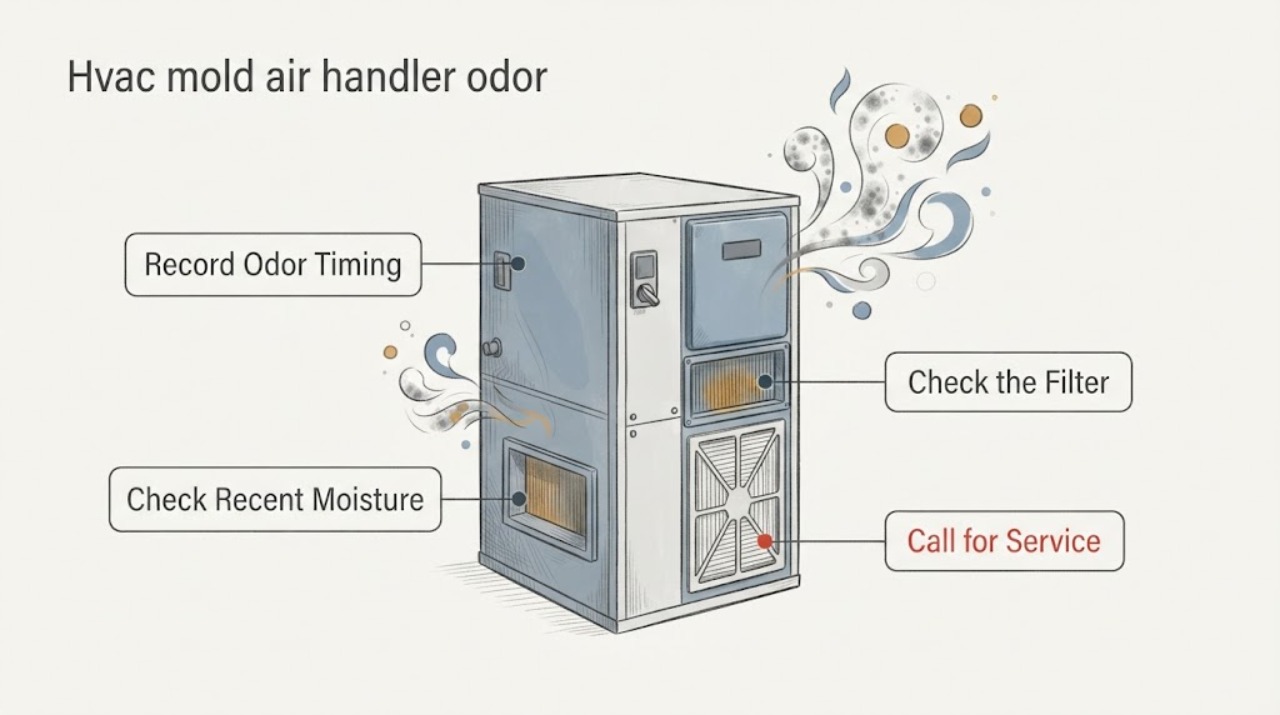
Work through in order
Diagnostic checks
Use only checks that match the exact appliance or system and its official guide.
-
Check 1
With the system controls untouched, note whether the odor is present when the HVAC is off, at startup, during operation, or after shutdown.
Expected result: Record the timing and whether it occurs at every supply register, only one register, or near the return/air-handler area.
Next step: Continue with external visual checks and arrange professional assessment if the odor is persistent or returns.
Stop if: Stop if anyone develops breathing or other health symptoms, or if you see suspected growth or water inside an HVAC component; leave the area and seek professional guidance.
Why this matters
Why: An odor tied to airflow points toward the air path, while an odor that remains with the system off may be in nearby building materials; neither observation confirms mold.
-
Check 2
From a safe, well-lit position, look around the air handler, return grille, nearby ceiling/wall, and floor for water marks, condensation, damp insulation, or a recently wet filter.
Expected result: Record dry versus damp surfaces, staining, pooled water, or an active leak without touching suspected mold or removing the filter housing.
Next step: Photograph the evidence and request HVAC/mold assessment rather than applying a household spray.
Stop if: Do not reach into the unit, remove panels, or disturb insulation, deposits, or visible growth.
Why this matters
Why: Moisture or staining supports a moisture-source investigation; a dry exterior does not rule out concealed contamination.
-
Check 3
Observe the filter and return grille only as the homeowner-accessible design permits, without forcing a cover or dismantling the unit.
Expected result: Note whether the filter is missing, visibly wet, heavily loaded, or bypassed by gaps, and whether odor is strongest at the return.
Next step: Follow the equipment manual for routine filter access only if it opens normally; otherwise leave it for the technician and record the model label from outside.
Stop if: Stop at resistance, exposed wiring, sharp metal, suspected mold, or any need to enter the cabinet.
Why this matters
Why: A wet or bypassed filter is evidence to provide to a technician, but replacing it alone will not resolve a damp or contaminated air handler.
-
Check 4
Write down rooms affected, occupants' symptoms if any, and whether the odor changes after rain, cooling, or a drain overflow.
Expected result: Look for a pattern tied to weather, cooling cycles, or one branch of the duct system.
Next step: Share the timeline, photos, and system information with a qualified HVAC/mold professional.
Stop if: Do not operate a suspected contaminated system merely to reproduce the smell.
Why this matters
Why: A repeatable moisture or airflow pattern helps separate a local register issue from a system-wide investigation, but it is not a DIY remediation diagnosis.
Use your observations
Decision map
Find the observation that best matches what you see, then follow the next safe action.
-
PATH 01Next step
What you see
Visible growth, damp insulation, standing water, or a strong odor at the air handler/duct is observed.
Do this next
Stop operating the system and call a qualified HVAC/mold professional for inspection.
-
PATH 02Next step
What you see
Odor is limited to one register with no visible external moisture.
Do this next
Record the register and airflow pattern; have the duct branch and nearby materials inspected rather than spraying into it.
-
PATH 03Next step
What you see
Odor persists with the system off and is stronger near a wall, ceiling, or other material.
Do this next
Investigate the surrounding moisture source with a water-damage or mold professional.
-
PATH 04Next step
What you see
No external moisture is visible but the odor repeatedly returns with operation.
Do this next
Arrange professional air-handler and duct assessment; inaccessible components can conceal moisture or growth.
Helpful context
Understand the symptom
What the odor can tell you
EPA guidance links mold growth in HVAC systems with moisture and says suspected contamination should be investigated promptly. A musty smell can also come from a wet filter, drain-pan moisture, nearby building materials, or another source, so location and timing matter more than smell alone.
Safe evidence to collect
Keep the checks visual and external. Record system state, odor location, recent water events, filter condition, and any accessible staining without removing covers or disturbing suspected growth. Photos taken from a safe standing position help a qualified professional scope the visit.
What happens next
A professional should identify the moisture source, assess accessible air-handler components and ducts, and determine whether cleaning, drying, replacement, or broader remediation is appropriate. A filter or portable cleaner may reduce some particles or odor but cannot correct a moisture source.
Safety boundary
Stop conditions
- Do not open HVAC panels, enter ducts, disturb suspected mold or insulation, spray chemicals into the system, perform electrical checks, or handle refrigerant.
- If mold is known or suspected inside the HVAC system, stop operating it and obtain qualified HVAC/mold guidance.
- Leave the area and seek health advice for significant respiratory symptoms, and use emergency services for an immediate medical emergency.
Only after diagnosis
Potential parts
- air-quality-monitor
Only consider a monitor as supplemental tracking after a professional has addressed suspected moisture; readings do not diagnose mold or replace inspection.
Choose a device appropriate for the room and treat readings as trend information, not a clearance test. - humidity-meter
Useful only for documenting humidity trends around a suspected moisture source; it cannot inspect inside ducts or the air handler.
Compare readings over time and keep the device outside the HVAC cabinet and away from wet surfaces. - HVAC-filter
Consider only if the existing filter is visibly wet, damaged, missing, or due for routine replacement and the holder opens normally.
Confirm the equipment manual's size and efficiency guidance; a filter does not cure mold or a leak.
When checks do not resolve it
Need a professional?
Call a qualified HVAC/mold professional when odor persists, returns with airflow, follows a leak or condensation event, or is accompanied by visible growth, damp insulation, standing water, or health concerns. Provide the timing, affected locations, photos, filter observations, and recent water history.
Common questions
FAQ
Does a musty HVAC smell prove there is mold?
No. It is a reason to investigate moisture and airflow. A professional must assess suspected HVAC contamination; do not spray or dismantle the system.
Should I keep running the HVAC to test the smell?
If contamination is known or suspected, stop operating it and arrange qualified guidance. Record when the odor occurred instead of repeatedly testing it.
Can a new filter remove the odor?
A correctly fitted routine filter may reduce some particles, but it cannot fix a leak, wet insulation, drain-pan problem, or mold source.
What should I photograph?
From a safe standing position, photograph the air-handler exterior, accessible drain area, filter label, visible staining, and affected registers without opening panels or disturbing material.
Read the exact guide
Official sources
- What does mold smell like?U.S. Environmental Protection Agency · General indoor mold-odor observations; odor is a clue requiring investigation, not a stand-alone diagnosis.
- Should You Have the Air Ducts in Your Home Cleaned?U.S. Environmental Protection Agency · General residential forced-air HVAC systems; used for moisture, inspection, and professional-escalation principles.
Community feedback
Share a repair observation
Share a plain-text repair observation. Accepted observations are published automatically; this page may take a moment to update.