
On this page
Start here
Quick answer
A musty smell does not by itself prove mold or prove that the HVAC system is the source. First note whether the odor appears only when heating or cooling runs, whether it comes from one room or several vents, and whether you can see condensation, water, staining, or a wet filter or return area. Compare the safe, normal room odor with the system off without opening equipment or ducts. A dirty accessible filter can affect air quality, but a filter or purifier will not correct a moisture source. If odor follows HVAC operation, visible water or condensation is present, multiple rooms are affected, the filter or return is wet, or symptoms occur, stop DIY cleaning and arrange qualified HVAC and mold assessment. Do not open the unit or ductwork, handle refrigerant or wiring, clean inside, or spray chemicals.
Before you begin
Safety first
- The HVAC professional evaluates safe operation, airflow, filter and return condition, condensate handling, and accessible equipment; the mold or building professional evaluates moisture, materials, source control, and containment. The provider should show visible evidence and correct moisture before proposing internal cleaning or chemical treatment.
Work through in order
Diagnostic checks
Use only checks that match the exact appliance or system and its official guide.
-
Check 1
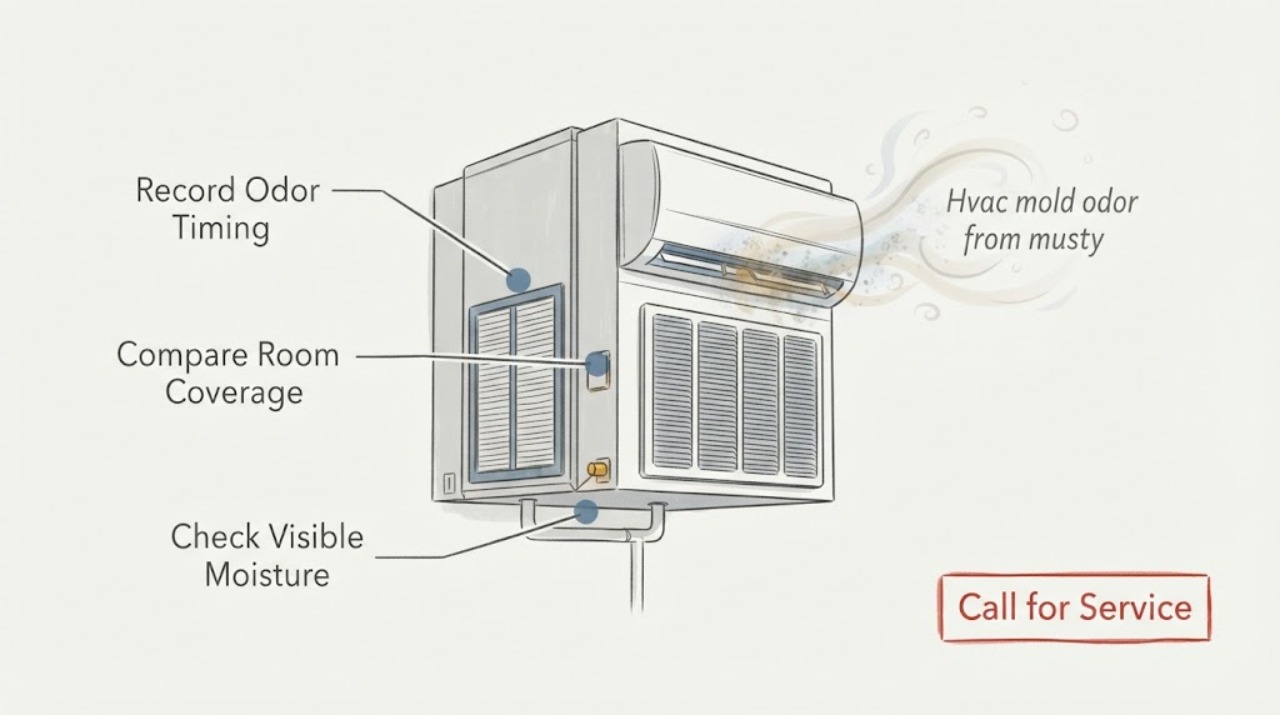
From a safe room position, record whether the musty odor is present before the HVAC starts, only after the blower or heating or cooling cycle begins, or after the system stops. Note the mode that was already in normal use and avoid creating repeated test cycles.
Expected result: The odor occurs only while air is being delivered; remains when the system is off; or is too inconsistent to place in either group.
Next step: Keep the timing log and use it to choose the room-coverage and moisture branches; do not run a system that is known or suspected to be contaminated just to reproduce the smell.
Stop if: Stop if anyone develops breathing difficulty, the unit leaks, makes a burning smell, arcs, or requires opening the equipment or touching wiring.
Why this matters
Why: An HVAC-on-only pattern raises the priority of checking the return, filter, air handler, condensate path, and duct distribution. An odor that remains off points toward a room or building source as well as HVAC. An inconsistent pattern needs a dated log rather than a guess.
-
Check 2
Without opening a register or duct, compare the odor at the affected room, nearby supply vents, and return grille from normal standing positions. Note whether one room, one vent, several supply vents, or the whole home is affected.
Expected result: Only one room or vent is affected; several vents on one zone are affected; or multiple rooms and returns are affected.
Next step: Photograph visible staining or condensation and tell the service provider the exact room and vent pattern; do not remove grilles or brush inside them.
Stop if: Stop if the smell is accompanied by visible growth, wet insulation, respiratory symptoms, or any need to enter an attic, crawlspace, or restricted area.
Why this matters
Why: A single-room pattern can be a local room or register-adjacent source. A zone-wide or whole-home pattern makes the return, air handler, shared duct path, or building moisture source more important to inspect.
-
Check 3
From an already accessible viewpoint, look near the indoor unit, accessible filter slot, return grille, supply grille, and nearby floor or wall for condensation, puddles, water staining, damp insulation, or a wet filter. Do not open covers, reach into a drain pan, clear a drain, or touch energized parts.
Expected result: No visible moisture is present; condensation or a wet filter is visible; or standing water, staining, damp insulation, or a recurring leak is visible.
Next step: Keep the area documented and arrange qualified service to trace the moisture source before internal cleaning or chemical treatment is considered.
Stop if: Stop and keep people away for standing water near electricity, sagging material, exposed wiring, active leaks, or any contaminated surface that would need handling.
Why this matters
Why: No visible moisture does not rule out concealed dampness. A wet filter or condensation supports an HVAC moisture investigation; standing water, damp insulation, or recurring leakage warrants prompt HVAC and mold or building assessment.
-
Check 4
If the filter slot or return grille is plainly labeled as user-accessible, observe whether the filter is present, dry, visibly overloaded, damaged, or seated with obvious gaps, and photograph its label. Do not open the air handler, remove internal panels, or choose a higher-resistance filter without system guidance.
Expected result: The filter is dry and intact; visibly loaded or damaged; wet or mold-like; missing; or the return area is inaccessible or has an obvious gap.
Next step: Provide the filter condition and label to the HVAC professional; replace only when the slot is clearly user-accessible and the exact system-approved replacement is known.
Stop if: Stop if the filter is wet or contaminated, the return is inside a restricted area, or reaching the filter requires a ladder, tool, panel removal, or contact with wiring.
Why this matters
Why: A dry intact filter makes it less likely that the filter alone explains a persistent musty odor. A loaded or missing filter may affect air quality and airflow. Wet or mold-like material, an inaccessible return, or bypass gaps need qualified evaluation and do not justify internal spraying.
-
Check 5
With the HVAC left in its normal safe state, note whether the odor remains in the room after the system is off and inspect only visible nearby sources such as a drain, carpet, wall, closet, stored material, or recent leak. Do not use fragrances, ozone, foggers, bleach, or sprays to mask the odor.
Expected result: The odor remains strongest at a room or building material with the system off; disappears when the system is off; or has no stable location.
Next step: Record the source candidate, timing, and visible moisture and ask for a moisture assessment that includes HVAC and nearby building materials.
Stop if: Stop if the suspected source is sewage, a wet wall or ceiling, visible growth over a large area, or a location requiring demolition or restricted access.
Why this matters
Why: A persistent local odor can be a non-HVAC moisture source, while an HVAC-on-only odor keeps the air path in scope. No stable location means the source is uncertain and should not be assigned to mold or ducts by assumption.
-
Check 6
Prepare a service handoff with the odor timing, heating or cooling mode, one-room versus multiple-vent pattern, visible condensation or water, filter and return condition, nearby non-HVAC sources, occupant symptoms, and areas not safely viewed.
Expected result: The record points to an HVAC-on-only pattern, a local room source, a visible moisture problem, a filter or return concern, a multi-room distribution pattern, or unresolved uncertainty.
Next step: Request qualified HVAC and mold or building-envelope assessment when moisture, distribution, visible growth, wet materials, or uncertainty remains.
Stop if: Do not open the system, clean inside, remove duct insulation, perform refrigerant or electrical work, or spray chemicals while preparing the handoff.
Why this matters
Why: This scope prevents a generic deodorizer or duct-cleaning visit from replacing source diagnosis. The provider can decide whether HVAC operation, moisture repair, material remediation, or coordinated services are needed.
Use your observations
Decision map
Find the observation that best matches what you see, then follow the next safe action.
-
PATH 01Safety boundary
What you see
The musty odor appears only while the blower or heating or cooling cycle is operating and fades when the system is off.
Do this next
Arrange qualified HVAC and mold or moisture assessment of the accessible filter, return, air handler, condensate path, and distribution pattern.
Why this path and its safety boundary
Why it matters: The HVAC air path or a moisture condition activated by operation deserves priority, but the odor does not prove mold.
Safety stop: Do not keep cycling the system, open the unit, clean ducts, or spray into registers.
-
PATH 02Safety boundary
What you see
The odor remains with HVAC off or is strongest near one room, drain, carpet, wall, closet, or stored material.
Do this next
Request a room and building moisture assessment and report the local source, timing, and any visible dampness.
Why this path and its safety boundary
Why it matters: A non-HVAC moisture or material source is plausible, although HVAC can still distribute the odor.
Safety stop: Do not cover the source with fragrance, ozone, paint, bleach, or chemical spray.
-
PATH 03Safety boundary
What you see
The odor is present at several supply vents, returns, or rooms rather than one local register.
Do this next
Request coordinated HVAC and mold or moisture inspection and keep the distribution map for the provider.
Why this path and its safety boundary
Why it matters: A shared return, air handler, duct section, or broader building moisture problem is more likely than one room surface.
Safety stop: Do not remove grilles, open ducts, brush insulation, or permit unsubstantiated internal chemical treatment.
-
PATH 04Safety boundary
What you see
Condensation, standing water, staining, a wet filter, damp insulation, or a recurring leak is visible near the HVAC or a nearby surface.
Do this next
Arrange prompt HVAC and moisture service to trace and correct the water source before remediation or replacement decisions.
Why this path and its safety boundary
Why it matters: There is a moisture clue that must be corrected; it is not safe to assume odor control alone will solve it.
Safety stop: Stop for water near electricity, active leakage, sagging material, or any need to enter a restricted space or touch the equipment.
-
PATH 05Safety boundary
What you see
The accessible filter is missing, wet, visibly mold-like, badly damaged, or the return has an obvious bypass gap or inaccessible location.
Do this next
Provide the filter label and photos to an HVAC professional; use only a clearly user-accessible, system-approved replacement if directed.
Why this path and its safety boundary
Why it matters: The filter or return may be affecting air quality or allowing contaminants to bypass filtration, but it is not proof of duct mold.
Safety stop: Do not open the air handler, select an unverified filter, spray the return, or reach into an inaccessible filter location.
-
PATH 06Safety boundary
What you see
No visible water or mold is found and the odor pattern remains uncertain.
Do this next
Keep a room-by-room timing log and arrange professional inspection if the odor persists or returns.
Why this path and its safety boundary
Why it matters: A hidden source, a non-HVAC material, or a different odor may be involved; absence of a visible sign does not prove the system is clean.
Safety stop: Do not use ozone, foggers, fragrances, chemical duct sprays, or repeated DIY cleaning to hide uncertainty.
-
PATH 07Safety boundary
What you see
Visible growth, wet porous material, known HVAC contamination, or respiratory symptoms are present.
Do this next
Limit exposure, avoid operating a known contaminated system when safe to do so, and request qualified HVAC and mold-remediation guidance.
Why this path and its safety boundary
Why it matters: The scope has crossed from odor troubleshooting into controlled health and contamination management.
Safety stop: Do not disturb contaminated material, open ducts, clean internally, or handle refrigerant or electrical components.
Helpful context
Understand the symptom
Treat musty air as a source question, not a mold diagnosis
A musty odor can be associated with mold, but the smell alone does not identify mold or locate it. Other damp building materials, drains, carpets, stored items, or a neighboring room can create a similar odor. EPA and NIOSH guidance favors finding moisture and making a careful visual assessment; short air samples cannot establish the health meaning of a mold concentration. Record the odor and its timing before selecting a cleaning or treatment service.
Use HVAC timing and room coverage as the first split
If the odor appears only when the blower or heating or cooling cycle runs, the air handler, return path, filter area, condensate system, or duct path deserves professional attention. If it remains with the system off, investigate non-HVAC sources such as a damp wall, carpet, drain, closet, crawlspace, or recent leak. A smell at one register is a different scope from the same smell at many supply vents or returns.
Look for moisture without opening the system
From an already safe viewpoint, look for visible condensation at a supply grille or accessible duct exterior, water or staining near the indoor unit, a wet filter, damp return grille, or a blocked-looking drain outlet. Condensation and standing water are evidence of a moisture problem, not proof of mold. Do not remove the air-handler cover, open a duct, reach into a drain pan, touch wiring, or handle refrigerant components.
A filter is a clue, not a remediation
An accessible filter may be visibly loaded, wet, damaged, or seated incorrectly. Record the filter label and condition without changing it if the slot is not clearly user-accessible. EPA notes that filters can supplement source control but do not address the cause of mold or musty odors; a wet or moldy system component needs qualified HVAC or remediation assessment rather than internal spraying.
Choose the right professional boundary
A qualified HVAC technician can evaluate operation, airflow, condensate handling, and accessible equipment; a mold or building professional can evaluate moisture, materials, and containment. If several rooms or vents smell musty, if a return path or insulated duct is suspected, or if visible growth or wet materials are present, request a coordinated scope. Do not treat a duct-cleaning or chemical-spray offer as a diagnosis without visible evidence and a moisture plan.
Safety boundary
Stop conditions
- Do not open the air handler, ductwork, registers, drain pan, or internal insulation; do not handle refrigerant, wiring, motors, or energized components.
- Do not perform internal HVAC cleaning, brush or remove duct insulation, inject chemicals, spray into ducts, fog, use ozone, or mask the odor with fragrances.
- Stop for standing water near electricity, active leaks, wet or mold-like filters, visible growth, respiratory symptoms, sagging materials, or any access requiring a ladder, attic, crawlspace, or restricted area.
- Do not run a system known or reasonably suspected to be contaminated merely to reproduce the odor; obtain qualified HVAC and mold or moisture guidance.
Only after diagnosis
Potential parts
- air-quality-monitor
Use only to log room trends or support a professional discussion; a monitor cannot diagnose mold or identify the moisture source.
Choose a device appropriate for the room and intended measurements, and do not treat a reading as proof of contamination or safety. - humidity-meter
Consider for trend logging when condensation or dampness is suspected, while keeping the HVAC and building inspection in scope.
Use it as a room-level observation tool; it does not measure hidden duct moisture or certify that mold is absent. - HVAC-filter
Consider only when the filter slot is clearly user-accessible and the existing filter specification or HVAC professional confirms the replacement.
Match the exact dimensions, airflow direction, system requirements, and filter location; do not choose a restrictive or unverified filter to mask an odor.
When checks do not resolve it
Need a professional?
Arrange prompt service for an HVAC-on-only musty odor, visible condensation or standing water, a wet or mold-like filter, multiple affected rooms or vents, recurring water damage, known contamination, or symptoms. Request planned assessment for a persistent unexplained odor even when no source is visible.
Safety scope: The HVAC professional evaluates safe operation, airflow, filter and return condition, condensate handling, and accessible equipment; the mold or building professional evaluates moisture, materials, source control, and containment. The provider should show visible evidence and correct moisture before proposing internal cleaning or chemical treatment.
Have this ready
- Whether the odor occurs only while HVAC operates or also when it is off
- One-room, one-vent, zone-wide, or multiple-room distribution pattern
- Visible condensation, water, staining, wet insulation, filter, or return observations
- Filter label and access limits without opening equipment
- Nearby drains, carpets, walls, closets, leaks, recent work, occupant symptoms, and any suspected contamination
Common questions
FAQ
Does a musty HVAC smell prove mold?
No. It can justify an investigation, but the smell may come from mold, damp materials, drains, carpets, or another building source. Record when and where it occurs and look for moisture without opening the system.
What does it mean if the smell happens only when HVAC runs?
That pattern raises the priority of the filter, return, air handler, condensate path, and duct distribution. It does not prove mold; a qualified HVAC and moisture assessment is needed if it persists.
Why does one room matter?
One room or one register can indicate a local source. Several vents, returns, or rooms suggest a shared air path or broader moisture problem and warrant a wider inspection scope.
Can I solve the odor by changing the filter or using an air cleaner?
An accessible, correct filter can support normal air quality, but EPA says filters and air cleaners do not correct the moisture source behind mold or musty odors. Do not use a filter change to avoid investigating water or contamination.
Can I spray cleaner into the vents or open the ducts?
No. Do not open ductwork or the air handler, clean internally, spray chemicals, fog, use ozone, or handle refrigerant or wiring. Ask qualified professionals to show evidence and define a safe remediation scope.
Read the exact guide
Official sources
- Guide to Air Cleaners in the HomeU.S. Environmental Protection Agency · Supports checking an accessible HVAC filter while explaining that filters do not correct the moisture source behind mold or musty odors.
- Mold, Testing, and RemediationCenters for Disease Control and Prevention, National Institute for Occupational Safety and Health · Supports visual assessment and odor investigation over unsupported air sampling, plus source repair and appropriate containment.
- What does mold smell like?U.S. Environmental Protection Agency · Supports treating a musty odor as a reason to investigate moisture and not as a standalone mold identification.
- Should You Have the Air Ducts in Your Home Cleaned?U.S. Environmental Protection Agency · Supports requiring visible evidence and qualified service for contaminated HVAC components and avoiding unsupported internal chemical treatment.
Community feedback
Share a repair observation
Share a plain-text repair observation. Accepted observations are published automatically; this page may take a moment to update.