
On this page
Start here
Quick answer
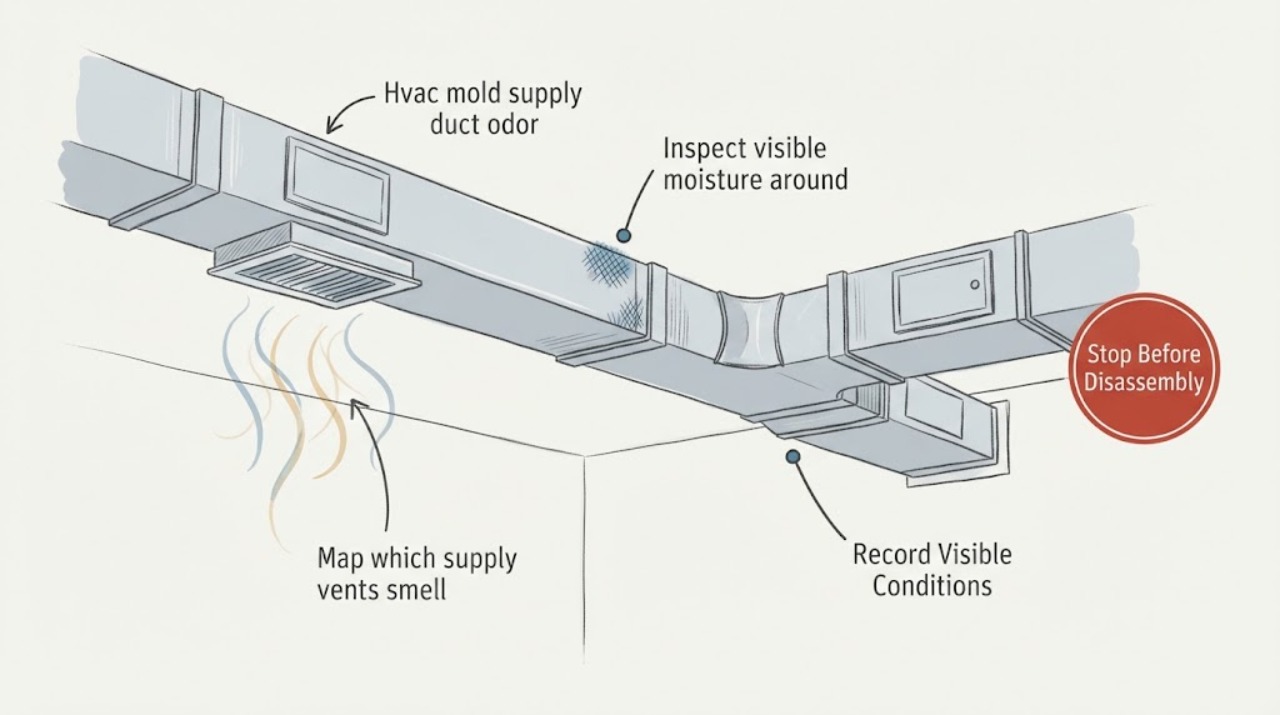
A musty smell from one or more supply vents can reflect moisture or contamination in a supply duct, the air-handler components feeding it, or nearby building materials. Map which vents smell and when the fan runs, inspect only visible grilles and surrounding surfaces, and arrange qualified HVAC/mold assessment when the odor repeats, moisture is present, growth is visible, or the system may be distributing material. Do not open ducts, scrape growth, remove insulation, spray chemicals, or perform refrigerant work.
Work through in order
Diagnostic checks
Use only checks that match the exact appliance or system and its official guide.
-
Map which supply vents smell
With the system safely in its normal state, note which supply grilles produce the odor, whether a nearby return or room smells the same, and whether the smell appears with the fan, cooling cycle, or system off. Do not remove a grille or put your face into the airflow.
Expected result: Record one vent, several vents on one branch, all supply vents, or a room that smells even when airflow is off. Note whether visible dust or moisture is present at the grille.
Next step: Photograph the grille and surrounding finish, mark the vent on a simple floor plan, and use the pattern in the service request.
Stop if: Stop and leave the area if material is blowing out, the odor is overwhelming, or occupants develop wheezing, shortness of breath, or other severe symptoms.
Why this matters
Why: One localized register points to a branch, nearby material, or local moisture possibility; many supply vents or a fan-linked pattern raises concern about an upstream HVAC source. The pattern cannot confirm mold or identify the material.
-
Inspect visible moisture around the supply path
From outside the duct and without removing panels, look at the grille, ceiling or wall around it, nearby insulation surface, and accessible condensate discharge area for staining, droplets, peeling finish, condensation, or dampness. Do not open a ceiling, wall, air handler, or duct chase.
Expected result: Record a dry area, a water stain, active moisture, condensation, a soft or damaged finish, or wet insulation near the supply branch.
Next step: Photograph the condition, keep the area undisturbed, and request HVAC and building-moisture inspection. Do not dry, cut, or remove contaminated material yourself.
Stop if: Stop for active leaks, sagging ceiling material, exposed wiring, wet internal insulation, or any need to open a concealed area.
Why this matters
Why: EPA identifies moisture and condensation as important indicators of potential biological growth and says standing water near cooling coils or wet insulation requires attention. A wet wall or ceiling can be the odor source even if the duct is clean.
-
Record filter and air-handler clues only when already visible
If the filter is accessible without opening the equipment, record its fit, visible dampness, heavy loading, or damage and photograph the label. From outside the closed cabinet, note any visible moisture or odor near the unit. Do not handle a wet or visibly contaminated filter or enter the cabinet.
Expected result: The filter may be dry and seated, clogged, wet, damaged, or visibly contaminated; the cabinet area may be dry or show moisture marks.
Next step: Provide the filter and unit observations to the service provider. If the filter is wet or visibly contaminated, avoid running the system until qualified guidance is given.
Stop if: Stop handling or inspecting if access requires removing a panel, reaching into the equipment, or contacting suspected contaminated material.
Why this matters
Why: EPA recommends keeping filters dry and properly installed, but a filter condition does not prove the supply duct is the source. Moisture at the unit can support contamination upstream of several supply branches.
-
Log humidity, condensation, and operating conditions
Use a humidity meter in occupied rooms and near the supply vent only from safe locations. Record readings, condensation on nearby surfaces, recent leaks or flooding, the thermostat mode, and whether odor intensity changes after the system has been off. An air-quality monitor may show trends but cannot diagnose mold.
Expected result: Note elevated humidity, repeated condensation, a recent water event, a dry environment, or an odor that reliably follows fan operation.
Next step: Send the dated log to the provider and ask that the supply branch, air handler, coils, drain pan, filter, and surrounding building materials be considered together.
Stop if: Do not enter an attic, crawlspace, or equipment enclosure to take readings or follow the duct.
Why this matters
Why: EPA and CDC identify moisture as the condition that supports mold growth and recommend correcting the moisture source. A fan-linked odor can distribute a source from upstream, but humidity and timing remain clues rather than a diagnosis.
-
Prepare a complete professional handoff
Compile the vent map, odor description, operating pattern, moisture photographs, filter condition, humidity log, recent water events, and occupant concerns. Ask the provider to identify the moisture source and show evidence for any claimed contamination before proposing cleaning or treatment.
Expected result: The record should show a localized supply-vent clue, a multi-vent distribution pattern, visible moisture or damage, or a persistent odor with no visible source.
Next step: Request prompt HVAC/mold inspection for a repeated odor, visible growth, standing water, wet insulation, or a fan-linked odor affecting multiple rooms. Keep the equipment closed and do not attempt duct cleaning.
Stop if: Do not cut ducts, remove insulation, scrape growth, use chemical treatments, or perform refrigerant work.
Why this matters
Why: EPA says all components of a contaminated HVAC system should be considered because leaving one untreated can permit re-contamination. Wet porous insulation may need replacement, and duct treatments have important limitations.
Use your observations
Decision map
Find the observation that best matches what you see, then follow the next safe action.
-
PATH 01Safety boundary
What you see
Several supply vents or the whole supply network carries the odor when the fan runs.
Do this next
Treat it as a possible upstream HVAC distribution problem and request inspection of the air handler, coil, pan, filter, cabinet, and accessible ductwork.
Why this path and its safety boundary
Safety stop: Do not operate the system if it blows visible debris or occupants develop serious respiratory symptoms.
-
PATH 02Safety boundary
What you see
Only one supply vent smells and nearby wall or ceiling material is damp, stained, or damaged.
Do this next
Request inspection of the local branch and surrounding building materials; document the exact register and moisture boundary.
Why this path and its safety boundary
Safety stop: Do not remove the grille, cut the ceiling, or assume the duct is the source.
-
PATH 03Safety boundary
What you see
Growth or wet porous insulation is visible from an existing opening or at the unit exterior.
Do this next
Keep the system closed and arrange qualified assessment of the affected HVAC components and materials.
Why this path and its safety boundary
Safety stop: No scraping, vacuuming, spraying, cutting, or material removal is included.
-
PATH 04Safety boundary
What you see
The odor repeats with airflow but no moisture or growth is visible without opening anything.
Do this next
Keep a dated operating and humidity log and request professional inspection rather than masking the smell or ordering routine duct cleaning.
Why this path and its safety boundary
Safety stop: Do not infer that the duct is clean because the odor temporarily stops.
Helpful context
Understand the symptom
Supply ducts deliver conditioned air, so an odor from a supply register is a distribution clue rather than proof that the duct itself is the source. EPA notes that moisture in ducts and near cooling coils can support biological growth, and that a contaminated system can distribute material through a home. A musty odor can also come from damp framing, carpet, a wall cavity, or a drain area near the register.
Keep the investigation observation-only. Do not remove a register, open an air handler, insert a camera or hand into a duct, cut duct liner, scrape suspected growth, use a fogger or biocide, or clean rodent or mold material. The useful homeowner contribution is a careful map of timing, locations, moisture, and visible conditions for a qualified provider.
Start with the vent pattern
If the smell is strong, debris is blowing out, or anyone has serious breathing symptoms, leave the affected area and arrange prompt help. Otherwise, keep grilles in place, avoid disturbing dust, and record the pattern before changing filters or operating modes.
Moisture correction comes before odor masking. EPA recommends attention to drain pans, cooling coils, filters, condensation, wet insulation, and the complete HVAC system when contamination is suspected.
Only after diagnosis
Potential parts
- air-quality-monitor
For trend logging only; readings cannot identify mold or replace a qualified HVAC and building inspection.
- humidity-meter
To document room humidity and condensation from safe occupied locations.
- HVAC-filter
Only when the system documentation confirms the fit and it can be accessed safely; a filter does not correct a wet duct or drain-pan problem.
When checks do not resolve it
Need a professional?
Request prompt HVAC mold inspection for a persistent or fan-linked supply-vent odor, multiple affected vents, visible growth, standing water, wet insulation, filter contamination, water damage, or blowing debris. Leave the area and seek appropriate medical help for severe breathing symptoms.
Common questions
FAQ
Does a musty supply-vent odor prove mold is inside the duct?
No. It can come from a supply branch, air-handler component, damp insulation, a wall or ceiling, or another nearby source. Map the pattern and have a qualified provider inspect the moisture source and connected components.
Should I remove the supply register to look inside?
No. Keep the register in place for this observation-only guide. Removing it can disturb material or expose a concealed condition; photograph the grille and request professional inspection instead.
Will changing the filter remove the supply-duct odor?
Not necessarily. A filter should be dry, correctly fitted, and maintained, but an odor from wet insulation, a coil, drain pan, cabinet, branch, or surrounding building material needs a source inspection.
Is spraying a duct deodorizer or mold product safe?
Do not spray, fog, or apply chemical treatments inside the duct or air handler. EPA cautions that chemical duct treatments have uncertain benefits and can distribute material through the system.
When should I call for HVAC mold inspection?
Arrange prompt service for a repeated or fan-linked odor, multiple affected supply vents, standing water, visible growth, wet insulation, water damage, blowing debris, or occupants with significant symptoms. Provide the vent map, timing, moisture observations, filter condition, and photographs.
Read the exact guide
Official sources
- Mold Course Chapter 9U.S. Environmental Protection Agency · Use for HVAC contamination pathways, drain and condensate pans, filters, odor investigation, and moisture control.
- Should You Have the Air Ducts in Your Home Cleaned?U.S. Environmental Protection Agency · Use for whole-system inspection, moisture near coils and pans, wet insulation, filter maintenance, and chemical-treatment cautions.
- MoldCenters for Disease Control and Prevention · Use for HVAC as a pathway, moisture correction, and health-symptom precautions.
- Indoor Air Quality Problem Solving ToolU.S. Environmental Protection Agency · Use for observation prompts covering air-handler moisture, drain pans, filters, odor, condensation, and humidity.
Community feedback
Share a repair observation
Share a plain-text repair observation. Accepted observations are published automatically; this page may take a moment to update.