
On this page
Start here
Quick answer
A musty odor that appears when heating or cooling starts suggests a moisture or contamination problem somewhere in the HVAC airflow path, but smell alone cannot identify the location or prove what the material is. Note when the odor starts, which rooms and vents are affected, indoor humidity, the visible filter condition, and any accessible moisture or condensation. Do not open the air handler or ducts, sample or disturb suspected mold, spray chemicals, work on refrigerant or wiring, or keep operating a system that a professional has identified as contaminated. Arrange an HVAC and mold/moisture assessment when the odor is persistent, localized to the system, accompanied by water, or associated with occupant symptoms.
Before you begin
Safety first
- Do not open ducts or the air handler, remove grilles, sample or disturb suspected mold, scrape or vacuum growth, mix or spray chemicals, fog the system, work on refrigerant or electrical parts, or enter an attic, crawlspace, or other unsafe area.
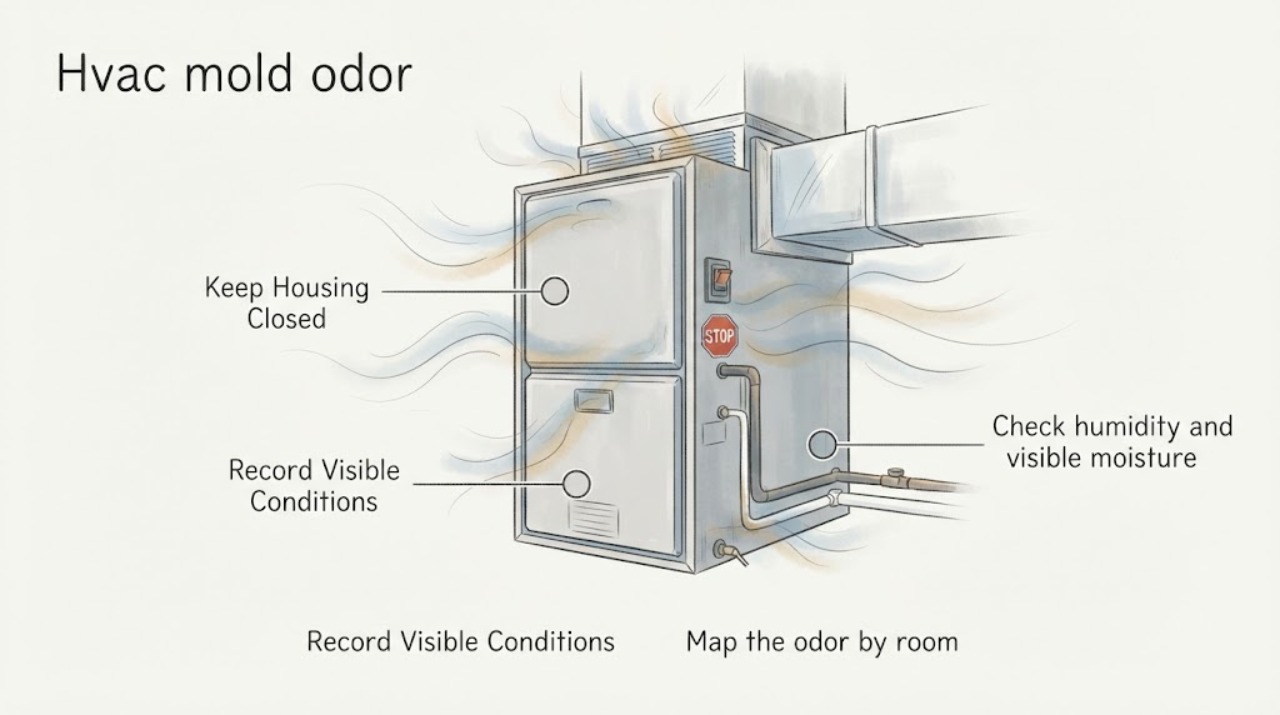
Work through in order
Diagnostic checks
Use only checks that match the exact appliance or system and its official guide.
-
Record when the odor appears
From a normal safe position, compare the odor timing with the HVAC operation: note whether it starts at startup, continues while air is moving, appears after shutdown, or is present even when the system is off. Record the mode if known and the date or recent weather or moisture event without repeatedly cycling the equipment.
Expected result: The smell is limited to airflow, follows a particular mode or startup, follows a recent leak or prolonged damp period, or remains in the room when the system is off.
Next step: Give the timing pattern to the HVAC or mold/moisture professional and avoid unnecessary operation if the odor is strong or worsening.
Stop if: Stop operating the system and seek professional guidance if the smell is strong, smoke-like, chemically irritating, or accompanied by visible water or breathing difficulty.
Why this matters
Why: An airflow-linked pattern makes an HVAC or nearby return/supply path worth assessing, while an always-present smell keeps wet building materials or another room source in the differential. Timing alone cannot locate mold.
-
Map the odor by room and vent
Walk only on clear, dry floors and note which supply registers, return grilles, rooms, closets, or nearby walls have the strongest odor; compare an affected room with an unaffected room without removing a grille or reaching into a duct.
Expected result: The odor is strongest at one register or return, across several rooms on the same system, near the equipment area, or away from all vents.
Next step: Photograph only visible, non-sensitive conditions and provide the room map to the professional so the inspection can start at the strongest pattern.
Stop if: Stop if locating the source would require removing a register, opening a ceiling or wall, entering an unsafe space, or disturbing dust or suspected growth.
Why this matters
Why: A single-room pattern may involve a local vent, nearby damp material, or a branch path; a whole-system pattern raises the priority of an HVAC assessment; an off-vent pattern makes a non-HVAC moisture source more plausible. These are routing clues, not a diagnosis.
-
Check humidity and visible moisture
Read indoor relative humidity with a room humidity meter if one is already available, and look from a safe position for condensation, damp surfaces, water staining, or standing water around accessible equipment and nearby walls or ceilings. Do not open the air handler or touch a condensate pan or drain line.
Expected result: Humidity is persistently high, condensation or dampness is visible, standing water or debris is present near equipment, or the accessible area is dry and the moisture source is not apparent.
Next step: Document the location and timing of water or condensation, protect people from slips, and request HVAC and moisture-source assessment rather than attempting drainage or cleanup inside the system.
Stop if: Stop immediately if water is near electrical equipment, ceiling materials are sagging, a leak is active, or access would require climbing or opening equipment.
Why this matters
Why: Persistent high humidity or visible water supports a moisture investigation; standing water near cooling equipment needs prompt professional attention. A dry visible area does not rule out concealed moisture or a duct problem.
-
Observe the accessible filter without opening equipment
If the filter is normally user-accessible and can be seen without removing a cover or entering the air handler, note whether it is dry, visibly loaded with dust, wet, damaged, missing, or seated with an obvious gap; otherwise leave it untouched.
Expected result: The filter is dry and seated, heavily loaded, wet or visibly affected, missing, or not safely reachable.
Next step: Record the filter size or identifying label only if it is plainly visible, then ask the professional to assess the filter fit, airflow, coil, drain-pan, and surrounding moisture conditions. Do not wash, spray, brush, or alter a suspect filter as a mold treatment.
Stop if: Stop if the filter is wet or visibly contaminated, the cover resists normal access, dust is being released, or the inspection would expose moving, electrical, or refrigerant components.
Why this matters
Why: A wet, damaged, or missing filter is a useful maintenance clue and may accompany a moisture or airflow problem; a dry filter does not clear hidden coils, pans, ducts, or surrounding materials. A filter appearance cannot confirm mold.
-
Record occupant and exposure context without diagnosing
Note whether anyone notices nasal irritation, coughing, wheezing, eye irritation, headache, or other discomfort during or after operation, and record the room, timing, duration, and whether symptoms improve away from the space; do not label the cause or perform health testing.
Expected result: No occupant symptoms are reported, symptoms correlate with the odor or a room, or someone has severe breathing difficulty or a known vulnerability to damp environments.
Next step: Move people away from the affected area when practical, tell the professional about the exposure pattern, and seek appropriate medical care for urgent symptoms; do not resume a suspected contaminated system just to reproduce the odor.
Stop if: Stop the DIY investigation for any severe breathing difficulty, rapidly worsening symptoms, or unsafe exposure condition and obtain urgent professional help.
Why this matters
Why: Occupant reports increase the urgency of reducing exposure and arranging an assessment, but they do not prove that HVAC mold caused a symptom. Severe breathing difficulty is an urgent health situation rather than a home troubleshooting step.
Use your observations
Decision map
Find the observation that best matches what you see, then follow the next safe action.
-
PATH 01Safety boundary
What you see
The odor is brief at startup, there is no visible moisture, humidity is controlled, and no occupant symptoms or worsening pattern are present.
Do this next
Record the pattern, verify that the visible filter is dry and correctly seated if it is safely accessible, and arrange routine HVAC maintenance if the smell returns.
Why this path and its safety boundary
Safety stop: Escalate if the odor becomes persistent, stronger, or linked with water or symptoms.
-
PATH 02Safety boundary
What you see
The odor is strongest at one room or vent while the rest of the home is unaffected.
Do this next
Request an inspection of that branch, register, return, and nearby building materials; do not remove the grille or open the wall yourself.
Why this path and its safety boundary
Safety stop: Stop if the suspected source is concealed, dusty, damp, or requires demolition or duct access.
-
PATH 03Safety boundary
What you see
The odor appears throughout the system, coincides with cooling, or is paired with high humidity, condensation, standing water, or a wet filter.
Do this next
Turn the system off if doing so is safe and arrange prompt HVAC and moisture assessment; protect occupants from the affected area and any slip hazard.
Why this path and its safety boundary
Safety stop: Do not run the system to test it, drain a pan, clear a line, open the air handler, or apply chemicals.
-
PATH 04Safety boundary
What you see
Visible suspected growth, wet or moldy insulation, or a hidden source is suspected inside ducts or the air handler.
Do this next
Request qualified HVAC and mold/moisture professionals to inspect and document the condition before any cleaning or remediation plan.
Why this path and its safety boundary
Safety stop: Do not sample, scrape, disturb, fog, seal over, or remove the material yourself.
-
PATH 05Safety boundary
What you see
An occupant has severe breathing difficulty, rapidly worsening symptoms, or a condition that makes damp or moldy exposure especially concerning.
Do this next
Leave the affected area and obtain urgent medical help as appropriate; separately arrange professional building and HVAC assessment.
Why this path and its safety boundary
Safety stop: Stop all odor testing and system cycling until the immediate safety concern is handled.
Helpful context
Understand the symptom
Why an HVAC odor needs an investigation
A musty smell can be carried from a damp return, filter area, cooling coil or condensate area, duct section, or another wet building material into the supply air. The same smell can also be strongest near a room, wall, ceiling, or return that is not the HVAC source. Treat the odor as a clue about moisture or contamination, not as a reliable way to identify a species or hidden location.
Stay on the observation side of the boundary
Use only normal, safe access. You may record a visible filter label or a visible puddle near equipment without opening a panel or touching system components. Do not brush, scrape, vacuum, drill, cut, fog, bleach, add a biocide, take a mold sample, or enter a crawlspace or attic to chase the smell. A qualified professional should inspect concealed HVAC components, duct interiors, condensate equipment, and suspected mold.
Only after diagnosis
Potential parts
- air-quality-monitor
Consider this category only if a professional recommends monitoring a broader indoor-air concern after the odor and moisture pattern is documented; it cannot identify mold or replace an inspection.
Choose measurement capabilities for the actual question and treat readings as context, not proof of contamination or a health conclusion. - humidity-meter
Consider this category only to document indoor humidity while investigating a musty odor or condensation pattern.
Use the meter according to its instructions and compare readings from relevant rooms; a reading does not locate hidden moisture or mold. - HVAC-filter
Consider this category only if the existing filter is safely accessible, visibly damaged or loaded, and the HVAC manufacturer or technician confirms replacement is appropriate.
Match the existing system's size, orientation, and manufacturer-recommended filter characteristics; do not use a filter change as mold remediation.
When checks do not resolve it
Need a professional?
Request prompt professional help when the odor is persistent or system-linked, a wet filter or standing water is visible, humidity or condensation remains high, suspected growth is inside HVAC components, or occupants report symptoms.
Safety scope: Do not open ducts or the air handler, remove grilles, sample or disturb suspected mold, scrape or vacuum growth, mix or spray chemicals, fog the system, work on refrigerant or electrical parts, or enter an attic, crawlspace, or other unsafe area.
Have this ready
- Provide the odor timing, affected rooms and vents, HVAC mode if known, recent water events, humidity readings, visible moisture or filter observations, occupant exposure reports, and photographs taken only from safe accessible areas.
Common questions
FAQ
Does a musty smell prove that mold is inside the HVAC system?
No. The odor is a useful reason to investigate moisture or contamination, but it can come from HVAC components, nearby building materials, or another room source. Smell alone cannot identify the material or its location.
Can I open the air handler or duct to look for mold?
No. Keep the check to visible, normal-access observations. Do not remove panels or grilles, enter unsafe spaces, sample, scrape, brush, vacuum, or disturb suspected growth; have qualified professionals inspect concealed components.
What does a wet filter or water near the HVAC equipment mean?
It is a moisture or maintenance clue that should be documented and assessed. A wet filter or standing water does not identify the root cause, so do not clear a drain, open the equipment, or apply chemicals yourself.
Should I buy an air-quality monitor to confirm mold?
A monitor may provide context if a professional recommends it, but it cannot confirm or locate mold and should not delay moisture or HVAC assessment.
What if someone feels ill when the system runs?
Record the timing without claiming the HVAC caused it, move away from the affected area when practical, and seek appropriate medical care for urgent or severe symptoms. Arrange professional building and HVAC assessment separately.
Read the exact guide
Official sources
- What does mold smell like?U.S. Environmental Protection Agency · Supports treating a musty odor as a clue that warrants investigation, without using odor alone to identify the source or species.
- Should You Have the Air Ducts in Your Home Cleaned?U.S. Environmental Protection Agency · Supports professional assessment of HVAC components and moisture, and the boundary against routine or chemical duct treatment.
- MoldCenters for Disease Control and Prevention · Supports recording occupant observations without diagnosing and keeping indoor humidity controlled as part of moisture prevention.
- A Brief Guide to Mold, Moisture and Your HomeU.S. Environmental Protection Agency · Supports observing condensation and humidity while avoiding disturbance of hidden mold sites.
Community feedback
Share a repair observation
Share a plain-text repair observation. Accepted observations are published automatically; this page may take a moment to update.