
On this page
Start here
Quick answer
An odor that appears when HVAC starts or runs is a timing clue, not proof that the HVAC system contains mold. First record whether the smell occurs only during a call for heating or cooling, whether it starts at one supply vent or reaches several rooms, and whether it fades after the system stops. From a stable, dry position, check only the user-accessible filter and visible return or supply areas for a wet or heavily loaded filter, condensation, or staining. Also compare the room with the HVAC off so a drain, cabinet, bathroom, crawlspace, or other non-HVAC source is not missed. Do not open the air handler or ductwork, spray chemicals, sample suspected growth, touch condensate or waste, alter refrigerant or electrical parts, or keep circulating air when contamination is known or strongly suspected. Arrange professional HVAC or mold assessment for recurring odor, visible growth, wet insulation, standing condensate, or a smell that spreads through multiple rooms.
Before you begin
Safety first
- This article is limited to stable, external observation. Do not open the air handler or ductwork, spray chemicals, sample or disturb suspected growth, touch waste or condensate, enter concealed spaces, or perform refrigerant or electrical work.
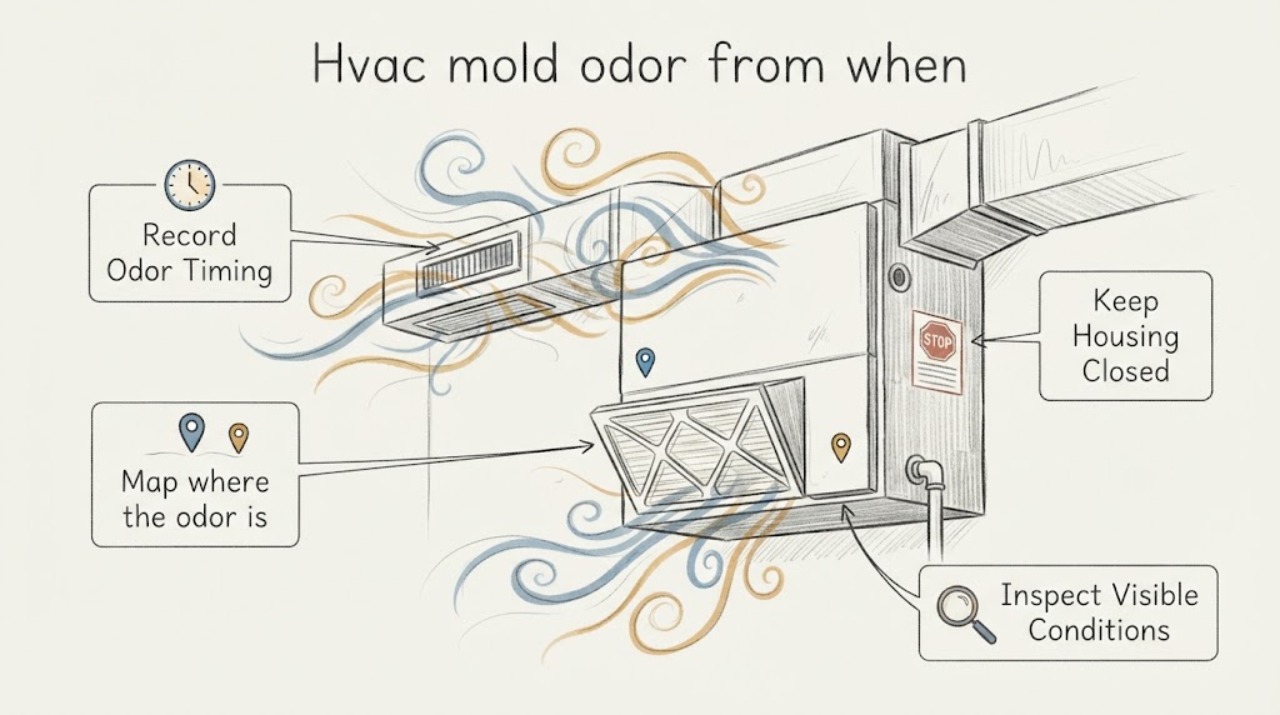
Work through in order
Diagnostic checks
Use only checks that match the exact appliance or system and its official guide.
-
Check 1
From a stable position, note the odor timing against the HVAC cycle without putting your face into a vent or repeatedly cycling the system. Record whether it starts at startup, after the system has run, only during heating or cooling, or after shutdown.
Expected result: Describe whether the odor is only-on-cycle, present with the HVAC off, strongest at startup, stronger after longer operation, or intermittent. Note whether the system is heating, cooling, or only moving air when the smell appears.
Next step: Write the start and stop sequence and avoid creating extra cycles. If the odor is strong, worsening, or accompanied by smoke, gas, water, or symptoms, stop operation and seek qualified or emergency help.
Stop if: Stop if observation requires opening a grille or unit, touching wet material or waste, entering a crawlspace, using chemicals, or approaching electrical, combustion, or refrigerant components.
Why this matters
Why: Only-on-cycle timing makes the air path, coil or drain area, filter, or nearby HVAC surface worth professional inspection, but it does not prove mold. An odor that remains with the HVAC off keeps non-HVAC sources such as a drain, cabinet, bathroom, crawlspace, or damp building material in the decision.
-
Check 2
Map where the odor is noticed without dismantling registers or duct covers. Compare the first affected supply vent, nearby return grille, and other rooms while the system remains in its ordinary safe state.
Expected result: Record whether one vent or room is affected, several rooms on one level share the odor, or the smell travels throughout the served area. Note visible dust, staining, condensation, or dampness only from outside the grille.
Next step: Photograph each accessible location and give the map to the HVAC or mold professional. Do not remove grilles, insert a camera, brush, vacuum, or sampling device, or spray into the opening.
Stop if: Stop if there is visible growth inside the opening, wet insulation, standing water, sewage, animal waste, or an unsafe ladder or ceiling-access requirement.
Why this matters
Why: A single-room pattern can justify checking a local grille, branch, nearby plumbing, or building moisture source; a multi-room pattern raises the scope to a shared return, air handler, duct system, or whole-building source. Distribution is a location clue, not a mold identification.
-
Check 3
After the HVAC is off and the filter area is safe and user-accessible, inspect the filter and its seating without opening the air handler. Look at visible return and supply surfaces, and if an exterior condensate drain termination is normally visible, note whether it is wet, overflowing, or stained.
Expected result: Record a filter that is wet, visibly loaded, damaged, missing, or not seated; condensation or water staining near the accessible cabinet; and any drain overflow or blockage visible from the normal exterior point. Do not touch suspected growth or pooled water.
Next step: Keep the filter and observations unchanged for documentation unless the owner's manual permits a simple user filter replacement. Request professional inspection for recurring odor, wet materials, drain overflow, or any inaccessible condition.
Stop if: Stop for pooled water, sewage, exposed wiring, hot surfaces, combustion odor, visible growth, or any need to open the cabinet, touch condensate, or reach behind the filter.
Why this matters
Why: A wet filter, condensation, or drain clue supports a moisture-control and HVAC service path. A clean, dry filter does not clear coils, pans, internal insulation, or concealed ducts, and cannot rule out a non-HVAC moisture source.
-
Check 4
Compare the odor with the HVAC off and with other nearby non-HVAC sources, using ordinary room observation only. Do not mask the smell with fragrance, bleach, ozone, or another chemical and do not run the system longer to intensify the test.
Expected result: If the odor disappears when the HVAC is off and returns from the same air path, report an HVAC-linked pattern. If it remains in the room with the HVAC off, moves independently of airflow, or is strongest near a drain, cabinet, wall, or crawlspace, report a possible non-HVAC source as well.
Next step: Provide the timing, room map, filter and moisture observations, and suspected non-HVAC locations to the service provider. Avoid further operation if contamination or a health or safety concern is suspected.
Stop if: Stop if occupants develop symptoms, the odor is accompanied by gas or burning smell, or the comparison would require access to concealed or contaminated areas.
Why this matters
Why: The off-versus-running comparison changes the inspection scope but cannot identify mold or its species. A running-only pattern can still be caused by a nearby source being disturbed by airflow, while an off-cycle odor can coexist with HVAC contamination.
-
Check 5
Prepare a professional handoff with the HVAC type and model if readable, heating or cooling mode, odor timing, first and widest affected locations, filter and drain observations, and any visible moisture or growth. Do not open equipment or ducts to improve the handoff.
Expected result: State whether the symptom is only-on-cycle, multi-room, recurring after cleaning, linked to cooling or condensation, or present with the HVAC off. Include what was not touched or opened and whether anyone reports respiratory or other symptoms.
Next step: Arrange qualified HVAC and, when indicated, mold or moisture assessment. Ask the provider to identify the visible evidence, source of moisture, affected components, and safe treatment boundary before any chemical or cleaning proposal.
Stop if: Stop the user path if anyone proposes opening the unit or duct, spraying an unverified chemical, handling suspected contamination without protection, or performing refrigerant or electrical work.
Why this matters
Why: This record lets the provider separate HVAC inspection, moisture-source correction, duct evaluation, and building remediation instead of treating every musty odor as a duct-cleaning job. Known or suspected contamination may require the system to remain off until assessed.
Use your observations
Decision map
Find the observation that best matches what you see, then follow the next safe action.
-
PATH 01Next step
What you see
The odor appears only while the HVAC runs or returns from the same supply path, but no visible moisture or growth is safely accessible.
Do this next
Request a qualified HVAC inspection of the filter, return, coils, drain pan, blower area, and accessible duct surfaces. Do not conclude that mold is present from timing or smell alone.
-
PATH 02Next step
What you see
One vent or room is affected while the rest of the home is not.
Do this next
Document the exact grille and nearby wall, ceiling, plumbing, cabinet, or crawlspace conditions for a local branch or building-moisture assessment. Do not remove the grille or probe the duct.
-
PATH 03Next step
What you see
Several rooms or the whole served area develop the odor during operation.
Do this next
Treat the scope as a shared return, air handler, duct, or building-source investigation. Keep the system off if contamination is known or strongly suspected and arrange professional evaluation.
-
PATH 04Next step
What you see
The accessible filter is wet or loaded, condensation or drain overflow is visible, or moisture staining is present near the unit.
Do this next
Request HVAC moisture-source service and mold assessment as needed. A filter replacement alone is not a fix for a leaking drain, wet insulation, coil, pan, or concealed moisture source.
-
PATH 05Next step
What you see
The odor remains with the HVAC off or is strongest near a drain, cabinet, wall, crawlspace, plumbing route, or other non-HVAC location.
Do this next
Keep the non-HVAC source in the inspection scope while reporting the cycle timing. Do not let an HVAC odor label replace building-moisture or plumbing assessment.
-
PATH 06Next step
What you see
There is visible growth inside a system component, wet or moldy internal insulation, standing water, contaminated water, smoke, gas odor, or electrical danger.
Do this next
Stop operation and keep people away as appropriate. Arrange qualified HVAC and mold or water-damage service, with emergency help for active fire, gas, or electrical danger.
Helpful context
Understand the symptom
Running-related timing narrows the question
The useful distinction is when the odor begins and where it travels, not whether it smells like mold. An odor limited to the first minutes of a cycle can have a different path from an odor that grows stronger throughout operation or remains after shutdown. One affected register can point toward a local grille, branch, or nearby moisture source; several rooms suggest a shared return, air handler, or broader building source. These observations do not confirm mold or a failed HVAC part.
Check moisture and filtration without opening the system
EPA guidance identifies condensation, cooling coils, condensate pans, wet insulation, and contaminated system components as reasons for professional evaluation. A user may document a visible filter, accessible grille, drain termination, or staining from a safe position, but should not open concealed assemblies or disturb suspected growth. A filter or portable air cleaner may affect particles or odor temporarily, but it does not remove a moisture source or prove that the HVAC system is contaminated.
When to stop circulating air
If there is visible growth inside an HVAC component, wet or moldy internal insulation, standing water, sewage or other contamination, smoke, a gas concern, or an electrical hazard, stop the HVAC operation if it can be done without approaching the hazard and arrange qualified help. Do not spray biocide, fragrance, bleach, or another chemical into a vent or duct, and do not perform refrigerant or electrical work.
Safety boundary
Stop conditions
- Stop HVAC operation when contamination is known or strongly suspected, or when smoke, gas odor, electrical danger, standing water, or occupant symptoms are present.
- Do not open the air handler or ductwork, remove grilles, probe or sample suspected growth, or enter concealed or unstable spaces.
- Do not spray bleach, fragrance, biocide, sealant, ozone, or another chemical into the HVAC system, and do not perform refrigerant or electrical work.
- Use qualified HVAC, mold, moisture, plumbing, or emergency professionals according to the observed source and hazard.
Only after diagnosis
Potential parts
- air-quality-monitor
A monitor may document changes in a room, but it cannot confirm mold, locate a moisture source, or clear contaminated HVAC components.
Use only as supplemental observation; do not treat a reading as a diagnosis or substitute for professional HVAC and moisture assessment. - humidity-meter
Humidity readings can support a moisture investigation when the odor follows HVAC operation, but they do not identify mold or prove that a duct is contaminated.
Use in accessible occupied areas only and interpret with temperature, condensation, filter, drain, and building-source observations. - HVAC-filter
A replacement filter is relevant only when the existing filter is loaded, wet, damaged, or missing and the owner manual confirms the correct type and size.
Match the complete system specification and airflow requirement; a filter cannot correct a moisture source, hidden growth, blocked drain, or contaminated duct.
When checks do not resolve it
Need a professional?
Call a qualified HVAC or mold-remediation professional when the odor recurs, spreads to multiple rooms, returns with each cycle, follows condensation, or is accompanied by visible growth, wet insulation, standing water, or health concerns. Stop the HVAC and seek emergency help for smoke, gas odor, or electrical danger.
Safety scope: This article is limited to stable, external observation. Do not open the air handler or ductwork, spray chemicals, sample or disturb suspected growth, touch waste or condensate, enter concealed spaces, or perform refrigerant or electrical work.
Have this ready
- HVAC type and model if readable without opening equipment
- Whether the odor is only-on-cycle, startup-only, cooling-related, persistent after shutdown, or present with the HVAC off
- First affected vent or room and whether the odor reaches multiple rooms
- Filter condition, visible condensation or staining, drain observations, and nearby non-HVAC sources
- Photos from safe positions, recurrence history, occupant symptoms, and what was not touched or opened
Common questions
FAQ
Does an odor that appears when the HVAC runs prove mold in the system?
No. Running-related timing is a useful clue, but a nearby drain, damp building material, filter, condensate problem, or other source can be carried or disturbed by airflow. Professional inspection is needed to confirm contamination.
What does it mean if only one supply vent smells?
A single-room pattern keeps a local grille, branch, nearby moisture source, or room-specific source in the decision. It does not prove that the duct contains mold, and the grille or duct should not be opened for a home test.
Can I spray bleach, fragrance, or duct treatment into the vent?
No. Do not spray chemicals or mask the odor. EPA notes that chemical biocides and sealants in ducts require careful evaluation; first identify moisture, contamination, access, and the appropriate professional method.
Should I keep running the HVAC to see whether the smell gets stronger?
No. Record the existing timing and stop operation when contamination is known or strongly suspected, or when moisture, smoke, gas, electrical danger, or occupant symptoms are present. Do not create repeated cycles as a test.
Can a new filter or air cleaner solve the odor?
A correctly specified filter may affect airborne particles, but it cannot fix a water source, drain problem, wet insulation, or contaminated HVAC component. Treat it as a conditional maintenance item, not a mold diagnosis or remediation.
Read the exact guide
Official sources
- A Brief Guide to Mold, Moisture and Your HomeU.S. Environmental Protection Agency · Government mold guidance used for the stop-circulation boundary and separation of moisture-source correction from odor description.
- Should You Have the Air Ducts in Your Home Cleaned?U.S. Environmental Protection Agency · Government guidance used to distinguish odor timing from confirmed contamination and to set boundaries for internal duct inspection, moisture correction, and chemical treatment.
- Guide to Air Cleaners in the HomeU.S. Environmental Protection Agency · Government filter guidance used to keep filters and air cleaners conditional and separate from mold or moisture remediation.
Community feedback
Share a repair observation
Share a plain-text repair observation. Accepted observations are published automatically; this page may take a moment to update.