
On this page
Start here
Quick answer
Do not run an air handler that you know or reasonably suspect is contaminated with mold, because airflow can distribute particles through the served space. From a safe location, document only what is already visible on the exterior, around accessible condensate or drain areas, at nearby supply or return grilles, and in the owner-facing thermostat or control display. Do not open the cabinet, scrape or spray growth, remove contaminated material, perform a live electrical check, handle refrigerant, or repeatedly cycle the system. Use the normal off control only if it is safely accessible without opening equipment; otherwise keep people away and call an HVAC professional experienced with mold remediation. If there is active water, contact with electrical equipment, strong airborne odor, or breathing trouble, stop observing and seek urgent professional or medical help as appropriate.
Before you begin
Safety first
- The professional must handle cabinet access, mold assessment and containment, electrical and refrigerant work, drain and coil inspection, material removal or replacement, and return-to-service decisions. The reader should not run a suspected contaminated system, scrape, spray, vacuum, sample, open panels, disturb insulation, perform live tests, or enter a restricted space.
Work through in order
Diagnostic checks
Use only checks that match the exact appliance or system and its official guide.
-
Check 1
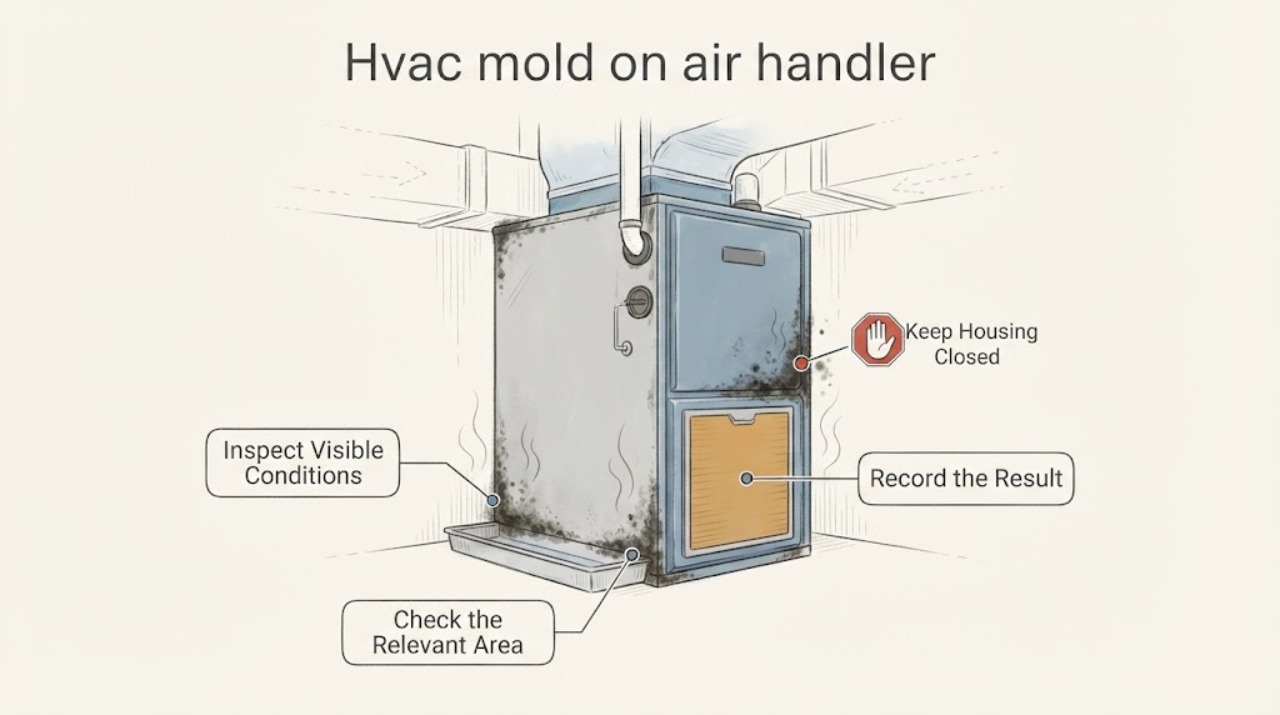
From a stable, safe position, inspect only the outside surfaces and already-visible seams, grilles, drain outlet area, and surrounding floor or platform of the air handler without opening, touching, scraping, or moving equipment.
Expected result: Record visible dark or fuzzy growth, staining, wet insulation, dripping or standing water, rust, damaged panels, or no visible abnormality; note the location and whether the change appears to be spreading.
Next step: Take photographs from the safe position and give the location and timeline to an HVAC professional experienced with mold-related work; do not disturb the suspected material.
Stop if: Stop immediately for active leaking onto electrical equipment, exposed wiring, smoke, burning odor, structural instability, or any breathing difficulty, and request urgent professional or emergency help as appropriate.
Why this matters
Why: Visible growth or moisture supports a prompt professional assessment, but an apparently clean exterior does not rule out contamination inside a cabinet, pan, coil section, liner, or connected duct.
-
Check 2
Without opening the air handler or handling a drain, look from a safe distance for visible water, a blocked-looking or overflowing drain outlet, condensation on nearby surfaces, damp flooring, recent flooding, or a history of repeated wetness.
Expected result: Note whether water is present now, whether the area is merely stained and dry, whether moisture follows cooling operation or weather, and whether the source is unknown; do not probe, flush, pour chemicals, or force a valve.
Next step: Report the moisture pattern and timing to the HVAC professional and ask them to assess the drain, condensate management, insulation, and other possible moisture sources as part of the remediation plan.
Stop if: Stop and keep people away if water is contacting electrical equipment, the floor is unsafe, the leak is increasing, or the source cannot be observed without opening equipment or entering a restricted space.
Why this matters
Why: A continuing moisture source can allow mold to return after cleaning, while a dry appearance does not prove that hidden insulation or the condensate pan is unaffected.
-
Check 3
From the normal occupied area, look at already-visible supply and return grilles and note any odor, dust or growth at the grille face, discoloration, or moisture without removing grilles, reaching into ducts, or running the HVAC to reproduce the smell.
Expected result: Record whether the odor or visible change is localized near one grille, present in several rooms, strongest after the system has been operating, or absent; describe the rooms and approximate timing.
Next step: Keep the system off if contamination is suspected and give the room pattern to the service provider so they can plan safe inspection and containment.
Stop if: Stop if anyone develops coughing, wheezing, shortness of breath, eye irritation, or other concerning symptoms; leave the affected area and seek medical guidance, with emergency help for severe breathing difficulty.
Why this matters
Why: A pattern across several outlets can indicate that the air path needs professional assessment, but odor and surface appearance cannot identify the source or confirm mold by themselves.
-
Check 4
Read the existing thermostat or owner-facing control display from a normal safe location and record the current mode, fan status, fault message, filter reminder, and last known time the system ran without changing settings repeatedly.
Expected result: The display may show off, a normal call for heating or cooling, a communication fault, a drain or equipment alert, or no message; preserve the exact wording and time rather than assuming a clear display means the air handler is clean.
Next step: If mold contamination is suspected, leave the system off using the normal control only when that control is safely reachable and does not require equipment access; send the status details to the HVAC professional.
Stop if: Do not open panels, reach into the unit, perform live electrical work, handle refrigerant, or repeatedly reset the system; stop if a burning smell, smoke, arcing, or electrical contact is present.
Why this matters
Why: Control information helps the technician distinguish an operating-status issue from a suspected contamination issue, but it cannot replace inspection of hidden components.
-
Check 5
Record when the odor or visible concern began, which rooms are occupied, whether the system was recently flooded or serviced, and whether any occupants report symptoms, without sampling air or disturbing materials.
Expected result: Note a single room versus several rooms, a recent moisture event versus a recurring pattern, and any respiratory or irritation symptoms; do not infer a medical cause from one observation.
Next step: Keep potentially affected occupants away from the area as practical, keep a suspected contaminated HVAC system off, and provide the timeline to an experienced HVAC remediation professional and a health professional when symptoms warrant.
Stop if: Stop all inspection for severe breathing difficulty, faintness, active flooding, electrical contact, or rapidly spreading odor or visible contamination; leave the area and seek urgent assistance.
Why this matters
Why: The distribution and timeline help the professional scope the air path and moisture investigation. Reported symptoms increase the need to reduce exposure and obtain appropriate health advice, not to self-diagnose the mold type.
Use your observations
Decision map
Find the observation that best matches what you see, then follow the next safe action.
-
PATH 01Safety boundary
What you see
Someone has severe breathing difficulty, faintness, or another urgent health concern, or there is active water on electrical equipment, smoke, burning odor, or arcing.
Do this next
Leave the area, keep others away, and use emergency services for an immediate danger; seek medical help for serious symptoms.
Why this path and its safety boundary
Safety stop: Stop all troubleshooting until the urgent hazard has been addressed.
-
PATH 02Safety boundary
What you see
Visible growth, a musty odor with a moisture history, or contamination near the air path makes the air handler reasonably suspect.
Do this next
Keep the HVAC system off using only a safely accessible normal control and arrange an experienced HVAC mold-remediation assessment.
Why this path and its safety boundary
Safety stop: Do not scrape, spray, vacuum, sample, open the cabinet, remove insulation, handle refrigerant, or perform electrical work.
-
PATH 03Safety boundary
What you see
Water, condensation, or dampness is visible but no growth is visible.
Do this next
Treat the moisture as a service issue and request prompt HVAC inspection before operating if contamination is plausible.
Why this path and its safety boundary
Safety stop: Stop if the source requires opening equipment, entering a confined area, contacting electrical parts, or disturbing insulation.
-
PATH 04Safety boundary
What you see
No visible growth, moisture, or control abnormality can be confirmed from a safe location.
Do this next
Do not dismiss the concern or attempt a test cycle; preserve the odor and timing history and arrange professional advice if the report persists.
Why this path and its safety boundary
Safety stop: Stop if further investigation would require equipment access, mold disturbance, chemicals, electrical work, refrigerant work, or operation that could spread contamination.
Helpful context
Understand the symptom
Why an air-handler sighting needs a broader assessment
An air handler can contain a condensate pan, wet insulation, coil area, fan section, and connected air paths that are not visible from outside. A substance that looks like mold is not confirmed by appearance alone, and a musty smell can come from a hidden moisture source. A professional needs to identify the affected materials, stop the moisture source, and decide what can be cleaned or must be replaced.
Keep the system and occupants safe
If contamination is suspected in the air handler or its air path, avoid operating the system until an experienced professional evaluates it. Do not improvise containment, chemicals, fans, scraping, vacuuming, or cabinet access. People with respiratory symptoms, asthma, severe allergies, immune suppression, or other concerns should avoid the area and ask a health professional for advice.
What a service provider should be able to explain
Ask the provider to show the observed contamination where safely possible, identify the moisture source, describe how the affected air-handler components and connected paths will be contained, and explain how they will verify that the system is dry and suitable to return to service. A filter, humidity device, or monitor is conditional equipment and cannot substitute for remediation.
Only after diagnosis
Potential parts
- HVAC filter
Consider a replacement filter only if the HVAC professional confirms the filter is wet, damaged, or due for replacement and identifies the correct size and rating.
Confirm the system's exact filter dimensions and manufacturer requirements before ordering; a filter does not remediate mold inside an air handler or duct. - humidity meter
A humidity meter may help document room conditions after a professional identifies a moisture-control question, but it cannot diagnose hidden air-handler mold.
Use it only as a general observation aid and do not treat a single reading as proof that the HVAC system is safe or clean. - air-quality monitor
An air-quality monitor may help record changes in the occupied space when a professional requests additional context, but it cannot identify mold species or replace HVAC inspection.
Choose a device appropriate to the intended room and treat its readings as supplemental observations, not a clearance test.
When checks do not resolve it
Need a professional?
Call an experienced HVAC and mold-remediation professional for visible growth, suspected contamination near the air path, persistent musty odor with moisture, water damage, repeated recurrence, or a system that may have spread contamination. Seek emergency help for fire, arcing, active electrical danger, flooding danger, or severe breathing difficulty.
Safety scope: The professional must handle cabinet access, mold assessment and containment, electrical and refrigerant work, drain and coil inspection, material removal or replacement, and return-to-service decisions. The reader should not run a suspected contaminated system, scrape, spray, vacuum, sample, open panels, disturb insulation, perform live tests, or enter a restricted space.
Common questions
FAQ
Should I keep running the air handler to see whether the odor gets worse?
No. If the air handler may be contaminated, do not run it to reproduce the odor. Keep it off using only a safely accessible normal control and ask an experienced professional to assess it.
Can I spray or wipe the visible growth on the air handler?
Do not disturb suspected growth or apply chemicals yourself. Air-handler remediation can spread particles and may involve hidden wet insulation, condensate areas, electrical parts, or refrigerant equipment that require professional handling.
Does a musty smell prove that the air handler has mold?
No. The smell is a useful observation, but the source may be hidden and a substance that looks like mold is not confirmed by appearance alone. Give the location and timing to a qualified professional.
Is changing the HVAC filter enough?
Not if contamination may be inside the air handler or connected air path. A filter may be replaced only when its condition and fit are confirmed, while the moisture source and affected components still need professional assessment.
Read the exact guide
Official sources
- Mold Course Chapter 5: Large Areas and Other Special ConcernsU.S. Environmental Protection Agency · Supports using professionals experienced with HVAC remediation, stopping a contaminated system, containment, and the need for professional judgment.
- Should I have the air ducts in my home cleaned?U.S. Environmental Protection Agency · Supports correcting moisture, having providers show claimed contamination, recognizing limits of visual confirmation, and replacing wet or moldy insulated duct material when appropriate.
- Mold Remediation in Schools and Commercial Buildings Guide: Chapter 3U.S. Environmental Protection Agency · Supports checking for moisture sources, recognizing hidden mold in air-handler condensate pans and porous liners, protecting occupants, and using experienced professional support.
Community feedback
Share a repair observation
Share a plain-text repair observation. Accepted observations are published automatically; this page may take a moment to update.