
On this page
Start here
Quick answer
Scratching, droppings, and chewed insulation in an attic should be treated as a possible active rodent infestation with two separate risks: contaminated material and damaged wiring. From a safe position, document where the signs occur, whether they are fresh or increasing, and whether insulation or wiring is affected. Do not sweep or vacuum droppings, handle nests, walk on uncertain attic surfaces, touch wiring, or use loose poison. Arrange pest-control assessment for exclusion and removal; arrange qualified electrical inspection before using any circuit associated with chewed or exposed wiring.
Before you begin
Safety first
- This page supports safe observation and handoff only. Do not enter an unsafe attic, disturb contaminated material, handle rodents or traps, touch wiring, perform live testing, use loose poison, or seal an active entry as a DIY repair.
Work through in order
Diagnostic checks
Use only checks that match the exact appliance or system and its official guide.
-
Check 1
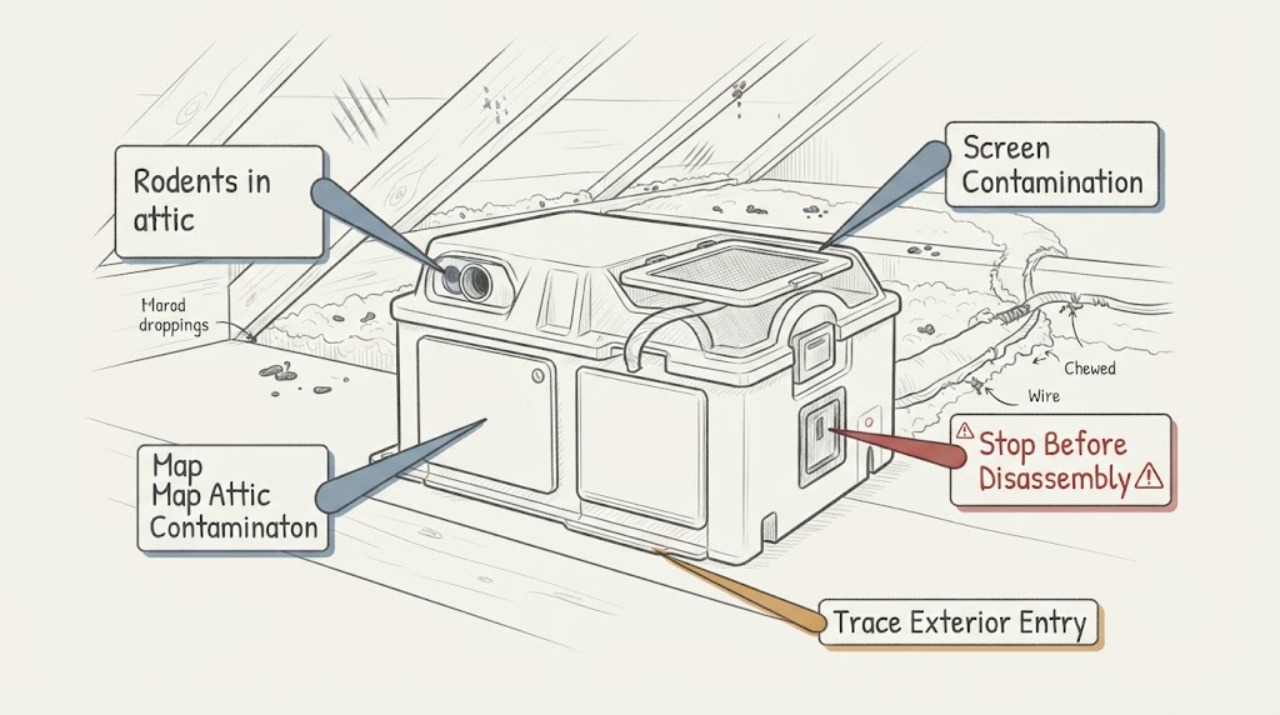
From the attic access threshold or another stable, safe position, photograph and map the sounds, droppings, nesting material, gnaw marks, odors, and insulation disturbance without stepping onto uncertain surfaces or touching the material.
Expected result: Record the exact room or roof area, whether signs are clustered near an eave, vent, utility penetration, duct, or cable route, and whether the droppings or damage look new, dry, or recently disturbed.
Next step: Keep the access area controlled and give the map and photos to a qualified pest-control professional. Do not move insulation or open a concealed cavity to follow the trail.
Stop if: Stop before entering if flooring is uncertain, access requires unsafe height work, the area is hot or poorly lit, or signs are widespread or heavily contaminated.
Why this matters
Why: A concentrated path near an exterior penetration suggests an entry and travel route to show the pest professional; a broad or inaccessible pattern raises the need for a more controlled inspection. Appearance alone cannot prove the species or whether the infestation is active.
-
Check 2
Without disturbing droppings, urine staining, nests, carcasses, or insulation, determine whether contamination is isolated, repeated along a travel path, inside porous insulation, or near a heating or cooling duct.
Expected result: Note a small localized area versus multiple piles, strong odor, visible nesting, dead rodents, contaminated insulation, or evidence that material has entered ductwork; do not sweep, vacuum, blow, or dry-brush it.
Next step: Keep people and pets out, leave the material undisturbed, and request pest-control and qualified cleanup assessment. Tell the professional if anyone has already disturbed or vacuumed the area.
Stop if: Stop for heavy accumulation, a dead animal, suspected disease exposure, respiratory symptoms, or any need to handle contaminated material or enter the attic.
Why this matters
Why: Porous or widespread contamination changes the cleanup scope, and material near ductwork can affect the ventilation system. A heavy infestation or inaccessible contamination needs professional cleanup and health guidance rather than household dusting.
-
Check 3
From the ground or another safe exterior position, inspect the roof edge, eaves, soffits, gables, attic vents, and openings around electrical, plumbing, cable, or gas lines for gaps and fresh rub or gnaw evidence.
Expected result: Record an opening, displaced screen, damaged vent, rub mark, droppings below a penetration, or no visible exterior route; do not climb onto the roof, reach into a vent, or seal an opening that may still contain an animal.
Next step: Photograph the location from a safe distance and ask pest control to confirm the animal, active route, exclusion material, and timing of any seal-up.
Stop if: Stop for roof or ladder access, unstable ground, power-line proximity, aggressive wildlife, or any opening that requires reaching into a void.
Why this matters
Why: A visible gap gives the pest professional a specific exclusion target, while no visible gap does not rule out a concealed route or a roof-level access problem. Entry repair must be coordinated with removal so animals are not trapped inside.
-
Check 4
From a non-contact position, look only for visible chewed cable jackets, missing insulation, exposed conductor, scorch marks, melted material, flicker, a repeatedly tripped breaker, or a burning odor; do not touch, move, test, splice, or cover a wire.
Expected result: Classify the wiring evidence as no visible damage, jacket damage without a visible conductor, exposed conductor or scorching, an electrical symptom in the home, or impossible to judge safely.
Next step: Keep people away and arrange a qualified electrician to identify and make safe the affected wiring. If there is smoke, active sparking, or a fire, leave the home and use emergency services; do not re-enter to inspect.
Stop if: Do not enter an attic to reach wiring, remove a cover, open a panel, perform live testing, disconnect conductors, or make a temporary splice. Stop immediately for smoke, sparks, burning odor, or heat.
Why this matters
Why: Any exposed conductor, scorching, melted insulation, burning odor, unexpected heat, or associated electrical symptom makes the circuit a potential electrical hazard; a cable that looks intact from a distance does not clear concealed damage. Damaged insulation needs qualified electrical assessment, not tape or a pest-control workaround.
-
Check 5
List the control decisions separately: pest removal and exclusion, contaminated-material cleanup, insulation assessment, and electrical inspection, including any ductwork or occupied-room impact.
Expected result: Mark whether each need is absent, suspected, visible, worsening, inaccessible, or already associated with a symptom such as odor, dust, electrical interruption, or a damaged ceiling.
Next step: Send the list, photos, timing of scratching, and any electrical or air-quality symptoms to pest control, cleanup, and electrical professionals as applicable.
Stop if: Do not choose a part, chemical, insulation replacement, or wiring repair from the symptom alone, and do not use a fan or vacuum to move contaminated dust.
Why this matters
Why: A trap may address an animal but cannot make damaged wiring safe; replacing insulation cannot stop re-entry; and sealing a hole cannot substitute for cleanup or electrical repair. Multiple marked needs call for coordinated professionals.
-
Check 6
Use the location, freshness, access, and household-risk observations to choose a professional control path rather than scattering bait or setting traps in the attic blindly.
Expected result: Record whether children, pets, or wildlife can reach the area; whether the attic is occupied or connected to ventilation; and whether the entry route, animal type, and safe trap or bait location are known.
Next step: Ask pest control to document the removal method, exclusion plan, monitoring and carcass-handling plan, and any restrictions for children, pets, wildlife, or ventilation. Use only products and placements that comply with their label and local requirements.
Stop if: Never scatter loose poison, place bait where children or pets can reach it, handle a carcass or trap without the required precautions, or seal an active entry before the professional has assessed the attic.
Why this matters
Why: EPA identifies prevention and sealing, lethal traps, live traps, and tamper-resistant bait stations as different options. Unknown access, contamination, or animal location makes professional placement and follow-up more appropriate than loose poison or an inaccessible trap.
Use your observations
Decision map
Find the observation that best matches what you see, then follow the next safe action.
-
PATH 01Safety boundary
What you see
A conductor is exposed, insulation is missing, scorching or melting is visible, or there is a burning odor, smoke, sparking, flicker, or repeated breaker trip.
Do this next
Keep clear and arrange qualified electrical assessment; leave and call emergency services for smoke, active sparking, or fire.
Why this path and its safety boundary
Why it matters: The electrical risk takes priority over attic inspection or rodent cleanup.
Safety stop: Do not touch wiring, open panels, enter the attic, or attempt a splice.
-
PATH 02Safety boundary
What you see
Droppings, urine, nests, carcasses, or contaminated insulation are widespread, strongly odorous, inside porous material, or near ductwork.
Do this next
Keep the area closed and arrange pest-control and qualified cleanup assessment; disclose any prior sweeping or vacuuming.
Why this path and its safety boundary
Why it matters: The exposure and cleanup scope exceed casual household cleaning.
Safety stop: Do not sweep, vacuum, blow, handle, or remove the material yourself.
-
PATH 03Safety boundary
What you see
A gap, damaged screen, or penetration near the attic has fresh rub or gnaw evidence and the animals may still be inside.
Do this next
Have pest control confirm occupancy and coordinate removal, monitoring, and exclusion before the opening is closed.
Why this path and its safety boundary
Why it matters: The exclusion point is identifiable, but timing matters because sealing can interfere with removal.
Safety stop: Do not climb to the opening, reach into it, or close it as a DIY test.
-
PATH 04Safety boundary
What you see
Signs are limited, no wiring or duct hazard is visible, access is safe from the threshold, and the exterior route can be documented without climbing.
Do this next
Maintain exclusion from the attic, store food and pet food securely, and schedule pest-control assessment for removal and prevention.
Why this path and its safety boundary
Why it matters: A focused pest-control visit can use the evidence map without turning the homeowner into the inspector or cleanup worker.
Safety stop: Stop if signs increase, odors or dust enter occupied rooms, the access becomes unsafe, or any wiring symptom appears.
Helpful context
Understand the symptom
Treat the clues as one infestation with separate safety paths
Noise, droppings, nesting material, and gnaw marks can point to rodent activity, but they do not identify the animal, prove that it is still present, or prove which wire is energized. The useful first record is the location and pattern of each clue: above a room, near an eave or vent, around an air handler, along a cable route, or inside insulation. Keep the pest-control question separate from the electrical question so a trap or cleanup decision does not become an improvised wiring repair.
An attic is not automatically a safe inspection area
Only observe from a stable, normally accessible position with adequate lighting and without stepping onto uncertain flooring or compressed insulation. Attic access can involve falls, hidden utilities, heat, dust, and contaminated material. If signs are beyond the threshold, widespread, or near ductwork or wiring, record what can be seen without entering and ask the professionals to inspect the space.
Keep cleanup and exclusion in the right order
CDC advises against sweeping or vacuuming rodent droppings or nesting material because contaminated particles can become airborne. It also identifies special precautions for heavy infestations and says exposed insulation contaminated with urine or droppings should be bagged for removal. A pest professional should first assess whether rodents remain and how they are entering; a cleanup professional can then handle contaminated insulation and waste safely.
Safety boundary
Stop conditions
- Do not sweep, vacuum, blow, or dry-brush rodent droppings, urine, nests, carcasses, or contaminated insulation.
- Do not enter an attic with uncertain flooring, unsafe height access, poor lighting, heavy contamination, or inaccessible utilities.
- Do not touch, move, test, splice, tape, or cover chewed or exposed wiring; use qualified electrical help.
- Do not scatter loose poison, place bait where children or pets can reach it, or handle carcasses or traps without appropriate precautions.
- Do not seal a suspected active entry until pest control has assessed whether animals remain inside and coordinated removal.
- Leave and call emergency services for smoke, active sparking, fire, or an immediate electrical danger.
When checks do not resolve it
Need a professional?
Arrange qualified pest-control assessment for scratching, droppings, nesting, or chewed insulation in an attic. Request cleanup or remediation help for heavy or inaccessible contamination, contaminated insulation, dead rodents, or ductwork involvement. Arrange a qualified electrician before using or disturbing circuits associated with chewed, exposed, scorched, or otherwise damaged wiring. Use emergency services for smoke, active sparking, or fire.
Safety scope: This page supports safe observation and handoff only. Do not enter an unsafe attic, disturb contaminated material, handle rodents or traps, touch wiring, perform live testing, use loose poison, or seal an active entry as a DIY repair.
Common questions
FAQ
Should I vacuum mouse droppings from the attic?
No. CDC warns that sweeping or vacuuming can put contaminated particles into the air. Keep the area undisturbed and ask for appropriate cleanup assessment, especially when contamination is widespread or insulation is affected.
Can I seal the hole where rodents enter the attic?
Document the opening from a safe position, but have pest control assess occupancy and coordinate removal, monitoring, and exclusion before closing an opening that may still be active.
What should I do if rodents chewed the attic wiring?
Do not touch, test, tape, splice, or move the wiring. Keep people away and arrange qualified electrical assessment; leave and use emergency services for smoke, active sparking, or fire.
Is poison safe to use in an attic?
Do not scatter loose poison. EPA says consumer rodenticide must be used in the supplied secured bait station, kept away from children and pets, and handled according to the label; pest control should decide whether bait is appropriate for the location.
Do I need to replace attic insulation?
Not from the symptom alone. A qualified cleanup or remediation professional should determine whether insulation is contaminated, whether rodents remain, and how removal can be done without spreading material or exposing occupants.
Read the exact guide
Official sources
- How to Clean Up After RodentsCenters for Disease Control and Prevention · Residential rodent contamination; used for the no-sweeping/no-vacuuming boundary, contaminated insulation, ductwork escalation, and protective precautions.
- How to Seal Up to Prevent RodentsCenters for Disease Control and Prevention · Residential rodent prevention; used for safe exterior observation and identifying possible entry routes without unsafe roof access.
- Options for Dealing With Rodent InfestationsU.S. Environmental Protection Agency · Residential rat and mouse infestation control; used for separating exclusion, trapping, and bait decisions and for child, pet, and wildlife access limits.
- National Fire Protection Association ReportNational Fire Protection Association · Electrical safety reference for visible or suspected damaged wiring; used to route chewed insulation and exposed conductors to qualified assessment rather than DIY repair.
- Safely Use Rodent Bait ProductsU.S. Environmental Protection Agency · Consumer rat and mouse bait products; used to prohibit loose poison and require label-directed, inaccessible bait stations and prompt carcass handling.
Community feedback
Share a repair observation
Share a plain-text repair observation. Accepted observations are published automatically; this page may take a moment to update.