
On this page
Start here
Quick answer
Chewed material is a clue, not proof of a rodent species or a currently used entry hole. From a safe, already accessible position, photograph the mark and record the material, location, fresh fragments, new droppings or nesting signs, food contamination, monitoring results, and any pipe, cable, vent, or shared-wall route. Do not touch waste barehanded, open a wall, mix poisons, or permanently seal the opening before a qualified professional assesses whether an animal is still inside or using the path.
Before you begin
Safety first
- The professional confirms the species and occupancy, checks connected routes, chooses an exclusion and cleanup plan, and coordinates any electrical, ventilation, health, or building work that is outside safe observation.
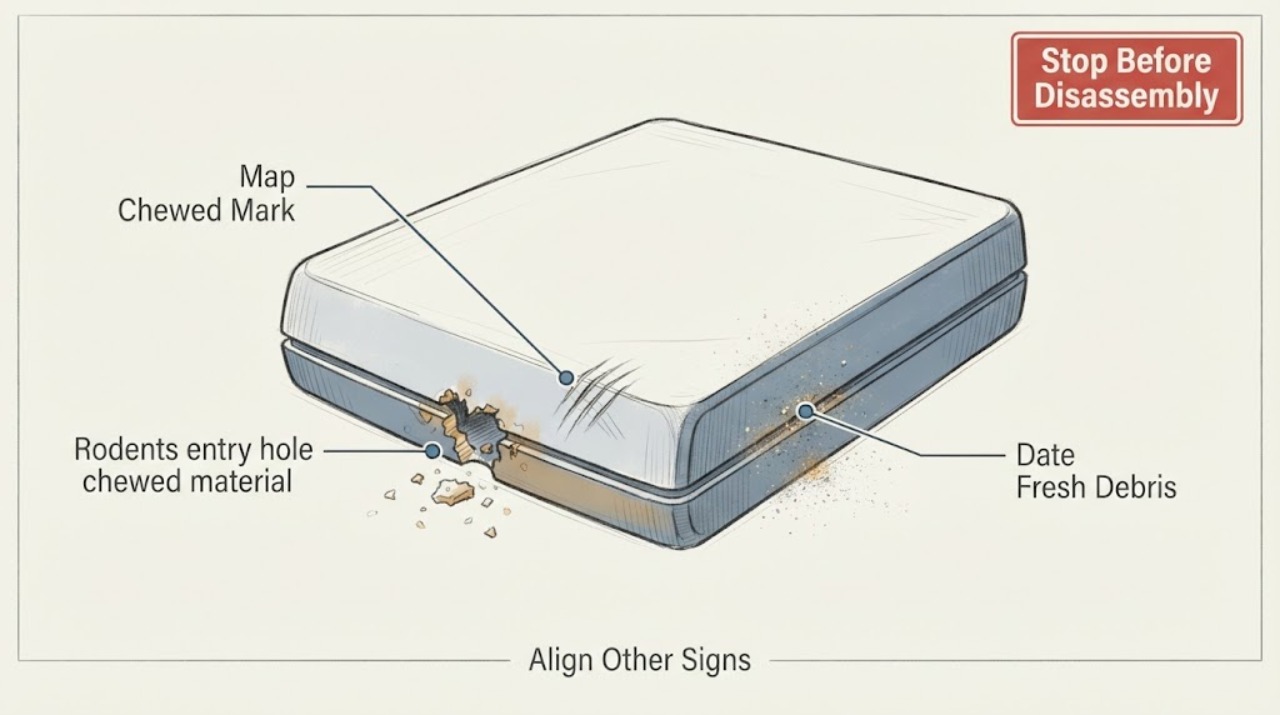
Work through in order
Diagnostic checks
Use only checks that match the exact appliance or system and its official guide.
-
Check 1
From a safe, already accessible position, photograph the chewed area without touching it or moving nearby material.
Expected result: Record the exact room and side of the building, material involved, approximate size, edge shape, nearby dust or fragments, and whether the mark looks weathered, painted over, or newly exposed.
Next step: Keep the photo and date with the service request, and leave the opening unchanged until occupancy and the correct exclusion material are assessed.
Stop if: Stop if observing it would require climbing, reaching behind equipment, handling waste, touching a cable, or entering a wall, attic, or crawlspace.
Why this matters
Why: A dry, worn mark without fresh fragments may be old damage or a non-rodent cause; a sharp edge with light-colored fragments is stronger evidence of recent chewing but still does not identify the animal.
-
Check 2
Compare the chewed spot on separate dates from the same safe viewpoint; do not clean, scrape, or collect the fragments.
Expected result: Note whether new shavings, tooth marks, displaced insulation, or nesting fibers appear after the first photograph, and write down when each change was seen.
Next step: Send the dated comparison to a pest professional rather than trying to prove activity by disturbing the opening or repeatedly checking an unsafe area.
Stop if: Stop and keep clear if an animal is visible, the material is unstable, or checking it would expose you to dust or contamination.
Why this matters
Why: New debris or changing edges make current activity more plausible; no change over a documented interval lowers but does not eliminate that possibility.
-
Check 3
Scan only visible, normally accessible surfaces around the mark for other signs that can be photographed without contact.
Expected result: Look for newly dated droppings, urine staining, odor, tracks, nesting material, rub marks, or nighttime sounds along the same route; note where each sign starts and ends.
Next step: Give the full pattern to the professional and ask for species and occupancy confirmation; do not state that the chew proves mice or rats.
Stop if: Do not touch, sweep, vacuum, or bag droppings, urine, nests, or a dead animal during this check.
Why this matters
Why: Several aligned signs support an active rodent path, while an isolated chew with no other evidence leaves the species and activity uncertain. A small animal or ordinary material failure can look similar.
-
Check 4
Check the nearby pantry, pet-food, recycling, and trash areas from a clean, accessible position for new package damage or exposed food.
Expected result: Record the item, location, and date of any torn packaging, tooth marks, scattered food, or droppings; keep children and pets away from suspected contamination.
Next step: Separate suspected food from normal use without handling contaminated material, and tell the professional where food, water, and waste are available.
Stop if: Stop if food or surfaces appear contaminated, if waste must be moved, or if the check would require mixing or applying pesticide.
Why this matters
Why: A repeated chew pattern tied to food access raises the urgency of pest control and sanitation coordination, but food damage alone does not prove that the wall opening is the entry route.
-
Check 5
From the room side only, map visible gaps where pipes, wires, conduits, vents, door edges, foundation details, or a shared wall meet the chewed material.
Expected result: Note whether the mark is beside a utility penetration, ventilation opening, threshold, or neighboring unit, and photograph the route without removing covers or insulation.
Next step: Send the route to the pest professional and, in a multi-unit building, notify the property manager so adjacent spaces can be assessed.
Stop if: Do not open a wall, remove a vent or cover, pull insulation, touch wiring, enter an attic or crawlspace, or permanently block a route that may contain an animal.
Why this matters
Why: A utility or shared-building path can let animals travel beyond the first room and may carry electrical, ventilation, or property-management implications; it needs coordinated assessment rather than a local patch.
-
Check 6
If a professional or property manager has already placed a non-toxic monitor or trap, record its labeled location and status without moving or opening it.
Expected result: Write down the date, whether the monitor shows a new mark or capture indication, and whether that result is on the same route as the chewed material.
Next step: Report the result to the person managing the monitoring plan and let them decide placement, removal, and treatment.
Stop if: Do not add bait, handle a trap or animal, mix poisons, or use a monitor as a reason to enter a restricted space.
Why this matters
Why: A dated result on the same path strengthens the case for current activity; an unchanged monitor does not identify the species or clear the opening by itself.
-
Check 7
Prepare a service handoff that includes photos, dates, the material and route, other signs, food impact, monitoring status, and any children, pets, allergies, or shared-unit concerns.
Expected result: State what was visible, what was not accessible, and whether activity continued; do not claim a species, nest location, or active entry without professional confirmation.
Next step: Request prompt qualified pest-control service for fresh evidence, repeated damage, food contamination, an air-duct or utility path, heavy waste, or any safety concern; use planned assessment only when the mark is old-looking and no current signs are present.
Stop if: Stop all DIY work and keep the area isolated if waste is extensive, an animal is present, exposed wires are chewed, people become ill, or safe observation cannot continue.
Why this matters
Why: A complete record lets the professional choose an inspection, exclusion, and contamination-cleanup plan that accounts for occupancy and building-wide movement.
Use your observations
Decision map
Find the observation that best matches what you see, then follow the next safe action.
-
PATH 01Safety boundary
What you see
The mark is dry or weathered, no fresh fragments or new aligned signs appear, and no food contamination is found.
Do this next
Keep a dated photo, arrange a planned assessment if the opening matters to the building, and wait for professional guidance before exclusion work.
Why this path and its safety boundary
Why it matters: The damage may be old or have another cause; the absence of a current sign does not prove that the opening is safe to seal.
Safety stop: Do not scrape, fill, or permanently seal the opening during this uncertain state.
-
PATH 02Safety boundary
What you see
New fragments or changing tooth marks line up with new droppings, nesting, odor, sounds, or monitoring evidence.
Do this next
Request prompt professional inspection and provide the dated route record; keep people and pets away from the evidence.
Why this path and its safety boundary
Why it matters: Current rodent activity is more plausible, but species and the exact entry point still need confirmation.
Safety stop: Do not disturb contamination, set unplanned bait, or seal a route that may contain an animal.
-
PATH 03Safety boundary
What you see
Chewed food packaging or exposed food is present, especially with droppings or urine nearby.
Do this next
Keep children and pets clear, identify the affected items without barehand contact, and ask a qualified professional or local health authority about cleanup.
Why this path and its safety boundary
Why it matters: The area has a possible health and sanitation impact as well as a pest path; a chew alone cannot show which opening was used.
Safety stop: Do not eat suspected food or sweep, vacuum, or handle waste without the appropriate cleanup precautions.
-
PATH 04Safety boundary
What you see
Chewing is beside wiring, a conduit, a vent, a duct, or another service penetration.
Do this next
Stop using the affected system if it is unsafe, notify the property manager when relevant, and request pest and trade professionals to coordinate the inspection.
Why this path and its safety boundary
Why it matters: The path may create electrical or indoor-air risk and may extend beyond the visible opening.
Safety stop: Do not touch wires, remove covers, enter the duct, or open the wall to follow the route.
-
PATH 05Safety boundary
What you see
The opening connects to a shared wall, common area, adjacent unit, foundation, or other route beyond the room.
Do this next
Give the route and dates to the property manager and pest professional for coordinated inspection and exclusion planning.
Why this path and its safety boundary
Why it matters: A local repair could leave a connected path untreated or trap an animal between spaces.
Safety stop: Do not enter another unit or common service space and do not close the route before occupancy is assessed.
-
PATH 06Safety boundary
What you see
There are gnaw-like marks but no fresh debris, dated activity, aligned waste, food impact, or monitor result.
Do this next
Document the uncertainty and ask for an inspection if the mark is recurring, near a utility, or important to the building envelope.
Why this path and its safety boundary
Why it matters: Species and active entry remain unconfirmed; wear, another animal, or a material failure remains possible.
Safety stop: Do not label the animal or buy a treatment solely from the tooth-mark appearance.
-
PATH 07Safety boundary
What you see
There is heavy contamination, a dead animal or nest, an animal in the opening, exposed chewed wiring, illness concern, or unsafe access.
Do this next
Keep people and pets away, stop work, and request the appropriate qualified service; report possible exposure to a healthcare or local health authority when needed.
Why this path and its safety boundary
Why it matters: The risk exceeds ordinary observation and may require pest, health, electrical, ventilation, or building professionals.
Safety stop: No barehand cleanup, sweeping, vacuuming, poison mixing, wall opening, trap handling, attic entry, or permanent sealing.
Helpful context
Understand the symptom
A gnawed edge in wood, plastic, foam, a food package, or another soft material can be old damage, wear from another animal, or a route that is still in use. The useful question is whether the mark lines up with fresh debris and other dated evidence. A photo, scale reference, exact location, and first-observed date give a pest professional more information than a guess based on tooth marks alone.
Integrated pest management uses monitoring, food and water reduction, and exclusion together. EPA guidance identifies gnaw marks and droppings as signs to log, and calls out openings around wires, pipes, vents, and shared building paths. That makes the surrounding route as important as the chewed spot; do not alter it while you are still determining occupancy or access.
If droppings, urine, nesting material, or a dead animal is present, keep people and pets away and do not sweep or vacuum it. CDC guidance treats rodent waste and nests as contamination hazards and gives separate precautions for cleanup. Heavy contamination, an air-duct route, exposed wiring, or an inaccessible wall or attic is a professional handoff, not a do-it-yourself opening or sealing job.
Safety boundary
Stop conditions
- Do not touch rodent waste, nesting material, dead animals, or chewed debris barehanded; do not sweep or vacuum suspected waste.
- Do not mix or apply poisons, handle traps or animals, open walls, enter an attic or crawlspace, touch chewed wiring, or use a hose or other test to force activity.
- Do not permanently seal a chewed opening until a qualified professional has considered whether an animal is inside, whether the route is shared, and which exclusion material is appropriate.
- Keep children and pets away from suspected contamination and stop immediately for heavy contamination, an inaccessible route, an animal, illness concern, exposed wiring, or unsafe access.
Only after diagnosis
Potential parts
- rodent-proof-mesh
Consider only after a professional confirms the opening, route, occupancy status, and suitable material; a mesh patch is not a substitute for finding the active path.
Material and installation suitability depend on the opening and building conditions; confirm before ordering. - door-sweep
Consider only if the documented route is a door-bottom gap and a professional confirms that a sweep is appropriate after checking for an animal and adjacent paths.
Confirm door type, threshold, clearance, and building requirements before ordering. - exterior-sealant
Consider only after the route is confirmed, the opening is cleared as appropriate, and the professional selects a material rodents cannot readily chew through.
Confirm substrate, exposure, and compatibility with the surrounding building material before ordering.
When checks do not resolve it
Need a professional?
Call promptly when dated evidence suggests current activity or when contamination, wiring, ventilation, shared spaces, or unsafe access is involved.
Safety scope: The professional confirms the species and occupancy, checks connected routes, chooses an exclusion and cleanup plan, and coordinates any electrical, ventilation, health, or building work that is outside safe observation.
Have this ready
- Dated photos and the exact location of the chewed material
- Material type, fresh debris, other signs, food impact, monitoring result, and utility or shared-wall route
- Access limits, children or pets, allergies or illness concerns, and any exposed wiring or ventilation concern
Common questions
FAQ
Do chewed marks prove that mice or rats are using the opening now?
No. Tooth marks are evidence to document, not species or occupancy proof. Fresh fragments, changing edges, aligned droppings or nesting, food damage, and dated monitoring make current activity more plausible, but a professional should confirm the animal and route.
What should I photograph around a chewed entry hole?
Photograph the mark from a safe position and include the material, exact room or exterior location, nearby fragments, utility or vent penetrations, and any other visible signs. Add the date and do not scrape or collect anything.
Should I seal the opening as soon as I find it?
Not before occupancy and connected routes are assessed. Immediate sealing can leave an animal inside or shift activity to another path. Keep people and pets away and ask a qualified professional to plan exclusion.
What if the chew is near a wire, vent, or pipe?
Treat it as a utility or building-path concern. Do not remove covers, open the wall, touch wiring, or enter the duct. Photograph what is visible, stop using anything unsafe, and request coordinated pest and trade assessment.
Can I sweep or vacuum the droppings near the mark?
No. CDC advises against sweeping or vacuuming rodent urine, droppings, or nesting material because contaminated particles can become airborne. Keep the area clear and obtain appropriate cleanup guidance, especially for heavy contamination.
When is this urgent?
Call promptly for fresh or repeated chewing, new droppings or nesting, food contamination, an animal in the opening, heavy waste, a shared or ventilation route, chewed wiring, illness concern, or unsafe access.
Read the exact guide
Official sources
- Pest Control: Resources for Housing ManagersU.S. Environmental Protection Agency · Supports logging gnaw marks and droppings, checking openings around wires, pipes, vents, doors, and shared building paths, and coordinating residents, maintenance, and pest professionals.
- How to Clean Up After RodentsCenters for Disease Control and Prevention · Supports keeping readers away from suspected waste, not sweeping or vacuuming it, and escalating heavy contamination or ventilation-system access.
Community feedback
Share a repair observation
Share a plain-text repair observation. Accepted observations are published automatically; this page may take a moment to update.