
On this page
Start here
Quick answer
If rodents remain active after an entry hole was sealed, do not assume the first repair failed or immediately add more poison or sealant. First establish whether the new signs are fresh, then inspect every accessible route around the building—not only the repaired spot—for gaps around doors, vents, foundations, roofs, and utility lines. Remove accessible food, water, and shelter, and keep a dated activity log. Do not open walls, climb onto a roof, disturb nests, or sweep or vacuum dry droppings. Fresh indoor signs, a chewed or displaced patch, activity in concealed or ventilation spaces, heavy contamination, or repeated activity after these checks calls for a licensed pest professional.
Before you begin
Safety first
- The homeowner scope is visual observation, accessible source control, and label-directed monitoring that stays away from children, pets, food, and hazards. Do not enter confined spaces, climb roofs, open walls or ducts, disturb nests or carcasses, sweep or vacuum dry waste, or work around gas, electrical, structural, or contaminated conditions.
Work through in order
Diagnostic checks
Use only checks that match the exact appliance or system and its official guide.
-
Check 1
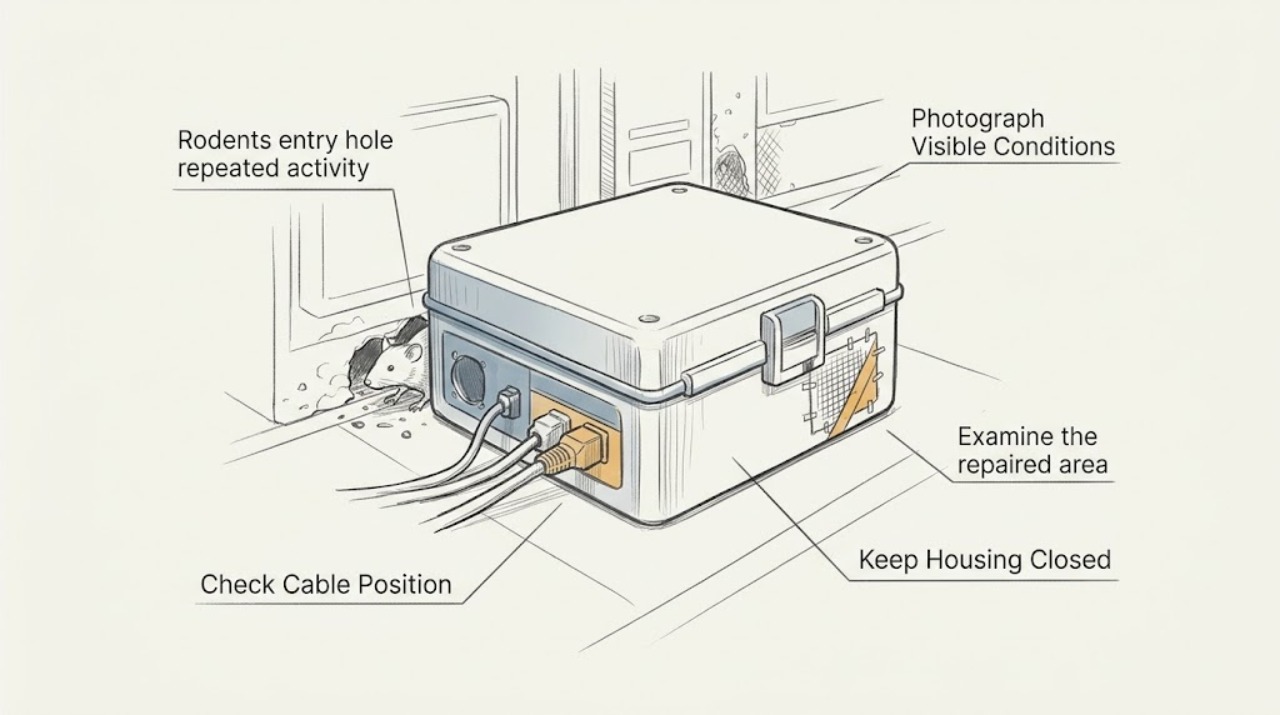
From a safe, accessible position, photograph the repaired hole and record the date, exact location, sounds or sightings, droppings, gnaw marks, nesting material, and odor. If droppings are present and the area is a light, accessible infestation, follow CDC wet-disinfectant cleanup guidance; do not sweep or vacuum them dry.
Expected result: After the area is safely cleaned, no new signs appear, or new droppings, gnaw marks, nesting material, odor, or sightings appear during later checks.
Next step: Keep a dated log and continue to the whole-perimeter inspection. If signs return quickly, are numerous, or are in a closed or poorly ventilated area, stop cleanup and arrange professional help.
Stop if: Stop if contamination is heavy or uncertain, a nest or carcass must be handled, the area is enclosed without ventilation, or cleaning would require disturbing insulation, walls, ducts, or other concealed spaces.
Why this matters
Why: No new signs after safe cleanup makes an old sign or a remaining outside route more plausible, while new signs indicate continuing rodent activity and justify tracing the route rather than assuming the original patch solved it.
-
Check 2
Inspect all reachable interior and exterior edges without climbing, removing covers, or opening a wall: doors and thresholds, windows, foundation-to-ground joints, crawl-space and attic vents, roof eaves and soffits visible from the ground, floor drains, and openings around plumbing, electrical, gas, sewer, cable, and HVAC lines.
Expected result: You find another gap, a torn screen, a door gap, a hole about one-quarter inch or larger, a route that is hidden behind a service panel, or no additional accessible opening.
Next step: Photograph and map each finding, then have a qualified pest or building professional select durable exclusion materials and inspect concealed routes. Do not seal around an active utility, vent, gas line, or unknown moisture condition by guesswork.
Stop if: Stop for roof or ladder access, unstable structure, exposed wiring, gas piping, a confined space, a sealed service panel, or any route that cannot be examined without dismantling building components.
Why this matters
Why: A second or bypassed opening is more likely than failure of the original hole alone; no visible route does not rule out a concealed path or a route above the accessible inspection area.
-
Check 3
Examine the repaired area and its immediate surroundings from both sides where accessible, looking for fresh gnawing, loose or missing mesh, foam that has been chewed, a gap at the edge of the patch, rub marks, or a new opening nearby. Do not pry the patch out or put fingers into a hole.
Expected result: The patch is intact with no fresh signs, or it is damaged, bypassed, damp, loose, or surrounded by a new gap or fresh gnawing.
Next step: Leave the patch undisturbed, document the defect, and request professional exclusion review. Keep people and pets away from the area and do not keep adding foam, caulk, or poison without identifying the route.
Stop if: Stop if the patch is near live electrical or gas services, if structural material is loose, if a rodent is visible at close range, or if access would require cutting, drilling, climbing, or opening the wall.
Why this matters
Why: An intact patch with fresh activity elsewhere makes another route or remaining indoor animal more likely; a damaged or bypassed patch indicates that exclusion is incomplete and the material or surrounding construction needs a site-specific assessment.
-
Check 4
Audit accessible food, water, and shelter around the building: open trash, pet or livestock feed, bird seed, compost, leaks or standing water, brush, deep mulch, wood piles, dense vegetation, and clutter against the foundation. Secure or remove what can be changed without entering a hazard area.
Expected result: One or more attractants or sheltered areas remain near the activity, or food, water, and shelter are controlled with no obvious nearby source.
Next step: Use tight-lidded containers for food and waste, remove accessible debris and nesting shelter, keep the perimeter clear where practical, and continue the activity log. Ask a professional to assess persistent activity rather than escalating chemicals.
Stop if: Stop if removing material would expose you to droppings or nests, require heavy lifting, enter a crawl space or roof, or disturb a suspected contaminated or unstable area.
Why this matters
Why: Continuing attractants can keep rodents near the structure even after one route is closed; when those sources are controlled and activity still recurs, an overlooked entry, nest, or established population becomes more likely.
-
Check 5
Review the activity map after the safe checks and, only if a licensed professional or the product label directs it, use monitoring or snap traps in locations inaccessible to children and pets. Record trap or monitoring locations and any new signs without handling a catch until it has been disinfected according to official guidance.
Expected result: Activity concentrates at the repaired area, shifts to another edge or room, remains outside, or continues despite attractant control and exclusion review.
Next step: Provide the map, photographs, timing, and monitoring results to a licensed pest professional and request identification, exclusion review, and a low-risk integrated treatment plan.
Stop if: Stop if children or pets can reach the device, a live or dead rodent must be handled, activity is widespread, or the device would need to be placed in a wall, duct, food area, or other unsafe location.
Why this matters
Why: The pattern helps distinguish a remaining indoor animal or alternate entry from outside activity near the building, but monitoring cannot by itself prove that every entry route is closed.
Use your observations
Decision map
Find the observation that best matches what you see, then follow the next safe action.
-
PATH 01Safety boundary
What you see
The repaired patch is intact, no new indoor signs appear after safe cleanup, and observations remain limited to the outside of the building.
Do this next
Keep monitoring and maintain food, water, trash, and shelter controls. Treat outside sightings as a reason to recheck accessible perimeter routes if they approach the building, not as proof that the sealed hole reopened.
Why this path and its safety boundary
Safety stop: Escalate if fresh indoor droppings, gnawing, nesting material, or repeated indoor sightings appear.
-
PATH 02Safety boundary
What you see
Fresh signs reappear inside near the same wall, utility route, vent, threshold, or repaired opening.
Do this next
Assume an active route or remaining indoor rodent is possible; preserve the map and photographs and arrange a professional inspection of the adjoining structure and concealed path.
Why this path and its safety boundary
Safety stop: Do not pry open the patch, seal an occupied cavity, or repeatedly apply chemicals to the same location.
-
PATH 03Safety boundary
What you see
The patch is chewed, displaced, damp, or bypassed, or another accessible opening is found.
Do this next
Leave the defect documented and request durable exclusion repair matched to the opening and surrounding material; have the professional check adjacent routes before closing the new gap.
Why this path and its safety boundary
Safety stop: Do not climb, cut, drill, or seal around gas, electrical, plumbing, HVAC, or structural components without qualified help.
-
PATH 04Safety boundary
What you see
Food, water, shelter, debris, vegetation, feed, or trash remains near the structure and activity follows those resources.
Do this next
Remove or secure the accessible attractants, keep the perimeter orderly, and continue monitoring while the exclusion plan is reviewed.
Why this path and its safety boundary
Safety stop: If source control is complete but activity persists or spreads, stop DIY escalation and arrange professional service.
-
PATH 05Safety boundary
What you see
Signs are heavy, the structure is closed or poorly ventilated, rodents have reached ducts or inaccessible voids, or contamination cannot be safely classified.
Do this next
Keep people and pets away, ventilate only when it can be done safely, and contact a licensed pest professional and the local or state health department for cleanup and control guidance.
Why this path and its safety boundary
Safety stop: Do not sweep, vacuum, enter a confined or contaminated space, disturb nests, or handle carcasses without the required professional controls.
Helpful context
Understand the symptom
Why a sealed hole does not prove the route is solved
Rodents can use more than one opening, and a hole that looks closed from one side may still have a gap around a pipe, cable, vent, door, foundation, roof edge, or crawl-space opening. A patch can also be chewed, displaced, or bypassed. Continued noise or sightings alone does not identify the route, so preserve the pattern and inspect the whole accessible perimeter rather than repeatedly treating one spot.
Separate fresh evidence from an old sign
Droppings, gnaw marks, nesting material, odor, and a new sighting are useful clues, but old marks can remain after activity has stopped. CDC notes that safely cleaning an area and finding droppings again can indicate active presence. Do not sweep or vacuum dry waste; use the CDC disinfectant-and-wet-cleanup procedure for a light, accessible situation, and leave heavy or uncertain contamination to public-health or pest professionals.
Exclusion works best with source control and monitoring
Sealing openings is only one part of an integrated response. Food, water, clutter, vegetation, wood piles, trash, pet or livestock feed, and bird feeders can keep rodents near the building or provide shelter. Correct the accessible attractants, document where signs recur, and ask a licensed professional for an integrated plan when activity does not decline or the work would enter a void, duct, roof, or other unsafe area.
Only after diagnosis
Potential parts
- rodent-proof metal mesh
Consider this category only after a confirmed accessible opening or damaged patch is measured and a professional or applicable building guidance identifies mesh as suitable for that location; repeated activity alone does not establish fit or material choice.
Match the opening, surrounding construction, corrosion exposure, vent function, and local requirements; do not use mesh to cover a gas, electrical, HVAC, or structural defect without qualified assessment. - exterior door sweep or weather seal
Consider this category only when a visual inspection confirms a door-threshold gap that is serving as an entry route and the door still needs to close and latch normally.
Confirm the door profile, threshold, clearance, weather exposure, and required ventilation before selecting a replacement; a sweep does not repair a concealed foundation, wall, or utility penetration.
When checks do not resolve it
Need a professional?
Escalate for fresh or spreading indoor signs, damaged exclusion, concealed or ventilation-space activity, heavy contamination, an unsafe access route, or no improvement after accessible attractants are controlled.
Safety scope: The homeowner scope is visual observation, accessible source control, and label-directed monitoring that stays away from children, pets, food, and hazards. Do not enter confined spaces, climb roofs, open walls or ducts, disturb nests or carcasses, sweep or vacuum dry waste, or work around gas, electrical, structural, or contaminated conditions.
Have this ready
- Provide dated photographs, a floor or perimeter map, exact repaired-hole location and material if known, timing of sightings or sounds, fresh-sign observations, food/water/shelter findings, trap or monitoring locations, and any prior chemical or exclusion work.
Common questions
FAQ
Why are rodents still active after I sealed an entry hole?
The sealed spot may not be the only route, the repair may have been chewed or bypassed, a rodent may remain inside, or food, water, and shelter may still be nearby. Verify whether signs are fresh and inspect accessible doors, vents, foundations, roofs, and utility penetrations before asking a professional to assess concealed routes.
How can I tell whether the activity is fresh?
Photograph and document the sign, then follow CDC safe wet-cleanup guidance for a light, accessible area rather than sweeping or vacuuming. Droppings that return after safe cleaning support active presence, while old gnaw marks alone may only show that rodents were present previously.
Should I add more foam, caulk, or poison to the sealed hole?
Not before the route is understood. A professional should check whether the opening is actually closed, whether an adjacent utility or vent is involved, and whether other entry points or attractants remain. Do not improvise chemicals, repeatedly seal an occupied cavity, or work around gas, electrical, structural, or contaminated conditions.
Is it safe to sweep or vacuum the droppings near the repaired hole?
No. CDC advises against sweeping or vacuuming dry rodent urine, droppings, and nesting material because dust can become airborne. For a light, accessible situation, wet the material with an appropriate disinfectant and follow the full CDC cleanup steps; heavy, uncertain, enclosed, or duct contamination needs professional guidance.
When should I call a pest professional?
Call when fresh indoor signs return, activity spreads, a repair is damaged or bypassed, the route is hidden, rodents reach a duct or wall void, contamination is heavy or uncertain, or source control does not reduce activity. Provide photographs, timing, an activity map, and details of the repair and any products already used.
Read the exact guide
Official sources
- Hantavirus Pulmonary SyndromeNational Park Service · NPS public-health guidance for excluding rodents, checking gaps, reducing food and shelter, monitoring with snap traps, and avoiding dust during cleanup.
- Integrated Pest ManagementNational Park Service · NPS IPM process supporting a site-specific, low-risk sequence of identification, monitoring, source correction, exclusion, and evaluation.
- Controlling Wild Rodent InfestationsCenters for Disease Control and Prevention · CDC overview for recognizing droppings and gnaw marks, safely checking whether signs recur, and combining exclusion with food, water, and shelter reduction.
- Take Action Against Anticoagulant RodenticidesNational Park Service · NPS public guidance supporting removal of food resources and hiding places, sealing holes and cracks, and professional integrated management when the problem is too large for a resident to control.
- How to Clean Up After RodentsCenters for Disease Control and Prevention · CDC cleanup guidance for light, accessible rodent contamination and escalation precautions for heavy infestations or ventilation systems.
- Identify and Prevent Rodent InfestationsUnited States Environmental Protection Agency · EPA consumer prevention guidance supporting inspection for droppings, nesting, chewing, stale odors, holes, and reduction of nearby food, water, and shelter.
- How to Seal Up to Prevent RodentsCenters for Disease Control and Prevention · CDC guidance for checking indoor and outdoor gaps, sealing small and large openings, and reducing food, water, and nesting sources around homes and outbuildings.
Community feedback
Share a repair observation
Share a plain-text repair observation. Accepted observations are published automatically; this page may take a moment to update.