
On this page
Start here
Quick answer
A hole where a pipe, cable, conduit, or service line enters the building can be a rodent route, but do not plug it blindly. From a safe, accessible position, document the opening, check for droppings, gnawing, grease marks, nesting, moisture, and live utilities, and note whether signs continue on both sides. Do not open a wall, disturb wiring/plumbing/gas lines, mix poison, or seal an active route before the infestation is assessed. Request pest-control service for recurring signs, inaccessible penetrations, or any route near gas, electrical, water, or concealed spaces.
Before you begin
Safety first
- Request coordinated inspection and exclusion. This self-check does not include utility disconnection, wall opening, rodent handling, poison mixing, or sealing an active service penetration.
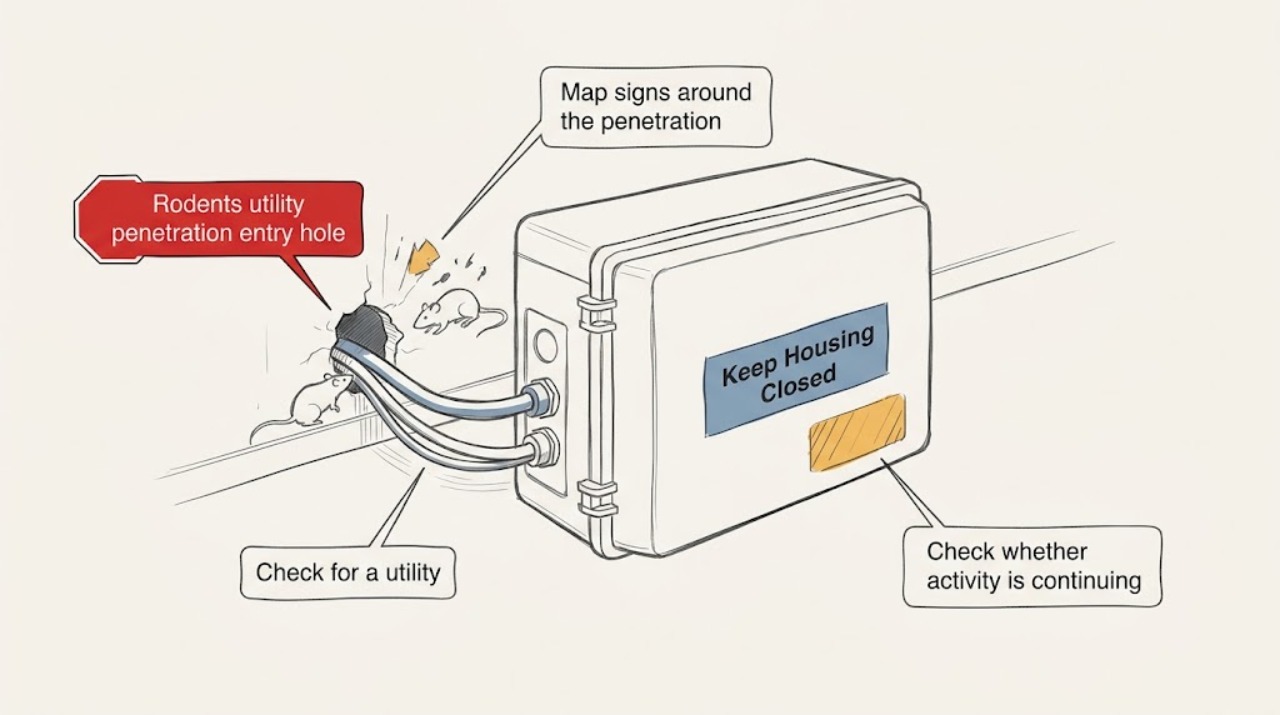
Work through in order
Diagnostic checks
Use only checks that match the exact appliance or system and its official guide.
-
Check for a utility or exposure hazard
From a safe position, determine whether the penetration is near gas, electrical wiring/conduit, pressurized water, heating equipment, or a wall/ceiling void. Look for gas odor, sparks, heat, leaks, damaged insulation, or droppings that must be touched to see more.
Expected result: Yes: a utility, leak, odor, damaged wire, or inaccessible contamination is involved. No: the opening is exposed and can be observed without touching utilities or waste.
Next step: For yes, keep clear and contact the relevant emergency/utility or qualified service provider, plus pest control when rodent evidence exists. For no, continue with distant documentation only.
Stop if: Stop if gas odor, sparks, heat, leaking water, damaged wiring, or hidden waste is present.
Why this matters
Why: Utility damage or concealed contamination can create fire, shock, water, or health hazards and is beyond a user observation. An exposed clean-looking gap still needs route and infestation assessment.
-
Map signs around the penetration
Without moving the line or opening the wall, inspect the exposed area for fresh droppings, gnawing, rub/grease marks, nesting fibers, odor, damaged insulation, or a disturbed seal. Photograph the opening, adjacent floor/wall, and the utility’s direction.
Expected result: There are no signs, isolated old-looking signs, or a cluster of fresh/recurring signs around the penetration.
Next step: Record the location and provide the photos to a pest-control professional. Do not caulk, foam, mesh, or stuff the opening until active occupancy and utility safety are assessed.
Stop if: Stop if inspection requires touching droppings, nesting, damaged insulation, wiring, piping, or a concealed panel.
Why this matters
Why: A sign cluster makes this opening a likely route, but rodents may have more than one entry. No visible sign does not rule out movement inside the wall or behind equipment.
-
Check whether activity is continuing
After documenting the area, keep it undisturbed and compare the location over safe observation periods. Note new droppings, fresh gnaw marks, sounds, odor, or a rodent sighting; do not use loose food, poison, or improvised tracking material as a test.
Expected result: New signs appear, or no new sign appears during the observation period.
Next step: For new signs, request inspection and exclusion promptly. For no new signs, keep food and garbage secured, monitor, and call if evidence returns or the route is inaccessible.
Stop if: Stop if a rodent enters an occupied area, signs spread into a cavity, or testing would require bait, poison, wall opening, or utility contact.
Why this matters
Why: New evidence indicates an active route or infestation. No new sign lowers the immediate evidence at that spot but does not prove the penetration is closed or the building is clear.
-
Check nearby food, water, and access conditions
From accessible areas, note leaks/condensation, food or pet-food storage, garbage, clutter, doors, and other visible holes near the utility route. Move food into tight-lidded clean containers and clean spills; do not dismantle fixtures or seal a utility opening yourself.
Expected result: Nearby food/water sources or additional gaps are visible, or the surrounding area appears controlled with no other visible route.
Next step: Document each condition for the professional; keep food and garbage secured while awaiting service. Have utilities or building maintenance address leaks and unsafe penetrations.
Stop if: Stop if correcting the condition requires moving heavy equipment, opening a wall, or handling utilities, droppings, or an animal.
Why this matters
Why: Available food, water, and connected gaps can sustain activity even if one penetration is closed. A controlled area reduces attractants but does not resolve existing rodents or concealed damage.
-
Prepare the exclusion handoff
Provide room and penetration location, utility type, dimensions by visual estimate only, photos, sign locations/dates, food/water conditions, suspected connected spaces, and any person/pet exposure. State that the wall, utilities, and opening were not disturbed.
Expected result: The record separates visible evidence from concealed route and utility conditions that were not inspected.
Next step: Request prompt service for recurring signs, an active route, inaccessible penetration, or any uncertainty about exclusion. Seek health guidance for exposure or illness concerns.
Stop if: Stop self-triage when control requires poison, handling rodents, wall opening, or work on a live utility.
Why this matters
Why: This lets pest control coordinate with plumbing/electrical/building professionals and plan exclusion without trapping rodents or damaging a service line.
Use your observations
Decision map
Find the observation that best matches what you see, then follow the next safe action.
-
PATH 01Safety boundary
What you see
Gas odor, sparks/heat, damaged wiring, pressurized leak, or unsafe concealed utility is involved.
Do this next
Keep clear and contact the appropriate utility/emergency or qualified trade professional; request pest control separately when rodent evidence is present.
Why this path and its safety boundary
Safety stop: Do not stuff, drill, cut, foam, or wet the penetration.
-
PATH 02Safety boundary
What you see
Fresh droppings, gnawing, sounds, odor, or a rodent sighting recurs around the penetration.
Do this next
Request pest-control inspection and exclusion and provide dated photos; coordinate utility repairs where needed.
Why this path and its safety boundary
Safety stop: Do not seal an active route blindly, mix poison, or trap rodents in a wall.
-
PATH 03Safety boundary
What you see
The opening continues behind a fixed cabinet, wall, ceiling, appliance, or service chase.
Do this next
Leave it intact and request professional assessment of the connected space and utility safety.
Why this path and its safety boundary
Safety stop: Do not open the wall, remove utility covers, or reach into the chase.
-
PATH 04Safety boundary
What you see
The exposed gap has no repeat signs and no immediate utility hazard.
Do this next
Keep food/water controlled, monitor, and ask a professional to confirm the exclusion approach if the route remains open or signs return.
Why this path and its safety boundary
Safety stop: Do not treat an empty-looking gap as proof that rodents are absent.
Helpful context
Understand the symptom
Identify the route without disturbing utilities
Rodents can use gaps around plumbing, electrical, cable, gas, or HVAC penetrations to enter and travel through a building. A visible hole is evidence of access, not proof that it is the only route. Keep children and pets away, avoid contact with droppings, and do not pull, cut, or move any line to inspect behind it.
If there are fresh signs, an active rodent, damaged wiring, gas odor, water leakage, or a hole inside a wall/ceiling, stop and call the appropriate professional. The entry route should be inspected and controlled as part of the wider infestation; plugging one opening alone can leave rodents inside or redirect them into another cavity.
Document before any exclusion work
Record room, wall/floor/ceiling location, utility type, opening condition, photos, droppings/gnaw marks, moisture, and when signs were first seen. Do not dry-sweep or vacuum droppings. Keep food, pet food, garbage, and water sources controlled while waiting for inspection.
Safety boundary
Stop conditions
- Stop for gas odor, sparks, heat, damaged wiring, water leakage, or any utility condition that could create immediate danger.
- Do not open walls/ceilings, cut or move pipes/cables/conduit, or stuff a penetration that may contain an active utility.
- Do not sweep or vacuum droppings, handle rodents/nests, mix poison, or trap animals in a wall or service chase.
- Do not seal an active route blindly; request pest-control inspection and coordinate utility/building repairs.
Only after diagnosis
Potential parts
- rodent-proof-mesh
Relevant only after a professional confirms the opening, utility clearance, active-route status, and material suitability.
Do not install around live gas, electrical, plumbing, or concealed utilities without qualified direction. - door-sweep
May reduce a confirmed door access route but cannot replace utility-penetration inspection or infestation control.
Match door clearance and fit; keep the wider building route under review. - exterior-sealant
Only appropriate after the utility penetration is identified, dry, structurally sound, and cleared for sealing by a qualified professional.
Use a material compatible with the substrate and service line; do not seal a route while rodents may remain inside.
When checks do not resolve it
Need a professional?
Request pest-control service for recurring rodent signs, an active utility-penetration route, inaccessible openings, gnawing near utilities, or uncertainty about exclusion. Use the relevant utility/emergency professional first for gas, electrical, or water hazards.
Safety scope: Request coordinated inspection and exclusion. This self-check does not include utility disconnection, wall opening, rodent handling, poison mixing, or sealing an active service penetration.
Common questions
FAQ
Can I fill the hole around a pipe or cable right now?
Do not plug it blindly. First document the opening and signs, confirm utility safety, and have pest control assess whether rodents are active or inside the cavity. Never disturb gas, electrical, water, or concealed services.
What signs show a utility penetration is an active route?
Fresh droppings, gnaw marks, grease/rub marks, nesting, odor, sounds, or a rodent sighting near the opening are useful clues. They do not prove it is the only route, so request inspection and exclusion.
Can poison solve rodents entering around utilities?
Do not mix or improvise poison or place it where children, pets, wildlife, or trapped rodents in a wall could be harmed. A pest-control professional can choose a compliant control plan after inspecting the route.
Should I open the wall to follow the hole?
No. Wall opening can contact live utilities and spread contamination. Photograph the accessible opening and ask pest control and the relevant trade professional to assess the concealed path.
Read the exact guide
Official sources
- Pest Control: Resources for Housing ManagersU.S. Environmental Protection Agency · Supports monitoring droppings/gnawing, reducing building access, inspecting utility penetrations, coordinating trades, and avoiding improper pesticide use.
- How to Seal Up to Prevent RodentsCenters for Disease Control and Prevention · Supports checking around electrical, plumbing, gas, sewer, HVAC, and cable penetrations, controlling food/water sources, and contacting professionals for inaccessible rodent areas.
Community feedback
Share a repair observation
Share a plain-text repair observation. Accepted observations are published automatically; this page may take a moment to update.