
On this page
Start here
Quick answer
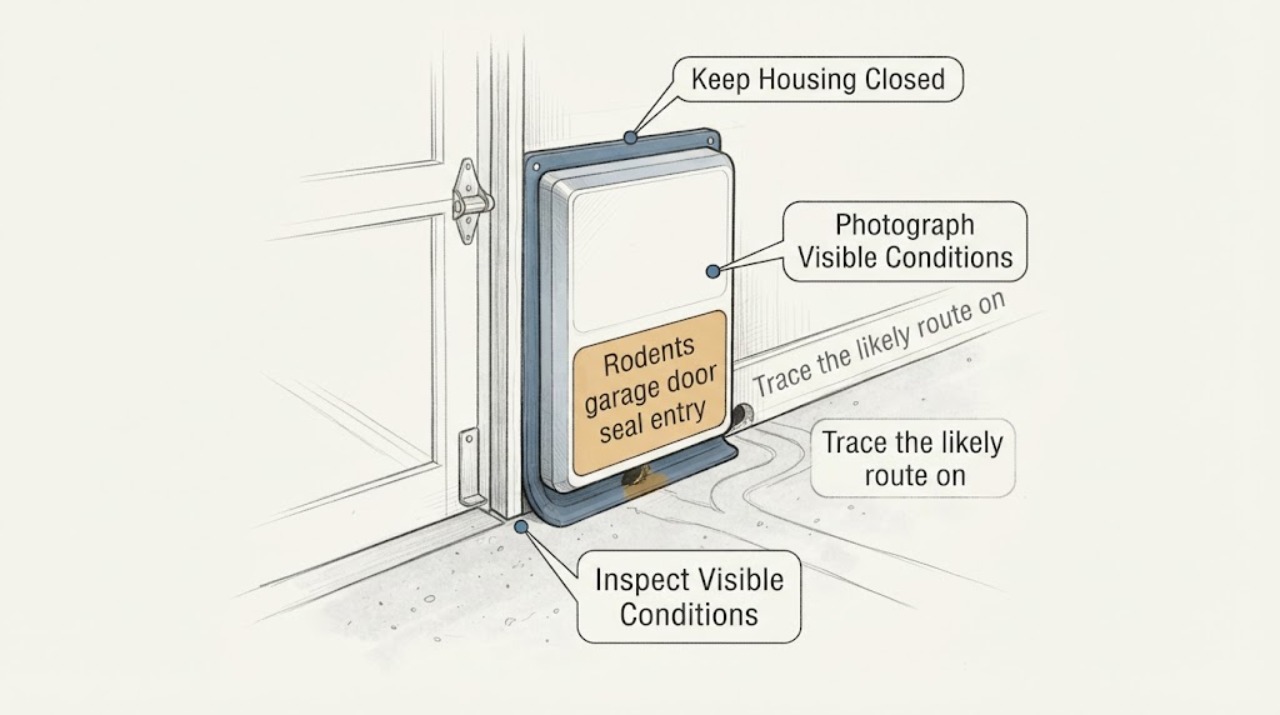
A gap at the garage-door seal can be a rodent entry route, but the visible gap may be only one part of a larger pathway. From a safe position, document the gap, droppings, gnaw marks, nesting material, tracks, and whether activity is current. Do not reach into the gap, disturb nests or droppings, set traps, mix poison, open walls, or seal an opening while rodents may still be inside. Arrange rodent-exclusion service when signs continue or the path leads into an inaccessible cavity.
Work through in order
Diagnostic checks
Use only checks that match the exact appliance or system and its official guide.
-
Photograph and measure the visible seal gap without touching it
From outside the garage-door path, photograph the bottom seal, side seals, threshold, corners, and jamb. Place a ruler or other clean object beside the gap only if it can be done without touching droppings, nesting material, or the door hardware.
Expected result: Record whether the gap is at the bottom, side, corner, or damaged seal; whether daylight is visible; and whether the door is closed evenly or has a bent section.
Next step: Keep the photograph and measurements for the exclusion technician. Do not remove or install a seal until current animal activity and the full route have been assessed.
Stop if: Stop if the door is unstable, the seal is attached to damaged hardware, the gap opens into a cavity, or touching the area would contact animal material.
Why this matters
Why: A gap at the door boundary can provide entry, but the location and door condition determine whether a compatible sweep, seal, or structural repair is appropriate. CDC says garages and outbuildings should also be sealed, while EPA notes rodents can use holes inside and outside the home.
-
Look for signs of current or past activity
From a safe distance, inspect the floor near the seal, corners, stored items, and the exterior foundation for droppings, urine staining, gnaw marks, shredded paper or fabric, tracks, nesting, or a stale odor. Use a flashlight from outside the suspected route; do not sweep, vacuum, spray, or pick up anything.
Expected result: Record no signs, old-looking signs, fresh droppings or gnawing, nesting material, an animal sighting, or odor coming from a hidden space.
Next step: Photograph signs from a distance and request professional inspection when signs are fresh, repeated, or inside an inaccessible space.
Stop if: Stop and keep the area closed if you see an animal, nest, carcass, heavy droppings, or material that could be contaminated.
Why this matters
Why: EPA identifies droppings, nesting material, gnawing, chewed openings, and stale hidden smells as clues. Fresh signs near the garage seal make an active route more likely, but visual clues cannot establish species or whether animals remain inside.
-
Trace the likely route on both sides of the boundary
Visually follow the seal line to the jambs, corners, foundation, nearby vents, utility penetrations, and any visible gap under or beside the garage. Check the inside and outside surfaces only where they are open and safely reachable; do not enter a crawlspace, attic, wall, or tight void.
Expected result: Note whether the garage seal gap connects to a foundation gap, damaged jamb, utility opening, vent, stored clutter, or a route that disappears into a wall or floor.
Next step: Give the technician a simple sketch or photographs showing every visible opening and where the route becomes inaccessible.
Stop if: Do not remove paneling, insulation, trim, stored items covering an active route, or any wall or floor material to follow it.
Why this matters
Why: CDC recommends checking around doors, foundations, vents, and utility openings because rodents can use small gaps. A garage-door repair alone may not stop entry if another opening connects to the same route.
-
Record attractants near the garage
Observe, without handling suspected contamination, whether pet food, bird seed, garbage, standing water, cardboard, woodpiles, brush, or clutter is near the garage or seal. Note any recent move of storage or landscaping that could have changed shelter or food access.
Expected result: Record no obvious attractant, accessible food or water, sheltered clutter, or an attractant directly beside the entry gap.
Next step: Secure food and garbage in closed containers and report outdoor shelter or water conditions to the exclusion provider. Do not disturb a nest or contaminated item to clean it.
Stop if: Stop if cleanup would require handling droppings, urine, nesting material, dead animals, or material inside an inaccessible area.
Why this matters
Why: EPA and CDC both recommend removing food, water, and shelter sources as part of rodent prevention. Removing an attractant may reduce activity but does not prove the gap is no longer usable.
-
Prepare a safe exclusion handoff
Compile the gap photographs, approximate opening location, signs and dates, animal sightings, route sketch, attractant notes, door condition, and any symptoms or property damage. State whether the gap is still open and whether animals may be inside.
Expected result: Your record should identify a visible seal defect, current or uncertain rodent activity, a route into an inaccessible space, or no repeatable signs yet.
Next step: Request rodent-exclusion service for active or repeated signs, an inaccessible route, a damaged seal that cannot be safely replaced, or uncertainty about animals inside. Arrange garage-door service separately if the door itself is unstable.
Stop if: Do not trap, poison, seal an active opening, remove the seal, open a wall, or clean rodent waste as part of this guide.
Why this matters
Why: A pest professional can select exclusion materials and sequence work safely when they know whether active animals, contaminated material, or a damaged garage door is involved. EPA guidance says not to begin work in infested zones until infested materials are properly addressed.
Use your observations
Decision map
Find the observation that best matches what you see, then follow the next safe action.
-
PATH 01Safety boundary
What you see
Fresh droppings, new gnawing, nesting, an animal sighting, or repeated activity is present near the garage-door seal.
Do this next
Keep people and pets away, do not disturb the area, and request prompt rodent-exclusion inspection.
Why this path and its safety boundary
Safety stop: Do not place traps or poison, handle waste, or close the opening before the professional confirms whether animals remain inside.
-
PATH 02Safety boundary
What you see
The gap leads behind the jamb, wall, floor, insulation, or another inaccessible space.
Do this next
Photograph the route from the safe opening and arrange professional inspection of the cavity and building boundary.
Why this path and its safety boundary
Safety stop: No wall opening, attic or crawlspace entry, or removal of building material is included.
-
PATH 03Safety boundary
What you see
The seal is visibly damaged or daylight is present, but no current rodent signs are visible.
Do this next
Document the defect and request compatible garage-door seal/exclusion advice after a wider exterior inspection.
Why this path and its safety boundary
Safety stop: Do not assume a new seal alone solves entry if another gap or animal route is present.
-
PATH 04Safety boundary
What you see
The garage door is bent, unstable, cannot close, or the seal is attached to damaged hardware.
Do this next
Keep the opening clear and request garage-door repair together with rodent-exclusion assessment.
Why this path and its safety boundary
Safety stop: Do not force, lift, or remove the door or its seal while an animal route or mechanical damage is present.
Helpful context
Understand the symptom
The bottom and side seals around a garage door are part of the building boundary. CDC advises checking inside and outside for gaps and holes because mice can fit through an opening about the width of a pencil, and EPA lists holes, nesting material, gnawing, and stale hidden smells as signs to investigate. A gap does not by itself identify whether the visitor is a mouse, rat, or another animal.
This article keeps the homeowner's role to observation and safe reporting. Do not handle rodents, carcasses, droppings, nests, or contaminated insulation. Do not use poison, place traps, remove a garage-door seal, pry the door, fill a cavity, or open a wall before a professional checks whether animals are present and where the route continues.
Start with the opening and current activity
Keep the garage door closed if it can close normally without contact with the suspected gap, keep children and pets away from the area, and take photographs from outside the opening. If the door is damaged, cannot close, or the gap is an active animal route, leave it alone and request service.
Exclusion is most effective when the entry route, food or water source, and any animals already inside are addressed together. EPA and CDC both recommend finding and closing gaps, but active infestation, inaccessible spaces, and contaminated materials warrant trained pest-control handling.
Only after diagnosis
Potential parts
- rodent-proof-mesh
Only after a professional confirms the route and that no animal remains inside; material and opening size must suit the building boundary.
- door-sweep
When a garage-door technician confirms the bottom seal is the defect and the replacement fits the existing channel without affecting door operation.
- exterior-sealant
For a confirmed exterior gap after active rodent signs and the underlying route have been professionally assessed; sealant alone may not resist gnawing.
When checks do not resolve it
Need a professional?
Request prompt rodent-exclusion service for fresh or repeated signs, animals, nests, contaminated material, an inaccessible route, or a gap that remains open. Request garage-door repair when the door or seal is bent, unstable, or cannot close normally.
Common questions
FAQ
Can mice enter through a garage-door seal gap?
Yes, a small gap can be an entry route, but the visible seal may not be the only opening. CDC advises checking doors, foundations, vents, and utility openings throughout the inside and outside boundary.
Should I replace the garage-door seal right away?
First document the gap and determine whether rodents may still be inside. Replacing or closing a route without addressing active animals or connected openings can trap animals or leave another route open.
Can I sweep up droppings near the garage door?
Do not sweep, vacuum, or handle droppings, nests, urine staining, or carcasses as part of this observation guide. Keep the area isolated and follow public-health or professional cleanup guidance.
Does sealing one hole stop a rodent problem?
Not necessarily. Rodents can use several small gaps and may already be inside. A professional should inspect the garage boundary, route, food and water sources, and any inaccessible spaces before exclusion work.
When should I call pest control for a garage entry hole?
Call promptly for fresh signs, repeated activity, an animal sighting, a nest, a route into a wall or floor, contaminated material, or uncertainty about whether animals remain inside. Also request garage-door service if the door or seal is mechanically damaged.
Read the exact guide
Official sources
- How to Seal Up to Prevent RodentsCenters for Disease Control and Prevention · Use for inspecting gaps around doors, garages, foundations, vents, and utility openings and for professional escalation when areas cannot be reached safely.
- Identify and Prevent Rodent InfestationsU.S. Environmental Protection Agency · Use for signs of rodent presence, sealing holes, and removing food, water, and shelter sources.
- Energy Savings Plus Health: Indoor Air Quality Guidelines for Multifamily RenovationsU.S. Environmental Protection Agency · Use for professional escalation in infested zones, pest-resistant exclusion materials, and not starting work before contaminated material is addressed.
- How to Trap Up to Remove RodentsCenters for Disease Control and Prevention · Use for documenting activity before exclusion and for the warning that traps and baits require child/pet precautions and instructions.
Community feedback
Share a repair observation
Share a plain-text repair observation. Accepted observations are published automatically; this page may take a moment to update.