
On this page
Start here
Quick answer
Treat mouse droppings in an attic as evidence of a rodent-access and contamination problem, not as ordinary dust. From the attic entrance or another safe position, document where droppings, urine staining, nesting, gnaw marks, sounds, or odors appear. Do not sweep, vacuum, touch, bag, or disturb droppings, nests, dead rodents, insulation, or chewed wiring; CDC guidance warns that disturbing contaminated material can put it into the air. If evidence is heavy, fresh or widespread, the attic is cramped or unventilated, or wiring or HVAC may be affected, leave the area and arrange prompt professional rodent inspection and cleanup.
Work through in order
Diagnostic checks
Use only checks that match the exact appliance or system and its official guide.
-
Check 1
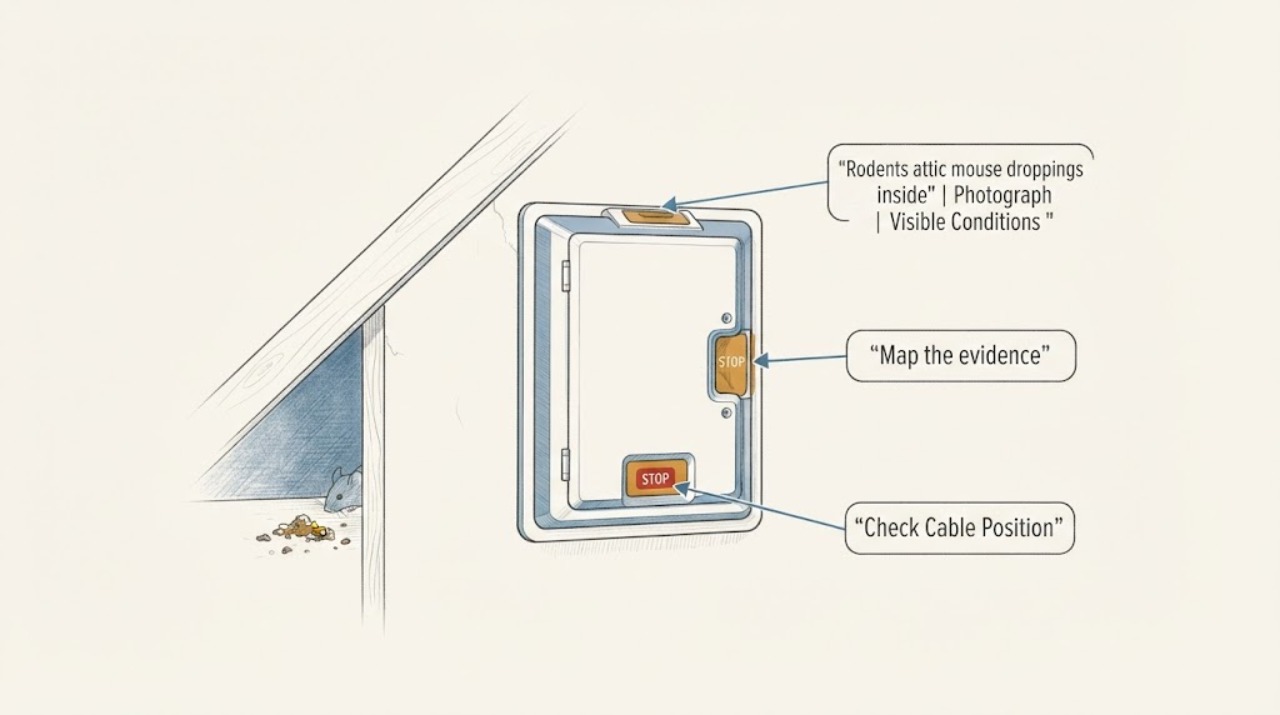
From the attic entrance or another stable safe position, visually scan the accessible floor edge, rafters, insulation surface, and stored-item perimeter without stepping into insulation or touching anything. Photograph droppings, urine-like stains, nesting, gnaw marks, tracks, fur, or dead rodents from a distance.
Expected result: There is no visible evidence, a few isolated droppings, fresh-looking or repeated droppings, a nest, a dead rodent, or a broad area of contamination.
Next step: Record the exact attic zone and take photos without touching or moving the material; leave the space if evidence is heavy or the area is not safely accessible.
Stop if: Do not sweep, vacuum, brush, pick up, bag, spray, or otherwise disturb droppings, nests, carcasses, or contaminated insulation.
Why this matters
Why: One old-looking mark does not prove current occupancy. Repeated or fresh evidence, nests, dead rodents, or broad contamination indicate an active or established problem and increase the need for professional inspection and cleanup.
-
Check 2
Map the evidence from the safe boundary: note whether signs cluster near the eaves, roof or gable vents, soffits, plumbing or electrical penetrations, attic hatch, chimney, or wall edges. Do not move insulation or open a cover to follow the trail.
Expected result: Evidence is confined to one visible edge, follows several attic boundaries, surrounds a penetration, or disappears into an inaccessible void.
Next step: Add the zone map and photographs to the service request and identify every area that could not be inspected safely.
Stop if: Do not crawl, kneel on insulation, pull back stored materials, open wall or vent assemblies, or reach into a void.
Why this matters
Why: A cluster can help a professional prioritize likely entry and travel routes, but the visible location may be a feeding or resting area rather than the entry point. A concealed route needs controlled inspection rather than probing.
-
Check 3
Look from a safe position for signs that rodents contacted building systems: chewed or frayed wires, disturbed duct insulation, damaged vapor or air barriers, shredded insulation, water staining, or droppings near an HVAC return. Do not touch wiring, insulation, ductwork, or electrical equipment.
Expected result: No building-system damage is visible, or there is apparent wire damage, disturbed ductwork, damaged insulation, moisture, or contamination near an air path.
Next step: Photograph the area from a distance and request coordinated pest, electrical, HVAC, or building-envelope assessment as indicated.
Stop if: Leave immediately if wiring is exposed, a burning smell or electrical noise is present, insulation is unstable, or the attic air or floor feels unsafe.
Why this matters
Why: Rodent evidence near wiring, HVAC, or damaged insulation can create electrical, indoor-air, or building-envelope concerns beyond pest removal. A visible issue does not make it safe to test or repair the system in the attic.
-
Check 4
Observe for rodent activity without trying to flush it out: note scratching or movement sounds, odor, new droppings seen on separate days, disturbed insulation, or a rodent entering or leaving through a visible opening. Keep people and pets away from the attic access.
Expected result: No activity is heard, activity is occasional, activity or new signs recur, or a live or dead rodent is visible.
Next step: Record dates, times, sound location, and direction of movement without approaching; request inspection and removal when activity recurs or an animal is visible.
Stop if: Do not chase, corner, handle, release, or relocate a rodent, and do not enter an occupied or confined area to obtain a better view.
Why this matters
Why: Recurring signs or a visible animal support current occupancy or a route that remains open. A live or dead rodent also creates a handling and contamination risk; species and removal should be managed by a qualified professional.
-
Check 5
Check the accessible rooms below and around the attic for rodent odor, ceiling or wall staining, noises, insects around carcass odor, or signs that insulation or air handling may have carried contamination. Do not open ceilings, remove drywall, or operate questionable HVAC equipment to investigate.
Expected result: No related indoor symptoms are present, or there is odor, staining, unusual air quality, visible contamination, or a concern that an HVAC return or occupied room is connected.
Next step: Keep occupants out of affected areas, document the room and symptom, and tell the pest and appropriate building professionals before any cleanup or system use.
Stop if: If anyone develops respiratory symptoms after exposure, leave the area and seek medical advice while reporting the rodent exposure; do not continue inspection.
Why this matters
Why: A localized attic sign may still need exclusion, but indoor odor, staining, or air-path concern expands the scope to cleanup and building or HVAC assessment. The EPA notes that moisture and building conditions are part of pest management, not separate afterthoughts.
-
Check 6
Prepare the professional handoff with the attic-zone map, dated photographs, activity log, entry-point observations, building-system concerns, indoor symptoms, occupants or pets at risk, and any prior trapping or treatment history. Ask for species identification, exclusion, removal, safe waste cleanup, and follow-up monitoring.
Expected result: The evidence is isolated and old-looking, or it is fresh, recurring, widespread, inaccessible, or associated with wiring, HVAC, moisture, or illness concerns.
Next step: Request a written scope that separates inspection, safe cleanup, rodent removal, exclusion, repairs, and follow-up; keep the attic closed to unprotected occupants until assessed.
Stop if: Stop homeowner handling and cleanup here; do not use poison, mix chemicals, seal an occupied void, or modify building systems.
Why this matters
Why: The pattern determines whether the first priority is inspection, urgent exclusion and removal, public-health cleanup, or coordinated electrical/HVAC/building work. A trap or seal alone is unlikely to address contaminated material and an unverified entry route.
Use your observations
Decision map
Find the observation that best matches what you see, then follow the next safe action.
-
PATH 01Safety boundary
What you see
Only a small amount of old-looking evidence is visible, with no new signs, odor, damage, or activity.
Do this next
Arrange a non-emergency inspection to confirm whether the route is inactive and document any accessible exterior gaps before exclusion work is considered.
Why this path and its safety boundary
Safety stop: Do not clean or seal based on appearance alone; return to professional guidance if new evidence appears.
-
PATH 02Safety boundary
What you see
New droppings, urine marks, nesting, noises, or disturbed insulation recur in the same area or several areas.
Do this next
Arrange a high-priority rodent inspection and provide the date-stamped pattern and attic-zone map.
Why this path and its safety boundary
Safety stop: Do not enter farther, set or check traps in contaminated areas, or seal a route before an inspection confirms occupancy and exit.
-
PATH 03Safety boundary
What you see
A nest, dead rodent, heavy pile of droppings, or broad contamination is present.
Do this next
Leave the attic and request professional rodent cleanup and removal with appropriate protective controls; contact local health authorities when public-health guidance is needed.
Why this path and its safety boundary
Safety stop: Do not sweep, vacuum, spray, bag, or handle the material or carcass.
-
PATH 04Safety boundary
What you see
Droppings or nesting are near electrical wiring, HVAC returns or ducts, damaged insulation, or moisture.
Do this next
Request coordinated pest and building-system assessment and provide photographs without touching the affected components.
Why this path and its safety boundary
Safety stop: Do not energize, test, open, repair, or clean contaminated wiring or HVAC components.
-
PATH 05Safety boundary
What you see
A live rodent is visible, the route is concealed, or the attic is cramped, dusty, poorly ventilated, or unsafe to enter.
Do this next
Stop observation at the access boundary and schedule qualified pest professionals with appropriate access and handling controls.
Why this path and its safety boundary
Safety stop: Do not chase, trap-check, handle wildlife, crawl through insulation, or improvise respiratory protection.
-
PATH 06Safety boundary
What you see
An occupant has respiratory symptoms or illness concerns after contact with rodent-contaminated attic material.
Do this next
Leave the affected area, seek medical advice, and mention the rodent exposure; arrange professional cleanup and inspection.
Why this path and its safety boundary
Safety stop: Do not resume attic entry or cleanup while symptoms or contamination concerns remain unresolved.
Helpful context
Understand the symptom
Why attic droppings need more than a trap
Droppings show that a rodent has accessed the attic, but they do not identify whether the animal is still present, where it entered, or whether the species is a mouse or rat. Other evidence—urine staining, nesting material, gnaw marks, rub marks, noises, and food or insulation disturbance—helps map the problem. The U.S. Environmental Protection Agency describes monitoring, exclusion, moisture control, and cooperation with pest professionals as parts of integrated pest management.
Do not create contaminated dust
CDC says not to sweep or vacuum rodent urine, droppings, or nesting material because contaminated particles can become airborne. Heavy infestations require additional protective equipment and respiratory precautions. This article therefore focuses on safe observation and service handoff; professional cleanup should follow current public-health guidance.
Start from a safe boundary
Use only a dry, stable, well-ventilated position at the attic entrance or a safe view from below. Do not crawl across insulation, move boxes, handle a rodent, pull a trap, open ductwork, or enter a space where the floor, wiring, air quality, or access is uncertain.
Only after diagnosis
Potential parts
- snap-trap
Relevant only after a professional or safe inspection confirms the species, route, placement, and household constraints; a trap does not clean contamination or repair an entry route.
Use only a clearly labeled product in an appropriate location and follow applicable safety directions; do not handle or check traps in contaminated or inaccessible attic areas. - rodent-proof-storage
Relevant when accessible stored food, feed, or nesting materials are attracting rodents and can be moved without entering contaminated or unstable areas.
Choose a rigid, tight-lidded container suitable for the stored material; do not move contaminated boxes or insulation without the appropriate cleanup plan. - door-sweep
Relevant only when a professional or safe inspection identifies a compatible door-bottom gap as one of the confirmed access routes.
Confirm the door, threshold, clearance, and local building requirements before selecting a sweep; it will not close attic, roof, vent, or utility penetrations.
When checks do not resolve it
Need a professional?
Arrange high-priority rodent inspection and cleanup for fresh or recurring droppings, nesting, a live or dead rodent, heavy contamination, inaccessible attic areas, gnawed wiring, HVAC contamination, moisture damage, or illness concerns after exposure.
Have this ready
- Provide the attic-zone map, dated photos, activity and odor log, likely entry areas, signs near wiring or HVAC, indoor symptoms, children or pets, and any previous traps or treatments. Ask for species identification, exclusion, safe cleanup, removal, building repairs, and follow-up monitoring.
Common questions
FAQ
Can I sweep or vacuum mouse droppings in the attic?
No. CDC warns that sweeping or vacuuming can put contaminated particles into the air. Do not disturb the waste; heavy or inaccessible attic contamination should be handled under appropriate professional cleanup precautions.
Do droppings prove that mice are still in the attic?
Not by themselves. New droppings, urine marks, nesting, noises, disturbed insulation, or a visible animal make current activity more likely. Document dates and locations and have a professional confirm occupancy and the entry route.
Should I seal the attic hole as soon as I find it?
Do not seal an opening until an inspection determines whether rodents are inside and identifies a safe exit and cleanup plan. Premature exclusion can leave animals or contamination in the building and may conceal the route that needs repair.
What if droppings are near wiring or an HVAC return?
Do not touch or clean the wiring, insulation, or duct. Photograph the area from a safe boundary and request coordinated pest, electrical, HVAC, or building assessment because contamination may affect more than the attic surface.
When is attic rodent evidence an urgent service call?
Call promptly for fresh or recurring signs, heavy piles, nests, a live or dead rodent, inaccessible or poorly ventilated space, chewed wiring, HVAC contamination, moisture damage, or illness concerns after exposure.
Read the exact guide
Official sources
- How to Seal Up to Prevent RodentsCenters for Disease Control and Prevention, National Center for Emerging and Zoonotic Infectious Diseases · Supports mapping attic, roof, vent, utility, wall, and cabinet access routes and separating entry exclusion from safe cleanup and removal.
- Pest Control: Resources for Housing ManagersU.S. Environmental Protection Agency · Supports using monitoring evidence to select control measures, inspecting building access and water sources, and coordinating pest, electrical, plumbing, and maintenance roles.
- How to Clean Up After RodentsCenters for Disease Control and Prevention, National Center for Emerging and Zoonotic Infectious Diseases · Supports not sweeping or vacuuming rodent waste, treating heavy infestations as requiring additional protective precautions, and referring cleanup to appropriate trained personnel.
Community feedback
Share a repair observation
Share a plain-text repair observation. Accepted observations are published automatically; this page may take a moment to update.